Austin Layover Guide: Congress Avenue, AUS
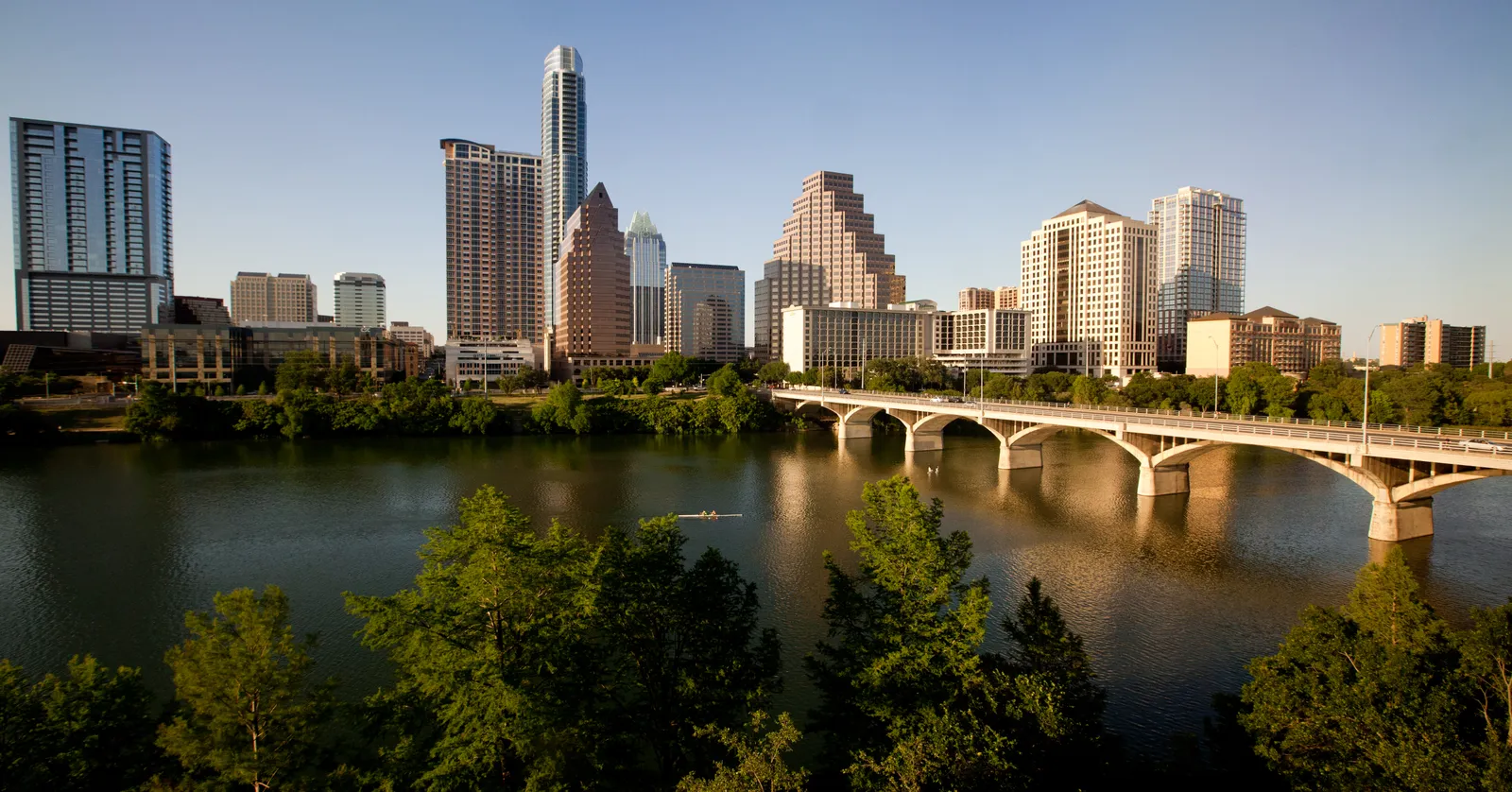
Austin’s Congress Avenue runs eleven blocks downhill from the Texas Capitol to the bridge over Lady Bird Lake, where up to 1.5 million bats pour out from under the deck at dusk between spring and fall, and the Capitol, the bridge and the lake trail below it all cost nothing.
Up to 1.5 million bats live in the Congress Avenue bridge
The Ann W. Richards Congress Avenue Bridge opened on 4 April 1910 and carries the avenue over Lady Bird Lake at the southern edge of downtown Austin. The underside of its deck is seamed with narrow expansion crevices, warm, dark and about an inch across, which happens to be precisely what a Mexican free-tailed bat looks for in a roost; they moved in in numbers after the bridge was rebuilt in 1980 and have stayed. The colony runs between 750,000 and 1.5 million, the largest urban bat colony in North America, and it is a maternity roost: pregnant females arrive first in spring, the pups are born in early summer, and the males only turn up afterwards.
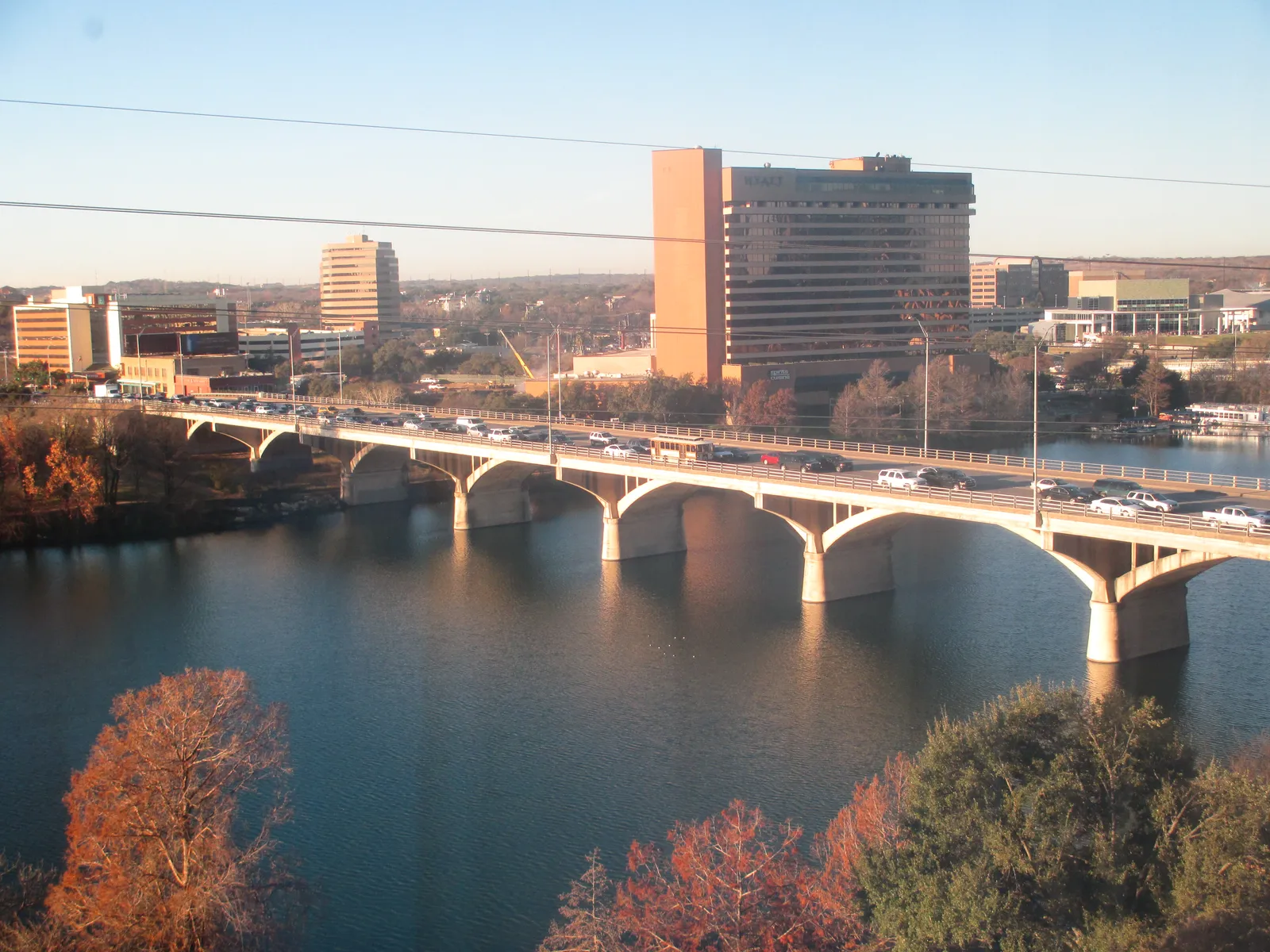
The season runs from about mid-March, when the first of them come back from Mexico, to early November, and the heaviest flights are in late July and August once that year’s young are in the air. They go up at dusk, in one column that streams east down the lake, and it costs nothing to watch: the sidewalks on both sides of the bridge and the grass on the lake’s southeast bank all face it. Dusk is the whole constraint, and dusk moves by hours between March and November, so it is worth building the afternoon backwards from the day’s sunset rather than hoping to catch it.
If you would rather be under the column than over it, a sunset cruise that finishes at the bridge runs from the lake through the season, with departures from late afternoon into the evening.
The bridge sidewalk is narrow, and in bat season the crowd on it stands still rather than walks, which is easier to join without a suitcase.
The Boardwalk pushes out over Lady Bird Lake’s south shore
Lady Bird Lake is the Colorado River held behind Longhorn Dam, six miles of it lying through the middle of Austin, and the Ann and Roy Butler Hike-and-Bike Trail makes a 10.2-mile loop around the whole thing. For decades that loop had a hole in it on the south shore, where private land came down to the water and walkers were pushed up onto the road. The Boardwalk closed the gap in June 2014: 1.3 miles of deck carried on more than 300 piers driven into the lakebed, with seven viewing platforms pushed out past the bank and the downtown towers standing directly across the water from them.
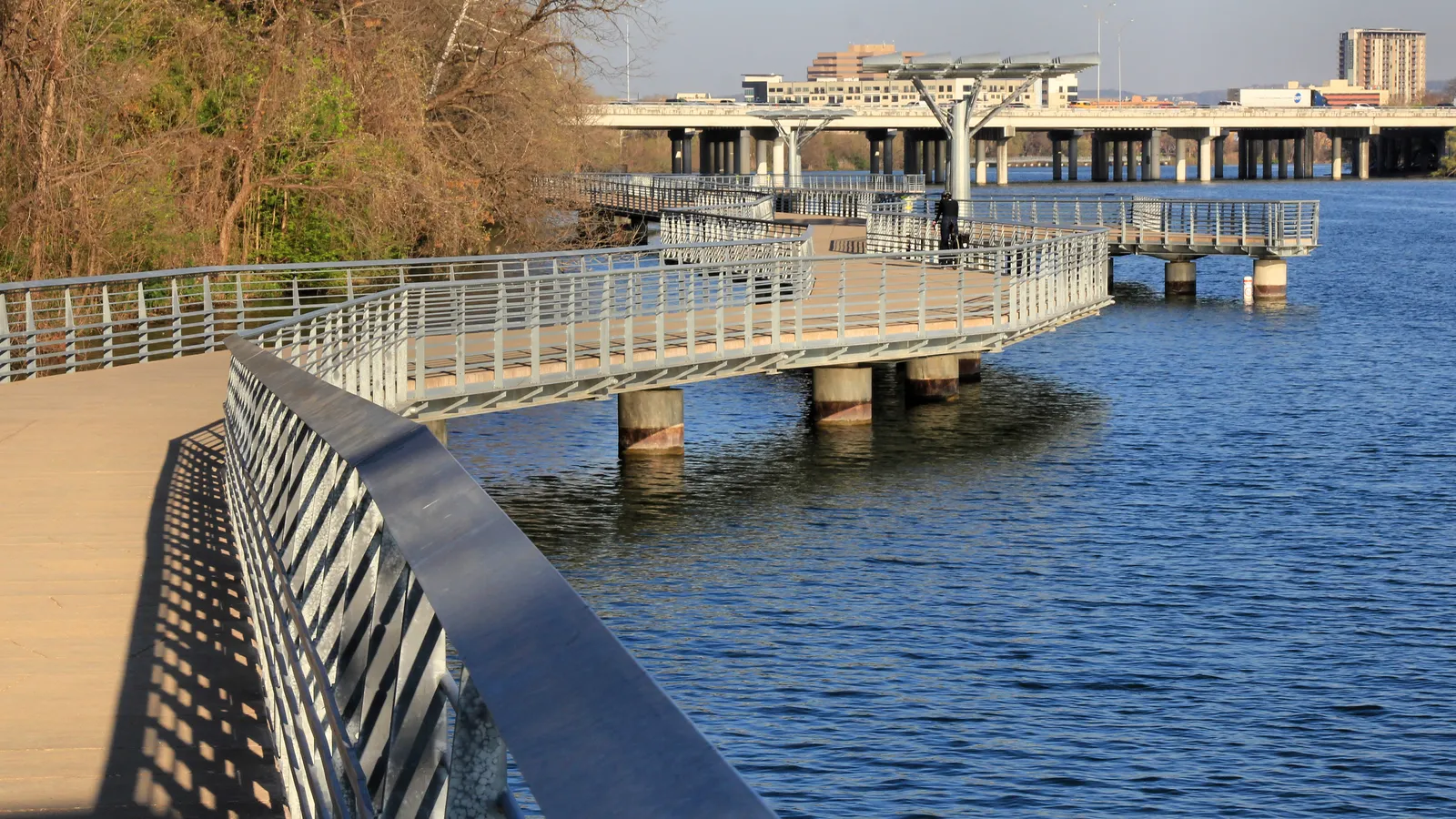
The trail takes something like 2.6 million visits a year, which is why the approaches at either end of the Boardwalk have their own rush hours. It is flat, paved and free from end to end. The useful short version of it for an afternoon is the loop between the Congress Avenue bridge and the South First Street bridge, about a mile and a half of water on both sides. If you would rather have the far end of the lake than the downtown mile of it, a guided e-bike ride covers considerably more of the loop than legs will in the same two hours.
A few minutes back from the water at 710 West César Chávez Street, the Austin Central Library opened in 2017 with a planted garden on its roof, native beds and shaded seating six floors up looking back at the lake and the skyline. Nobody charges to go up, and nobody asks what you are there for. It closes at 8pm Monday to Thursday and 5pm the rest of the week, opening at noon on Sundays, which makes it the reliable indoor half of a wet afternoon.
The Texas Capitol stays open until eight at night
Elijah E. Myers drew the Capitol in 1881 and it went up between 1882 and 1888, clad in sunset red granite that the owners of Granite Mountain near Marble Falls, fifty miles northwest, gave the state free after the original limestone began rust-staining. Nearly twelve million pounds of it went on the building. It stands 308 feet from the ground to the star in the Goddess of Liberty’s raised hand, which puts it above the dome on the United States Capitol in Washington.
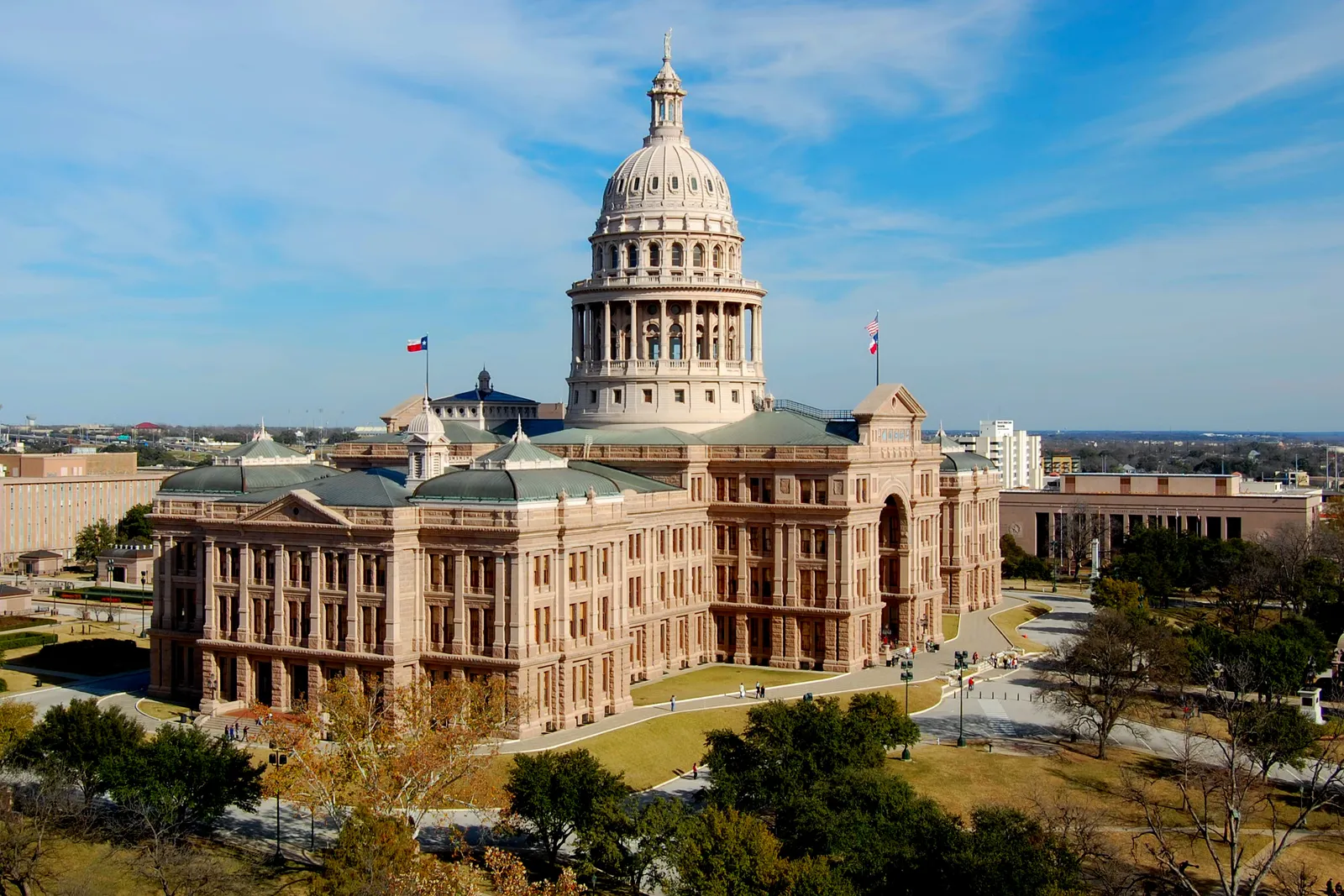
Inside, the rotunda opens 218 feet to a sheet-metal star eight feet from point to point with TEXAS lettered around it, and the terrazzo floor laid down for the 1936 centennial carries the seals of the six nations that have governed the state: Spain, France, Mexico, the Republic of Texas, the Confederacy and the United States. The Goddess standing on the dome is an aluminum duplicate, put up in 1986 to replace the 1888 zinc original.
Nothing in the building charges. It opens at 7am on weekdays and 9am at weekends and does not close until 8pm, and free guided tours leave every fifteen to thirty minutes, from 9am to 4.15pm Monday to Saturday and from noon to 4.15pm on Sunday, taking about forty minutes each. Groups of more than ten are asked to call ahead; everyone else turns up.
The half of it most visitors never find is under the north lawn. The Capitol Extension, finished in 1993, buried four floors of offices, committee rooms and an auditorium rather than putting them on the skyline, and lights them through open courts cut down from the grass above. At the middle of it is a second rotunda, the same sixty-foot span as the one upstairs, with the pattern of the dome’s ceiling laid out on the floor instead. It is free, it is air-conditioned, and in August that is not a small thing.
The only building Ellsworth Kelly designed, at the Blanton Museum
Kelly worked the design out decades before anything was built, then gave it to the Blanton Museum of Art on the University of Texas campus in 2015 and died that December without seeing it stand. It opened to the public on 18 February 2018: 2,715 square feet of barrel-vaulted stone, faced in 1,569 limestone panels quarried at Alicante in Spain, with colored glass windows in three of its end walls.
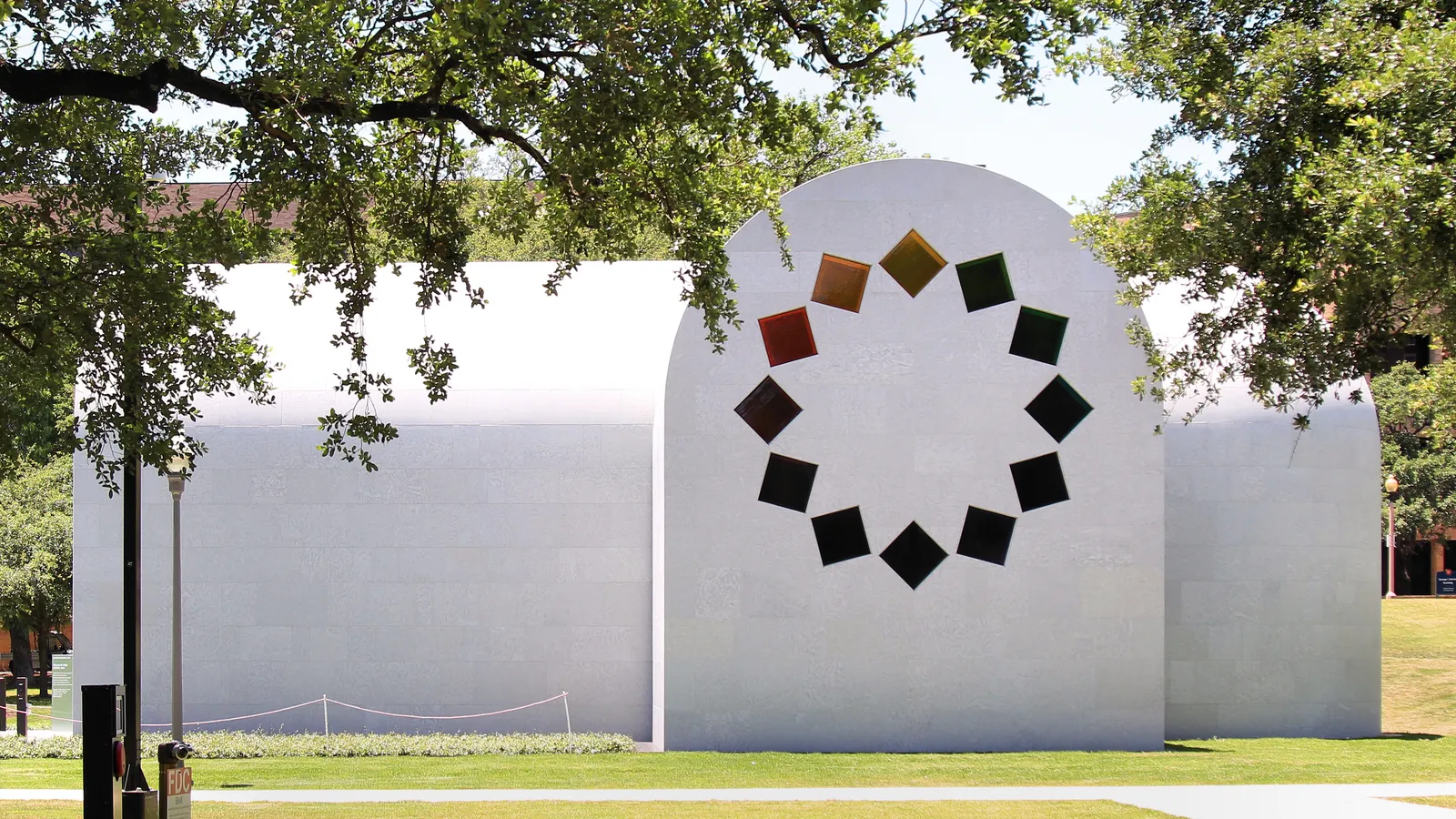
There is no altar in it and no congregation. Fourteen black and white marble panels line the walls, Belgian black against Italian white, laid out in the rhythm of the Stations of the Cross with none of the content, and an eighteen-foot redwood totem stands in the one wing that has no window. What moves is the light: the colored glass drops the only color in the room onto a white interior and walks it across the floor through the afternoon.
Entry is included with the Blanton’s own admission, $15 for an adult and free to everyone on Tuesdays. The museum shuts on Mondays and otherwise opens 10am to 5pm, staying open until 8pm on Saturdays. Across Martin Luther King Jr. Boulevard from it, the Bullock Texas State History Museum charges $17, and the thing there worth a ticket is the original Goddess of Liberty: sixteen feet of zinc in more than eighty welded pieces, cast in a foundry in the Capitol’s own basement in the 1880s and now standing at ground level where her face is actually visible.
Barton Springs Pool stays under 70 degrees in August
Three acres of pool sit in Zilker Park, two and a half miles west of Congress Avenue, filled by springs rising out of the Edwards Aquifer at a steady 68 to 70 degrees Fahrenheit no matter what the air above is doing. The bottom is the original limestone rather than tile, the banks are mown grass on a slope, and there are fish in the water with you.
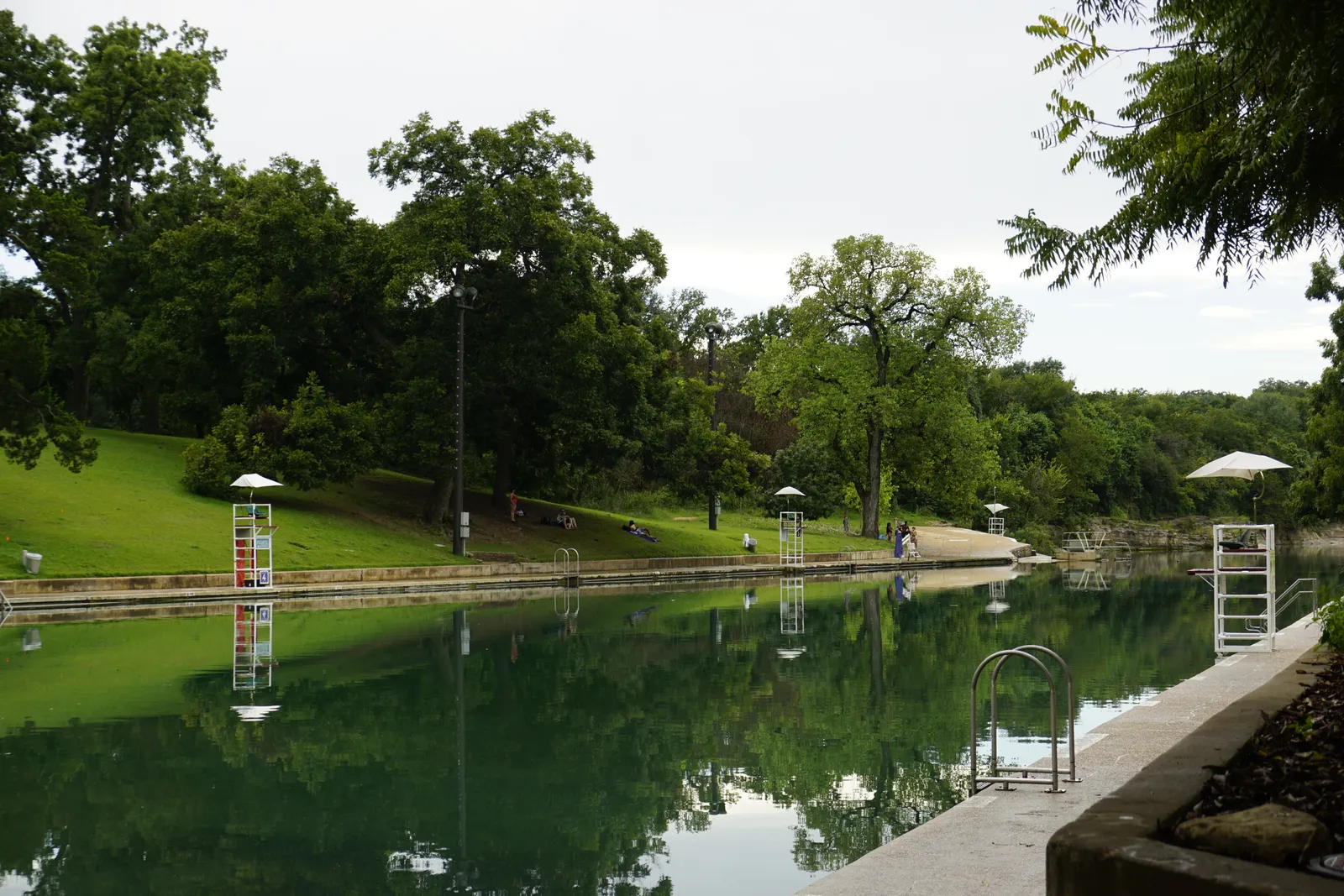
Admission runs from Austin’s spring break through the end of October and is nothing at all for the rest of the year: $9 for a non-resident adult, $5 if you live in the city, less for children and over-62s. It is open 5am to 10pm daily, with lifeguards on from 8am, and closed every Thursday between 9am and 7pm while staff blast algae off the limestone shallows. Five hours on the ground is enough for the Capitol and the bridge and not much else; from about seven, the ride out here fits.
Standing in the same park is a 165-foot cast-iron tower that most visitors read as an overbuilt street light. Austin bought thirty-one of them second-hand from Detroit in 1894 and raised them the following year to light the streets from overhead, six carbon arc lamps to a tower; every other city that tried the idea eventually took theirs down, and Austin’s are the only ones left standing anywhere. Fifteen survive, this one among them, and since 1967 the city has hung more than three thousand bulbs off it each December and called the result a Christmas tree.
The 20 bus is the only public route out to the airport
Route 20, signed Manor Road/Riverside, runs between downtown and the arrivals level at Austin-Bergstrom International Airport (AUS) seven days a week, every fifteen to thirty minutes, from around five in the morning until roughly midnight. The ride itself is about 35 minutes down Riverside Drive, longer in the evening rush, and it costs $1.25 one way, with CapMetro capping a whole day of local fares at $2.50, so a return trip is the most a day can cost you. Between midnight and 4am, Route 483 covers the same corridor.
There is no rail link to build a plan around. A Blue Line light rail down this same Riverside corridor has been drawn up but not built, so the bus, a taxi or a rideshare is the entire list, and the bus stops downtown on the same eleven blocks of Congress Avenue that everything else here sits on.
The airport asks for two and a half hours before a domestic departure and three before an international one, and that buffer, not the five miles, is what decides how much of the afternoon is actually yours.
None of this is a long walk. What makes it easier without a bag is that the two best parts of it, the bridge at dusk and the deck out over the water, are both places where you stop and stand for a while rather than pass through.
Frequently asked questions
What should I do during a layover in Austin?
Congress Avenue is the spine of it: eleven blocks downhill from the Texas Capitol, which charges nothing, stays open until 8pm and runs free guided tours every fifteen to thirty minutes, to the Ann W. Richards Congress Avenue Bridge over Lady Bird Lake. Up to 1.5 million bats fly out from under that bridge at dusk between about mid-March and early November, and the sidewalk view of it costs nothing. The Boardwalk on the lake's south shore is flat, paved and free, a few minutes below the bridge. With about seven hours on the ground, Barton Springs Pool in Zilker Park is two and a half miles west and sits at 68 to 70 degrees in any season; with five, leave it out. The bats are the one fixed appointment on the list, because dusk does not wait.
Are the Austin bats there all year?
No. The colony under the Ann W. Richards Congress Avenue Bridge is migratory and winters in Mexico. Numbers build from about mid-March as pregnant females arrive, the pups are born in early summer, the biggest flights come in late July and August once that year's young are flying, and the bridge is empty again by early November. The emergence happens at dusk, and dusk shifts by hours across that season, so look up sunset for the day you are there rather than assuming an evening slot. Arriving in February is not a reason to avoid the bridge, the view back up Congress Avenue to the Capitol dome is the same in any month, but there will be nothing overhead.
Does an Austin layover work in summer?
It works, but the heat picks the route. Austin averaged 29 days a year at or above 100 Fahrenheit between 1991 and 2020, most of them in July and August, when average highs sit around 98 to 99. The Boardwalk over Lady Bird Lake has no shade on it anywhere, and Congress Avenue has very little. Two places are built for exactly this: Barton Springs Pool, fed by an aquifer that holds 68 to 70 degrees whatever the air is doing, and the Capitol Extension under the statehouse's north lawn, four floors of air-conditioned public building that costs nothing to walk into. The bat flight helps as well, since dusk in July is the first comfortable hour of the day.
Is the walk down Congress Avenue step-free?
Yes, the whole way. Congress Avenue is continuous sidewalk on a steady, gentle grade from the Capitol's south lawn to the bridge, with no steps anywhere on it. The step-free way into the Capitol is from the north, through the underground Extension, rather than up the south steps, and there are elevators between the Extension's four levels. Down on the water, the Ann and Roy Butler Hike-and-Bike Trail and the Boardwalk are paved and flat, and the Boardwalk's viewing platforms include accessible decking. Barton Springs Pool is the exception: you get in down a sloped limestone bank with steps and handrails, not off a pool deck.
Is the bus or a rideshare better for getting to Austin's airport?
The bus, unless you are traveling between midnight and four in the morning. Route 20, signed Manor Road/Riverside, runs from downtown to the arrivals level at Austin-Bergstrom International Airport (AUS) every fifteen to thirty minutes, seven days a week, takes about 35 minutes for the ride, and costs $1.25, with CapMetro capping a whole day of local fares at $2.50. A rideshare covers the same five miles faster outside the evening rush on Riverside Drive and costs a great deal more. There is no train at all: a Blue Line light rail along this corridor is planned and not built. Between midnight and 4am, Route 483 covers the same ground.