Rainey Street Layover: Austin's Bungalow Bars
Part of the full Austin Layover Guide: Congress Avenue, AUS
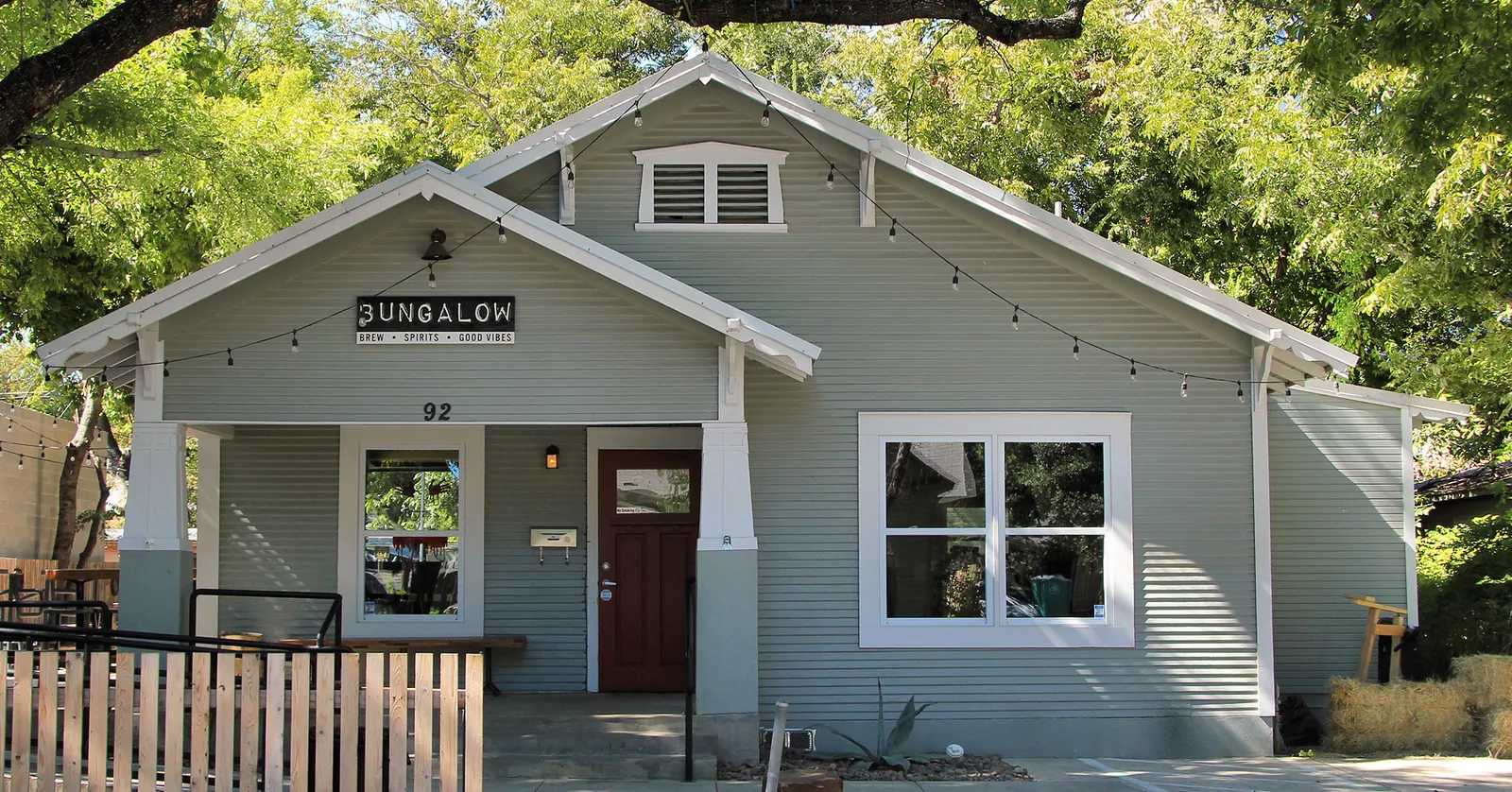
Austin’s Rainey Street is a listed block of 1900s bungalows that became bars, wedged between residential towers at the southeast corner of downtown, with the lake trail below it and a free cultural center at the bottom of the hill.
The bungalows on Rainey Street were houses first
The district went on the National Register on 17 September 1985: thirty-four buildings, twenty-one of them contributing, mostly vernacular bungalows and cottages put up between the 1880s and the early 1900s for working families at the edge of the city. It stayed residential and largely forgotten for a century. Then a bar called Lustre Pearl opened inside one of the houses in 2009, and within a few years nearly every porch on the street had a license and a yard full of picnic tables.
What makes it worth walking rather than just drinking on is the collision. The cottages are one story, wood-framed, with deep front porches, and the buildings now standing over them are thirty and forty floors of glass, close enough to put the whole street in shade for part of the afternoon. Several yards run food trailers rather than bar service. The lake is a two-minute walk below the southern end, where the waterfront path connects back into downtown without crossing a road, and the boat docks along that stretch are where an evening cruise out to the bat bridge starts from.
Waterloo Park rebuilt eleven acres of Waller Creek
Waller Creek runs down the eastern edge of downtown and spent most of a century as a flood channel with a bad reputation. The park that opened on it in August 2021 is the first finished piece of a longer project: eleven acres, a mile and a half of path, replanted banks, and a creek that has been re-engineered rather than merely tidied.
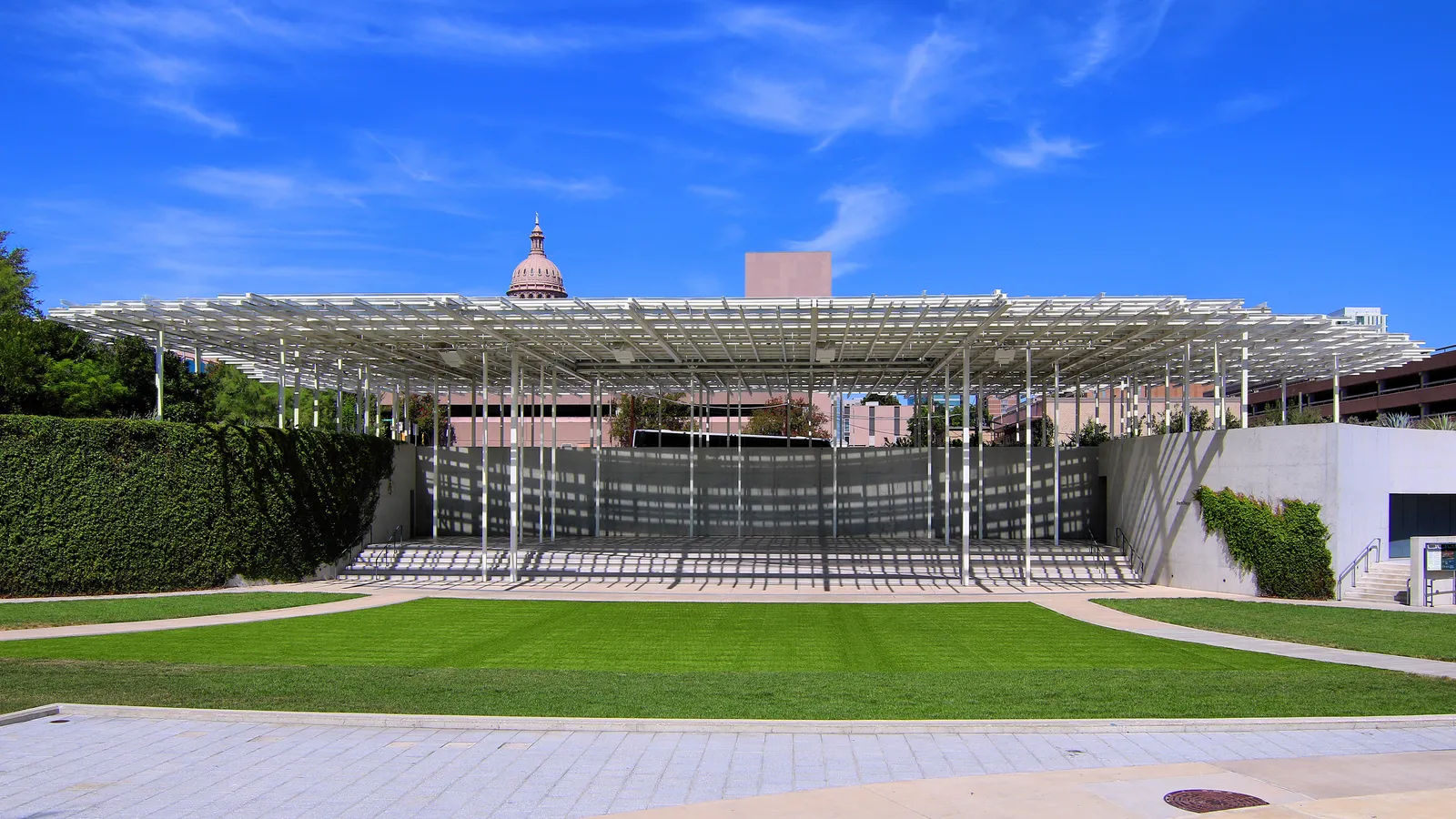
In the middle of it, Thomas Phifer designed the Moody Amphitheater as a thin white lattice roof on slim columns over banked seating and a lawn, holding up to 5,000, with the Capitol dome standing directly behind the stage. On a day with nothing booked the whole thing is open ground you can walk across. It is roughly ten minutes north of Rainey Street along the creek.
A free gallery of Mexican American art sits at the water end
The Emma S. Barrientos Mexican American Cultural Center stands at 600 River Street where Rainey Street meets Lady Bird Lake, and the building is worth the walk on its own: white concrete panels with marble aggregate, a long run of vertical fins, and a round drum at the center, designed by Teodoro González de León, who spent his career in Mexico City working out how to put pre-Hispanic weight into modernist concrete.
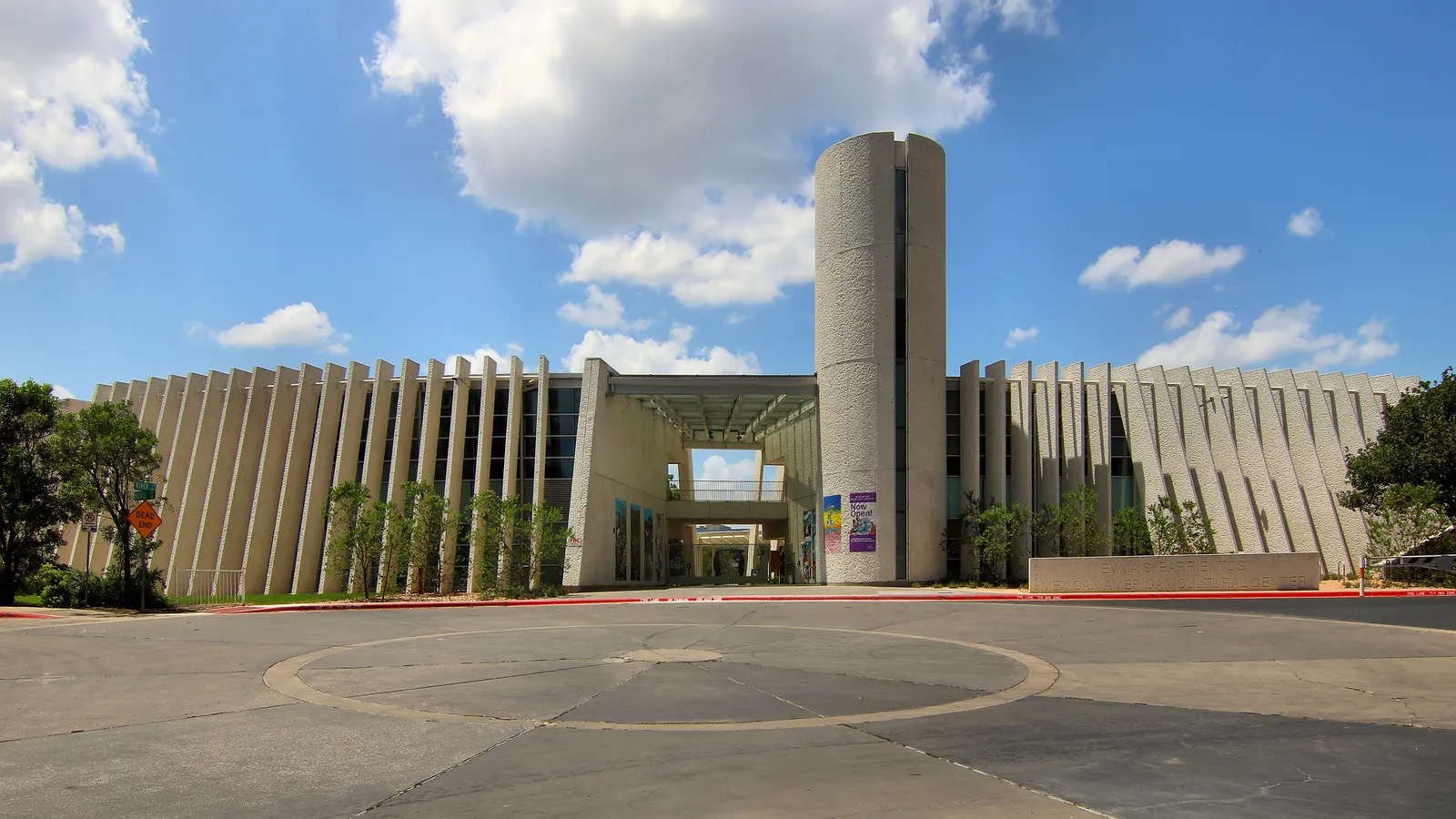
Exhibits are free to see, 10am to 9pm Monday to Friday and 10am to 4pm on Saturday, which makes the late weekday close unusually useful on a flight day. The galleries show Mexican American and Latino work on rotation rather than a fixed collection.
Almost everything here happens outdoors, on porches, in yards and along the water, with no indoor space along the street to leave anything in while you use it.
The night bus covers this corridor until four in the morning
Route 483 runs between midnight and 4am, which matters more on this street than on most, because the bars here keep going long after the daytime timetable has stopped. Before midnight the service that counts is Route 20, which is what reaches Austin-Bergstrom International Airport (AUS), and it leaves from stops in the middle of downtown rather than from this corner: about ten minutes northwest of Rainey Street and slightly uphill, every fifteen to thirty minutes seven days a week, roughly 35 minutes for the ride, $1.25 a trip with a $2.50 cap on a day of local fares.
The airport wants two and a half hours before a domestic departure and three before an international one, and this corner of downtown is close enough that the walk is the only thing to add. If you would rather spend the same hours on the city’s headline sights instead of one block of it, the Congress Avenue route starts at the Texas Capitol and finishes on the bridge at dusk. Rainey is the version for an afternoon you want to spend sitting down, which works considerably better without a suitcase parked next to the chair.
Frequently asked questions
What should I do during a layover near Rainey Street in Austin?
Walk the block itself first. Rainey Street went on the National Register in September 1985 as a district of 34 buildings, 21 of them contributing bungalows and cottages from the 1880s to the early 1900s, and since 2009 most of them have been bars with their porches and yards open to the street. At the water end, the Emma S. Barrientos Mexican American Cultural Center at 600 River Street shows its exhibits free, Monday to Friday 10am to 9pm and Saturday to 4pm. Ten minutes north, Waterloo Park opened eleven acres of reworked creek in August 2021 with the Moody Amphitheater in the middle of it. Three hours is enough for all three.
Is Rainey Street busy in the afternoon?
Far less than at night, which is the argument for coming on a flight day. Most of the houses open around the middle of the day and the yards stay quiet until the evening, so an afternoon here is porches, shade trees and food trailers rather than queues. The street fills properly after dark and on weekends, and the Thursday to Saturday late hours are a different proposition altogether. If you are catching an evening flight, the early half of the day is the version of this street that fits it.
Can you walk to Rainey Street from the lake trail?
Yes, and that is the easiest way in. The Ann and Roy Butler Hike-and-Bike Trail runs along the north shore of Lady Bird Lake directly below the district, and a short climb up from the waterfront puts you at the southern end of Rainey Street by the cultural center. It is a few minutes from the trail to the far end of the block. Coming from the middle of downtown instead, it is about ten minutes on foot southeast, gently downhill.
What is there to do on Rainey Street without drinking?
More than the street's reputation suggests. The cultural center at the bottom of the hill is free and air-conditioned, with changing exhibitions of Mexican American and Latino art. The lake trail below it is free and flat. Waterloo Park to the north is eleven acres of open ground, and the concert lawn is walkable when nothing is booked on it. Several of the bungalow yards run food trailers rather than bar service, which is a reasonable way to sit on a porch for half an hour without ordering a drink.