Tokyo Haneda Layover: Tokyo Tower and Zojo-ji
Part of the full Tokyo in One Day: Ueno and Asakusa
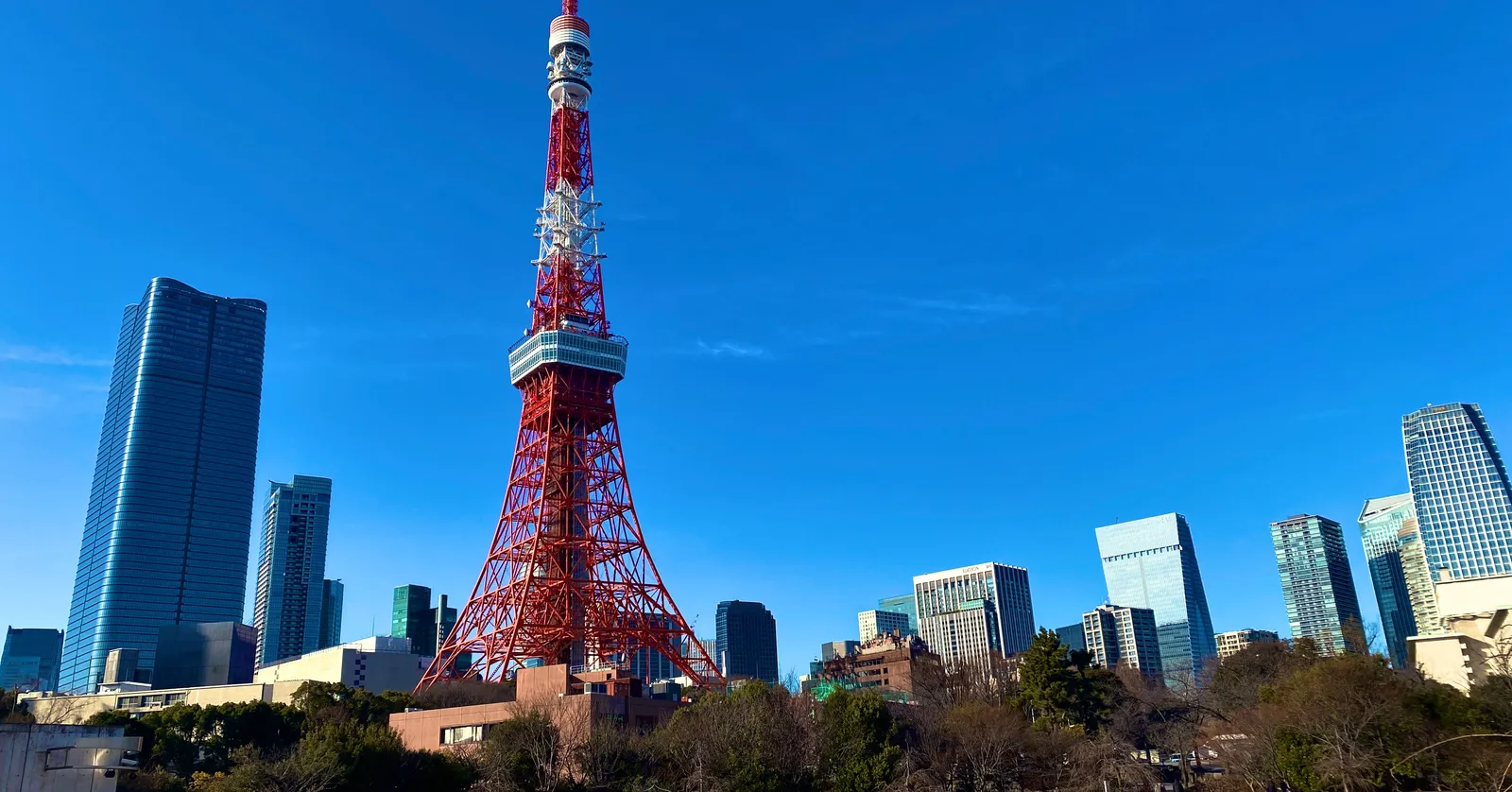
Haneda Airport sits inside Tokyo on the edge of the bay, 13 minutes by monorail from Hamamatsucho station, where Tokyo Tower, the Tokugawa family temple of Zojo-ji and a garden laid out in 1678 all stand within a fifteen-minute walk.
Tokyo Tower’s main deck, 150 metres over Shiba Park
Tokyo Tower rises out of Shiba Park about fifteen minutes on foot from Hamamatsucho’s north exit, visible the whole way down the street. It opened in 1958 at 333 metres, painted in the international orange and white that air-safety rules required, and for half a century it was the city’s broadcast mast until Tokyo Skytree took over. The main deck at 150 metres looks out over the whole low spread of central Tokyo, with the bay and Haneda’s runways to the south.
The main deck costs ¥1,500 for an adult and opens 9am to 11pm, late enough to fit an evening connection. Above it, the Top Deck Tour takes small guided groups up to 250 metres every 15 minutes for ¥3,300 bought online, ¥3,500 at the counter. Tower tickets are also sold through a tours and activities platform, with the top deck as an upgrade.
Zojo-ji, the Tokugawa family temple below Tokyo Tower
Zojo-ji has stood in Shiba since the 1590s, when Tokugawa Ieyasu, the first Tokugawa shogun, moved it here as his family’s temple, and six of the fifteen Tokugawa shoguns are buried behind its main hall. The grounds open onto Hibiya-dori through the Sangedatsumon, a two-storey vermilion gate 21 metres high, built in 1622 and the oldest wooden building left in Tokyo; it came through the 1945 air raids that burned most of the temple. The main hall behind it is a 1974 rebuild, and the view everyone photographs is the hall’s roofline with Tokyo Tower standing directly over it.
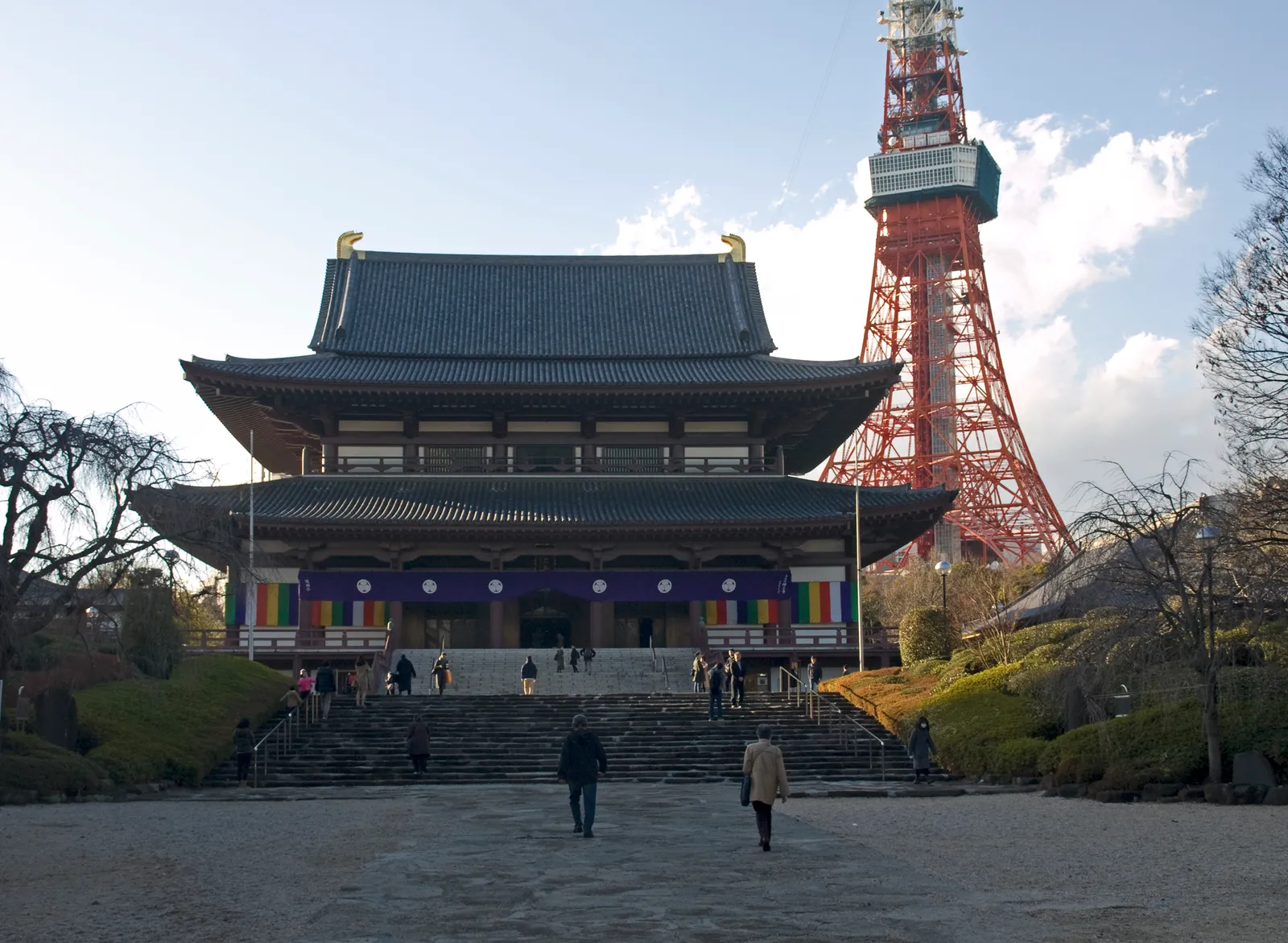
The grounds and the main hall are free. The Tokugawa mausoleum behind the hall charges a few hundred yen and keeps shorter hours than the grounds, roughly 10am to 4pm.
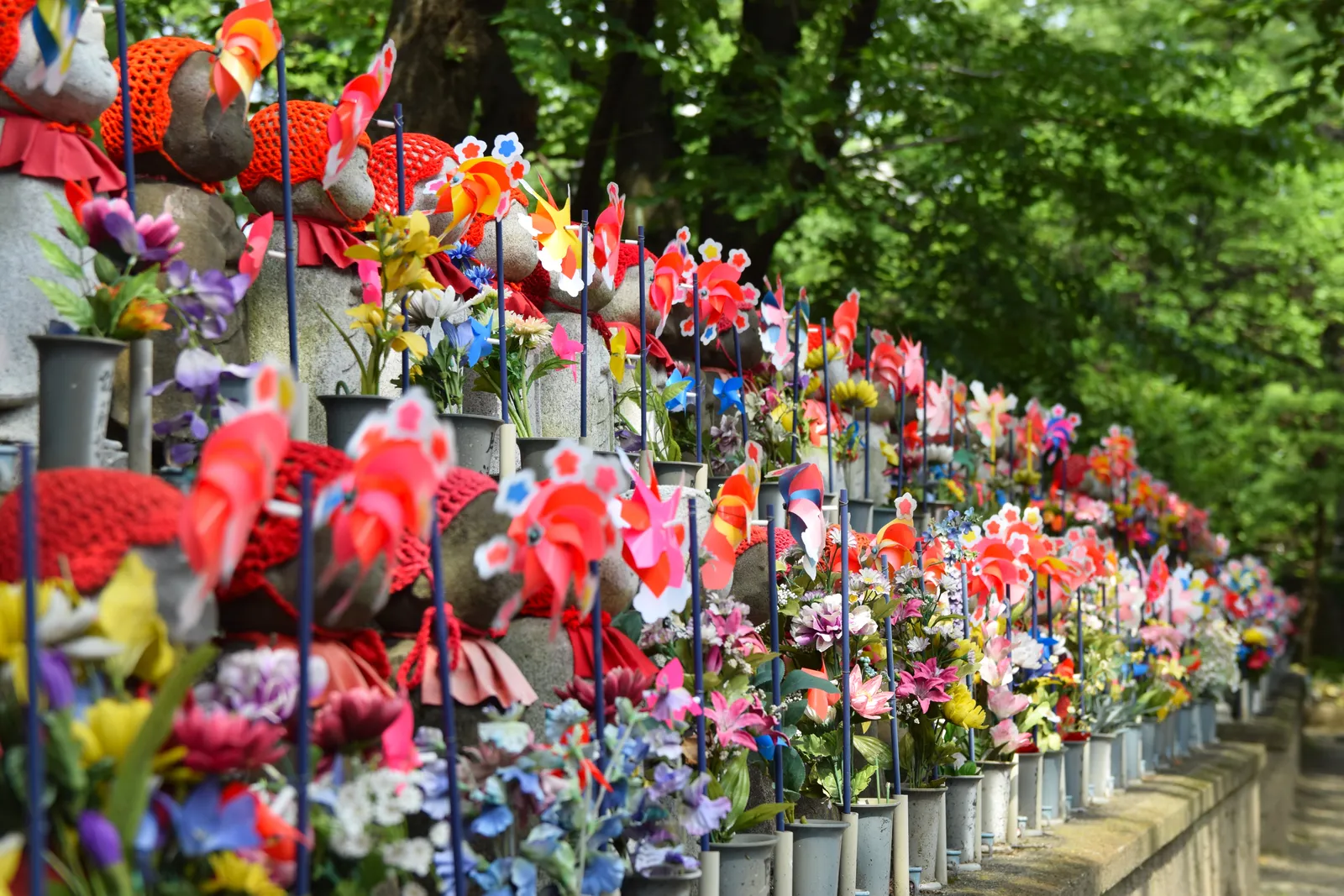
Along the western edge of the grounds, toward the tower, hundreds of small stone Jizo figures stand in rows, each one placed by parents in memory of a child who was miscarried, stillborn or never born. Most wear red knitted caps and bibs, and the plastic pinwheels pushed into the ground in front of them turn in any breeze.
Kyu-Shiba-rikyu, a 1678 garden at Hamamatsucho station
Kyu-Shiba-rikyu Gardens begin a minute’s walk from Hamamatsucho’s north exit, which makes them the easiest thing in Shiba to fit into a short gap. Okubo Tadatomo, a senior official of the shogunate, laid the garden out in 1678 on land reclaimed from the bay, and the pond at its centre still carries traces of the tidal inlet it was built around. A stone causeway across the water copies the one on West Lake in Hangzhou, and the central island holds an arrangement of rocks meant to stand for Mount Horai, the mountain of the immortals.
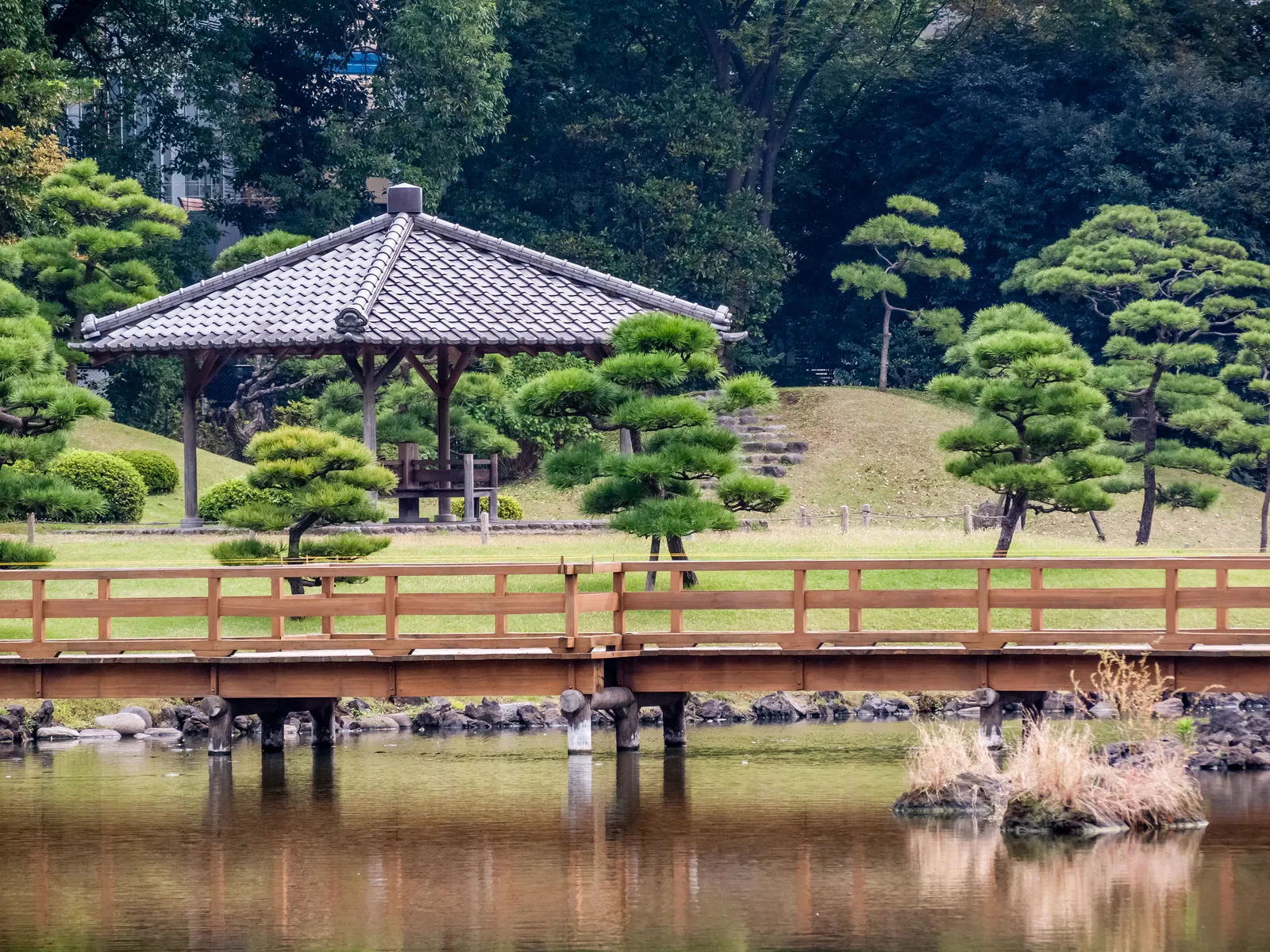
The garden later passed to the imperial household as a detached palace, lost its buildings in the fires after the 1923 earthquake, and opened to the public in 1924. Admission is ¥150, with doors 9am to 5pm and last entry at 4.30pm. The full loop takes about 40 minutes, with office towers standing directly over the pines on every side.
For a gap of seven hours or more, the Ueno and Asakusa route further north covers Tokyo’s national museum and its oldest temple instead.
Edo Koji, the old-town street inside Haneda’s Terminal 3
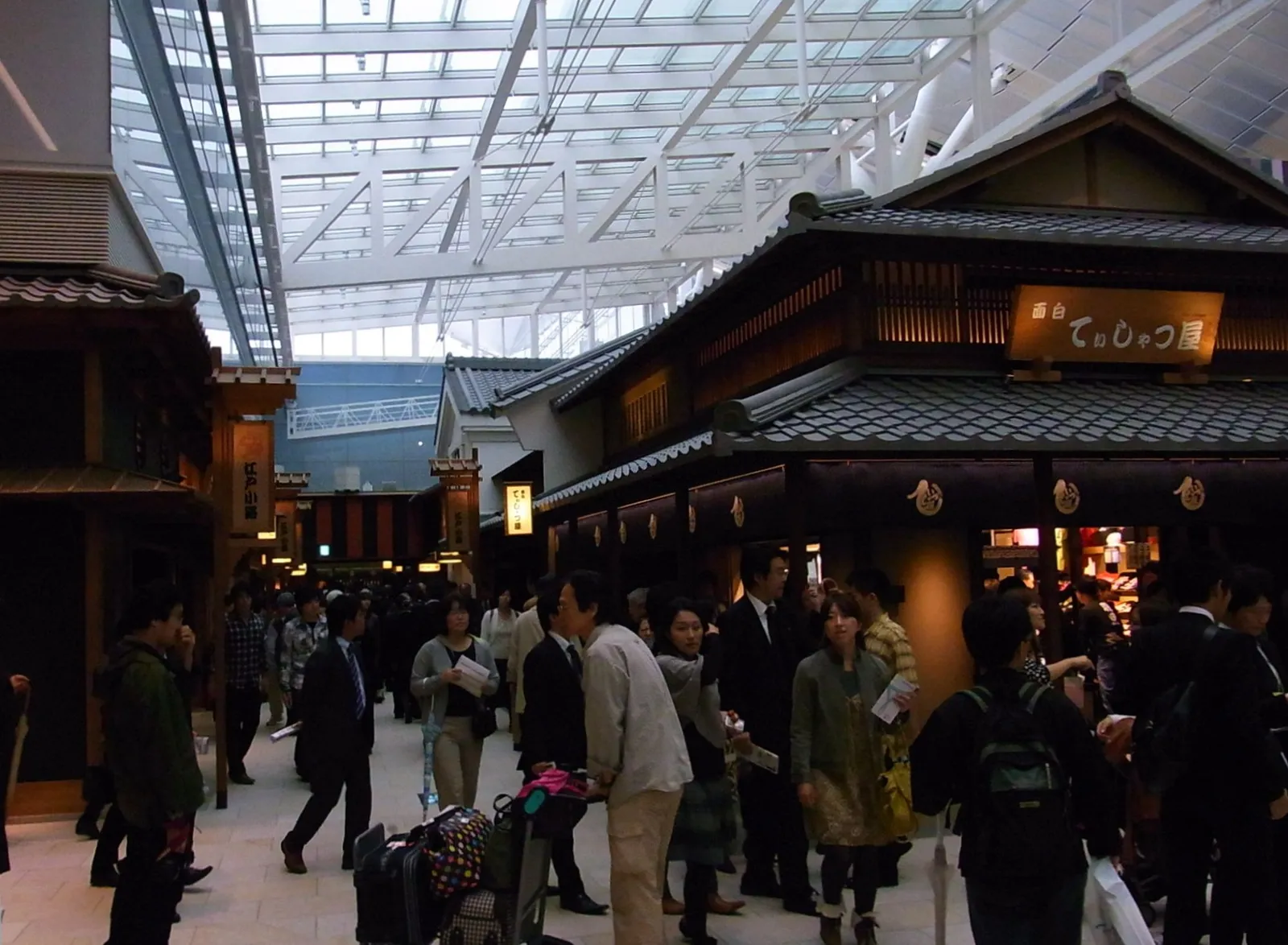
On a connection too short to leave, Terminal 3 holds its own version of old Tokyo. Edo Koji, on the fourth floor, is a run of shops and restaurants built as an Edo-period streetscape of timber fronts and tiled eaves, with most of it open from about 6.30am to 10pm, and at one end stands a copy of the Nihonbashi bridge built in Japanese cypress. One floor up, the roof deck runs the length of the terminal and is open around the clock at no charge; on a clear day both Tokyo Tower and Tokyo Skytree show on the skyline.
Luggage storage at Haneda Airport
Haneda has coin lockers in all three terminals, in the public areas before security, from ¥400 a day for a small locker to ¥1,500 for the largest at Terminals 1 and 2, and ¥500 to ¥2,000 per 24 hours at Terminal 3, for up to seven days. For a suitcase that won’t fit, staffed baggage counters on the basement floor of Terminals 1 and 2 and the second and third floors of Terminal 3 charge by size, from about ¥800 a day.
The Haneda Express reaches Hamamatsucho in 13 minutes
The Tokyo Monorail’s Haneda Express runs non-stop from all three Haneda terminals to Hamamatsucho in 13 to 14 minutes for ¥520; the rapid service, which stops on the way, takes about 20. At Terminal 3 the station opens straight off the second-floor arrivals hall, and at Terminals 1 and 2 it sits on the basement level under the terminal, which means a lift or a long escalator ride with whatever you are carrying, and on a ride this short that transfer between floors is where the minutes actually go.
Door to door from the arrivals hall to Tokyo Tower runs closer to 45 minutes than 13, with the walk from Hamamatsucho and the wait for a train counted. Add immigration on the way out and security on the way back, and a four-hour connection leaves around two hours in Shiba; six hours leaves enough for the tower, the temple and the garden without watching the clock.
Frequently asked questions
What should I do during a layover near Haneda Airport in Tokyo?
Ride the monorail 13 minutes to Hamamatsucho and spend the time in Shiba. Tokyo Tower's main deck is ¥1,500 and open until 11pm, Zojo-ji temple at its foot is free to walk around and holds the graves of six Tokugawa shoguns, and Kyu-Shiba-rikyu, a 1678 garden, sits a minute from the station for ¥150. The tower is the only part that is worth booking, and only for the higher deck; the temple and the garden can be dropped without breaking anything. On a shorter connection, stay in Terminal 3, where an Edo-style shopping street and a 24-hour roof deck cost nothing.
Is the monorail or the Keikyu train better from Haneda?
For this route, the monorail. The Tokyo Monorail's Haneda Express runs non-stop from all three terminals to Hamamatsucho in 13 to 14 minutes for ¥520, about 20 minutes on the rapid service that stops on the way, and Hamamatsucho is the station for Tokyo Tower, Zojo-ji and Kyu-Shiba-rikyu. The Keikyu line runs to Shinagawa instead, which is the better choice for anyone changing onto a shinkansen; see the Shinagawa station guide for what is near that end.
Is it worth booking Tokyo Tower ahead?
Only for the higher level. The main deck at 150 metres costs ¥1,500 for an adult whether you buy online or at the counter, and on most days you can walk up and go. The Top Deck Tour to 250 metres is the one to plan: it runs as small guided groups every 15 minutes, costs ¥3,300 online against ¥3,500 at the counter, and the timed slots are what fill up. A Tokyo Tower ticket bought through a tours and activities platform also includes upgrade options with the top deck.
Is Haneda or Narita better for a layover in Tokyo?
Haneda, by a wide margin, if you want to see the city. Haneda sits inside Tokyo on the bay, 13 minutes from Hamamatsucho, so a four-hour connection is workable. Narita is about 60 kilometres east, an hour or more each way to the centre, and a short connection there is better spent in Narita town at the Naritasan temple than in Tokyo itself.
Is there luggage storage at Haneda Airport?
Yes, before security in all three terminals. Coin lockers cost from ¥400 a day at Terminals 1 and 2 and from ¥500 per 24 hours at Terminal 3, for up to seven days, and staffed counters take larger suitcases from about ¥800 a day.