Valencia Layover: Old Town and Turia From VLC
Valencia’s old town clusters within a ten-minute walk of Xàtiva, the city’s central metro interchange: the Mercado Central’s iron-and-glass halls, the Gothic Silk Exchange across the road from it, and Valencia Cathedral’s twin doorways all sit inside that circle.
The Umbracle walkway at the City of Arts and Sciences
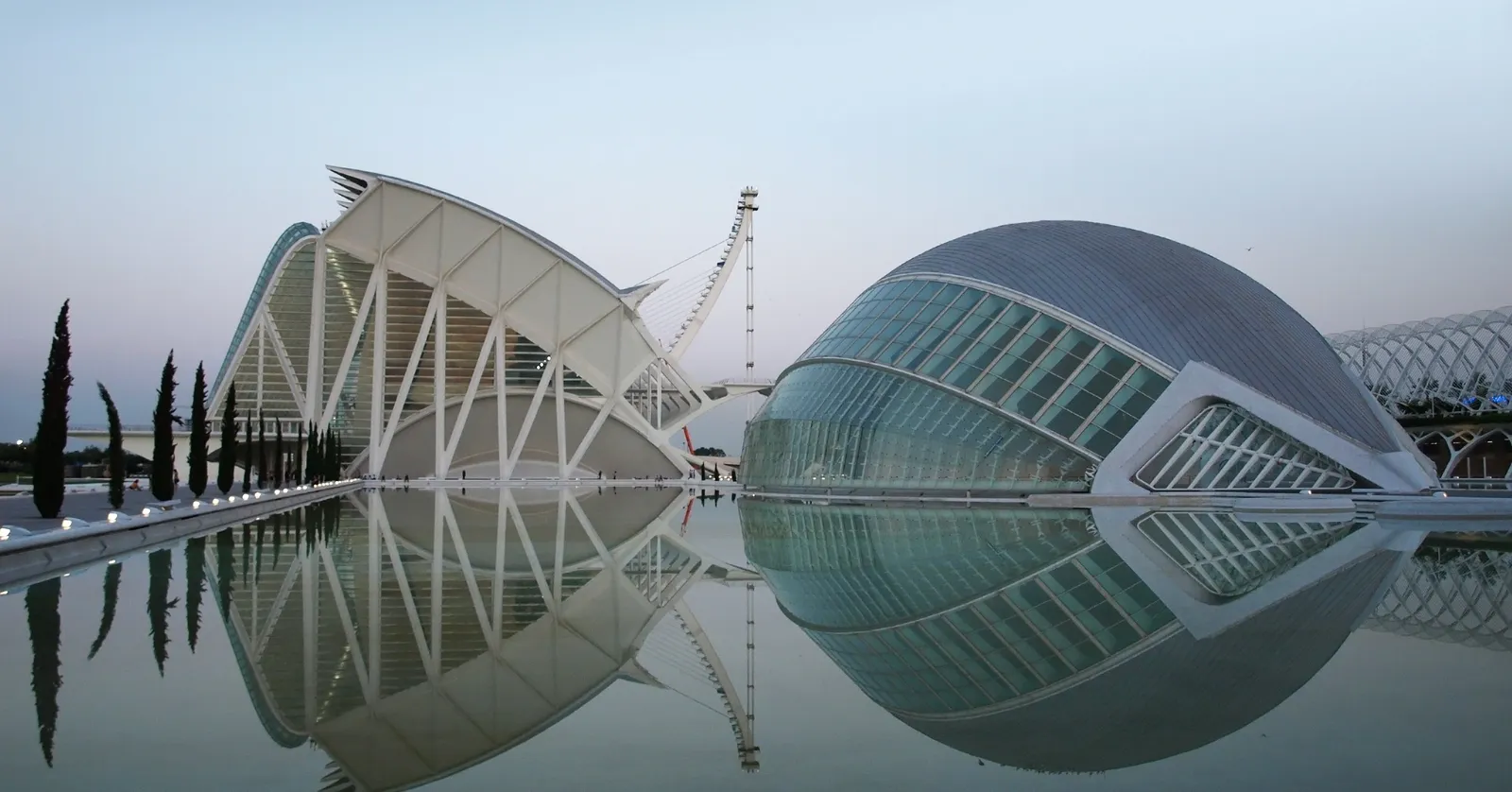
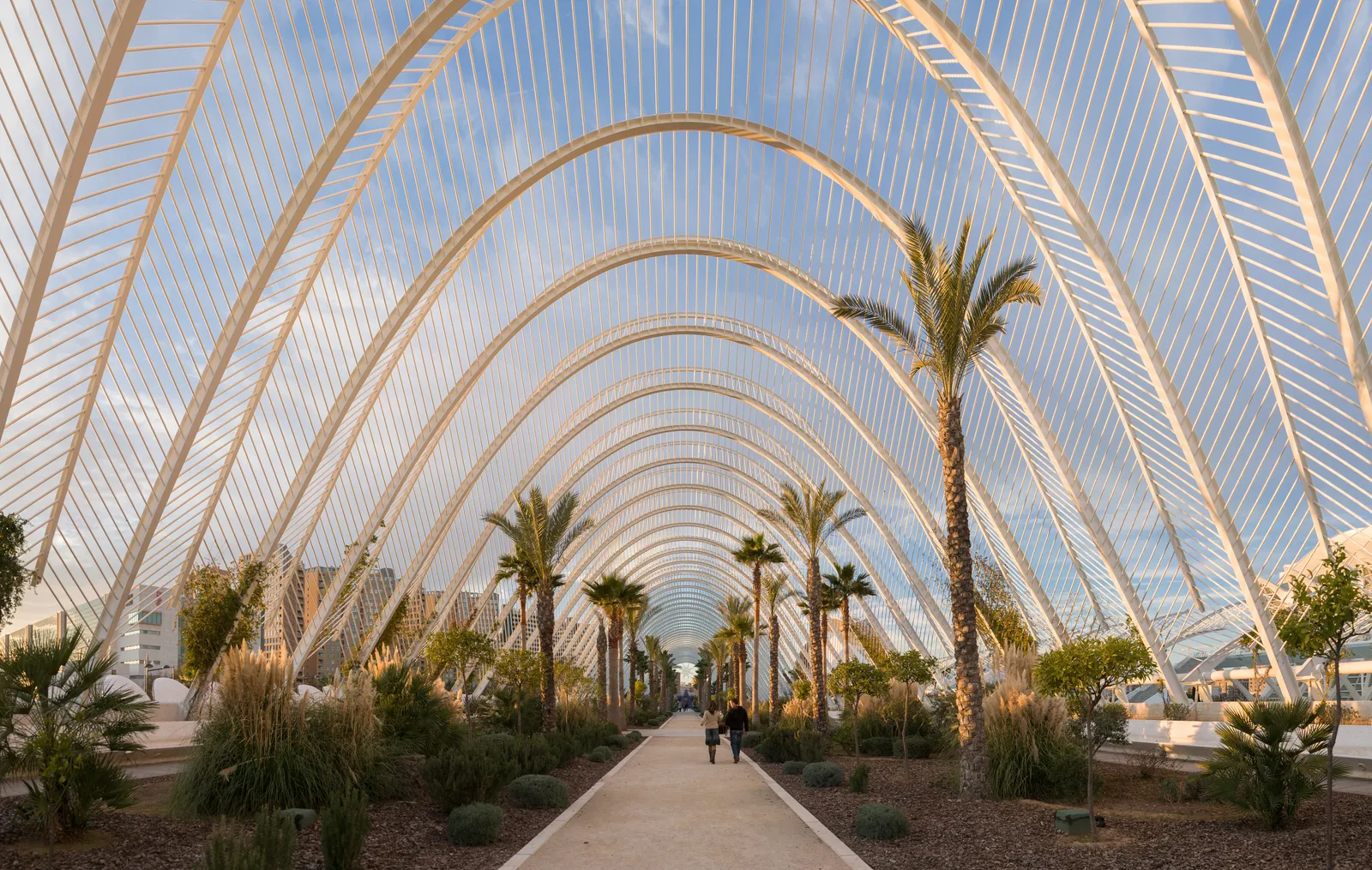
The City of Arts and Sciences fills the eastern end of the old Turia riverbed, the dry course the river was moved into after floodwater drowned the city centre in 1957, with Santiago Calatrava’s white buildings standing in shallow pools: the Hemisfèric shaped like an eyelid, the Príncipe Felipe science museum like a ribcage, the Ágora rising over the far end. The Umbracle is the one to walk through, a 320-metre arcade of white steel arches over a garden of palms, and it costs nothing.
That is true of the whole outside: the pools, the walkways and the footbridges are open ground, and only the buildings themselves are ticketed. The Oceanogràfic at the seaward end is the expensive one, priced by date from about 36 euros up to around 43 in the busiest weeks, and it wants three hours rather than forty minutes, so it is a decision about your whole afternoon rather than a stop you drop into. If it is the reason you came, book the entry before you land through a tours and activities platform; in July and August the queue at the door can take an hour off the time you have. About forty minutes’ walk from Xàtiva, or the number 95 bus from Alameda metro station, gets you there.
The Holy Grail chapel inside Valencia Cathedral
Valencia Cathedral turns a different face onto each of the two squares it sits between, five minutes’ walk from Xàtiva: a curved baroque front on the Plaza de la Reina, a Gothic doorway of apostles on the Plaza de la Virgen. Inside, in the old chapter house, an agate cup on a gold stem sits in the middle of an alabaster altarpiece. This is the Holy Chalice, the strongest surviving claimant to be the cup of the Last Supper: archaeologists date the cup itself to somewhere between the fourth century BC and the first century AD, the Vatican treats it as a historical relic without ruling on the rest, and two popes have said Mass with it here, John Paul II in 1982 and Benedict XVI in 2006.
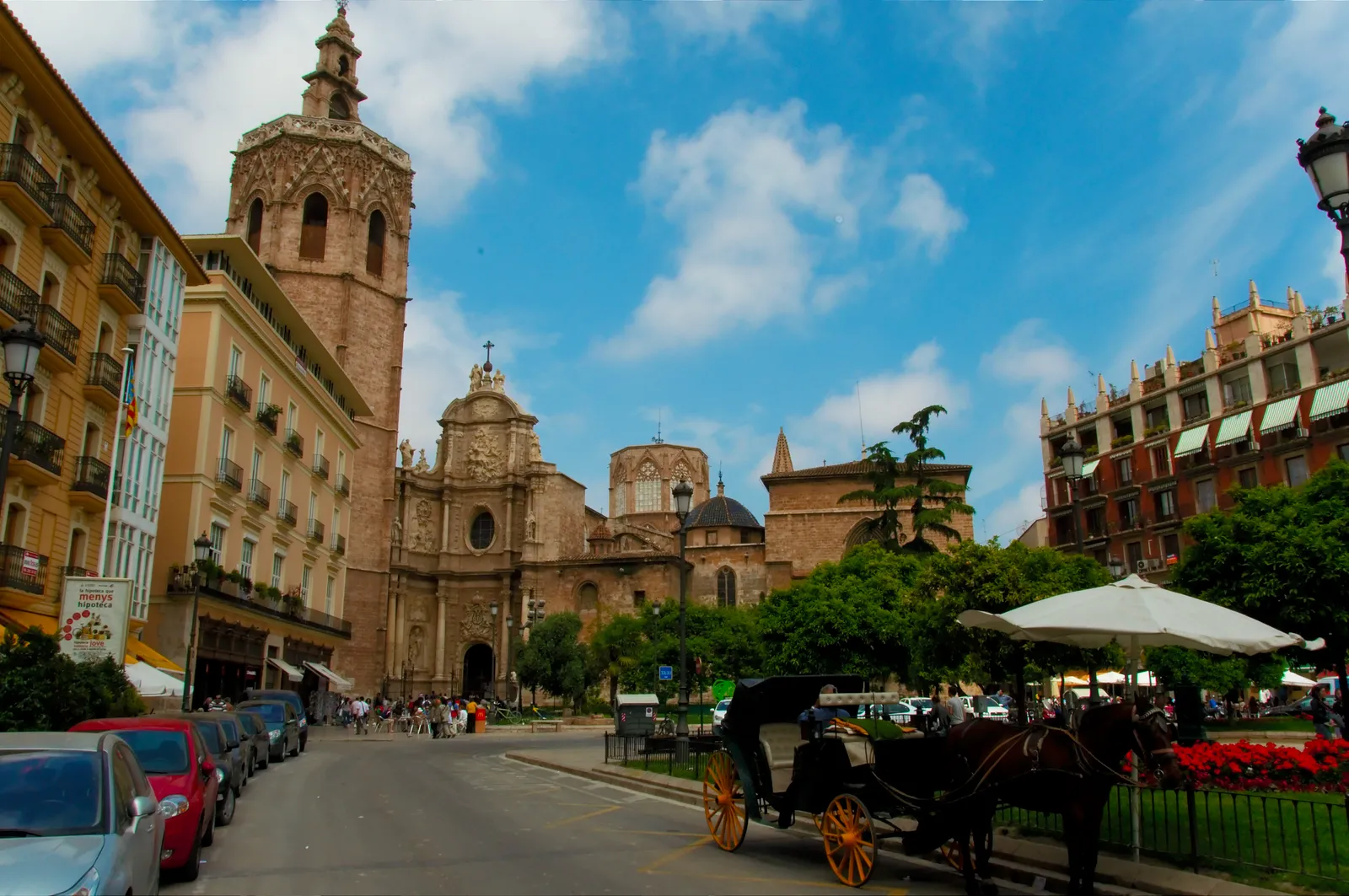
Entry is 12 euros and covers the chapel, the museum and an audio guide, and a guided walk of the old town that includes cathedral entry is bookable in advance through a tours and activities platform if you would rather not work it out at the door. The Miguelete, the octagonal bell tower on the corner, is a separate three euros and 207 steps up a spiral staircase; the reward is the only view that shows you how flat the huerta around the city is. On Sundays and public holidays the cathedral only opens to visitors from 2pm to 5.30pm.
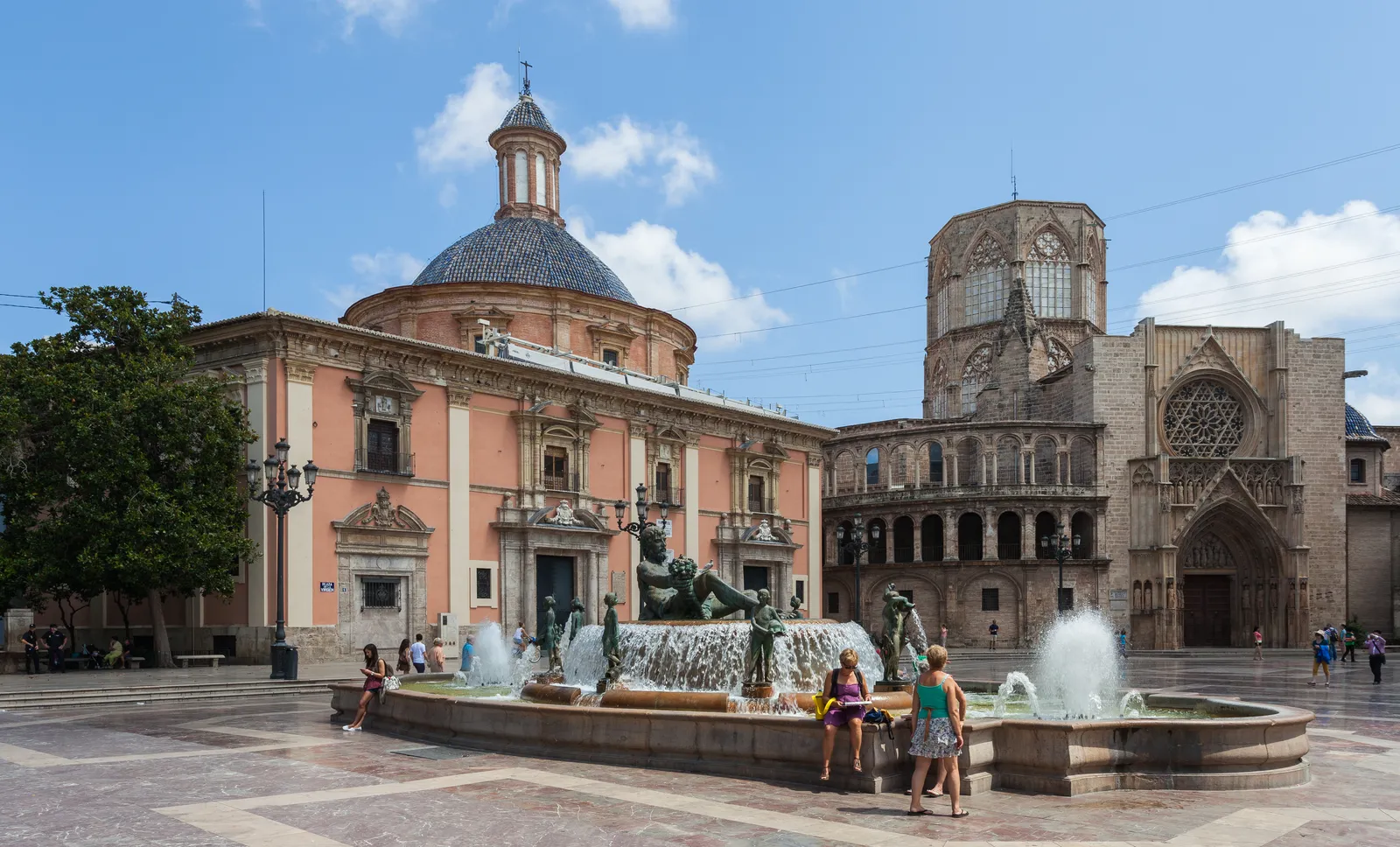
Come out of that Gothic doorway at noon on a Thursday and there will be eight men in black smocks sitting in a half circle of chairs on the paving in front of it, with a bailiff calling out the name of one irrigation canal after another. This is the Tribunal de les Aigües, the water court of the Valencian plain. Each of the eight is elected by the farmers of one canal, the cases are real disputes over irrigation water, the rulings are binding, and it has been done this way on this spot since the Middle Ages. Nobody sells a ticket and nothing is staged for visitors. UNESCO put it on its intangible cultural heritage list in 2009. It sits every Thursday except Christmas and Maundy Thursday and it does not usually run long, so be there before twelve rather than at five past. The fountain in the same square is the Turia itself: the reclining bronze figure is the river, and the eight women around him holding pitchers are the same eight canals whose names get read out at the door.
The Mercado Central’s iron and glass food hall
Ten minutes north of Xàtiva, past the Plaza del Ayuntamiento, the Mercado Central covers more than 8,000 square metres under iron trusses, coloured glass and two tiled domes. Alexandre Soler March and Francesc Guàrdia Vidal built it between 1914 and 1928, and they took the height and the dome from the Gothic buildings it had to stand next to. Thirty metres up on the main dome is a weathervane in the shape of a green parrot, known locally as the cotorra del mercat, the market parrot.
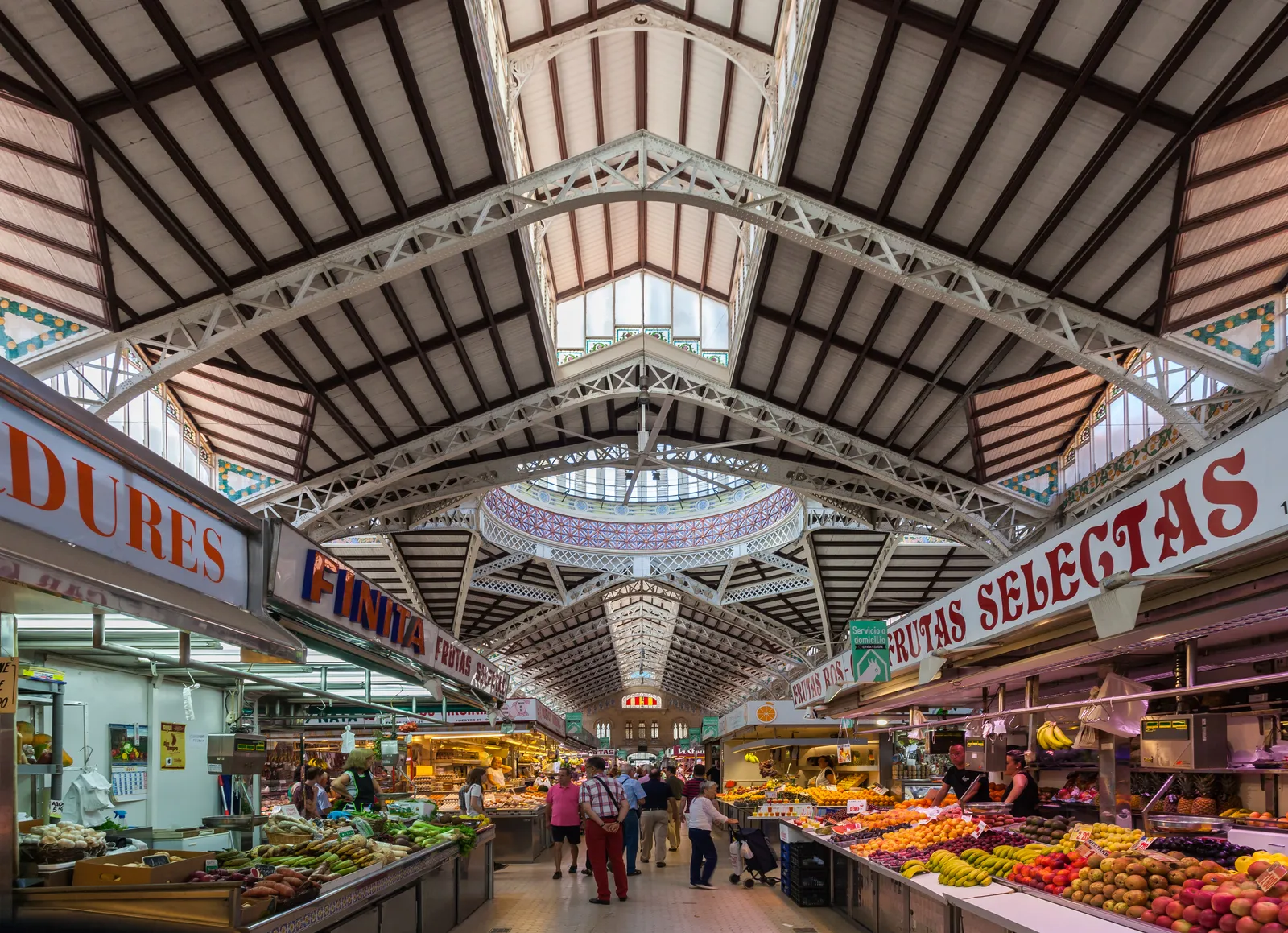
This is a food market rather than a food court, and the hours say so: Monday to Saturday, 7.30am to 3pm, shut all day Sunday. Before about eleven the aisles belong to people buying lunch, which is the version worth seeing. Walking in is free. The fish counters run down one side, the cured ham and the horchata stalls down the other, and the produce in the middle is mostly out of the huerta, the irrigated plain that starts a few kilometres away. Those aisles are shopping space at that hour and there is nowhere to stand a suitcase beside a stall, so leave the bag at a storage point near Xàtiva first.
Eight twisted stone columns in the Silk Exchange
Straight across the road from the Mercado Central’s west front, behind a crenellated wall, is the Lonja de la Seda, the hall Valencia’s silk merchants did their trading in. Pere Compte built the main room between 1483 and 1498, and its eight helical columns come out of the floor already twisting, carry on turning for the full height of the room, and open at the top into the ribs of the vault without a capital in between.
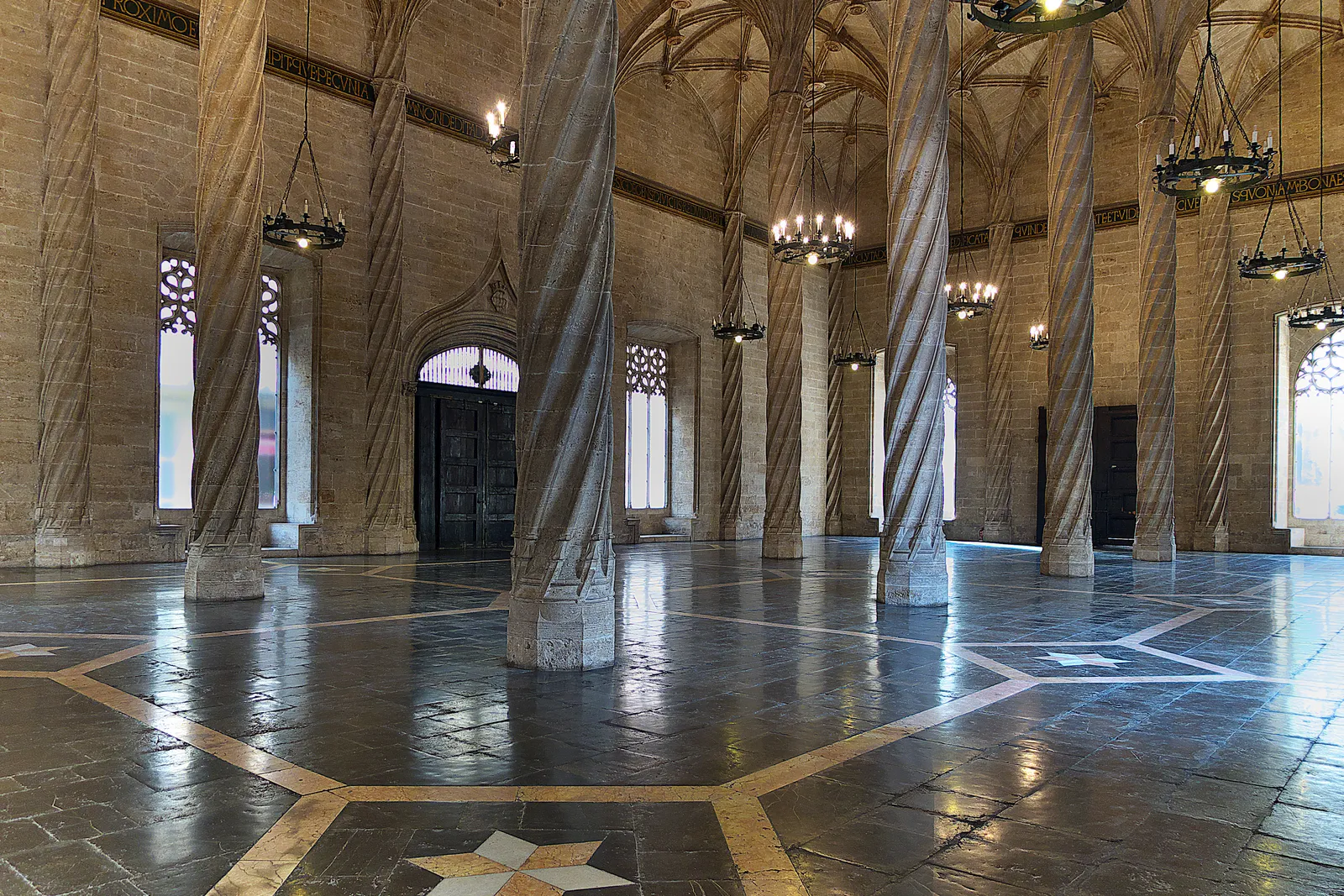
Around all four walls, in gold letters on blue, runs a Latin inscription telling the merchants underneath it that trading honestly and without usury will make them rich here and save them afterwards. Reading it on an actual trading floor is the sort of thing you go inside for. UNESCO listed the building in 1996. Entry is two euros, Monday to Saturday, 10am to 7pm; on Sundays and public holidays it is free but closes at 2pm, so you get the building cheaper and the day shorter. It belongs to the same Mediterranean Gothic that produced Santa Maria del Mar in Barcelona, built out of the same thing: sea trade money.
The park in the Turia’s empty riverbed
With more than four hours before the flight, Valencia’s old riverbed is worth the walk on its own. The city used to have a river through the middle of it. On 14 October 1957 the Turia came over its banks and drowned the city centre, and the engineering answer was to move the river: a new channel was cut around the south side of town and the water was sent down it, leaving several kilometres of dry bed running through the built-up city. The plan for the empty bed was a motorway. What got built instead, after a decade of local campaigning, is nine kilometres of park sunk a few metres below the streets, from Parque de Cabecera in the west to the sea.
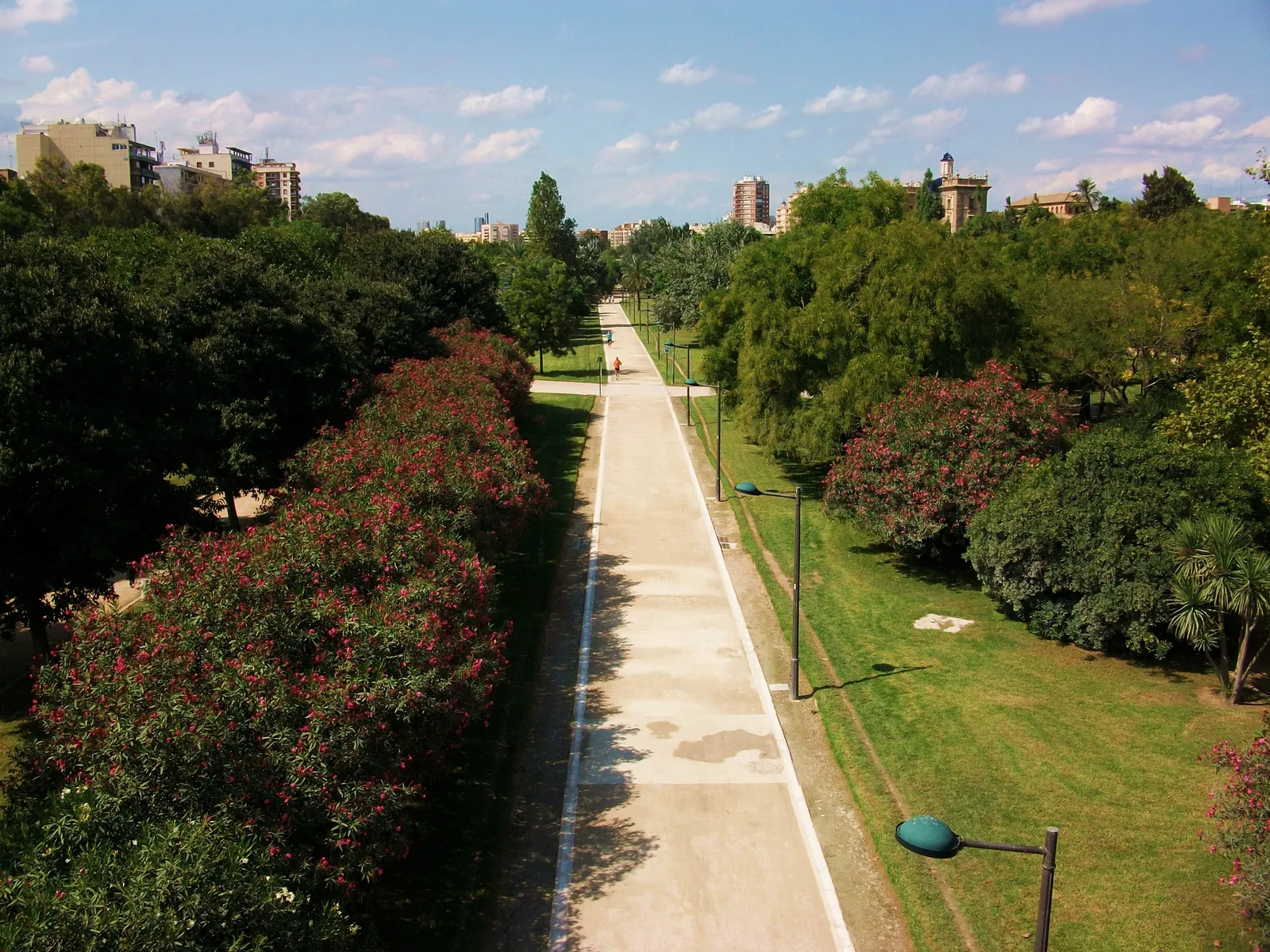
Eighteen bridges cross over the top of it, several of them centuries older than the gardens underneath. Because the whole thing sits below street level you never meet traffic in it, which is why Valencians use it to get across town rather than only to sit in: there are running tracks, football pitches, orange groves and a rose garden strung along its length. It costs nothing and most of it is unfenced.
One airport metro line stops running an hour before the other
Both lines go back from Xàtiva, but they keep different hours. Line 3, the red one, runs until about 11.30pm on weekdays; line 5 gives up around 10.30pm, so on a genuinely late departure line 3 is the one to look for on the platform screen. Trains leave every 15 minutes on weekdays and about every 20 at weekends and on public holidays. A single fare to the airport is 4.80 euros, more than an ordinary city ticket because the airport sits outside the central fare zone, and the reusable card it loads onto costs a euro on top the first time.
The metro platform is on the ground floor of the terminal, so the walk from train to check-in desk is a short one, and about 45 minutes door to door from the centre is a fair figure with the wait included. Two hours before departure is comfortable on that arithmetic, which means the bag can stay in the locker until the last thing you do.
Frequently asked questions
What should I do during a layover in Valencia?
With four to six hours, Xàtiva puts the Mercado Central, a working food market under iron and tile, within a ten-minute walk (mornings only, closed Sundays). Across the road, the Silk Exchange's twisting stone columns are 2 euros, then it's a short walk to the cathedral and the free Plaza de la Virgen. With time left, the City of Arts and Sciences and the sunken Turia riverbed that leads to it are worth the detour, including the free Gulliver Park for anyone travelling with children; book the Oceanogràfic aquarium ahead if that's on the list, since the queue at the door can eat into a short layover.
Which of these stops are shut on a Sunday?
The Mercado Central, all day. It is a working food market and it trades Monday to Saturday, 7.30am to 3pm. The Silk Exchange goes the other way on a Sunday: free instead of two euros, but closing at 2pm rather than 7pm. The cathedral only opens to visitors from 2pm to 5.30pm on Sundays and public holidays, because the mornings are given over to services. The Turia riverbed, the Plaza de la Virgen and the outdoor half of the City of Arts and Sciences are unaffected, so a Sunday is the day to weight the walk towards the park rather than the market.
Which metro line should I take back to the airport, and how late does it run?
Line 3 or line 5 from Xàtiva, but line 3 is the safer one on a late departure: it runs until about 11.30pm on weekdays, while line 5 stops around 10.30pm. Trains leave every 15 minutes on weekdays and about every 20 at weekends and on public holidays. The ride is about 25 minutes and the platform sits on the ground floor of the terminal, so budget about 45 minutes door to door from the centre. A one-way airport fare is 4.80 euros, more than an ordinary city ticket because the airport is outside the central zone, plus a euro for the reusable card the first time you buy one.
Is there anything here for children on a short stop?
Gulliver Park, in the Turia riverbed at the City of Arts and Sciences end, is a 70-metre figure of Gulliver lying on his back with slides, staircases and climbing ropes built into his clothes and his hair. It is free and there is no ticket desk. The hours are the thing to check: 10am to 8pm from April to June and in September, 10am to 5.30pm from October to March, and in July and August it opens 10am to 1.30pm and again from 5.30pm to 9pm, with the middle of the day closed.
Does this walk work in the July heat?
In the morning and the last hours of daylight. The old town's streets are narrow enough to hold shade most of the day, and the Turia riverbed has mature trees along nearly all of its length, but the plazas and the open ground around the City of Arts and Sciences have none, and the pools there throw the light back up at you. The market shuts at 3pm regardless, which pushes it into the morning half of the day, and Gulliver Park closes from 1.30pm to 5.30pm in July and August. If your free hours land in mid-afternoon, the Silk Exchange, the cathedral and the science museum are the stops with a roof.