Valencia Layover: Torres de Serranos
Part of the full Valencia Layover: Old Town and Turia From VLC
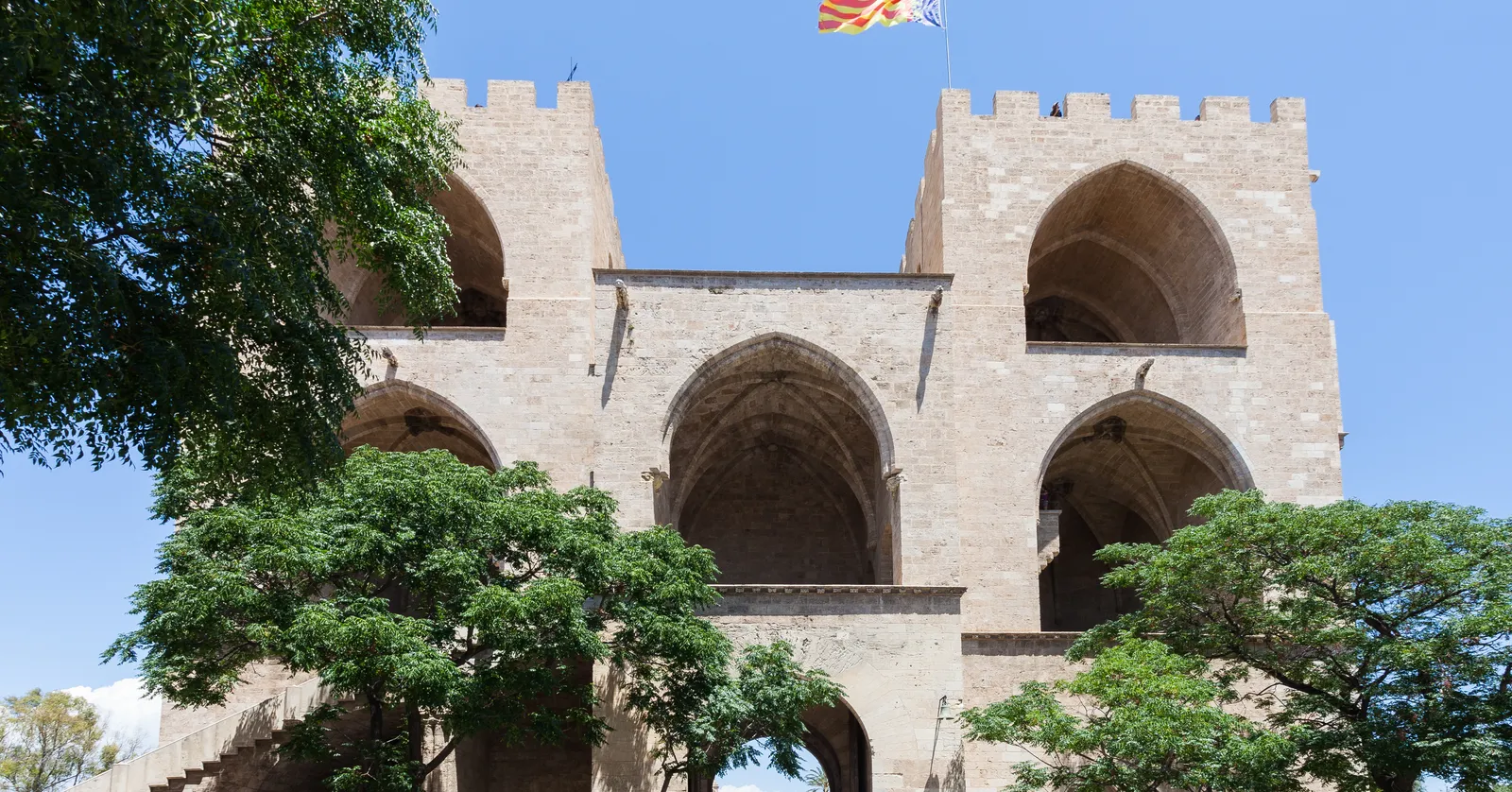
Valencia’s Torres de Serranos, the medieval city’s main gate, costs two euros to climb and nothing on Sundays, and the lanes running south from its arch through El Carmen are the oldest streets in the city, ending a kilometre away at a second gate still pitted with French cannonballs.
The Serranos towers hid the Prado’s paintings in the Civil War
Pere Balaguer built this gate between 1392 and 1398 and it survived the demolition of Valencia’s walls in 1865 because by then it was a prison, holding nobles and knights from 1586 until 1887. From the city side it looks unfinished: the back is open, floor by floor, so you can see straight into the galleries and up the external stairs to the roof.
In November 1936, with Madrid under bombardment, the Republic began moving the Prado’s collection out of the capital, and most of it came here. Twenty-two convoys brought 391 paintings and 181 drawings to Valencia between then and February 1938, and the government built a vault inside the lowest level of these towers to hold them: a 90-centimetre reinforced concrete slab over the paintings, a metre of rice husk on top of that to absorb a blast, a metre of earth over the husk, sandbags on the terrace, and a humidity and temperature system running underneath. Velázquez and Goya sat out part of the war inside the walls you are standing on.
The way to the roof is the reason to arrive without luggage: external stone staircases with a handrail on some flights and none on others, then a tighter stair inside each tower, and no lift anywhere in the structure.
The oldest streets in Valencia run through El Carmen
Go through the arch and you are in El Carmen, the quarter inside the line of the old Islamic wall and the oldest ground in the city. Carrer dels Cavallers runs its length, wide enough for one car, lined with the shuttered fronts of the mansions the Valencian nobility built when this was the good address, with the guild halls and small squares of the medieval city folded in behind them.
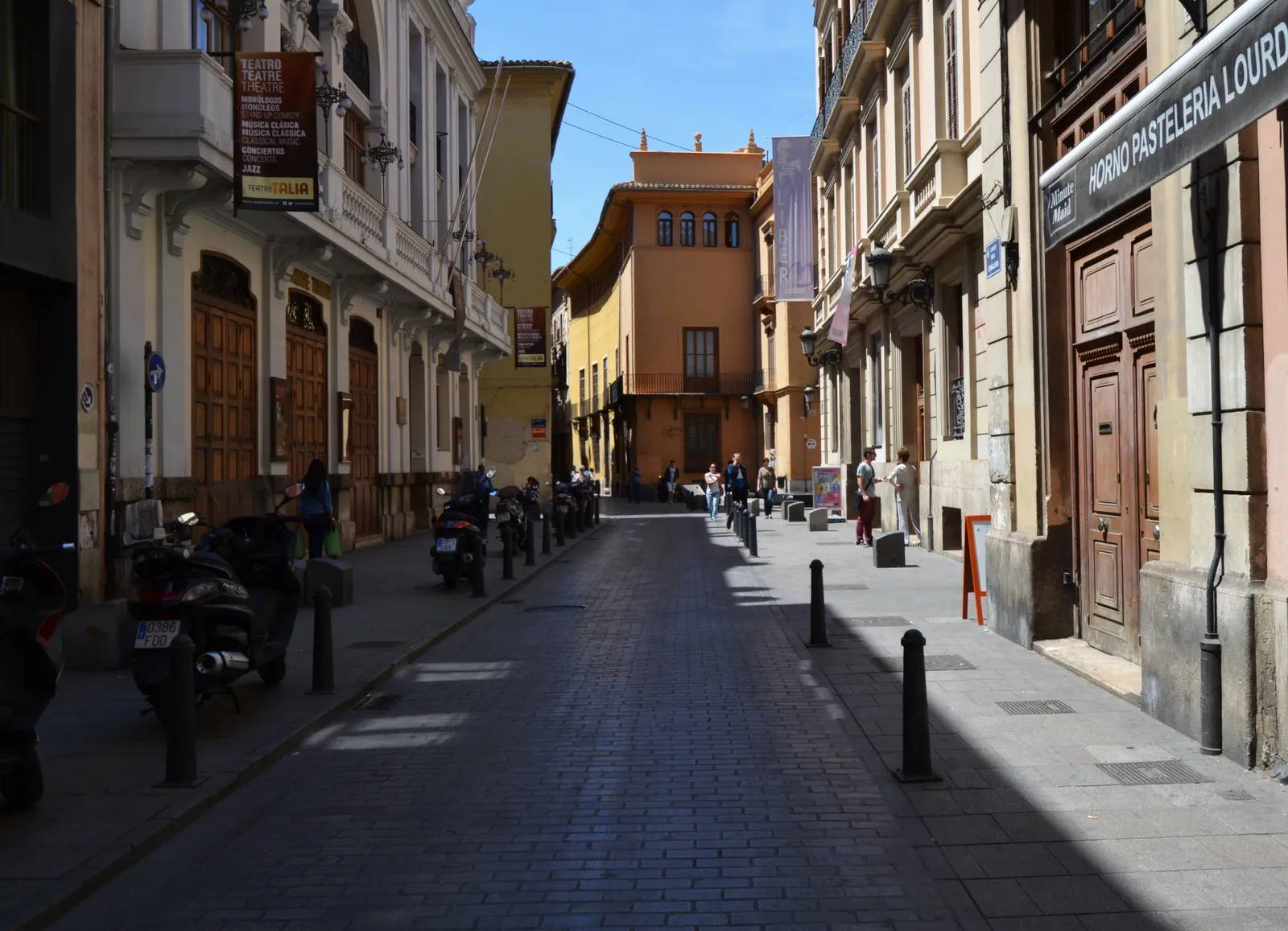
It is a quarter that has been through several lives and does not hide any of them: restored palace fronts next to peeling ones, workshops, bars that only open at night, and painted walls on almost every blank surface. If you would rather have the history narrated than guess at it, a guided walk through the old city is bookable through a tours and activities platform and covers this ground along with the Silk Exchange.
A gateway through the Moorish wall at the Portal de la Valldigna
On Carrer de Salinas, a few minutes in from Cavallers, a plain stone arch is cut straight through the front of a house, with a lane running away beyond it. This is the Portal de la Valldigna, opened in 1400 through the Islamic city wall to connect Valencia with the Moorish quarter that had grown up outside it after the Christian conquest.
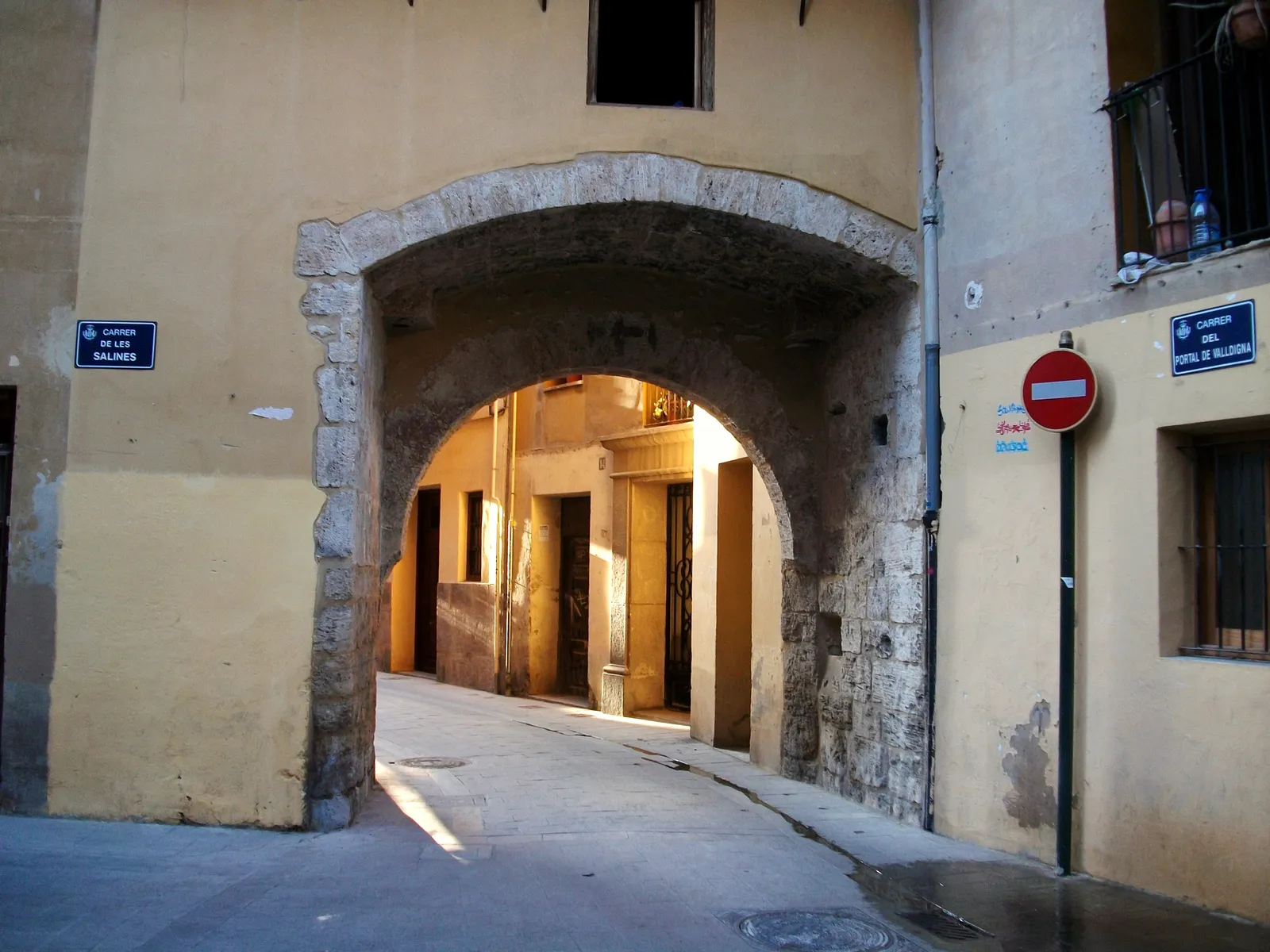
There was never a door in it; it simply separated one side from the other. The name comes from the lodging house the monastery of Santa María de la Valldigna kept here, and the buildings on either side have swallowed the wall it belonged to so completely that the arch is now the only trace of it on this street.
Cannonball scars on the Torres de Quart
Fifteen minutes west, where Carrer de Quart meets the ring road, two round towers stand over the western gate of the same wall, finished across the fifteenth century. They are squatter and blunter than the Serranos gate, and the stone is pitted all over as if it had been shot at, because it was.
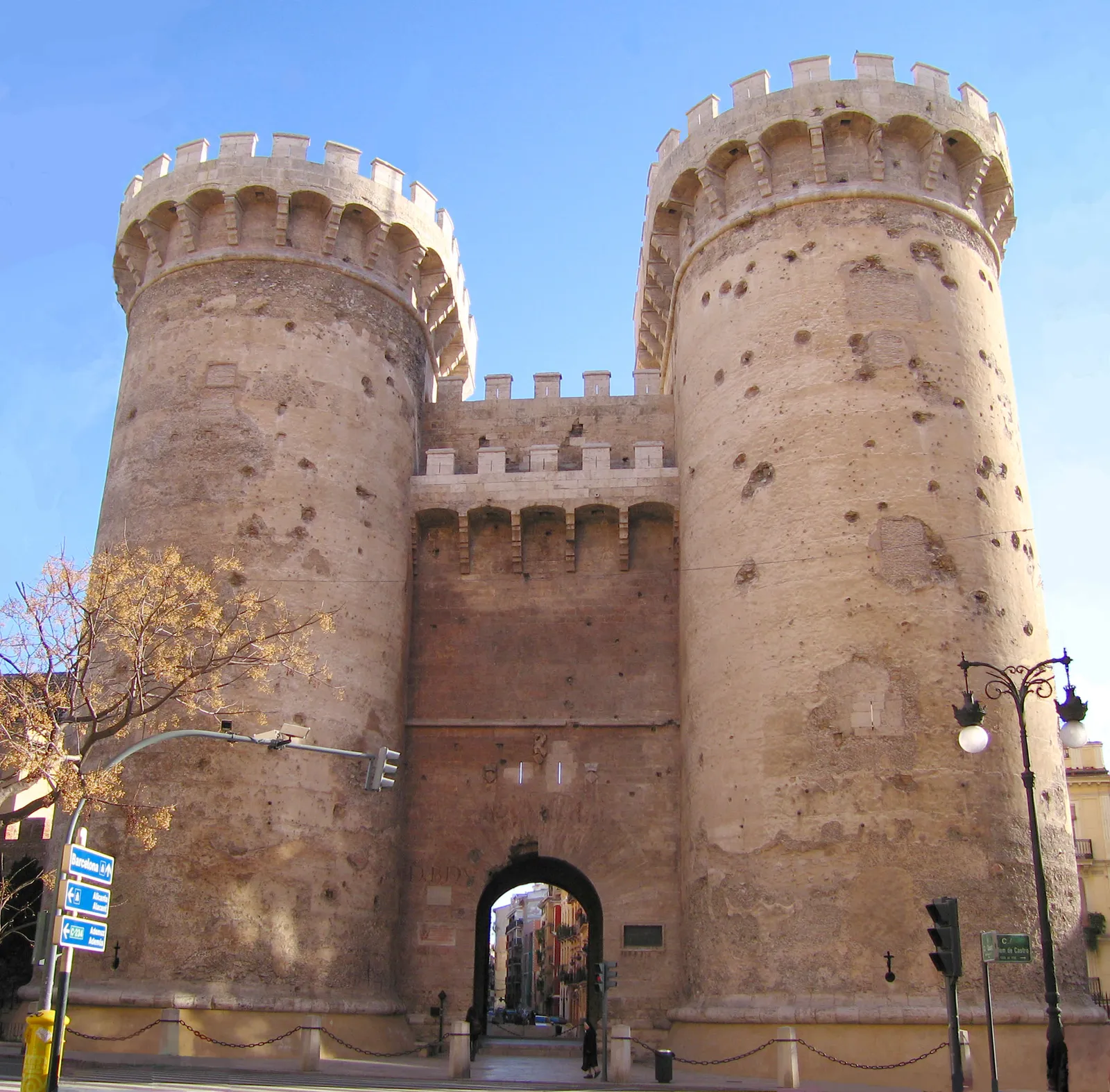
The damage is from the French bombardment during the Peninsular War in 1808, and it has never been patched: over a hundred cannonball strikes and a great many musket holes, left where they landed. These towers are climbable on the same terms as the Serranos ones, two euros and free on Sundays, and the roof looks back down Carrer de Quart into the quarter you just walked through.
The riverbed is the flat way back
The Turia gardens run along the far side of the Serranos gate, a few steps down from street level, and following them east is the easiest way out of this corner: no traffic, shade most of the way, and bridges up into whichever part of the city you want next. Alameda station, on lines 3 and 5, is about ten minutes along it, and those are the lines that run to Valencia Airport, roughly 25 minutes and 4.80 euros from there.
If the gates and the lanes are all you have time for, that is a complete afternoon on its own. If the day is longer, the main Valencia walk starts five minutes south of here at the cathedral and covers the market and the Silk Exchange, which sit inside the same walls this gate used to close.
Frequently asked questions
What does it cost to go up the Serranos towers?
Two euros, one for students and pensioners, and nothing at all on Sundays and public holidays. The Quart towers at the other end of the old town are on the same municipal ticket arrangement, so a Sunday gets you both climbs free. Neither takes long: twenty minutes up and down each, plus however long you stand on the top.
Are the towers climbable if stairs are a problem?
Not really. The back of the gate is open to the city by design, and getting to the roof means external stone staircases with a handrail on some flights and nothing on others, then a further stair inside each tower. There is no lift. The ground-level archway, the plaza in front and the riverbed gardens below are all flat and free, and the view from the bridge just north of the gate gives you most of the building without the climb.
How do I get to the Serranos gate from the middle of the city?
On foot, mostly. It is about five minutes' walk north of the Plaza de la Virgen and seven from the cathedral, straight up through the old town, and the Turia gardens run along its far side so you can also come at it from the riverbed. The nearest metro is Alameda, a walk of about ten minutes across the river.
Is there anything happening at the gate itself during the year?
One thing worth knowing about: on the last Sunday of February, at half past seven in the evening, the falleras mayores appear on the Serranos towers and formally open the Fallas festival to the square below, an event called the crida. It is free, nobody checks a ticket, and it is the one evening this gate is the centre of the city rather than an edge of it. Outside that, the towers are simply open to climb through the week.