Valencia Layover: City of Arts and Sciences
Part of the full Valencia Layover: Old Town and Turia From VLC
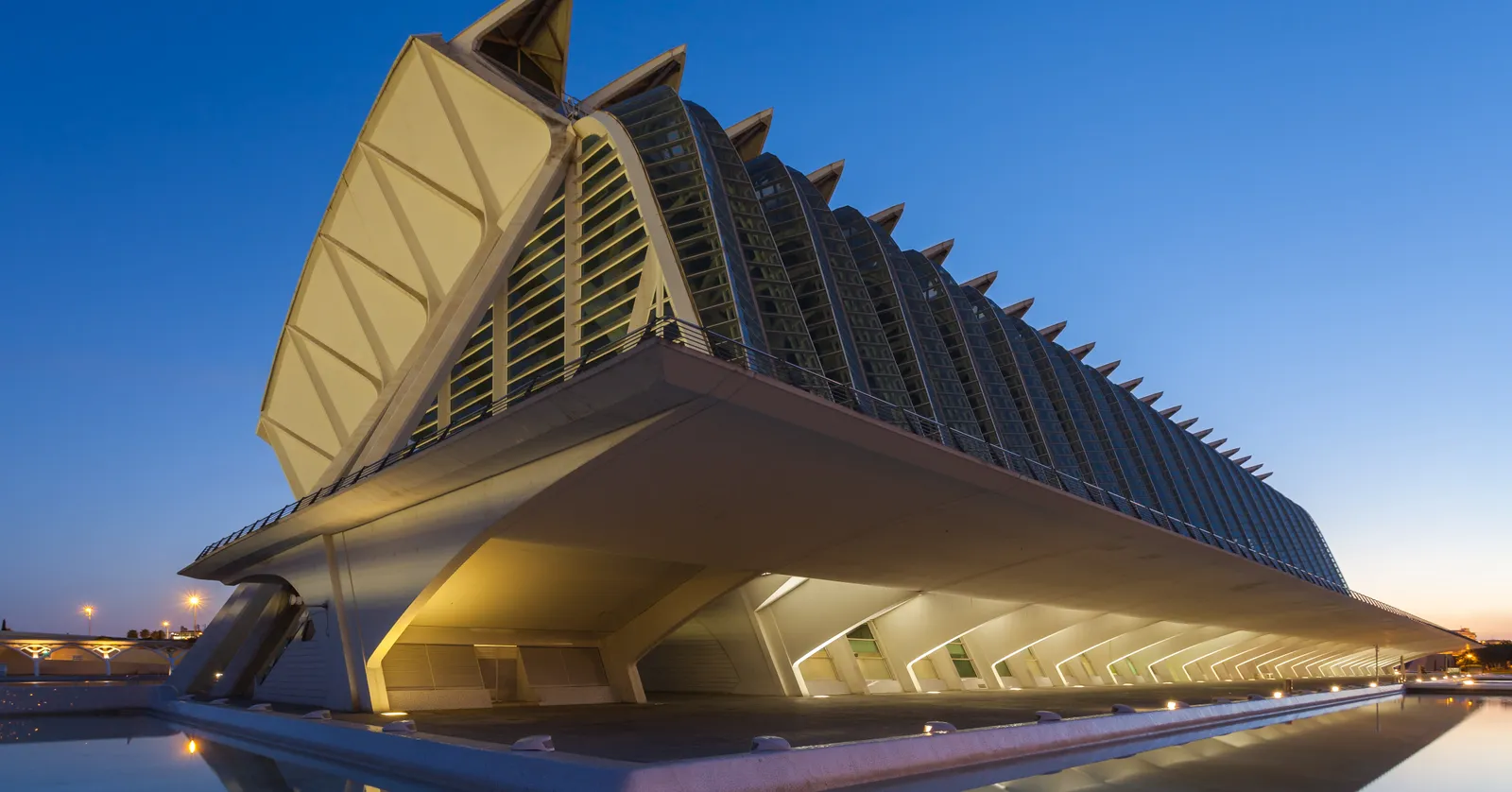
Valencia’s City of Arts and Sciences is one stop rather than a circuit: a tram runs from the centre to a stop called Oceanogràfic at the gate in about eleven minutes, and the lagoons, walkways and footbridges between Santiago Calatrava’s white buildings are all free to walk, with only the aquarium, the science museum and the domed cinema charging to go inside.
An eye-shaped IMAX dome at the Hemisfèric
The Hemisfèric opened on 16 April 1998 and was the first of these buildings to be finished. From the walkway it is a glazed dome inside a long curved shell, and the shell has a moving section that lifts like an eyelid; put the reflection in the pool underneath it together with the building above and the whole thing reads as an eye.
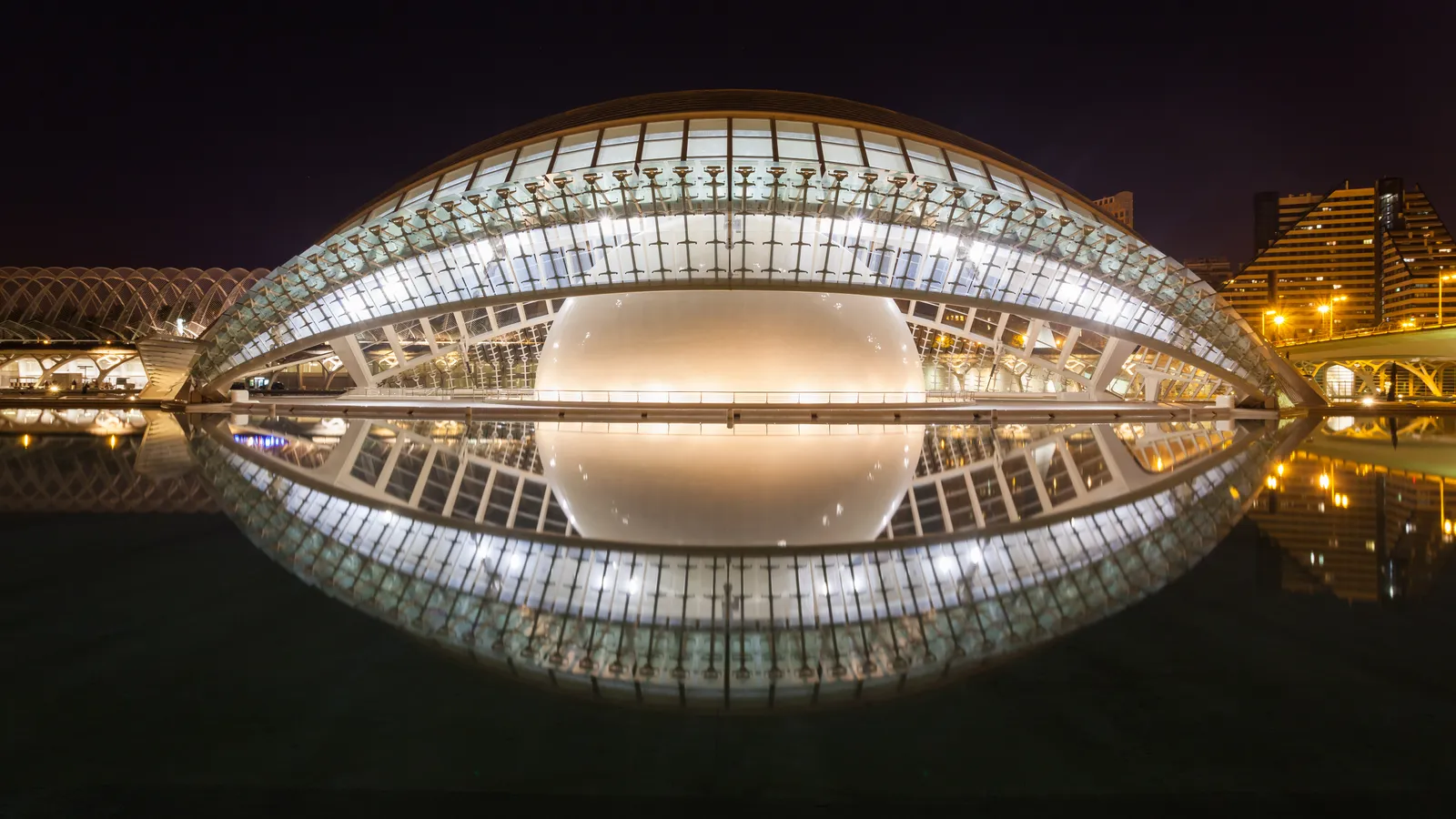
Inside the dome is a 900-square-metre concave screen used as an IMAX cinema and a planetarium. A screening is under an hour, which makes it the one ticketed building here that fits into a gap rather than defining the day.
Félix Candela’s concrete shells over the Oceanogràfic
The aquarium at the seaward end is not Calatrava’s. Félix Candela, the Spanish-Mexican engineer who spent a career proving how thin a concrete shell could be, designed the entrance building and the underwater restaurant: white petals folded over glass, sitting at the edge of a lagoon.
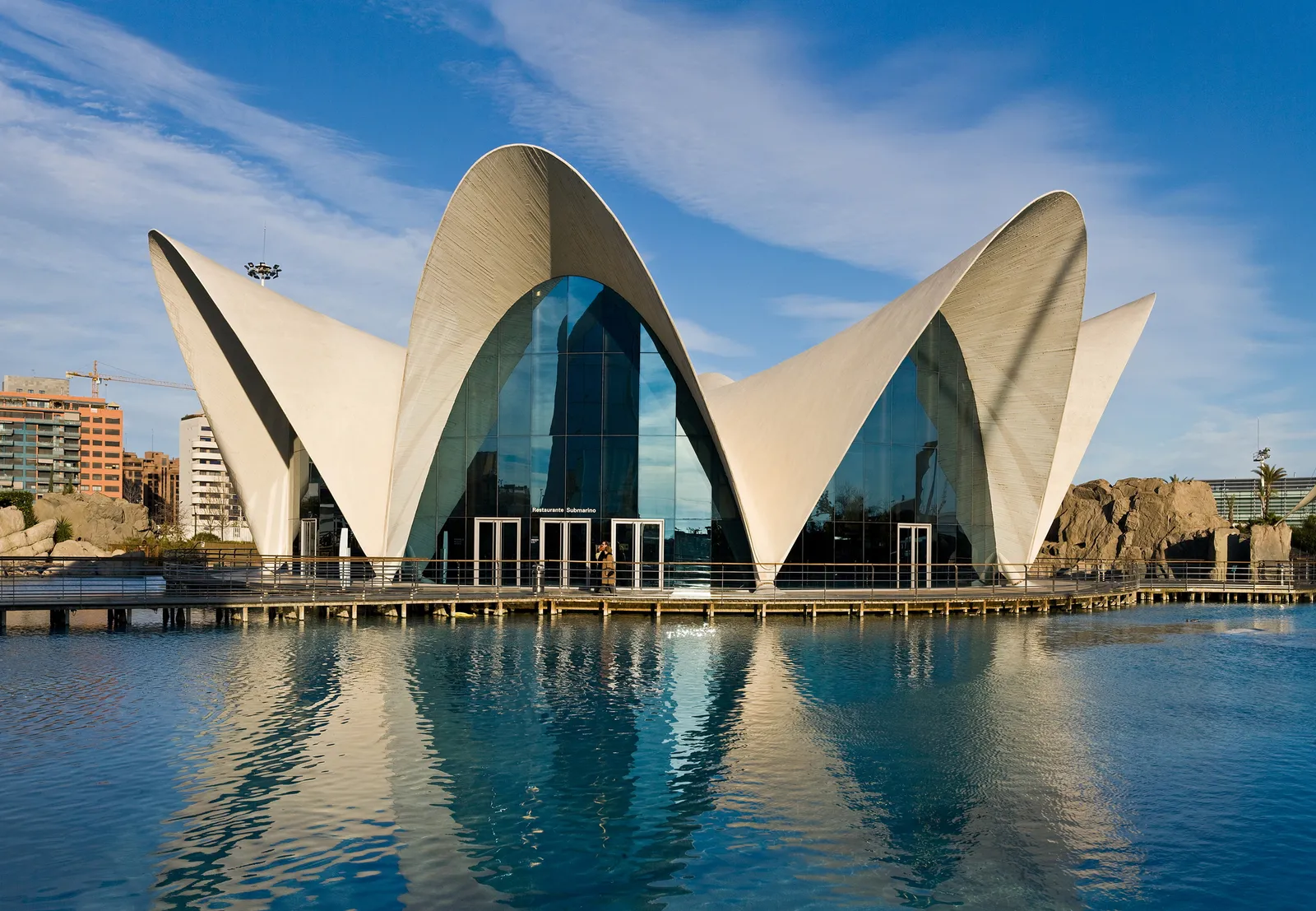
Inside is 110,000 square metres of aquarium arranged as ten separate habitats, from the Mediterranean to an Arctic dome with beluga whales, holding around 45,000 animals across 500 species. Prices move with the date, running from roughly 36 euros up to about 43 in the busiest weeks, and the ticket office closes an hour before the aquarium does. It is worth holding a dated entry in advance through a tours and activities platform, since the queue at the gate on a July morning is its own half hour.
Three hours in there is three hours on your feet in the dark reading tank labels, moving slowly through tunnels with a crowd, which is the one shape of afternoon a wheeled suitcase makes genuinely tedious. Leave it in the centre before you come out.
The science museum where not touching is the thing that is forbidden
The long ribbed building along the north side, finished in 2000, is the Príncipe Felipe science museum, and Calatrava built it to look like a whale’s skeleton laid on its side: a spine of struts down the middle and ribs curving out over three floors of open hall. Its motto, printed at the door, is that it is forbidden not to touch, not to feel, not to think, which is a fair description of what is inside: a working Foucault pendulum swinging through the floors, dinosaur skeletons, and rooms of things built to be pulled and pushed.
If the aquarium is already in the plan, the arithmetic on this one is unusual: adding the science museum to an Oceanogràfic ticket costs a couple of euros more than the aquarium on its own, whichever date you pick. A standalone science museum ticket is also bookable through a tours and activities platform if the aquarium isn’t part of the plan. On a flight day the constraint is time, not money, so treat either as a reason to add it only if you actually have the hour.
The Assut de l’Or bridge is the highest thing in Valencia
At the eastern end the riverbed narrows and a single white pylon goes up out of it, leaning back against 29 parallel cables that carry a 180-metre deck over the gardens. Calatrava finished it in December 2008 and named it for a weir, the assut de l’Or, the gold dam, that used to divert water nearby.
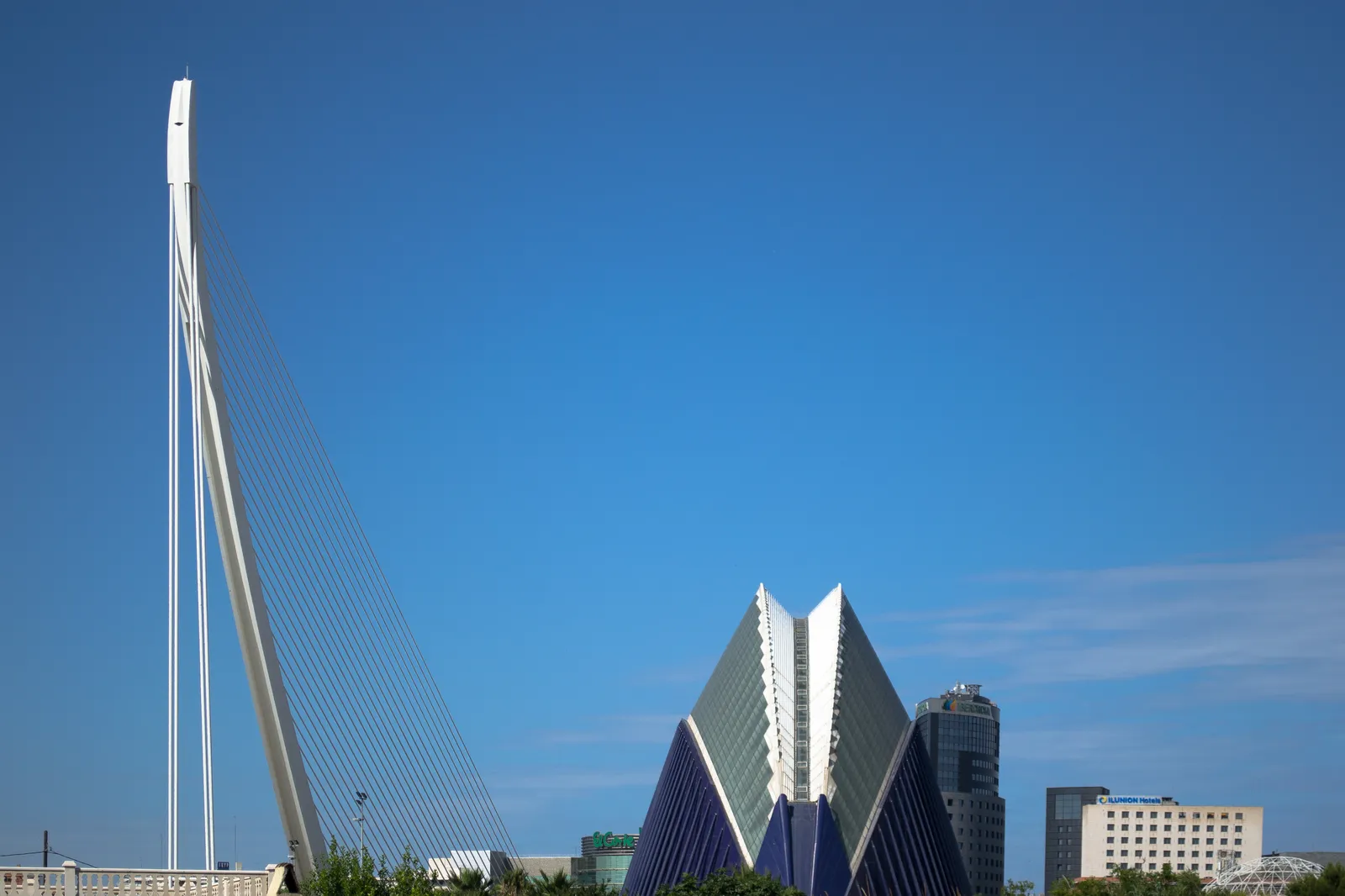
At 125 metres the pylon is the tallest structure in the city, taller than the cathedral tower by a wide margin, and it is the thing you can navigate back to from anywhere in the riverbed. Beside it stands the Àgora, a blue-panelled shell of a building used for events, worth the two minutes it takes to walk around even when nothing is on.
Gulliver lies in the riverbed with slides built into him
Walk a few hundred metres north-west along the Turia gardens and the ground opens into a sand pit with a seventy-metre man lying face up in it. The Gulliver playground turns the Lilliputian scene into a climbing frame: his coat, his hair and his ropes are slides, staircases and ramps, and children swarm the whole thing.
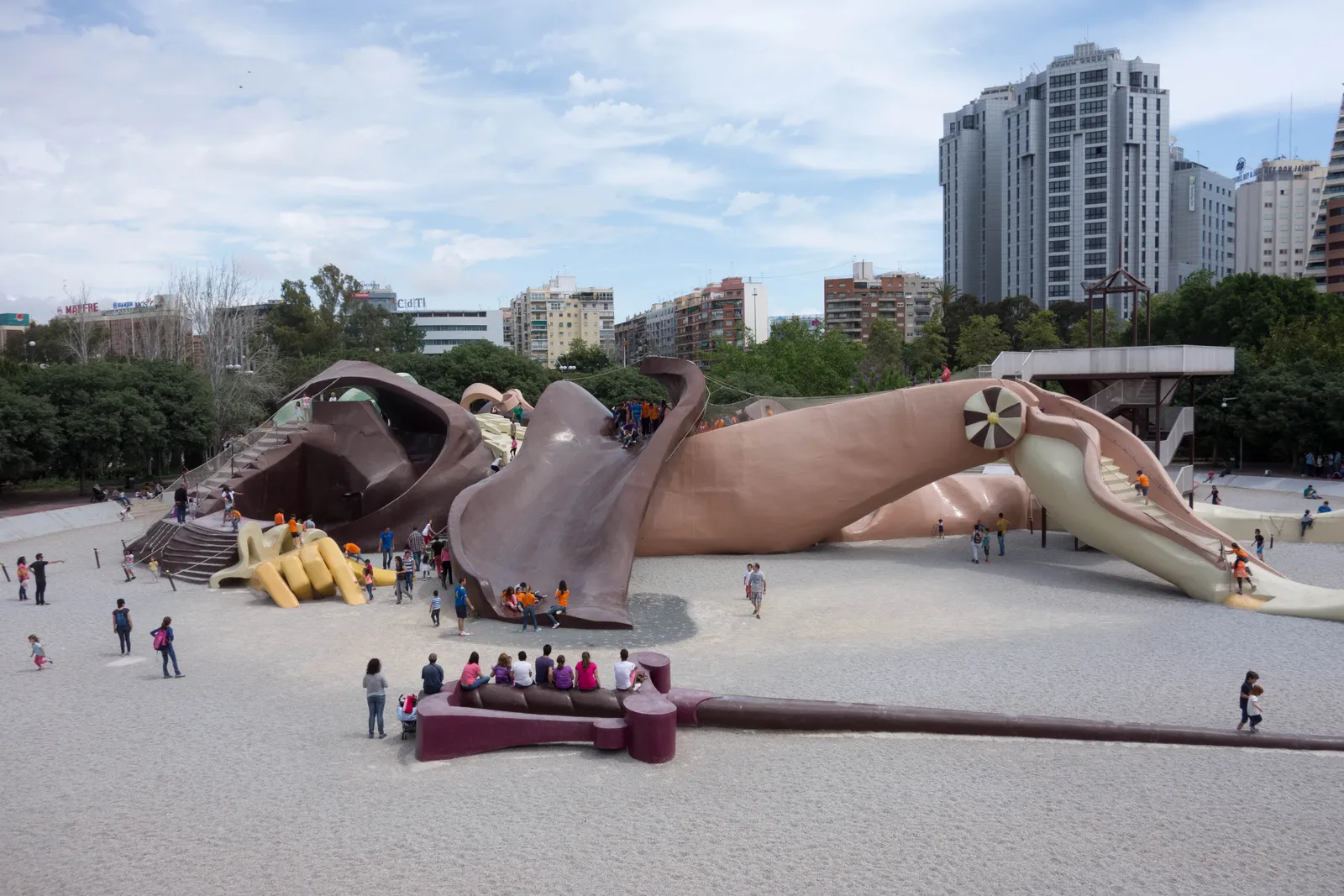
It costs nothing and has no ticket desk. Opening hours move with the season: 10am to 8pm from April to June and in September, 10am to 5.30pm from October to March, and in July and August it runs 10am to 1.30pm and then 5.30pm to 9pm with the hot middle of the day closed. If you are travelling with children and the aquarium is out of the budget, this is the substitute that actually works.
The tram stop at the gate opened in 2022
Line 10 runs from Alacant station in the centre out to Natzaret, eight stops over five kilometres, and it put a platform called Oceanogràfic directly at the aquarium gate in May 2022. Alacant connects to Xàtiva, the interchange under Estació del Nord, which is where lines 3 and 5 leave for Valencia Airport: about 25 minutes and 4.80 euros from there, with the last useful departures around 11.30pm on weekdays.
The other way back is on foot up the riverbed, forty minutes of flat gravel and orange trees that lands you at the edge of the old town, where the main Valencia walk picks up with the Mercado Central and the cathedral. On a flight day, pick one of those two ends of the city rather than both.
Frequently asked questions
How much of this complex can I see without buying a ticket?
Most of the ground. The lagoons and reflecting pools, the walkways between the buildings, the Umbracle's arched garden promenade, the Ágora forecourt and the footbridges are all open, unfenced and free, and every one of Calatrava's exteriors is visible from them. What costs money is going inside: the aquarium, the science museum and the domed cinema each sell their own ticket. Gulliver Park, a few hundred metres up the riverbed, is free too.
How long does the Oceanogràfic actually take?
Three hours is the honest minimum and four is more realistic if you stop at the dolphin show or eat there. It covers 110,000 square metres across ten separate habitat buildings, and the walk between the Arctic dome and the Red Sea section alone is several minutes. The ticket office shuts an hour before the aquarium does, so a late arrival can find the doors open and the till closed.
What is the fastest way here from the middle of Valencia?
A tram, which opened in May 2022 and runs from the centre through Russafa to a stop called Oceanogràfic at the gate of the aquarium, about eleven minutes end to end. Before it existed this was a bus ride or a forty-minute walk down the riverbed, which is why older guides route you differently. The walk down the Turia gardens is still the nicer version if the weather and the clock allow it.
Is it worth coming here just for the buildings after dark?
The pools are lit and the Hemisfèric doubles itself in the water into a full eye shape, which is the photograph everyone comes for, and none of that needs a ticket. The catch on a flight day is the return: line 3 of the metro runs to the airport until about 11.30pm on weekdays and line 5 stops around 10.30pm, so an evening spent out here has to be timed against the last useful train rather than against sunset.