Mexico City Layover: The Zócalo From MEX
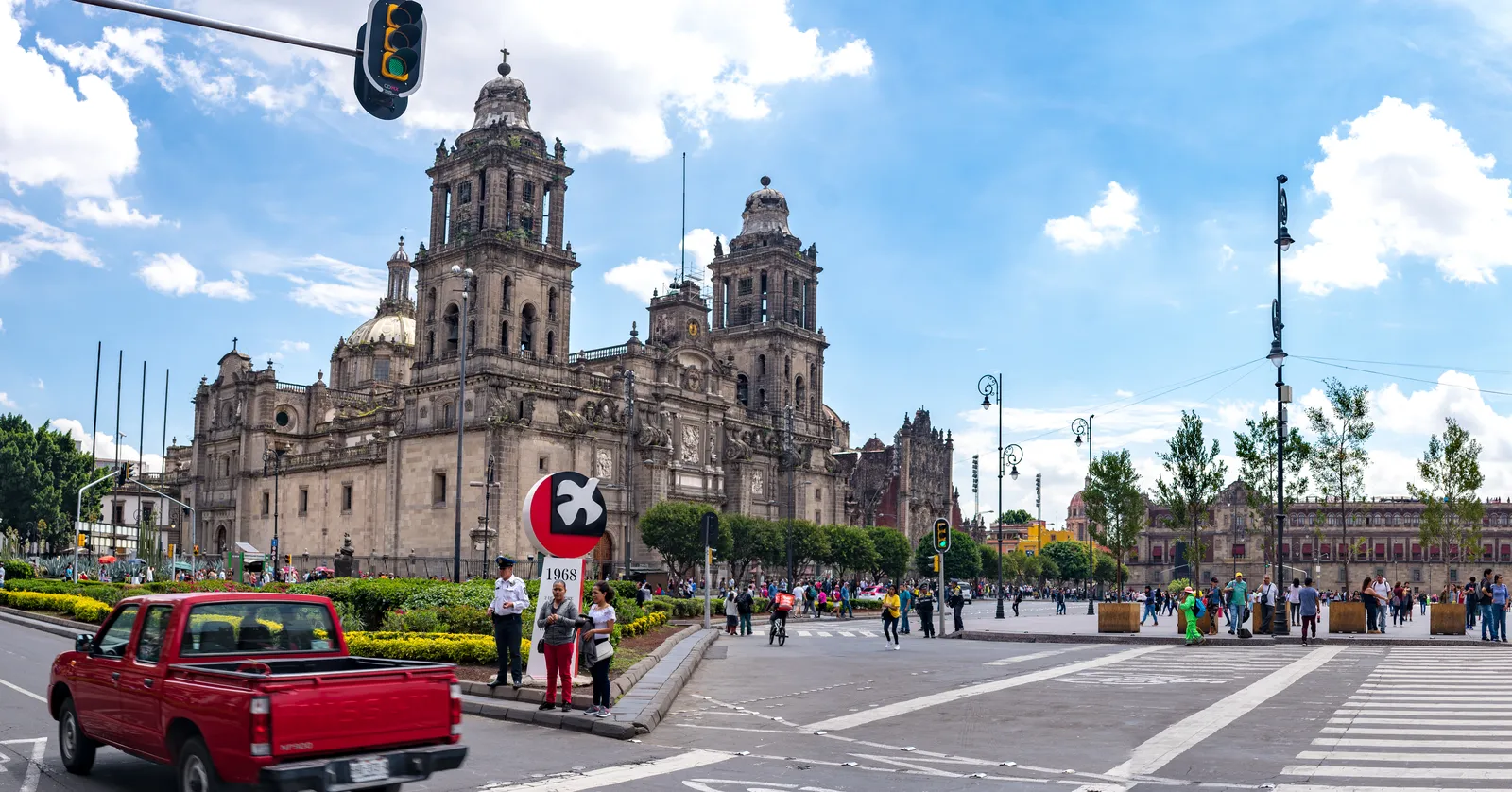
Mexico City’s Centro Histórico fits an excavated Aztec pyramid, a marble concert hall, a working post office worth walking into and a view from 44 floors up into about a dozen flat blocks around the Zócalo.
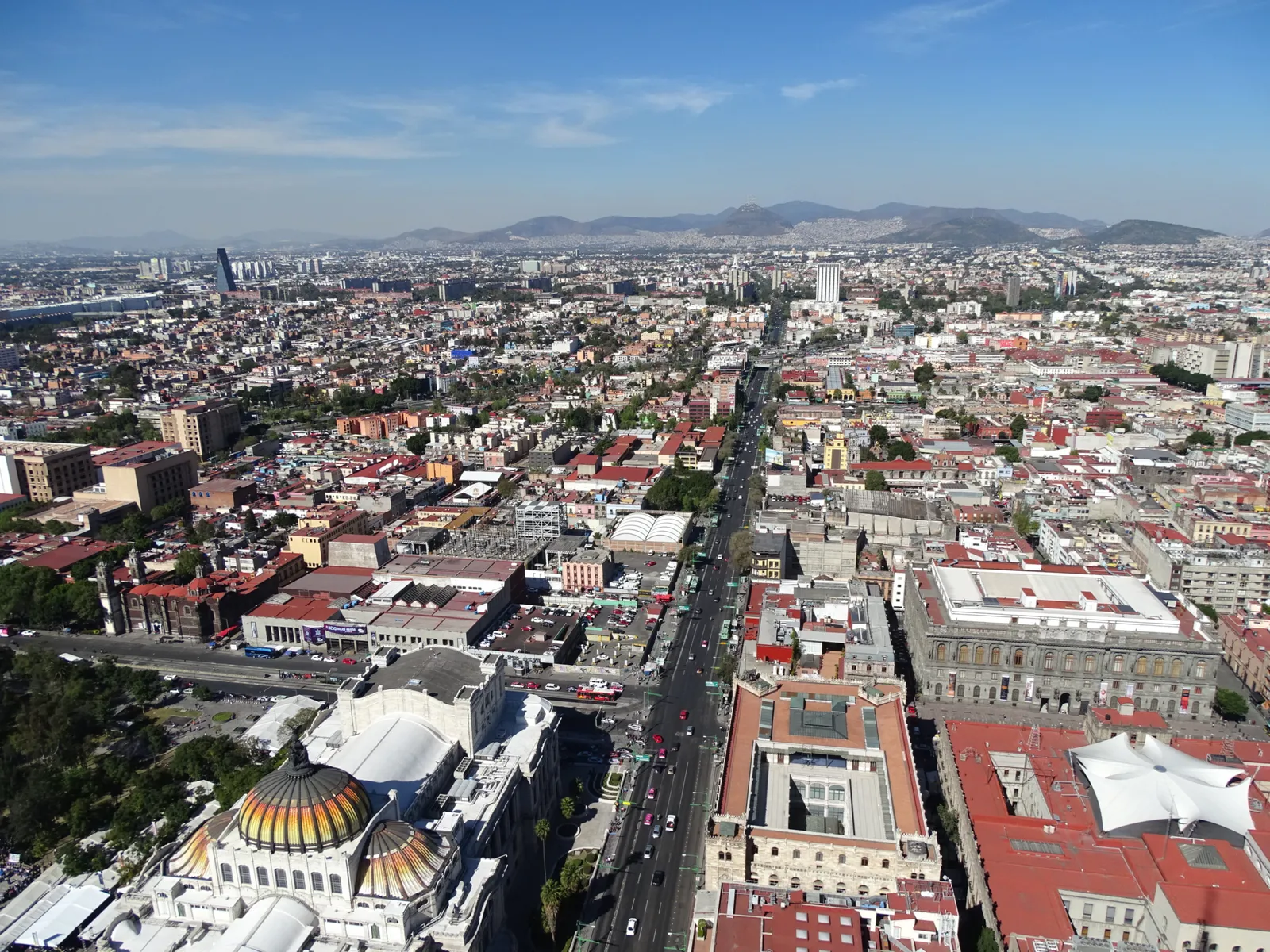
The 44th-floor deck on Torre Latinoamericana
Torre Latinoamericana went up on Avenida Madero in 1956, 166 metres of steel frame standing on piles driven deep into what used to be a lake bed, and it came through the magnitude 7.9 earthquake of 1957 and the 8.1 of 1985 while buildings around it did not. The engineers who designed it ran soil mechanics studies first, which was not standard practice at the time and is the reason the tower is still there.
The top floor is open to anyone who buys a ticket. From 44 storeys up you get the flat grid of the old city running out in every direction, the coloured dome of the concert hall almost directly below, and on a clear day the two snow-capped volcanoes on the eastern horizon. Adult admission is 220 pesos, and published hours vary between about 9am and 10pm depending on the source, so check the day you go; either way it stays open well after the museums below it have shut, which makes it the one stop here that still works late in the afternoon. You can buy the ticket before you set off and skip the queue at the lift.
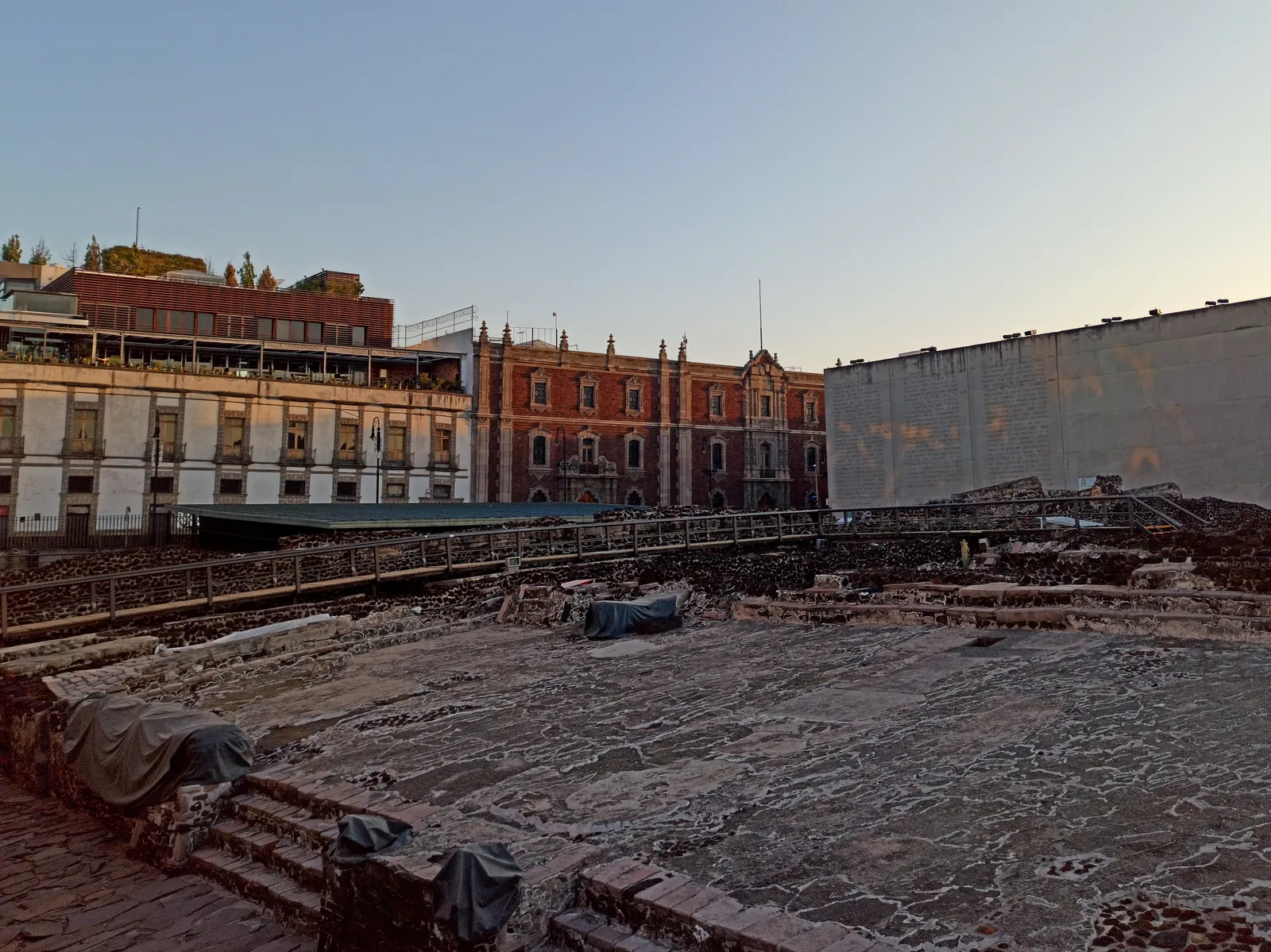
Templo Mayor, the Aztec temple under a city block
Electricity workers digging between Seminario and Justo Sierra streets in February 1978 struck a carved stone disc more than three metres across, two metres down. It showed Coyolxauhqui, the moon goddess, dismembered, and it turned out to be lying at the foot of the main temple of Tenochtitlan. The dig that followed cleared a whole block.
What is open now is the excavation itself, sunk below the level of the modern street, with the successive rebuildings of the pyramid nested inside one another like boxes and stone serpent heads still on the platform edges. A raised walkway runs through it. The museum alongside holds eight halls of what came out of the ground, the Coyolxauhqui stone included. It opens Tuesday to Sunday, 9am to 5pm, and is shut on Mondays; admission is 210 pesos for foreign visitors and 105 pesos for Mexican nationals and residents, and tickets are sold in advance if you would rather not queue in the sun on Seminario.
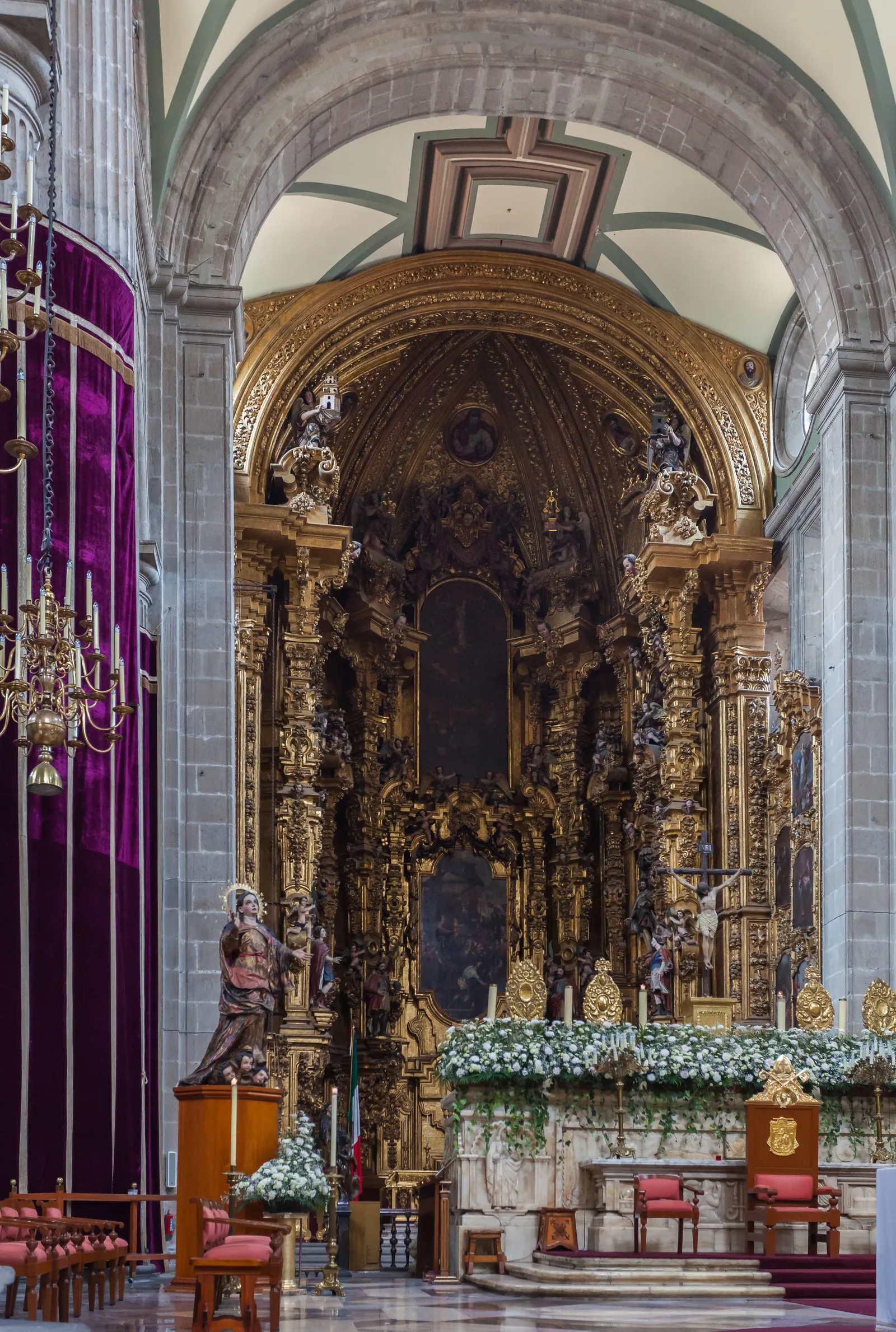
The gilded altarpiece inside the Metropolitan Cathedral
The Metropolitan Cathedral fills the north side of the Zócalo, and it took 240 years to finish, from 1573 to 1813, which is why the front carries three different centuries of taste at once. Restoration work through the 1990s stabilised the foundations, and the building came off the endangered list in 2000.
Walk to the far end of the nave for the Altar de los Reyes, the Altar of the Kings. Jerónimo de Balbás carved it in cedar between 1718 and 1725 and Francisco Martínez finished the gilding in 1737: 25 metres tall and nearly 14 wide, with six canonised queens along the bottom and six kings above them, the whole thing gold from floor to arch. Entry costs nothing and the doors are open through the day into the evening.
Out on the square itself, soldiers raise the national flag at eight in the morning and bring it down again at sunset, nearer six for most of the year. The flag is close to fifteen metres by twenty-five and weighs enough that it takes a couple of dozen of them to walk it in and fold it, which is the actual reason people stand around the flagpole at the end of the afternoon.
Crossing the Centro on the metro costs 5 pesos a ride, but the city’s mobility regulations keep anything over 80 by 50 by 30 centimetres, or 25 kilos, off the trains, which rules out most checked suitcases before you reach the platform.
Bellas Artes, the marble concert hall that sank four metres
Adamo Boari drew the Palacio de Bellas Artes for Porfirio Díaz in 1904 and specified Carrara marble throughout, on ground that was lake mud a few centuries earlier. The weight started pressing the building down almost at once; it has settled about four metres since work began. The Revolution stopped construction altogether by 1913, and the doors did not open until 1934, thirty years late and with an art deco interior fitted inside a beaux-arts shell that had been designed for a different era.
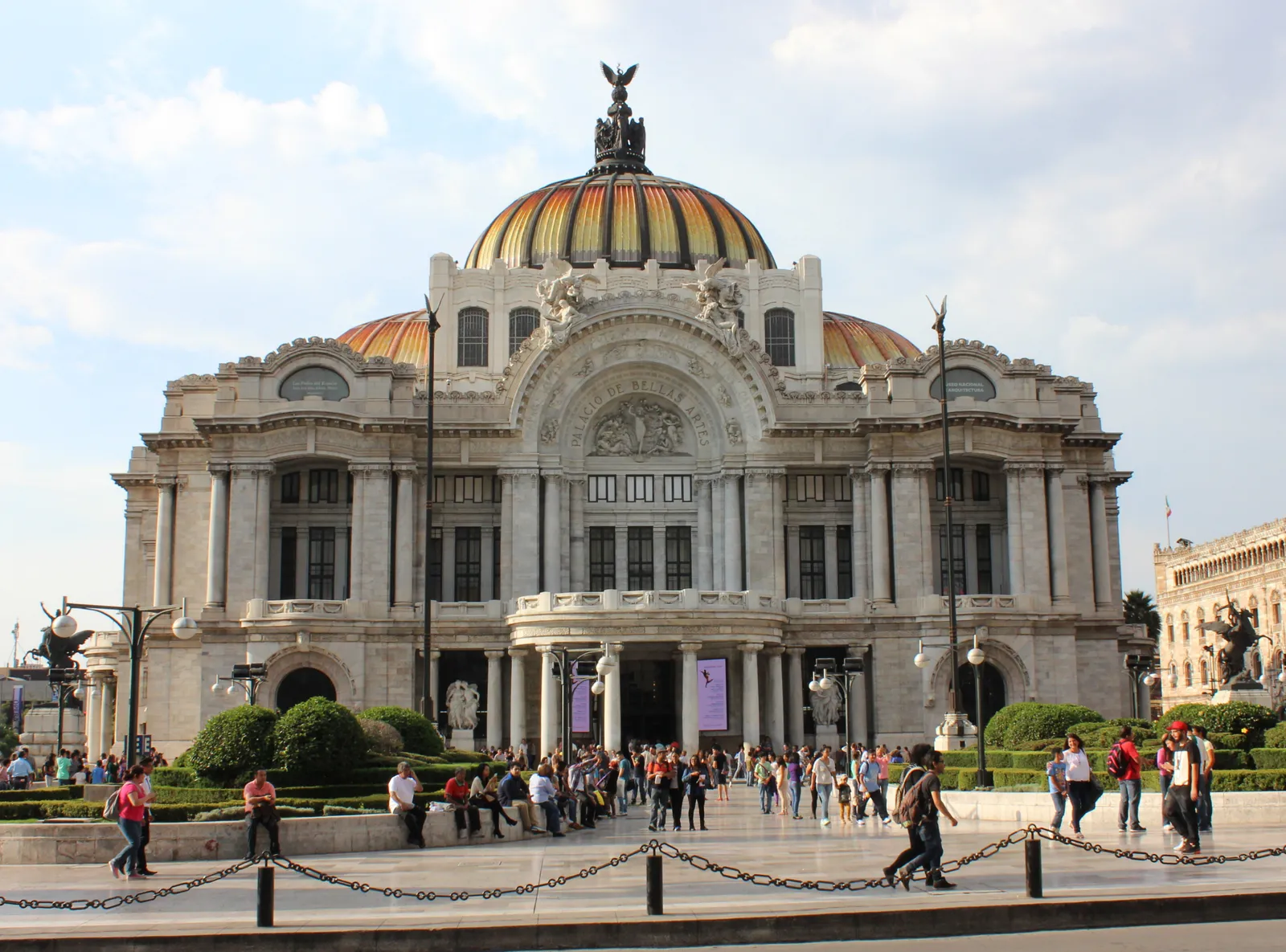
The lobby is free and worth the five minutes on its own, all coloured marble and geometric ironwork. Behind the proscenium hangs a stage curtain made of nearly a million pieces of iridescent glass by Tiffany of New York, 24 tonnes of it, worked into a picture of the two volcanoes east of the city. Upstairs, the murals by Rivera, Orozco and Siqueiros are in the ticketed museum, open Tuesday to Sunday 10am to 6pm and closed Mondays, and a guided tour of the building covers the parts a walk-in visit does not reach.
Palacio Postal is still a working post office
The main post office at Tacuba and Eje Central opened in 1907, the second building Adamo Boari designed in the Centro, and it has been in continuous use ever since. The hall inside is marble floors under a coffered ceiling, with counters and window frames of bronze and iron cast in Florence and a double staircase splitting at the landing. People queue at those windows to buy stamps, which is the part that makes it worth stepping into rather than photographing from the pavement.
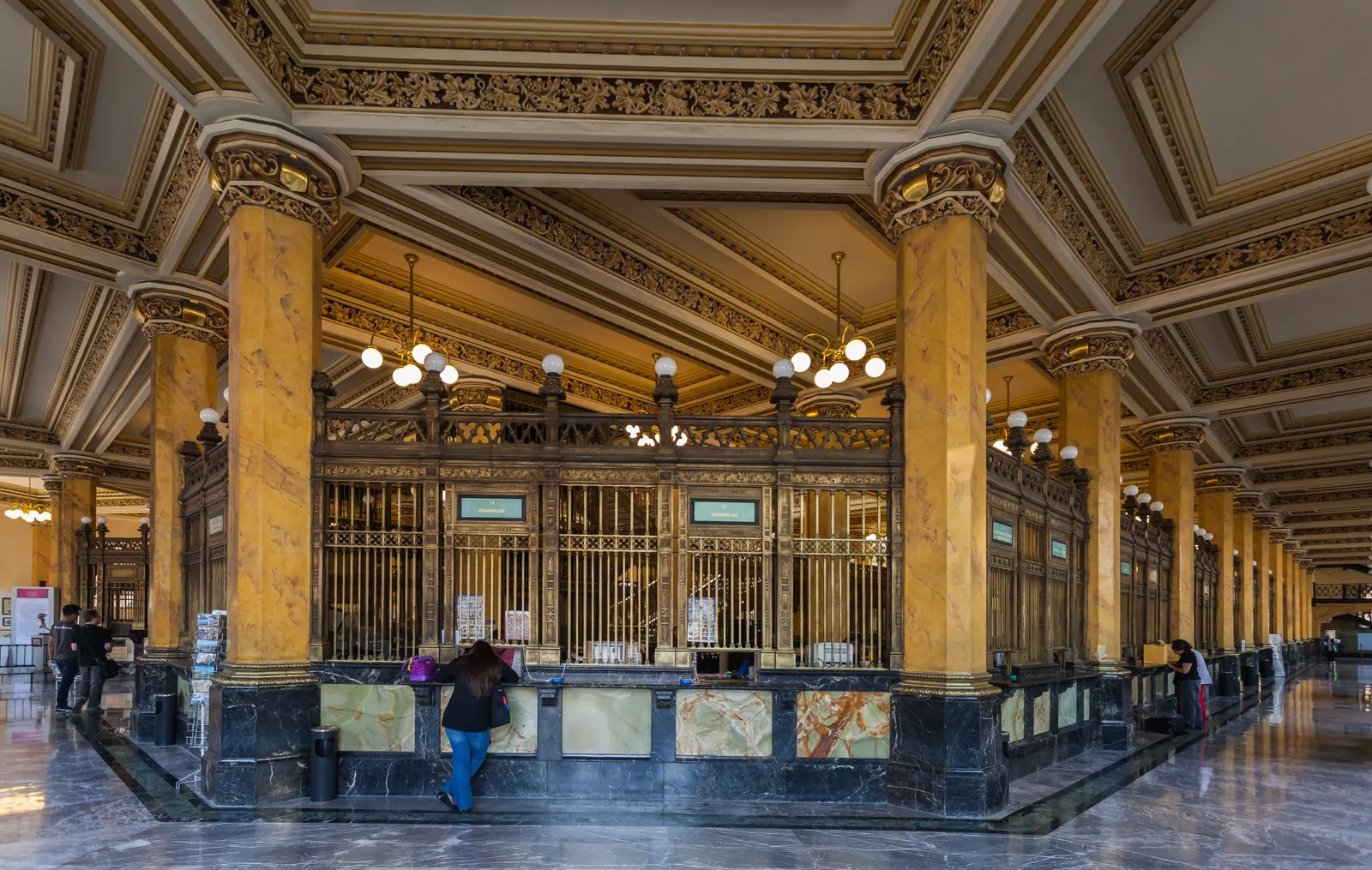
There is no charge and nobody to ask, but the hours are office hours: 8am to 4pm Monday to Friday and 8am to noon on Saturday. If your free afternoon starts late, this is the stop that will already be shut, and the one to move to the front of the list if it starts early.
The stone umbrella in the Anthropology Museum’s courtyard
The Museo Nacional de Antropología sits inside Chapultepec park, about half an hour west of the Zócalo by train, which makes it the addition worth having if you have six hours or more rather than four. The first thing past the entrance is a single carved concrete column holding up a canopy over most of the courtyard, with water sheeting off its rim onto the paving all day. It has been doing that since the museum opened in 1964.
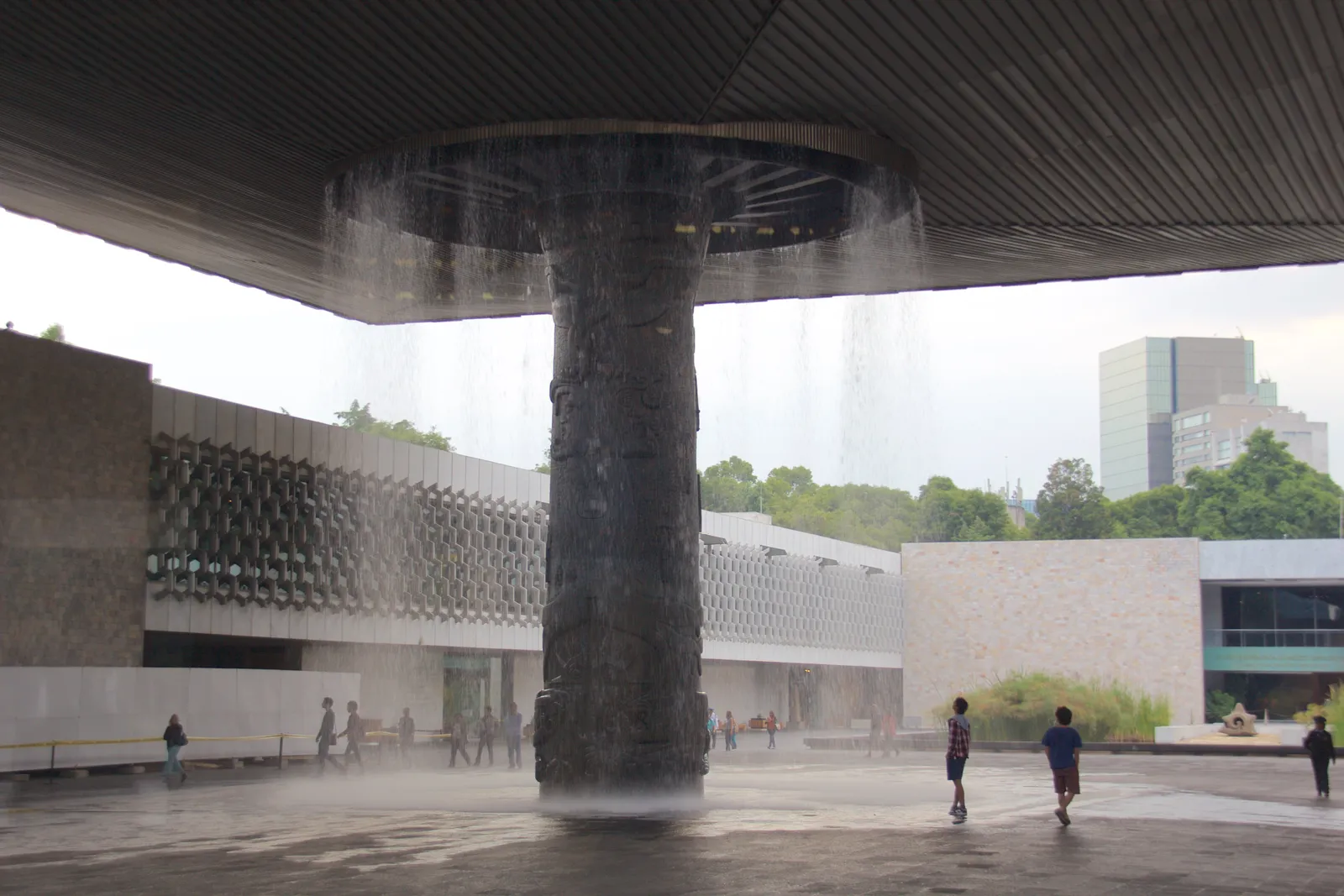
Inside, the Mexica hall holds the Sun Stone, a carved basalt disc more than three metres across that most people have seen a picture of without knowing where it lives. Admission is 210 pesos for foreign visitors and 105 for Mexican nationals and residents, Tuesday to Sunday, 9am to 6pm, closed Mondays like every other national museum in the city, and skip-the-line entry is worth having on a weekend.
The other direction is quieter and free. The Biblioteca Vasconcelos stands beside Buenavista station on the northern edge of the centre, and its reading hall is a single glass-roofed volume with the book stacks hung off the side walls several storeys up, and a grey whale skeleton by the artist Gabriel Orozco suspended down the middle of it. Entry is free, it opens 8:30am to 7:30pm every day of the week, and almost nobody in it is a tourist.
No cash on the airport bus, cards only
Metrobús Line 4’s Quetzalcóatl route opened on 30 January 2026 and runs 29 kilometres from Amajac on Paseo de la Reforma, through the Centro Histórico, out to Terminal 1 and Terminal 2 of Mexico City International Airport. The fare is a flat 30 pesos and there is no way to pay it with a banknote: you tap a Movilidad Integrada card, a contactless bank card, or a phone or watch at the turnstile. The card costs 15 pesos from a machine in any station plus whatever you load on it, and it works on the metro too.
Buses come every seven to ten minutes, 4:30am to midnight Monday to Saturday and from 5am on Sundays and holidays. From the stops nearest the Zócalo, 20 de Noviembre and Pino Suárez, the ride to Terminal 1 runs roughly 45 minutes to an hour depending on traffic; a press run of the full line from Amajac took 63 minutes, with another ten minutes on to Terminal 2. Those are the bus ride alone, so add the walk to the platform and up to ten minutes waiting, and budget about an hour and a quarter door to door before you start counting check-in and security. The buses stop at gate 7 at Terminal 1 and gate 2 at Terminal 2, and the two terminals are far enough apart that you want to know which one your airline uses before you board.
Everything on this list except Chapultepec is within a few blocks of those two Centro stops, which is the argument for leaving the suitcase near the Zócalo rather than towing it across the excavation walkways: pick it up on the way past and you are already at the turnstile.
Frequently asked questions
What should I do during a layover in Mexico City?
Stay in the Centro Histórico, where the Zócalo, the Metropolitan Cathedral, the Templo Mayor excavation, the Palacio de Bellas Artes and the 1907 post office hall all sit within about a dozen flat blocks of each other. The cathedral, the post office and the concert hall's lobby cost nothing; the Templo Mayor museum and the 44th-floor deck on Torre Latinoamericana are the two stops worth paying for, and both are easier with a ticket bought in advance. With six hours or more, the Museo Nacional de Antropología out in Chapultepec is about half an hour west by train. Everything except Chapultepec is close enough together that you can drop any of it without breaking the rest.
Why do Mexico City's museums cost more than my guidebook says?
Admission at national museums and archaeological sites went up on 1 January 2026 under a change to the federal fees law, and it now charges foreign visitors roughly double what Mexican nationals and foreign residents pay. The Templo Mayor museum and the Museo Nacional de Antropología are both 210 pesos for foreign visitors and 105 pesos for nationals and residents with documents. Sunday free admission still applies, but only to Mexicans and documented residents, so it does not help a traveller passing through. The cathedral, the Palacio Postal and the Bellas Artes lobby are unaffected because they never charged.
Can I get in to see the Diego Rivera murals at Palacio Nacional?
Not by turning up and walking in. The building on the east side of the Zócalo is free and open Tuesday to Sunday, 9am to 5pm, but visits run as guided tours at fixed times through the day, and you are expected to have booked ahead by email to visitas_guiadas@hacienda.gob.mx or in person at the finance ministry museum's entrance. You need a government photo ID or passport at the security check, and bags go through a screening, so it is a poor fit for anyone still carrying luggage. If the murals are the reason you are here, the ones at the Palacio de Bellas Artes are on public display in the museum upstairs for the price of a ticket.
Does Mexico City's altitude matter on a short stop?
The city sits at 2,240 metres, high enough that the air holds noticeably less oxygen than at sea level, and a first day here often comes with a mild headache, breathlessness on stairs, or tiredness that feels out of proportion to the walking. A layover is close to the mildest version of this, since the effect builds over a day or two and you leave before it does. The practical answer is to drink more water than you think you need, skip the beer until you land somewhere lower, and take the stairs at the Templo Mayor and the tower more slowly than you would at home.
Do I need cash to get back to the airport?
No, and cash will not work. The airport bus, the Quetzalcóatl route on Metrobús Line 4, charges a flat 30 pesos and takes only a Movilidad Integrada card, a contactless bank card, or a phone or watch at the turnstile. The card itself costs 15 pesos from a machine in any station, plus whatever you load onto it, and the same card works on the metro at 5 pesos a ride. Buses run every seven to ten minutes, 4:30am to midnight Monday to Saturday and from 5am on Sundays and holidays, and stop at gate 7 at Terminal 1 and gate 2 at Terminal 2.