Layover at Mexico City's Basilica of Guadalupe
Part of the full Mexico City Layover: The Zócalo From MEX
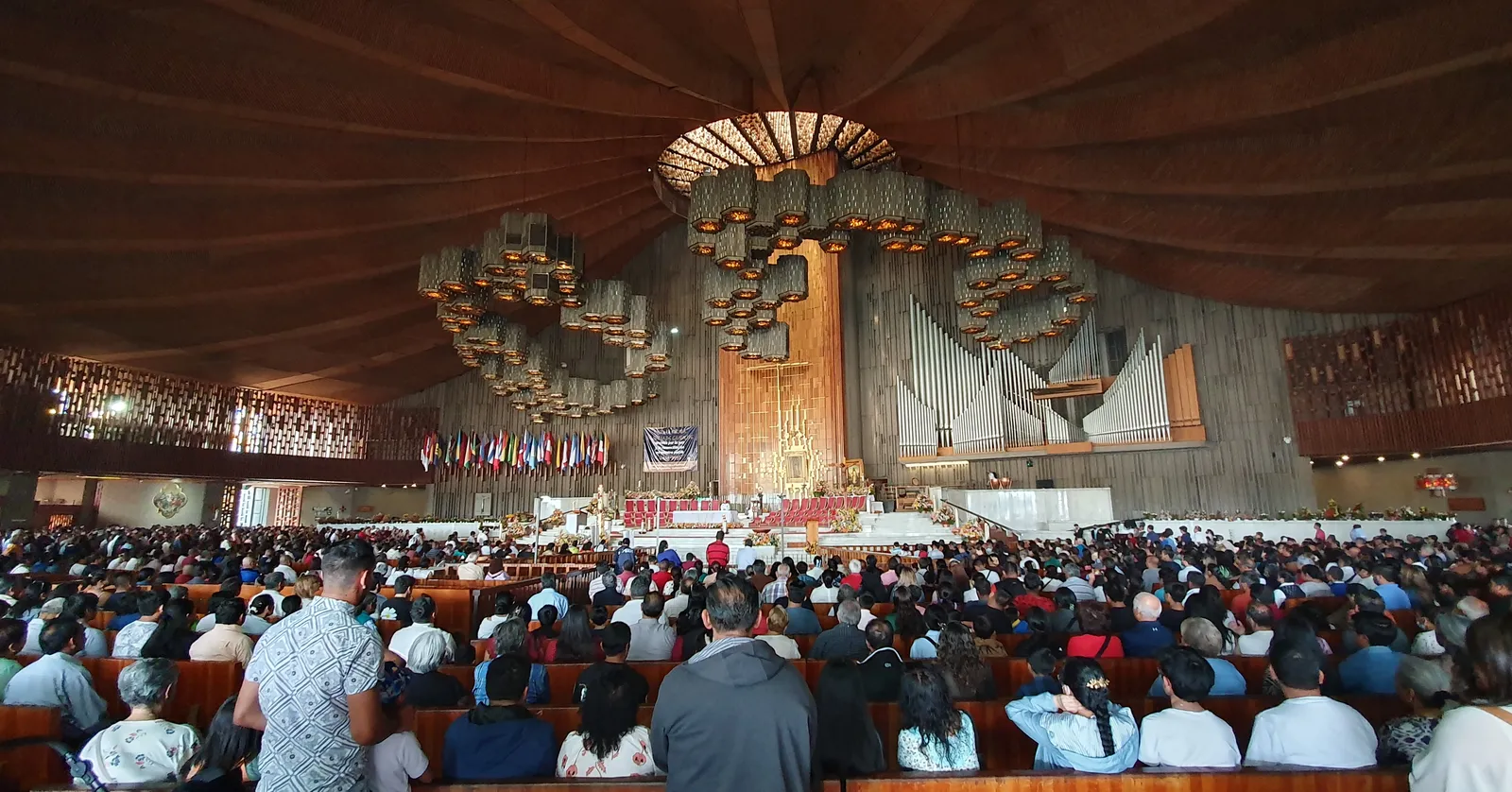
The Guadalupe shrine, in the north of Mexico City at the foot of Tepeyac hill, is a walled precinct holding two basilicas and a hill chapel, and the moving walkway under the image in the modern one is the only way anybody sees it up close.
The moving walkway under the image of Guadalupe
The round basilica went up between 1974 and 1976 to a design led by Pedro Ramírez Vázquez, who had built the Anthropology Museum a decade earlier, and its shape does one job: seat around ten thousand people so that every one of them can see the framed cloth above the altar. The ceiling is lined in timber and slopes down to the walls like a tent, which is what the form is meant to suggest.
Underneath the altar runs a conveyor. Rather than let a line build up in front of the image, the basilica moves people past it at a fixed pace, a few seconds each, and anyone who wants longer walks back around and rides it again. It is a piece of throughput engineering fitted under an altar, and nothing on the site charges admission. A day tour pairing the shrine with Teotihuacán is the usual way people combine it with the pyramids, since both sit on the same side of the city.
The old basilica beside it has been settling since 1709
Work began on the earlier church in March 1695 and finished in 1709, and it has been going down into the drained lake bed ever since. The subsidence is the reason the modern basilica exists at all: by the 1970s the old building was judged unsafe for the numbers coming through it, and the image was moved next door. It is open again now as the Templo Expiatorio a Cristo Rey, its baroque front in dark red volcanic stone with pale carved trim, twin towers and a yellow tiled dome.
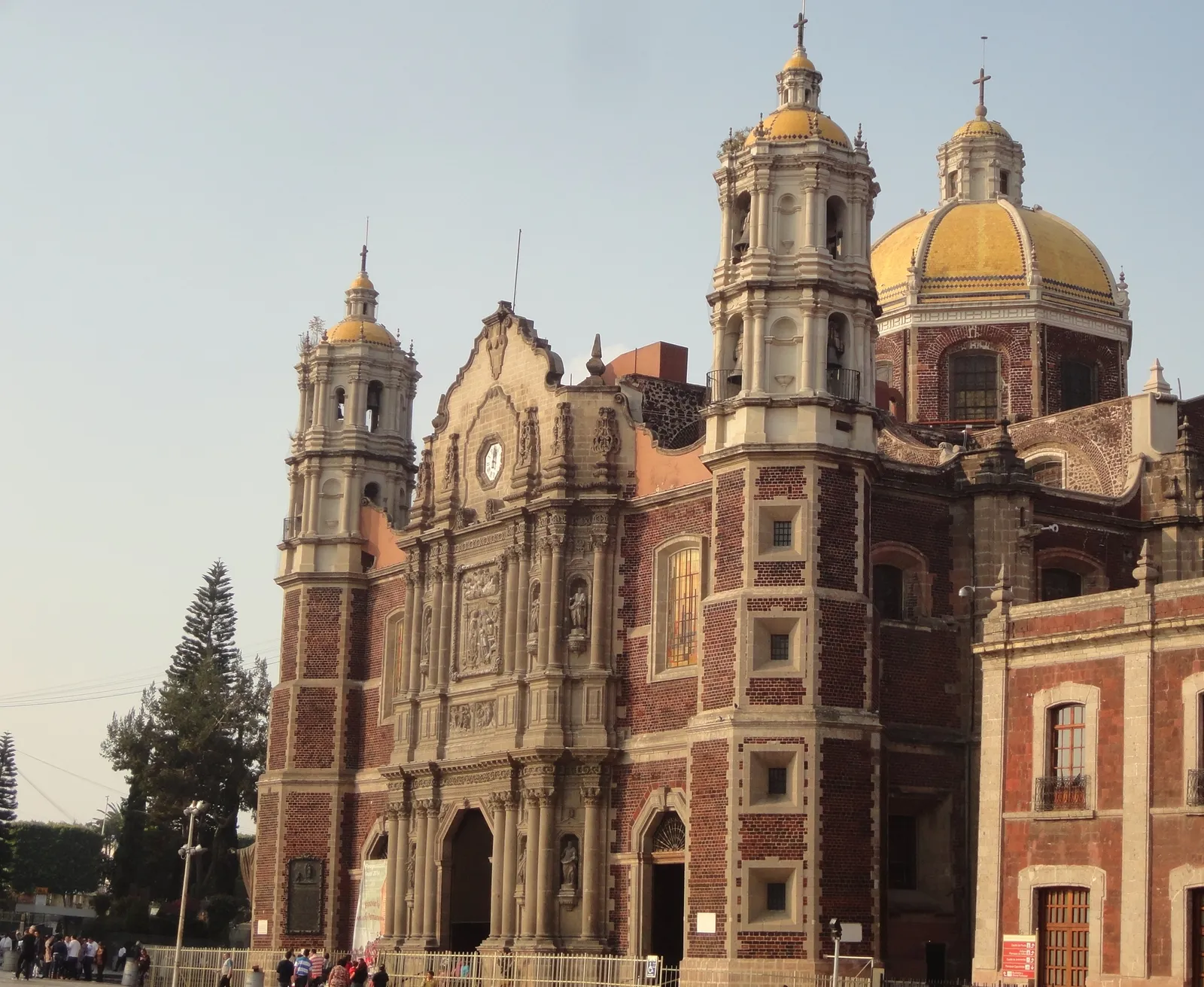
The atrium between the two buildings is the pressure point. About twenty million people come through this precinct in a year and roughly nine million of them in the days around 12 December, and on any Sunday the open ground fills with groups arriving together and stopping where they stand. A suitcase does not cross that at walking pace.
The chapel at the top of Tepeyac hill
Behind the atrium, a stone stair climbs the hill in flights broken by terraced gardens and fountains, and at the top sits the Capilla del Cerrito, a small dark-stone chapel marking the place where the apparitions are said to have happened. It takes ten or fifteen minutes at an unhurried pace, and it is the only part of the site with any gradient at all.
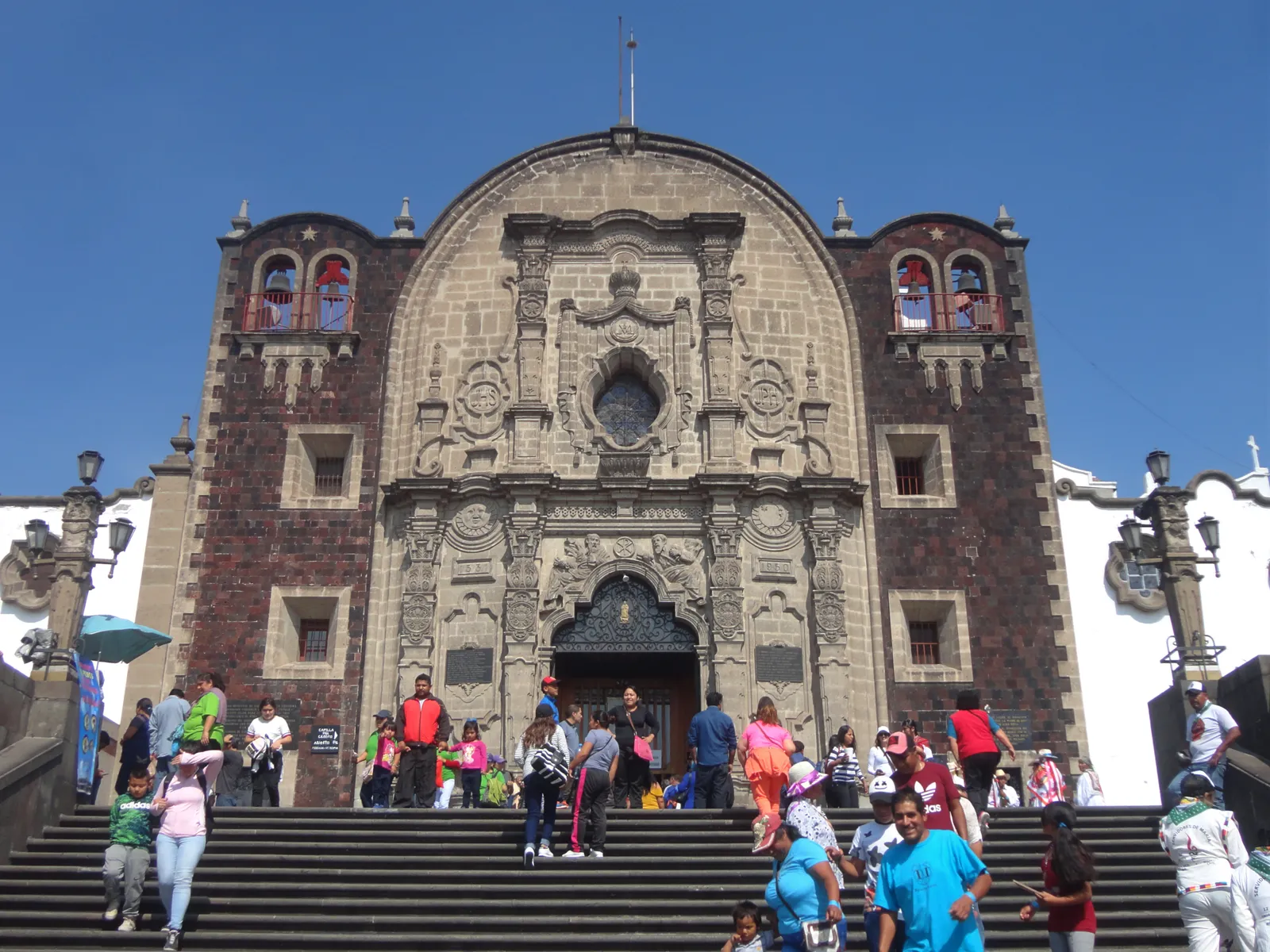
The view from the terrace outside it is the reason to climb: the two basilicas, the atrium and the whole northern spread of the city behind them. The Capilla del Pocito, an eighteenth-century chapel with tiled domes, sits at the bottom of the same slope on the way back down.
No airport bus comes this far north
The Quetzalcóatl route out to Mexico City International Airport runs across the southern side of the historic centre, several kilometres below this precinct, so there is no single ride from here to the terminals. What works is the metro south into the centre and then the airport service, a flat 30 pesos taken by contactless bank card, phone or Movilidad Integrada card at the turnstile, with the ride to Terminal 1 running 45 minutes to an hour on top of the metro leg. An hour and a half to two hours, atrium to gate, is a fair budget.
That makes this a three-to-four hour trip in total rather than a quick detour, and it is worth knowing that the shrine’s own draw is devotional rather than architectural: people come to see the cloth, not the buildings. If that is not what your free hours are for, the route through the Centro Histórico is closer to the airport bus and covers the cathedral, the Templo Mayor excavation and the Bellas Artes lobby instead.
Frequently asked questions
What should I do during a layover at the Basilica of Our Lady of Guadalupe in Mexico City?
The whole site is one walled precinct and none of it charges admission. Start in the round modern basilica, where a moving walkway runs under the framed image so that nobody stops in front of it, then cross the atrium to the old basilica of 1709, which has visibly settled into the ground it stands on. The steps up Tepeyac hill behind them lead to the Capilla del Cerrito and a view back over the whole complex. Two hours covers all three at a walk, and getting here and back adds another hour and a half.
When is the shrine busiest?
Around 12 December, when roughly nine million people come in the days either side of the feast, many of them walking the last stretch. It is also heavy every Sunday and through the week before Christmas. Across a normal year the site takes about twenty million visitors, so there is no genuinely quiet day, but a weekday morning outside December is as close as it gets. Nothing closes for the crowds; it simply takes longer to move.
How do I get to the airport from the basilica?
Not directly, because the airport bus route runs across the south of the centre and this is well north of it. The workable version is the metro south into the historic centre and then the Quetzalcóatl service on Metrobús Line 4 out to Mexico City International Airport, a flat 30 pesos paid with a contactless card or a Movilidad Integrada card, with the ride to Terminal 1 taking 45 minutes to an hour. Allow an hour and a half to two hours from the atrium to the terminal.
Is the site walkable if stairs are a problem?
The atrium, both basilicas and the moving walkway are all step-free, and the modern basilica was built with level access throughout. Tepeyac hill is the exception: the chapel at the top is reached by a long flight of stone steps with landings, and there is no lift. The garden terraces on the way up are a reasonable turning point if the full climb is too much, and they still give you the view across the atrium.