Apartheid Museum, Johannesburg: a JNB Layover
Johannesburg’s two apartheid-era museums stand about ten kilometres apart, the Apartheid Museum out in Ormonde and the Old Fort prison on Constitution Hill in Braamfontein, and each is a ticketed visit of an hour or two rather than a whole day.
The Apartheid Museum prints a race on your ticket
The Apartheid Museum sits in Ormonde, roughly ten kilometres south of the city centre, on the edge of the old mining belt. Buy a ticket and the machine marks it white or non-white at random, with no relation to whoever is holding it, and that slip decides which of two caged gates you walk through. Behind the bars on either side hang enlarged copies of the identity documents that once governed where a South African could live, work and travel. The point lands in the first minute, before a single wall of text has been read.
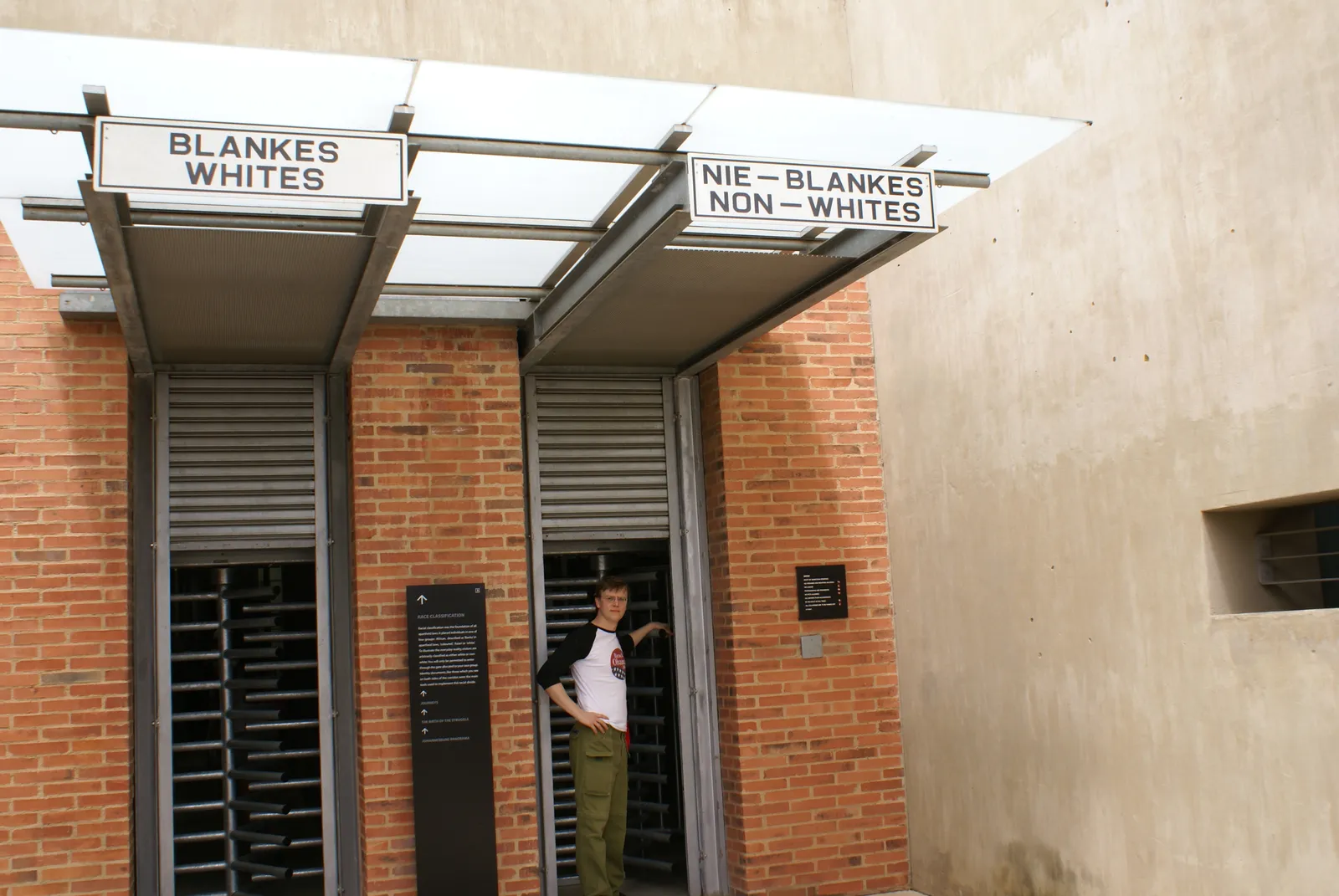
Past the gates the two paths rejoin and the permanent exhibition runs chronologically through segregation, resistance and the 1994 election. The museum opens Tuesday to Sunday, 09:00 to 17:00, and is shut on Mondays, so a Monday layover misses it entirely. An international adult pays R240 and a student, pensioner or child R190; South Africans with an ID pay R170 and R120. The museum asks visitors to allow two hours, and two hours is the floor rather than a suggestion. There is no train to Ormonde, so this is a car trip either way; if you would rather not improvise the logistics on a flight day, a private half-day tour pairs it with Soweto and handles the driving.
The Old Fort prison on Constitution Hill
Constitution Hill occupies a ridge in Braamfontein, a little under a kilometre north of Park Station, the city’s main railway terminus. The fort’s earth ramparts went up between 1896 and 1899 around a jail that was already there, and for most of the next century this was where Johannesburg locked people up. Gandhi was held here in 1908, Mandela in 1962. The complex splits into three: the Old Fort itself, the men’s section universally known as Number Four, and a separate Women’s Jail.
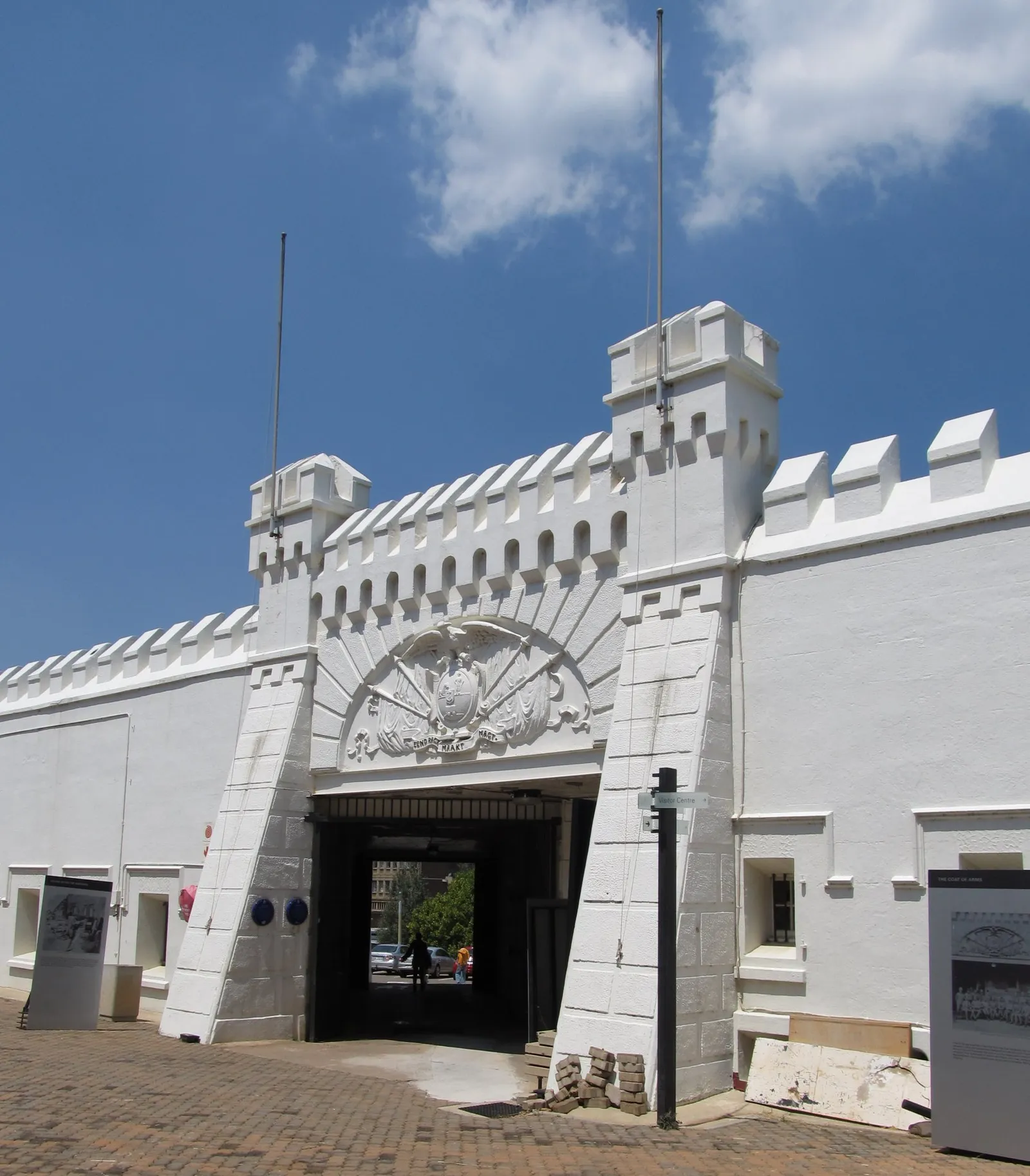
What makes the site worth the ticket is what was built next to the cells rather than the cells alone. South Africa’s Constitutional Court opened here in 2004, and its chamber was raised from the bricks of the Awaiting Trial Block, which was demolished to make room for it. Entry to the court building costs nothing at all: its atrium carries a collection of more than two hundred contemporary works assembled by Justice Albie Sachs, with Gerard Sekoto, William Kentridge and Cecil Skotnes among the names, and hearings are open to anyone who walks in. That is the stop to make if the clock is against you.
The prisons themselves need a guided ticket. The site opens daily from 08:45 to 17:00 with no tickets sold after 16:00; the hour-long Highlights Tour leaves every hour from 9am to 4pm at R150 for an adult and R90 for a child, student or pensioner, and the two-hour Full Tour runs at 10am and 1pm for R200 and R110. One quirk is worth timing your arrival around: the Highlights Tour alternates hour by hour, taking in the Women’s Jail, Number Four and the Constitutional Court on one run and the Old Fort, Number Four and the Constitutional Court on the next. Which hour you turn up decides which of the two you see.
None of these stops is walking distance from the next, so the day runs as a string of car and train hops with a suitcase coming out of a boot at every one.
Mandela House on Vilakazi Street in Soweto
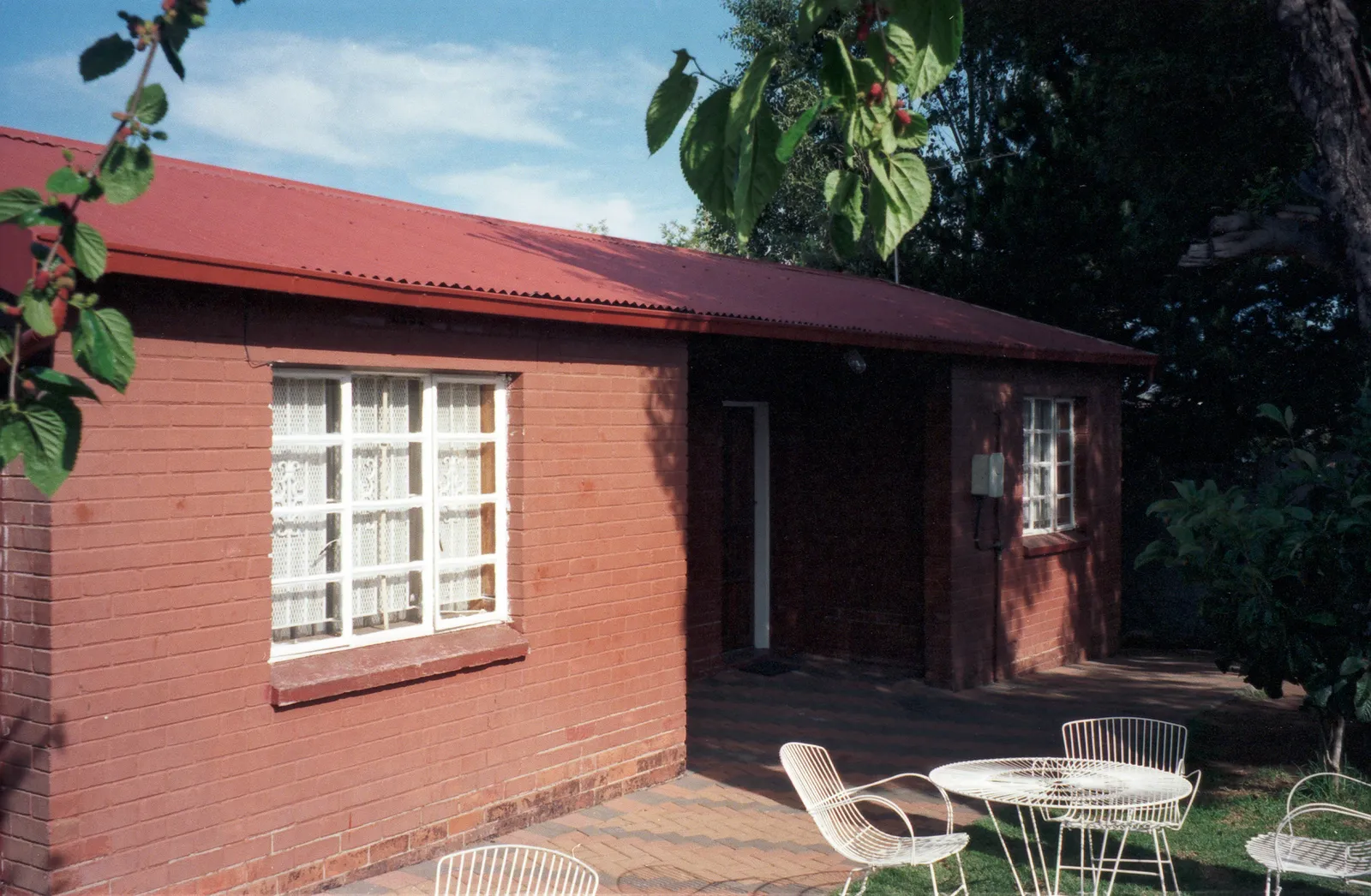
Vilakazi Street runs through Orlando West, in Soweto, about twenty kilometres southwest of the centre and a good half hour on the road each way. Number 8115 is a four-room red-brick house with a corrugated iron roof that Nelson Mandela moved into in 1946 and left in 1962, and it is small enough that the scale of it is the point: this is the house, not a wing of one. Desmond Tutu’s house stands a few hundred metres along the same street.
Soweto is not something to squeeze in around the edges. Between the drive, the house and the Hector Pieterson memorial a few streets away, it wants a clear half day on top of the two museums, which in practice means a stopover of nine hours or more rather than six. Going under your own steam also means arranging a driver who will wait; a four-hour guided bicycle tour covers the same ground on two wheels with lunch built in, which is a cleaner answer to the transport problem than a taxi meter running outside.
Nelson Mandela Bridge crosses 42 railway lines
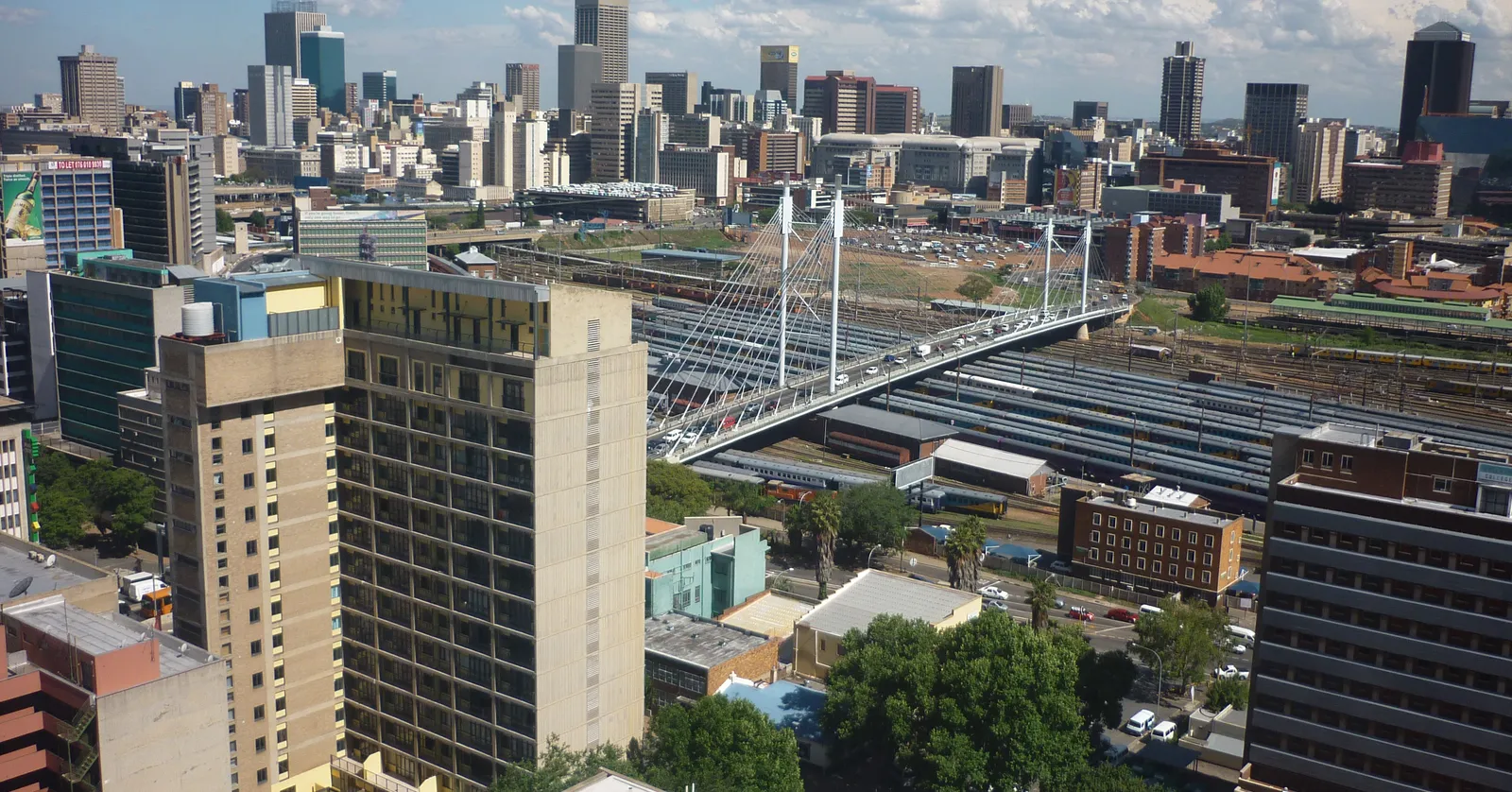
Nelson Mandela Bridge lifts off the northern edge of Park Station and runs 284 metres across the rail yards to join Newtown, on the south side, to Braamfontein on the north. It opened on 20 July 2003, carries two lanes of traffic and has a pedestrian walkway on either side. From halfway across, 42 sets of track fan out below with carriages parked along them, and the towers of the central business district stand behind.
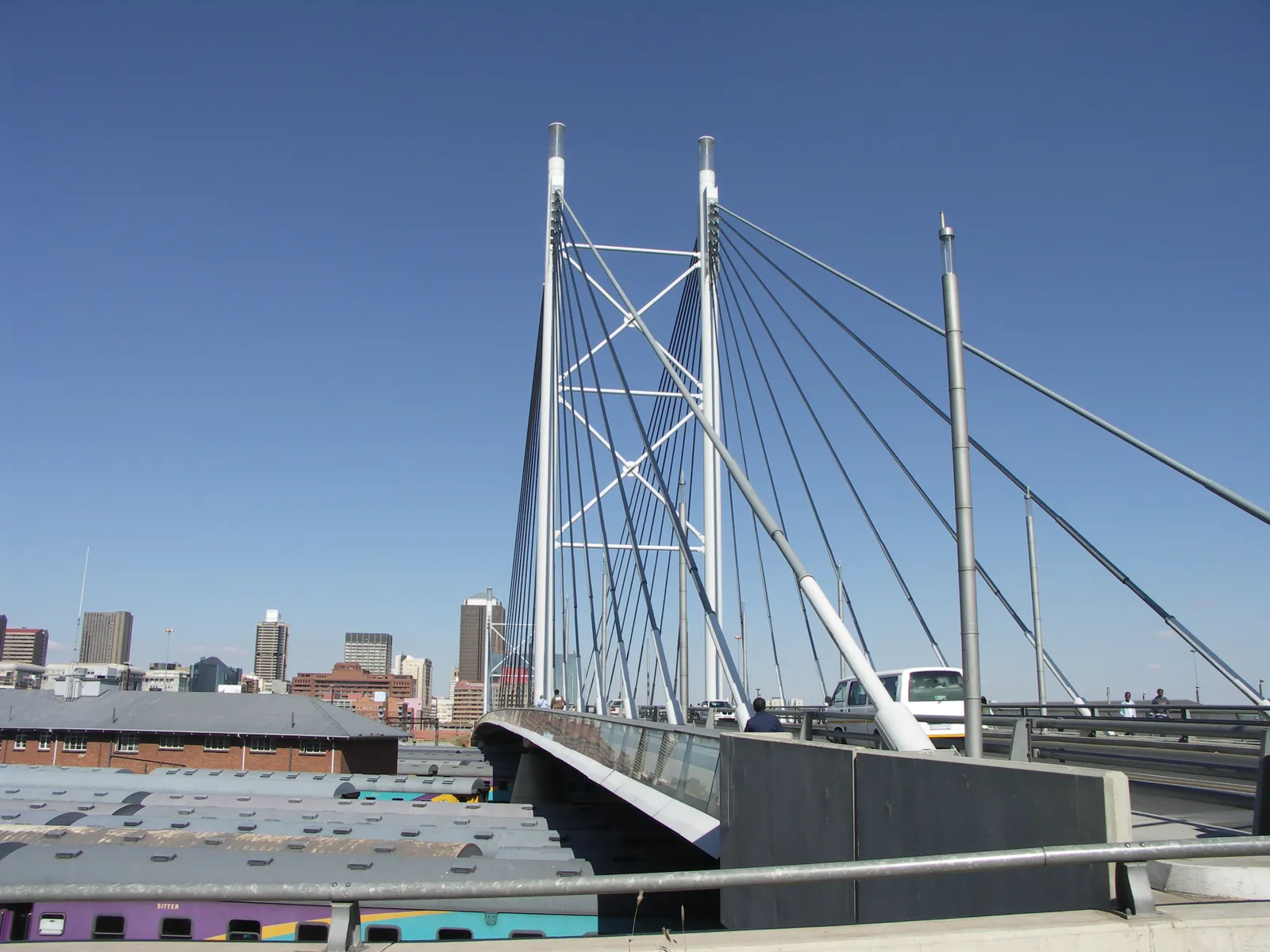
The Braamfontein end is the stretch of central Johannesburg most visitors actually walk. Juta and De Beer streets carry students down from the university a few blocks north, and on a Saturday the Neighbourgoods Market on Juta trades from nine until three: food stalls, coffee and makers’ tables, free to walk into and paid for by the plate. Any other day of the week the same street is quieter, and the bridge itself is the reason to come.
No airport train after about half past eight
O. R. Tambo International Airport (JNB) sits around twenty-five kilometres east of the centre, and the Gautrain’s airport service reaches it from Sandton in about fifteen minutes, running every twelve minutes at peak and every twenty off-peak. That service does not run to Park Station: from the centre you take the north-south line to Sandton and change there, which puts the whole trip at roughly half an hour of riding plus whatever the connection costs you. Trains run daily from about 05:30 to about 20:30. The operator’s own warning is the one to plan around, though: the last train out of the airport has no connection to the northern and southern stations, and the last trains on those lines have no connection to the airport, so an evening run can leave you on a train that does not finish the job.
Fares to and from the airport sit well above a normal hop on the network, roughly R220 to R230 one way between O. R. Tambo and Sandton, and you need either a Gautrain card with at least R38 loaded on it or a contactless bank card to get through the gates at all. When the trains stop, ride-hailing takes over and covers the same run in 30 to 45 minutes outside the afternoon peak, considerably more inside it. Leave the centre at least two and a half hours before boarding either way. Only Cairo handles more passengers a year than O. R. Tambo does, and the queues at check-in and passport control reflect that.
All of which is easier without a suitcase. Three of these four stops are reached by car, the fourth is a walk across a bridge, and the drop-off points here are at Park Station itself, which is where the train from Sandton puts you down in the first place.
Frequently asked questions
What should I do during a layover in Johannesburg?
Two museums carry the day. The Apartheid Museum, in Ormonde south of the centre, prints white or non-white on every ticket at random and sends each visitor through the matching gate before they have read a single caption; the museum asks for two hours and that is about right. Constitution Hill, in Braamfontein, holds the prison where both Gandhi and Mandela were locked up, and the Constitutional Court built on the same ground in 2004 costs nothing to walk into. Six hours between landing and boarding covers both once the drive each way is allowed for. Mandela House in Soweto is the piece to drop if you are tight, because it adds a full half day on its own.
Is it safe to walk around central Johannesburg?
In daylight, Braamfontein is the part of the centre people do walk. The university, Constitution Hill and the northern end of Nelson Mandela Bridge all sit inside it, and the streets around Juta and De Beer carry students and office workers through the working day. The blocks south and east of Park Station are a different proposition and are better crossed by car than on foot, which is what ride-hailing is for here: Uber and Bolt both cover the city and fares are low by European or North American standards. After dark, take a car everywhere, and keep a phone in a pocket rather than in your hand.
What can I see in Johannesburg without buying a ticket?
The Constitutional Court on Constitution Hill charges nothing to enter, and its atrium holds a collection of more than two hundred contemporary works assembled by Justice Albie Sachs, among them pieces by Gerard Sekoto, William Kentridge and Cecil Skotnes. Hearings are open to the public as well. Nelson Mandela Bridge has a pedestrian walkway on each side and costs nothing to cross. On a Saturday, the Neighbourgoods Market on Juta Street in Braamfontein trades from nine until three with no entry charge, though you pay for what you eat.
Does a Johannesburg layover work in the rainy season?
Nearly all of Johannesburg's roughly 713mm of annual rain falls between October and March, and it arrives as a highveld thunderstorm rather than a grey day: a warm clear morning, cloud building through the afternoon, a hard storm around mid-afternoon, then a fresh evening. That pattern is reliable enough to plan around. Put the indoor stops, the Apartheid Museum and the Constitution Hill cells, in the middle of the afternoon, and keep the bridge and the market for the morning. Between May and August it barely rains at all, but the nights turn cold.
Is the train or a car better for getting back to O. R. Tambo?
The train if it is still running, a car if it is not. The Gautrain's airport service covers O. R. Tambo to Sandton in about fifteen minutes, every twelve minutes at peak and every twenty off-peak, and from Park Station you ride the north-south line to Sandton and change there. It runs daily from about 05:30 to about 20:30, and the operator's own warning matters more than the timetable: the last train from the airport does not connect to the northern and southern stations, and the last trains on those lines do not connect to the airport. Expect roughly R220 to R230 one way between the airport and Sandton, and carry either a Gautrain card with at least R38 loaded or a contactless bank card. For a flight that boards late in the evening, plan on a ride-hailing car from the start rather than working out mid-afternoon that the trains have stopped.