Johannesburg Layover Near Maboneng
Part of the full Apartheid Museum, Johannesburg: a JNB Layover
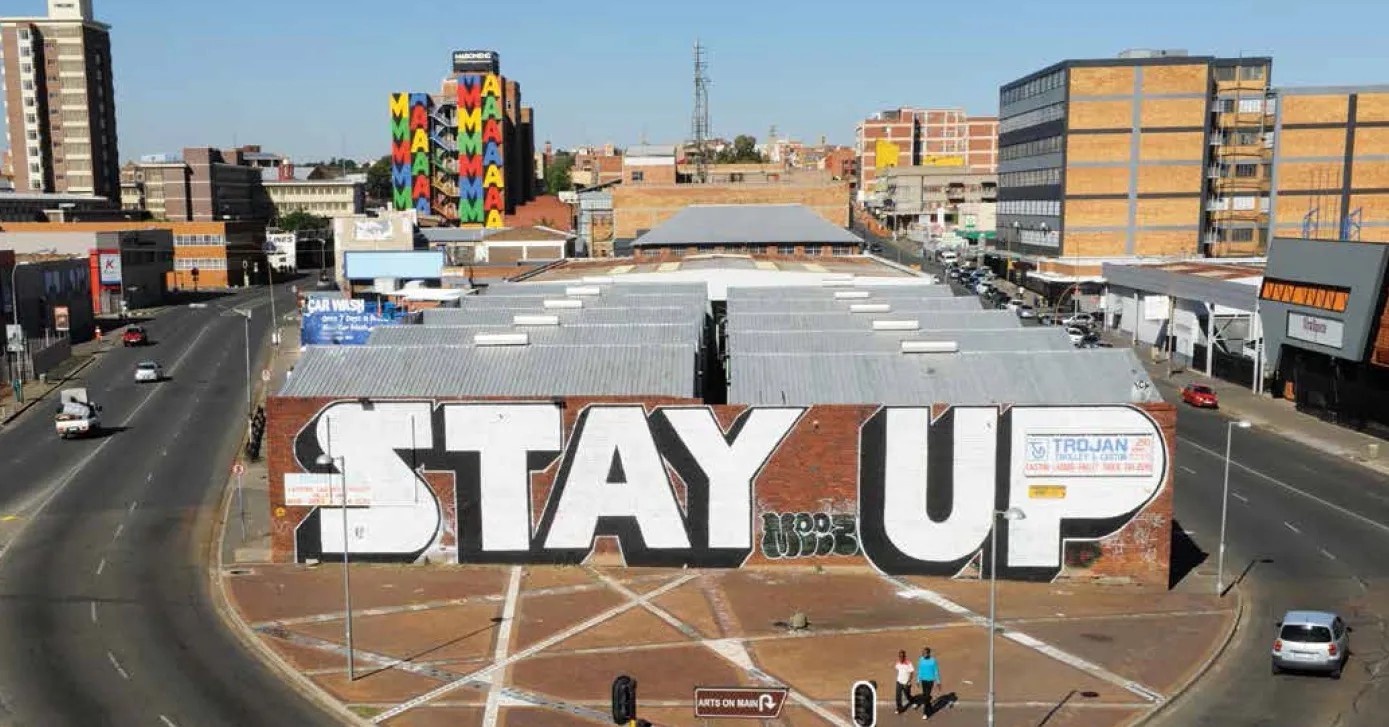
Johannesburg’s Maboneng is a handful of converted warehouse blocks on Fox Street, east of the city centre, where the painted walls cost nothing to walk past on any day and a food and design market takes over the Arts on Main warehouse complex on Sundays only.
Painted walls run the length of Fox Street
Maboneng is Sesotho for place of light, and it is a name from 2009: a property developer called Propertuity bought up a run of old industrial blocks in Jeppestown, on the eastern edge of Johannesburg’s inner city, and renamed the lot. The paint arrived with the conversion and has outlasted most of it. Murals run the full height of a building wall, shopfront shutters are painted rather than bare, and the walls along Fox Street are redone often enough that nobody can tell you in advance what is up there. None of it sits behind a ticket desk or a gate.
The walkable part is narrower than the map suggests. Fox Street is the spine, along with the blocks running off it for a street or two either side, and that is where the foot traffic and the security patrols are. Fox Street also runs further west than it once did: six blocks of it were sealed off for decades as the city’s diamond-trading district, closed to anyone without business inside, and a rebuild between November 2018 and September 2020 reopened the street straight through them on foot. If you would rather have someone else decide which corners are worth turning, a guided street art walk covers the murals and the blocks around them.
Market on Main trades one day a week inside a 1911 warehouse
Arts on Main stands at 264 Fox Street, on the corner of Berea Road, and it is five warehouses knocked into one. The oldest went up in 1911 as a bonded liquor store built for William McBain; the front offices later housed the building firm of D. F. Corlett, who was mayor of Johannesburg in 1931 and 1932. The conversion in 2009 kept the bones of all five: double-volume ceilings, concrete floors and oversized steel-framed windows. Galleries and artists’ studios occupy it the rest of the week, William Kentridge’s among them, though a working studio is not a room you can wander into.
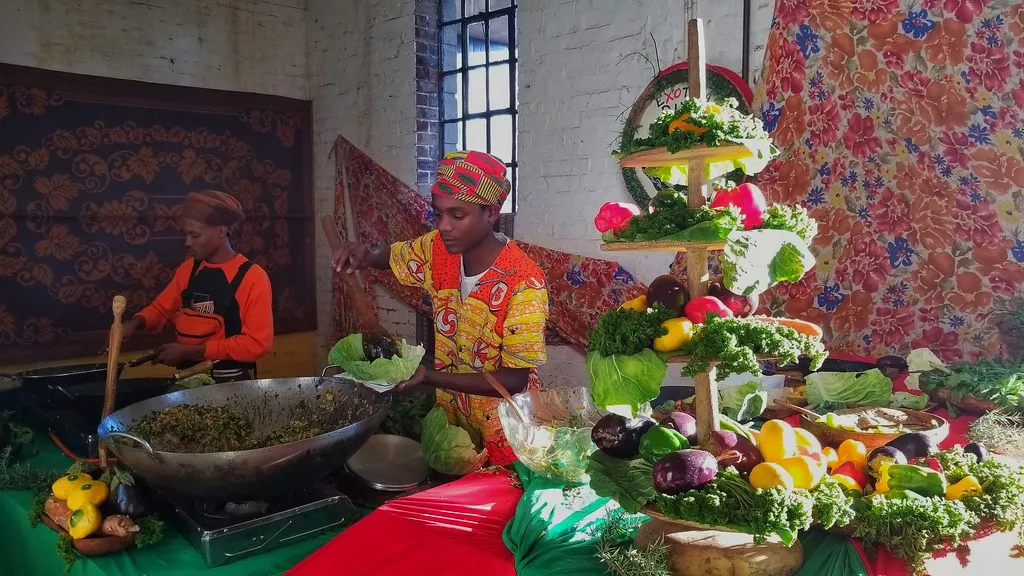
On Sundays the ground floor becomes Market on Main, which has traded there since January 2011: regional food cooked in front of you, produce, coffee and local design, from ten in the morning until three in the afternoon, free to walk into and paid for by the plate. It is the one thing here that fixes a visit to a particular day, and it is worth checking what day you land on before committing to the trip at all, because a Sunday in Maboneng and a Wednesday in Maboneng are two different places.
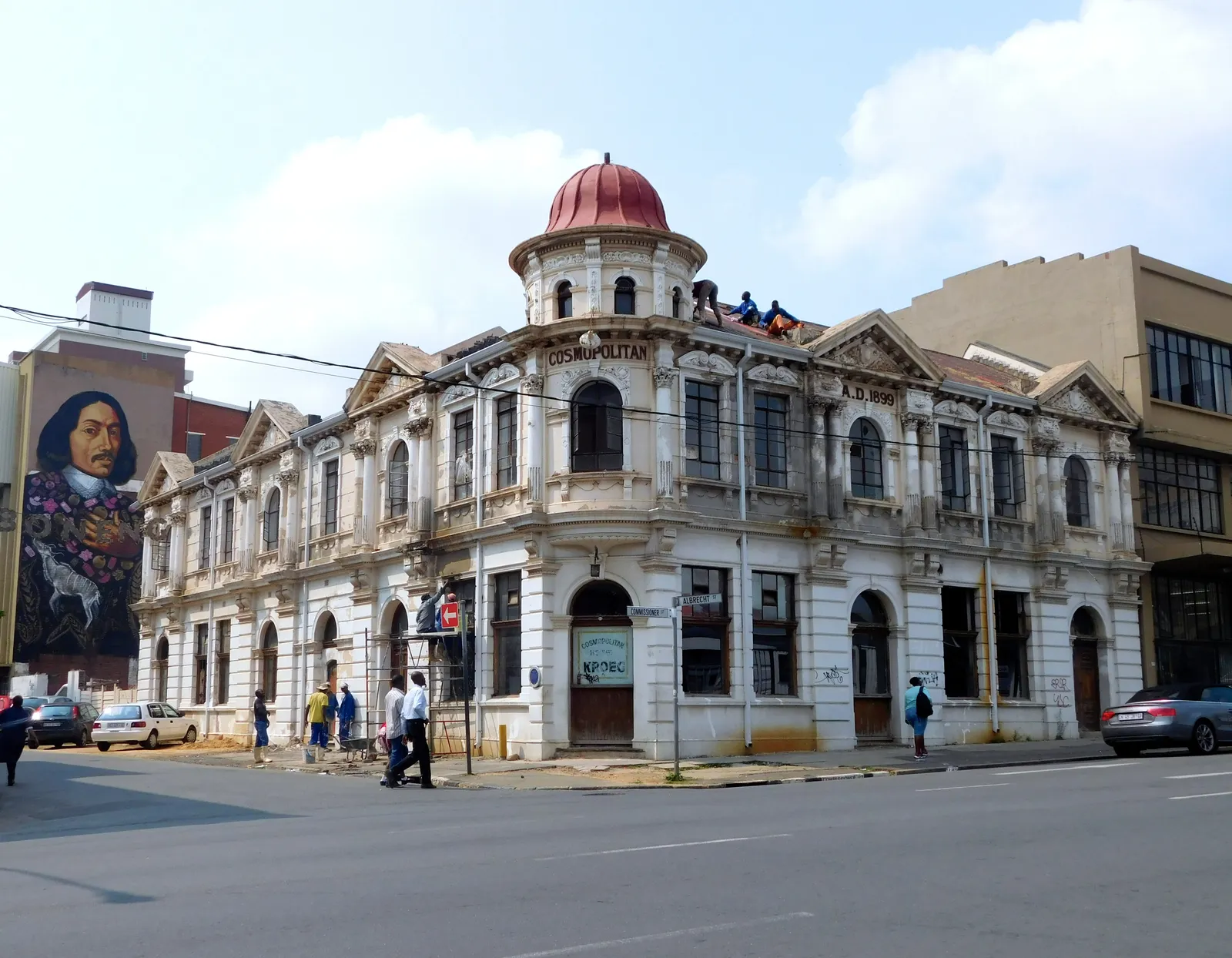
The Cosmopolitan’s red dome on Commissioner Street
At 285 Commissioner Street in Jeppestown, a two-storey corner building carries a domed tower, a row of gables and enough moulded plasterwork to look out of place among the warehouses around it. The brothers Arthur and Walter Reid drew the plans for the Cosmopolitan Hotel in 1899, the South African War held up the building, and it was finished in 1902. It was a drinking house first and foremost, known for its bar counter, and it now carries one of the City of Johannesburg’s blue plaques. What occupies it has changed hands more than once since the precinct was assembled, so treat the inside as a bonus and the outside as the reason to walk up.
The standing local advice for the precinct is to keep to the Fox Street spine and keep valuables out of sight on the street, which is easier with both hands free than with a suitcase behind you.
Maboneng has no station of its own
Park Station is the nearest point the Gautrain rail network reaches, a couple of kilometres west, and it has no direct service to O. R. Tambo International Airport (JNB) either: from there the airport means riding north to Sandton and changing, two trains and two walks in place of one car. So the honest answer from Maboneng is a car in both directions. The precinct’s own driving directions put the airport at about 22 minutes away by way of the M2 motorway, which is a clear-road figure; the late-afternoon peak on that stretch adds a lot to it, and ride-hailing is what covers the run either way. Give yourself two and a half hours before boarding.
That settles the shape of the visit: a car in, an hour or two of flat walking between Fox and Commissioner streets, a car out. On a Sunday that walking includes a market floor; on any other day it is the walls and the buildings, which is a smaller thing but still a real one.
Frequently asked questions
What should I do during a layover near Maboneng Precinct in Johannesburg?
Walk Fox Street and look at the walls. The paint is the free part and it is there on any day: whole warehouse ends, gable walls and shopfronts across the few blocks the name covers. On a Sunday, add Market on Main at 264 Fox Street, which trades from ten until three inside a 1911 warehouse and charges nothing at the door. A block north on Commissioner Street, the Cosmopolitan is a 1902 hotel building with a red-domed turret that you can look at from the pavement for nothing. Two hours covers all of it on a Sunday; on a weekday it is closer to one, because the market is the part that only happens once a week.
Why is Maboneng quieter than the photographs of it?
Because it no longer has one owner. The precinct was assembled building by building by a single developer, and when that company was wound up in 2019 its holdings were auctioned off to separate landlords, so nobody is now responsible for keeping every ground floor let. The murals and the architecture are unaffected and the Sunday market still fills Arts on Main, but the run of shops and bars the early photographs show is patchier than it was. If a quiet couple of blocks is not what you want out of a few free hours, the two apartheid-era museums across the city are the stronger use of the same time.
Can I walk Maboneng's murals on my own?
Plenty of people do, and the advice that comes with it is consistent: stay on the Fox Street spine and the blocks immediately off it, where there is steady foot traffic, and arrive and leave by car rather than walking in from the surrounding streets. If you would rather not judge those edges yourself on a flight day, a guided walk of the same murals hands the route to someone who already knows which corners are worth turning. Either way, after dark the answer changes: take a car.
How do I get back to O. R. Tambo from Maboneng?
By road, and plan on it from the start. There is no Gautrain station in the precinct, and the nearest one, Park Station, has no direct airport service: you would ride north to Sandton and change there, which turns a single car trip into two trains and a walk at either end. The precinct's own driving directions put O. R. Tambo at about 22 minutes away on the M2 motorway, which is a clear-road figure; the late-afternoon peak on that stretch can add a great deal to it. Leave at least two and a half hours before boarding.