Lima Layover: Catacombs and Fountains From LIM
Lima’s historic centre fits a bone-stacked catacomb, the square Francisco Pizarro laid out in 1535 and a park of thirteen lit fountains into about two and a half kilometres, with an adobe pyramid out in Miraflores if the day runs long.
The catacombs under the Basilica de San Francisco
The Basilica de San Francisco fills a block of Jirón Ancash in Lima’s historic centre, behind a yellow Liman Baroque facade with two bell towers and a walled forecourt that pigeons have entirely taken over. An earthquake flattened the original convent in 1655; the replacement went up between 1657 and 1672, and the wooden ceilings, the Moorish-tiled cloisters and the library of some 25,000 volumes all date from that rebuild.
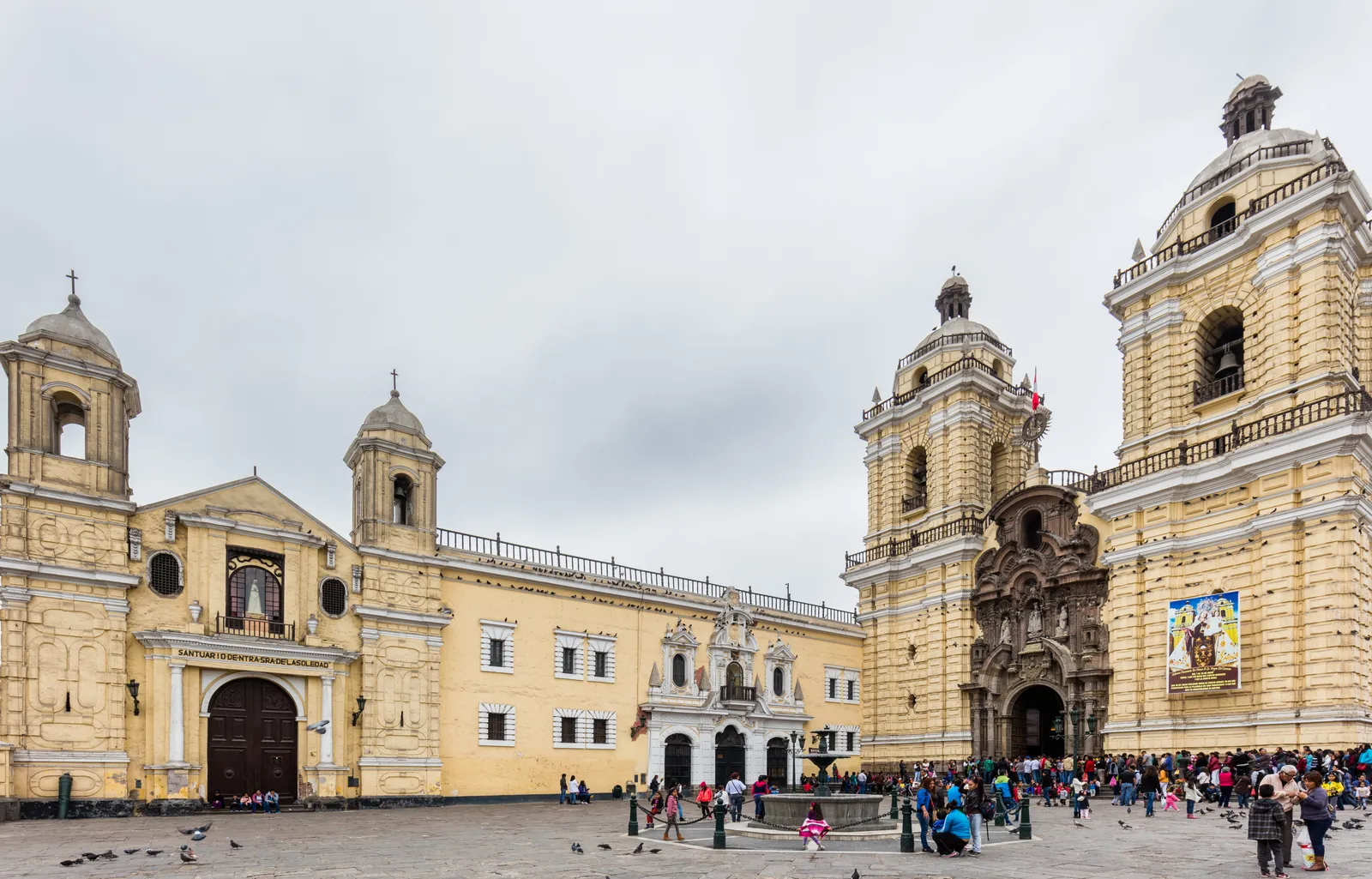
The reason most people queue is underneath. The vaults below the church served as the city’s cemetery until 1810 and were only rediscovered in 1951; the bones down there are sorted by type, femurs with femurs and skulls with skulls, and in several of the wells they have been laid out in concentric circles. Estimates of how many people were buried run from twenty-five thousand into the tens of thousands, and nobody has ever settled the figure.
Admission is 20 soles, includes a guide and takes about 45 minutes; the ticket desk sells timed spots rather than letting people wander, and photography stops at the top of the stairs. If you would rather have the wider colonial context first, a guided walk that takes in the monastery covers the surrounding streets on the way. The passages below run narrow, low and stepped, and the group moves through them together, so a suitcase is not coming down there with you.
Thirteen lit fountains in Parque de la Reserva
Parque de la Reserva is an eight-hectare public park wedged between the Paseo de la República expressway and Avenida Arequipa, a couple of kilometres south of the old town. Thirteen fountains were installed across it in July 2007 under the name Circuito Mágico del Agua, and the set holds the world record for the largest fountain complex in a public park. The Fuente Mágica in the middle throws a single jet past 80 metres; another is a tunnel of arched water you walk through, and the water is calibrated to miss you.
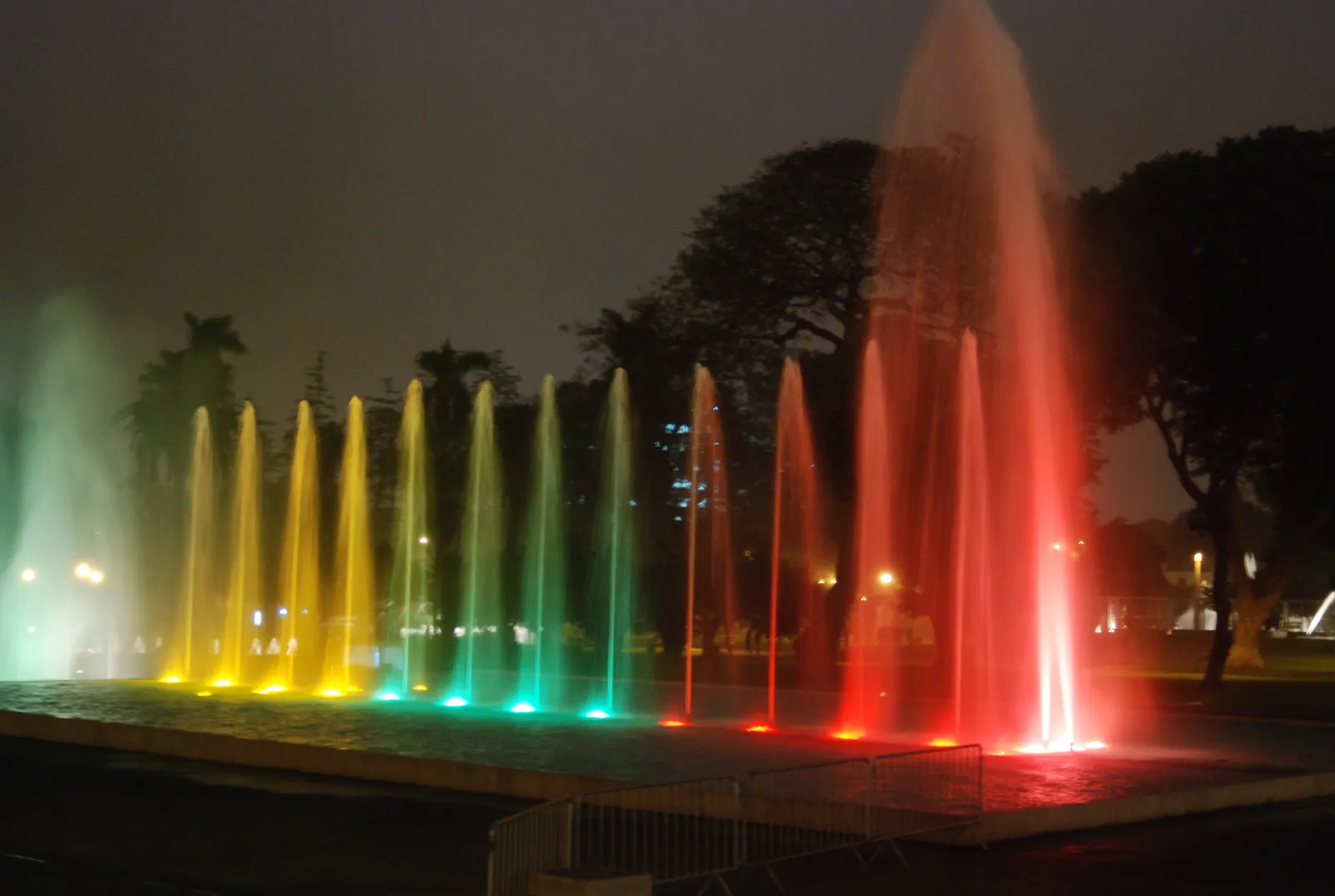
Gates open at three in the afternoon and close at ten, every day of the week. Admission is 5 soles, waived for children under five and for anyone over 65 with ID. The multimedia show, projections and lasers thrown onto a curtain of water, runs at 7:15, 8:15 and 9:10 in the evening, which is the part worth timing a visit around; an evening tour with transport included is the easier version if you would rather not work out the ride back in the dark.
Huaca Pucllana, an adobe pyramid in the middle of Miraflores
Huaca Pucllana sits behind a fence on Calle General Borgoño in Miraflores, roughly eight kilometres south of Plaza Mayor, with apartment blocks on three sides of it. The Lima culture built it between roughly 200 and 700 AD as a ceremonial and administrative centre: seven stepped platforms, a little over twenty metres high, spread across more than 500 metres of ground.
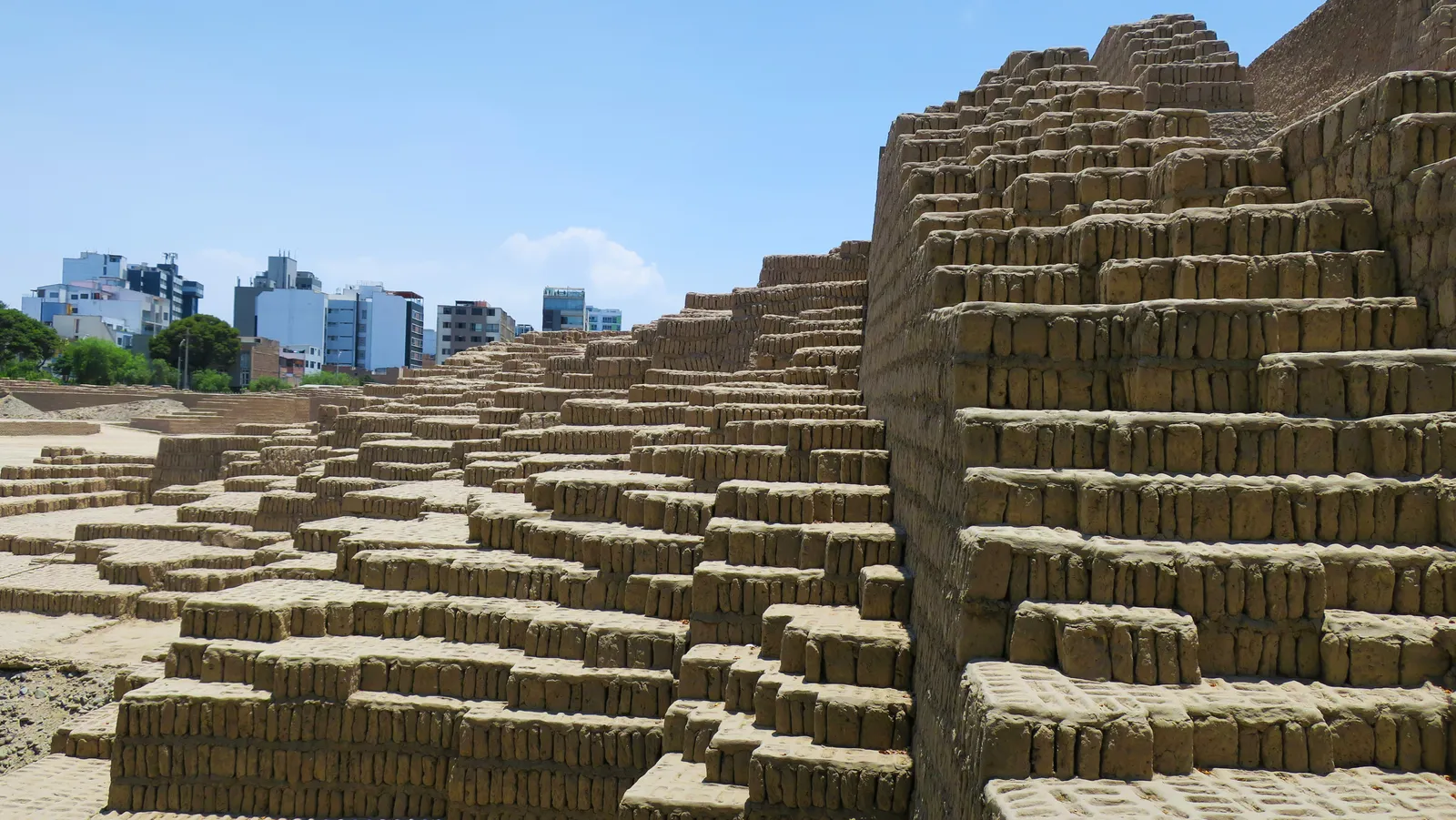
The construction is the thing to look at. Millions of small clay bricks were stood on end, side by side with deliberate gaps between them, bedded into clay above and below but not stuck to each other. When the ground moves, the bricks shift inside their gaps instead of cracking, which is how a mud-brick structure has outlasted 1,500 years on one of the most seismically active coastlines anywhere. Admission is 15 soles by day and 17 at night, and includes a guide either way. It shuts on Tuesdays, and the evening slot, when the platforms are floodlit, runs Wednesday to Sunday from half past six until nine.
The noon guard change outside the Government Palace
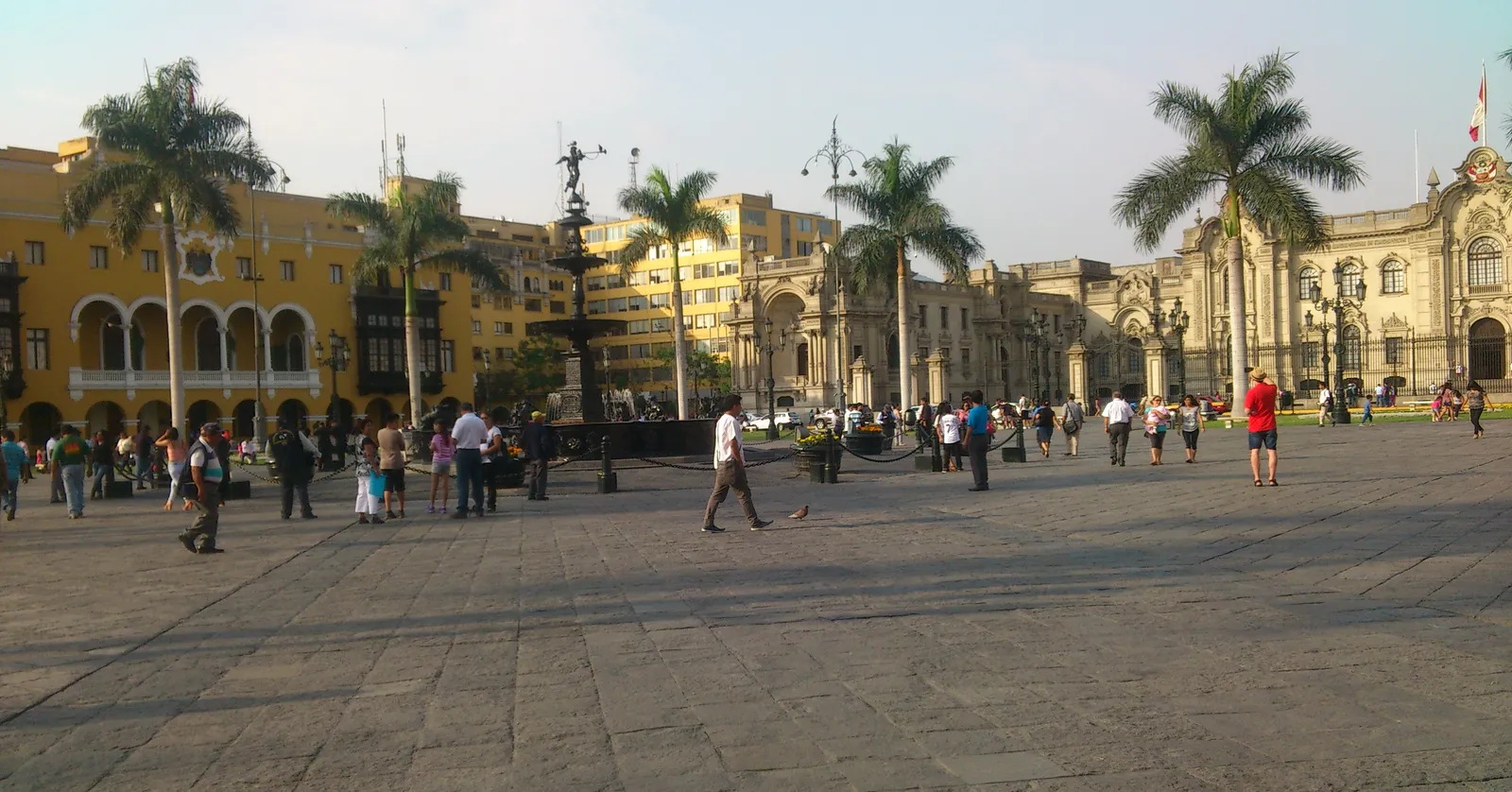
Plaza Mayor is the square Francisco Pizarro marked out on 18 January 1535 when he founded the city, and the bronze fountain at its centre, inaugurated on 8 September 1651, is the oldest thing still standing in it. Everything around the edges is newer than that: the cathedral, the arcaded Municipal Palace and the Archbishop’s Palace with its carved wooden balconies have all been rebuilt after one earthquake or another.

The Government Palace takes the north side, and its guard changes at noon every day: dress blues, plumed gold helmets, a military band and roughly half an hour of marching, watched for free from the square. The railings fill up from about 11:30. Two streets away on Jirón Ancash, the Casa de la Literatura Peruana occupies the old Desamparados railway station, finished in 1912 and turned into a public literature centre in 2009. It is free, open Tuesday to Sunday from ten until seven, and almost always quiet, which makes it the obvious fallback when the fog is down or the plaza is packed.
Barranco’s wooden bridge, the Puente de los Suspiros
Barranco is the cliff-top district at the southern end of Lima’s coast road, and the Puente de los Suspiros is the wooden footbridge at the middle of it, inaugurated on 14 February 1876. Chilean forces destroyed it along with most of the district in 1881 during the War of the Pacific, and it was rebuilt two years later. Underneath runs the Bajada de Baños, a cobbled ramp that fishermen used to reach the shore and that now descends past bars, galleries and a Chabuca Granda statue to the seafront.
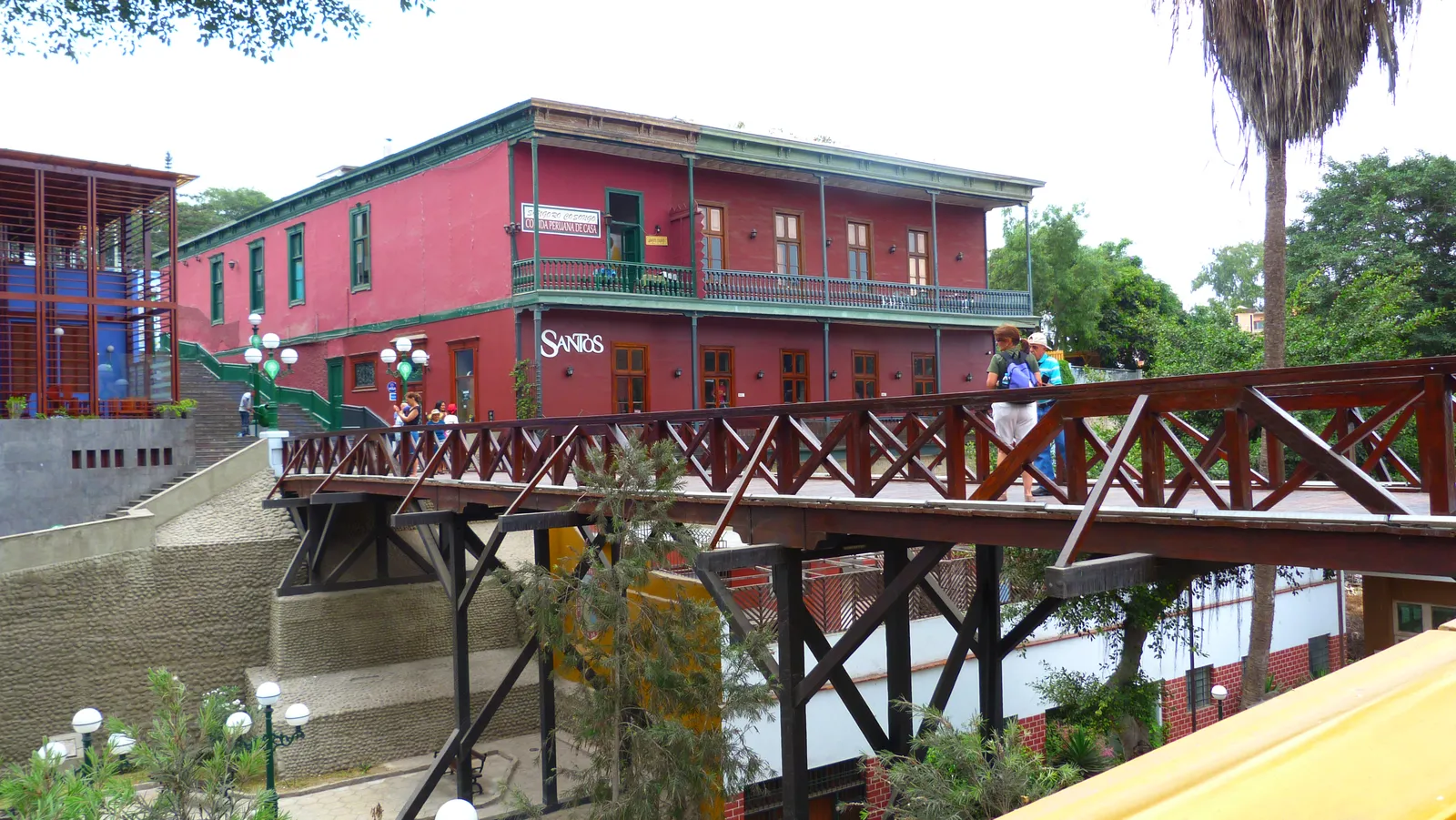
None of it costs anything, and it is the part of this list that needs the most time, since Barranco is a further twenty minutes south of Miraflores. One caveat worth knowing before committing an afternoon to the coast: from May to November Lima sits under the garúa, a low grey sea fog that seldom becomes actual rain but takes the horizon away completely. The bridge and the streets around it read the same in it; the ocean view from the clifftop does not.
The bus to the terminal costs two soles and runs all night
AeroDirecto’s Centro route is the cheap way back to Jorge Chávez: it leaves from Plaza San Martín, costs 2 soles paid to the conductor on board in cash, by card or by Yape, and takes about an hour to the terminal, running out along Avenida Óscar R. Benavides and then Avenida Faucett through Callao. It runs 24 hours a day, every 15 to 25 minutes between five in the morning and eleven at night and every half hour to hour after that, which is what makes it the reliable option for a departure in the small hours.
Airport Express Lima serves the other side of the city, four stops along Avenida Larco and Avenida Pardo in Miraflores, for 20 soles a head on a fixed hourly timetable. It takes 40 to 65 minutes depending on the stop and the traffic, but it does not run overnight, so a very late flight from that district means a taxi instead. Whichever you take, leave more than the ride itself: the run up Faucett is slow at peak times, and check-in and security still come after it.
Leaving the suitcase near Plaza San Martín is what makes the day fit together, because the historic centre, the fountain park and the bus back out all start and finish within a few blocks of each other, and nothing on this list has anywhere to put a bag down. If the onward flight connects through Buenos Aires, the Buenos Aires layover guide covers a similar walkable core at the other end.
Frequently asked questions
What should I do during a layover in Lima?
Give the historic centre the first block of time: the catacombs under the Basilica de San Francisco, Plaza Mayor with its 1651 bronze fountain, and the guard change outside the Government Palace at noon. Parque de la Reserva's thirteen lit fountains open at three in the afternoon and run their multimedia show three times each evening, which suits a night departure. Huaca Pucllana out in Miraflores and the Puente de los Suspiros down in Barranco both need a longer gap, and either can be dropped without breaking the rest. Only the catacombs really reward turning up early, since the tour runs in fixed groups and the queue builds through the afternoon.
Can you visit the San Francisco catacombs without a guide?
No. The 20-sol admission covers a guided tour and there is no self-guided option; groups leave every few minutes, run about 45 minutes, and cover the church, the cloisters, the library and the ossuary in one loop. Tours run in Spanish throughout the day with English departures at set times, so it is worth asking at the desk which slot is next in English rather than joining the first group at the door. Photography is not allowed once you are underground.
Does Lima's coastal fog change what's worth seeing on a layover?
From May to November the city sits under the garúa, a low grey sea fog that rarely turns into real rain but flattens the light and hides the horizon for weeks at a time. It makes the clifftop ocean views south of the centre a poor use of a short visit, and it does nothing at all to the catacombs, Plaza Mayor or the fountain park, which are the stops worth prioritising in those months. Temperatures stay mild, around 14 to 18°C, so a light jacket is enough.
Is the walk around Lima's historic centre step-free?
Mostly. Plaza Mayor is a flat paved square, Jirón de la Unión between it and Plaza San Martín is pedestrianised the whole way, and Parque de la Reserva's paths are level and surfaced. The catacombs are the exception: they are reached by a staircase into low, narrow brick passages with uneven floors and no lift, so that part of the visit is not wheelchair or stroller accessible, though the church and cloisters above ground are.
Is the airport bus or a taxi better for getting back to Jorge Chávez?
For one or two people the bus wins on price by a wide margin. AeroDirecto's Centro route runs from Plaza San Martín to the terminal for 2 soles paid on board, every 15 to 25 minutes through the day and every half hour to hour overnight, and it does not stop running at night. Airport Express Lima covers Miraflores instead for 20 soles, takes 40 to 65 minutes, and stops for the night, so a genuinely late departure from that side of the city means a taxi. A taxi from either district costs many times the bus fare and is not reliably faster, because both share the same congested run up Avenida Faucett.