Osaka Layover Guide: Dotonbori From KIX
Osaka Castle’s keep charges ¥1,200 for eight floors of museum and a gallery fifty metres up; the Dotonbori canal, the lantern lane a minute off it and the covered market at Nipponbashi are all free to walk.
Osaka Castle’s keep was rebuilt in concrete in 1931
Lightning burned the previous tower down in 1665 and nobody replaced it for 266 years. What stands there now was paid for by public subscription in 1931, 1.5 million yen raised across the city, and built in ferroconcrete rather than timber so it would not go the same way; it was overhauled again in 1997. Five storeys are visible from outside and eight exist within, and the eighth is an observation gallery fifty metres above the inner bailey, looking across the moat at the office towers of Osaka Business Park.
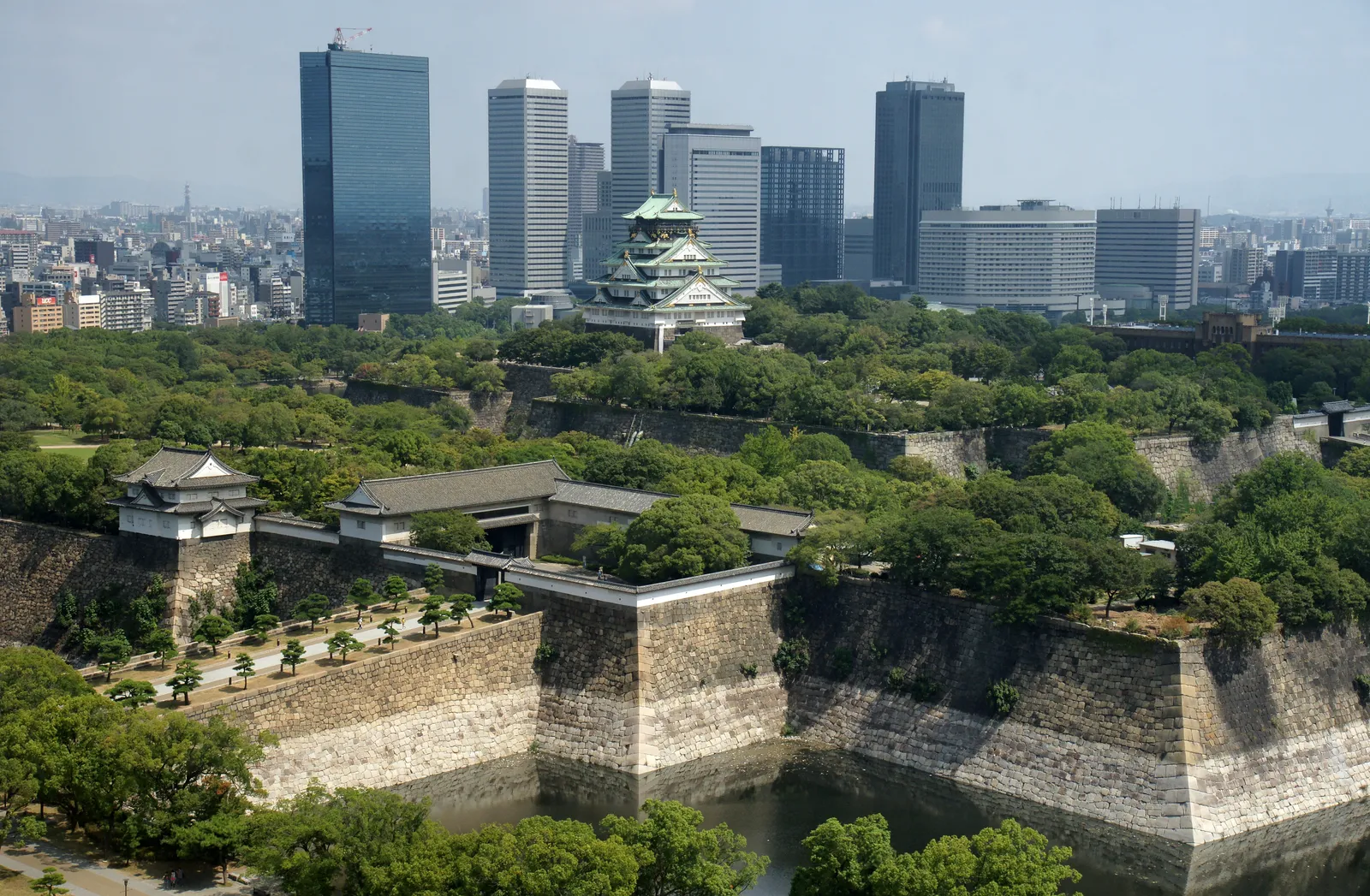
Admission is ¥1,200 for an adult and nothing for junior high age and under, and the doors run 9am to 5pm with the last entry at 4:30pm; the keep closes completely from 28 December to 1 January. It stands fifteen to twenty minutes’ walk inside the grounds from the nearest station gate, so budget for the approach as well as the climb. An entry ticket bought ahead through a tours and activities platform saves the counter queue, which is the part that varies. The park outside is free and has no gate at all, and the walled garden on the west side is ¥200. One thing to know before you climb: the general lift inside the keep stops at the fifth floor, and the last three flights up to the gallery are stairs.
Tsutenkaku tower stands 108 metres over Shinsekai
The main deck is at 91 metres and costs ¥900, with ¥300 more for the open-air one above it; doors at 10am, last ticket at 7:30pm. On the fifth floor sits Billiken, a grinning, pointed-headed luck figure that first appeared in the Luna Park amusement ground here around 1910 and disappeared when the park shut in 1923. The one there now was copied from an old photograph in 1979, and the custom is to drop a coin in the box and rub the soles of his feet. A deck ticket is sold in advance through a tours and activities platform.
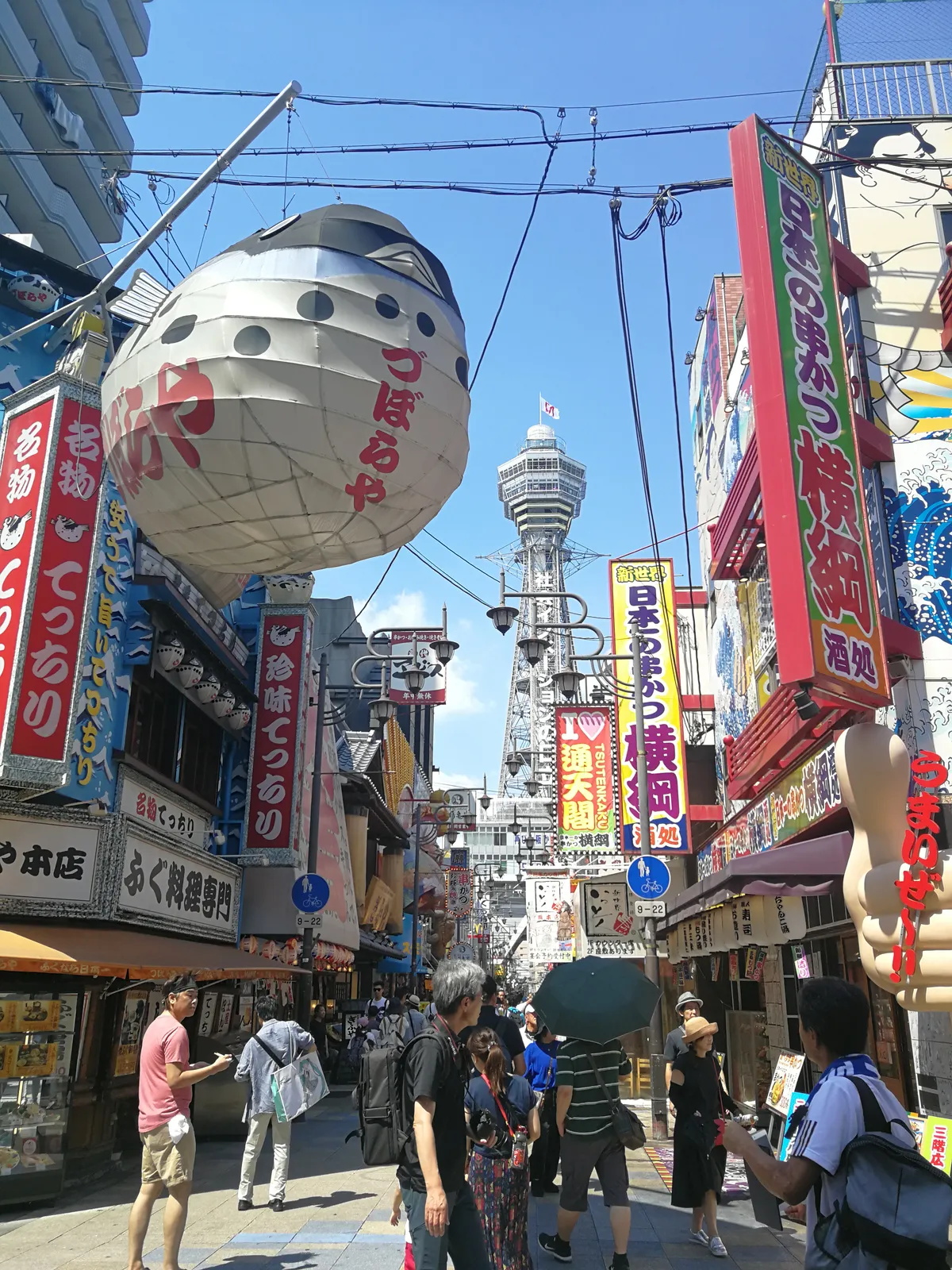
Kushikatsu, meat and vegetables breaded and deep-fried on skewers, was invented in the streets underneath about a century ago, and the counters that serve it all keep a communal tub of sauce with one rule attached: dip the skewer once, before the first bite, and never again. Shinsekai is two subway stops south of the Namba district and five minutes on foot from the station exit.
The roof deck joining Umeda Sky Building’s two towers
Hiroshi Hara finished the building in 1993 as a pair of 40-storey towers bridged across the top, and the bridge is the point. The Floating Garden Observatory is an open-air ring 173 metres up, reached by an escalator that crosses the gap between the towers inside a glass tube with the atrium dropping away underneath it. Admission is ¥2,000 and the last ticket goes at 10pm, which makes it the stop that survives a delayed morning; observatory tickets go through the same tours and activities platform.
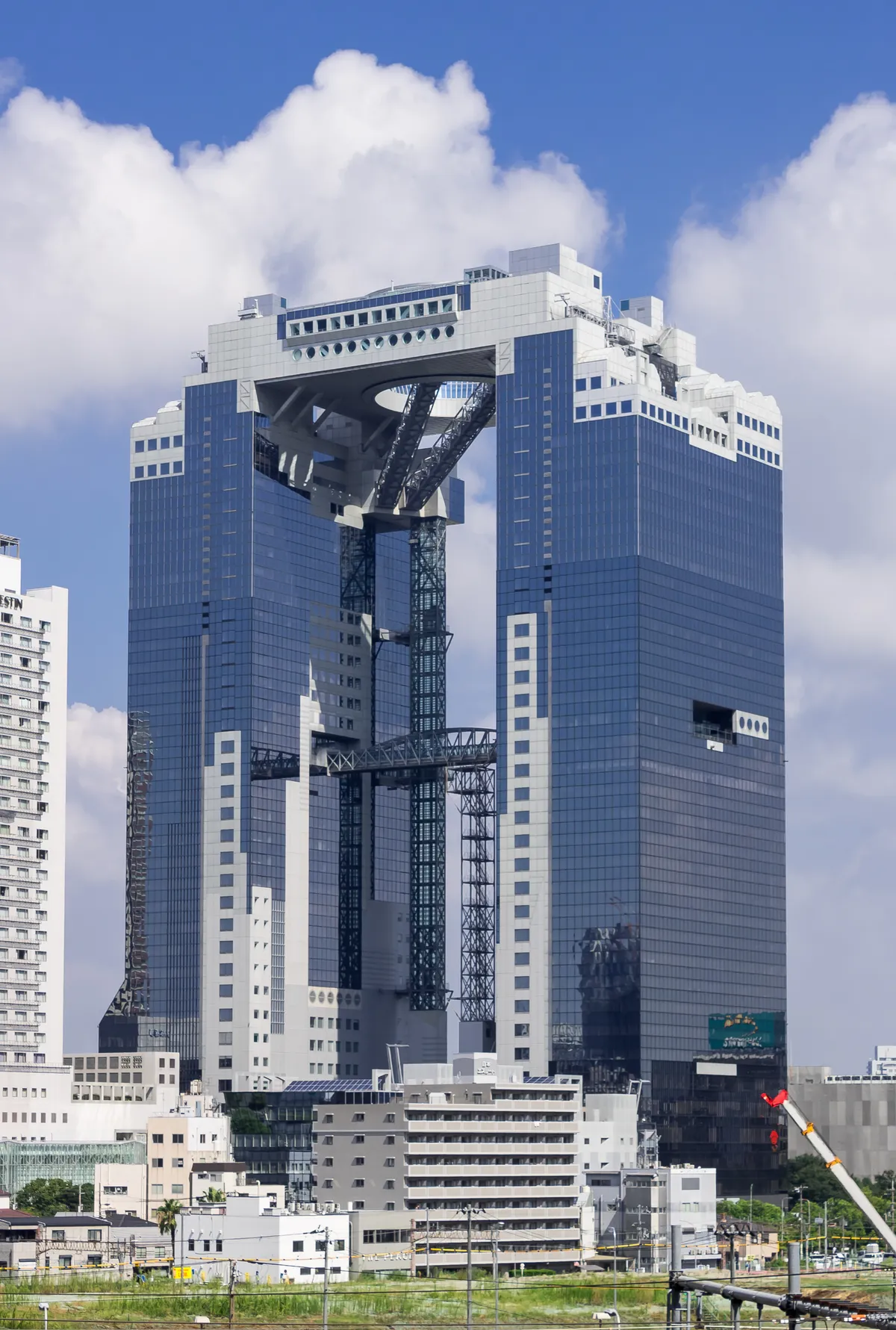
Add it if you have six hours or more before your flight: it is nine minutes’ walk from Osaka Station and four subway stops north of the canal district, so it costs the better part of an hour there and back on top of the time at the top. The basement is worth the detour on its own account and costs nothing. Takimi-koji is a reconstruction of an early-Showa Osaka street laid out under the building: stone paving, hand-operated pump wells, a round red postbox, a small Inari shrine and about twenty little restaurants, all indoors and all free to walk through.
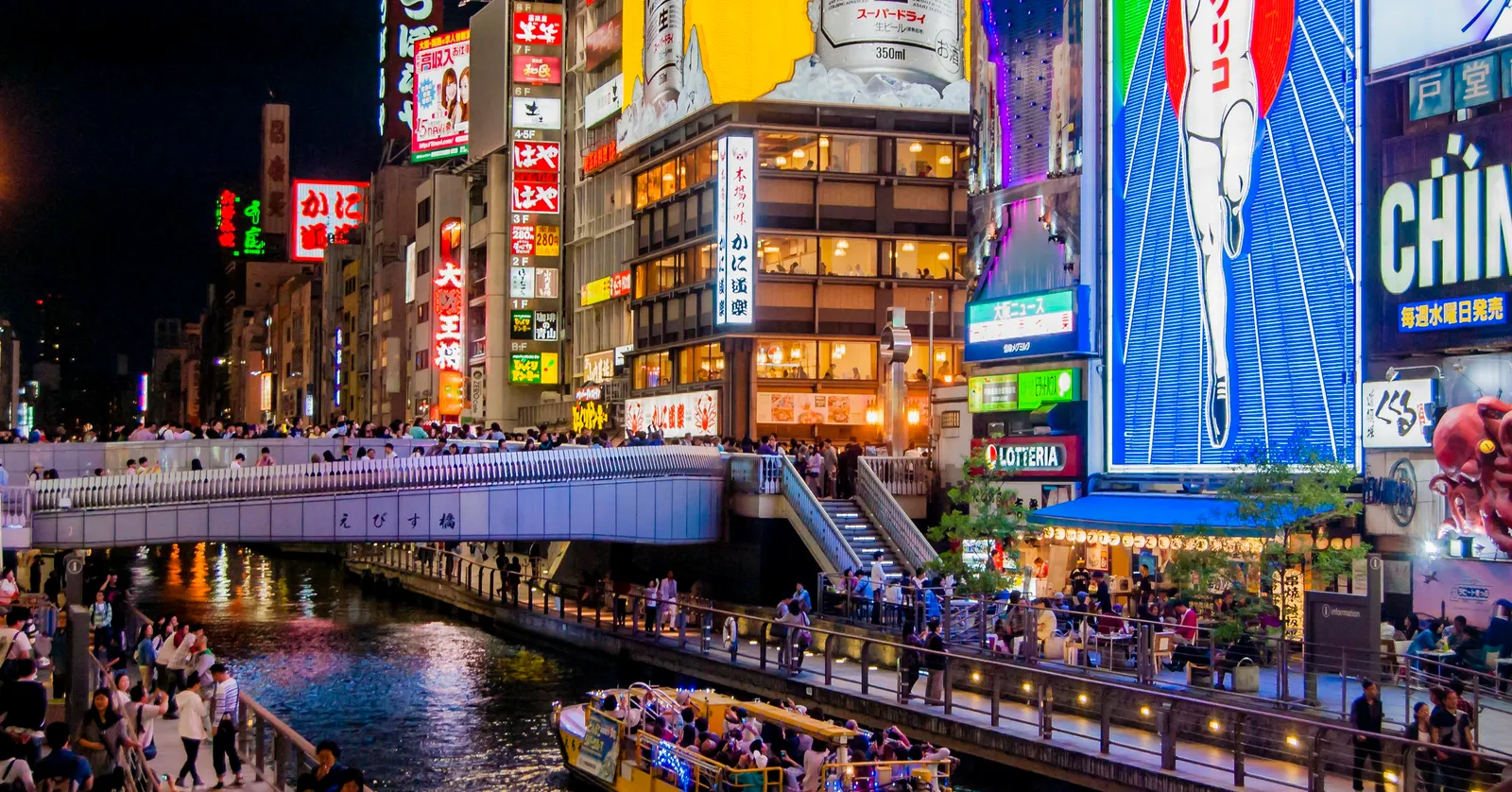
Dotonbori’s canal has carried the same advertising sign since 1935
Work on the waterway started in 1612 and finished in 1615, cut to link two rivers, and the theatres that lined it made this the city’s entertainment quarter for the three centuries after. The sign everyone stops for is a Glico confectionery hoarding, a runner crossing a finish line, first lit in 1935 and now on its sixth version, LEDs since October 2014. The crowd that photographs it stands on Ebisubashi, which is why the bridge moves slowly at any hour after dark. The Tombori River Walk runs along the water a level below the crush, free and considerably calmer, with 170 metres of it open between Tazaemonbashi and Ebisubashi since 2004.
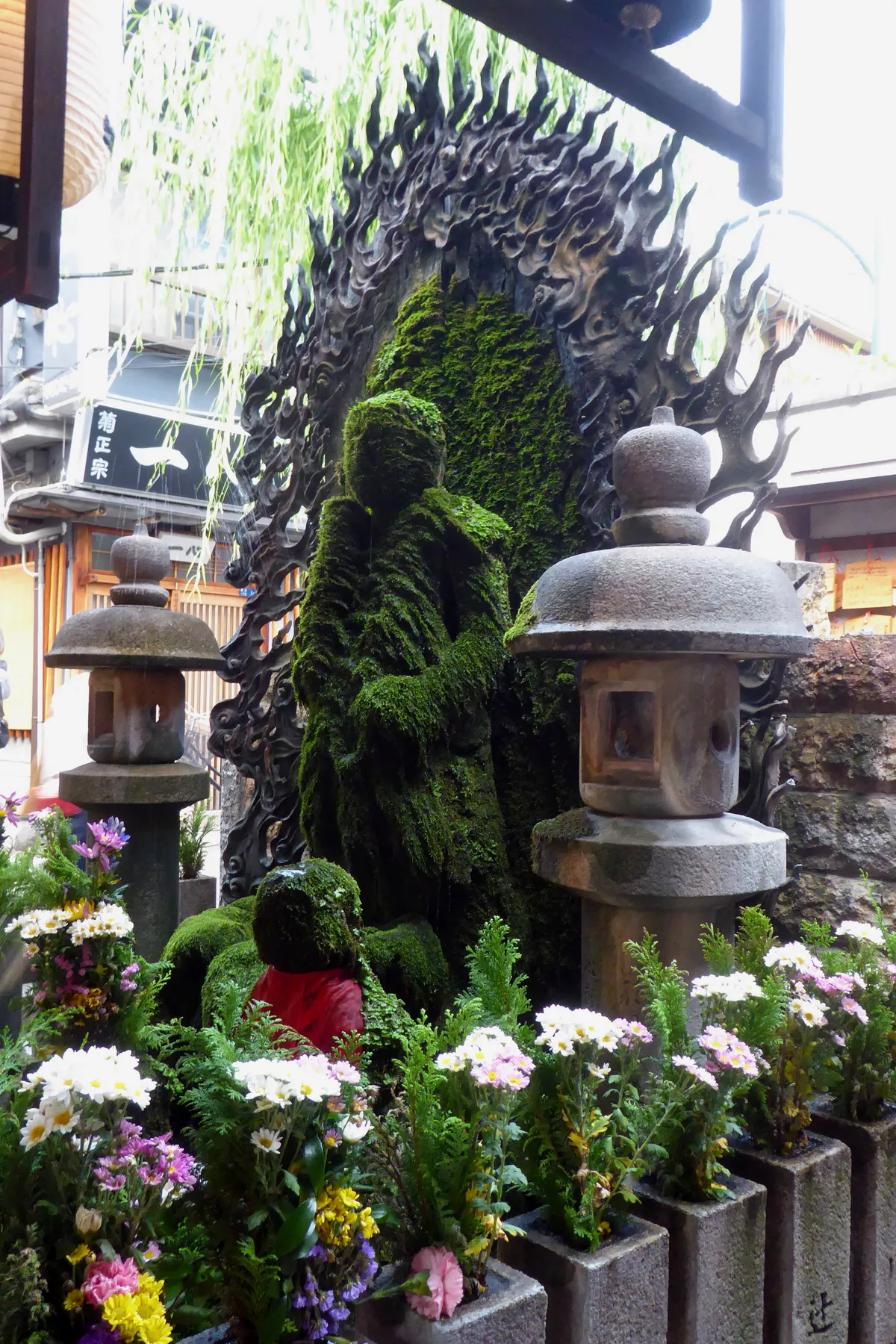
Two minutes south, through the arcade, Hozenji Yokocho is sixty metres of stone-paved lane with lanterns and small restaurants down both sides. At the end of it is Hozen-ji, founded in 1637, and a standing figure of Fudo Myo-o that visitors have poured water over for about eighty years. The moss has closed over the stone completely, so what is left is a green outline of a face and a robe, and it is the one thing at the temple that came through the 1945 bombing that took the rest.
Kuromon Ichiba, a covered market almost 600 metres long
About 150 shops trade under one continuous arcade roof at Nipponbashi, ten minutes’ walk from Namba, most of them between 8am and 6pm, and a good number of them shut on Sundays and public holidays. It started as a fish market and still reads as one: tuna cut to order, scallops and oysters grilled at the stall, sea urchin sold by the tray, most of it eaten standing up a metre from where it was cooked rather than carried home.
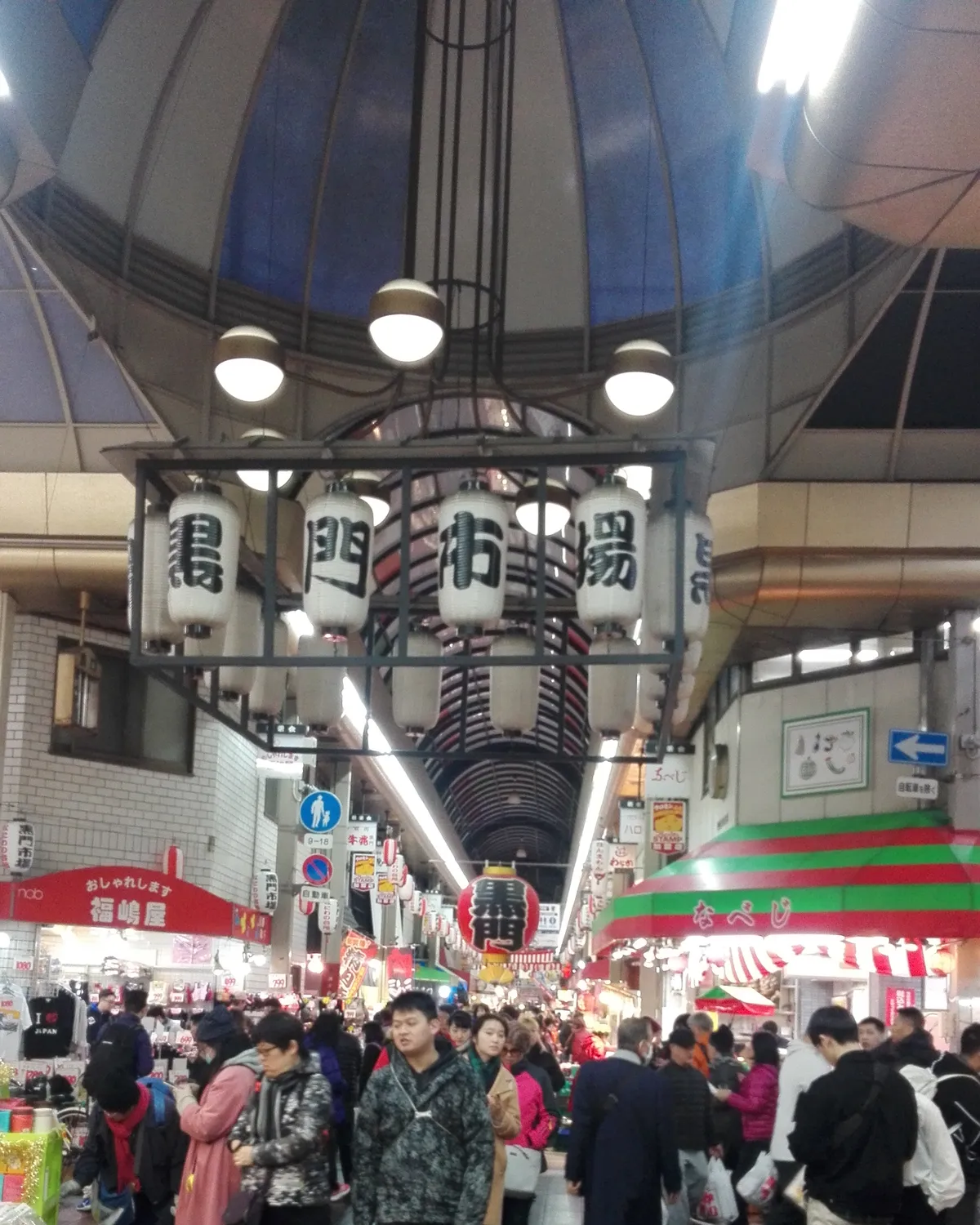
The roof is the practical argument for putting it late in the day. It is the one stretch of this itinerary that ignores the weather entirely, and it sits between the canal and the station the airport train leaves from.
Namba’s slower airport train runs four times an hour
The Airport Express on the Nankai line makes twelve stops between Namba and Kansai International Airport (KIX), takes 45 to 50 minutes and costs ¥970, and none of its seats are reserved. The Rapi:t is the limited express on the same track, 34 to 38 minutes and about two an hour, with every seat reserved. Its surcharge went from ¥520 to ¥700 on 1 April 2026, the first change in 31 years, which puts the full fare at ¥1,670; buying that surcharge on board rather than before you board adds a flat ¥300. Trains from the same airport station also run straight out to Kyoto in about 75 minutes, which is a different afternoon entirely.
Namba is five minutes’ walk from the canal and ten from the market, and it is also where the airport train leaves from, so a bag left at a storage point there sits on the way to the platform rather than a detour back across the city.
Frequently asked questions
What should I do during a layover in Osaka?
Pick one paid stop and spend the rest of the time on the free ones, which are all clustered together. Osaka Castle's keep is the paid stop most people want: ¥1,200, eight floors of museum, and a gallery fifty metres up, but it shuts at 5pm and sits fifteen to twenty minutes' walk inside its own grounds, so it eats about two hours end to end. The Dotonbori canal, the lantern lane at Hozen-ji and the Kuromon Ichiba arcade are within ten minutes' walk of each other and cost nothing, and they stay useful whatever time you land. Tsutenkaku tower and the Floating Garden Observatory at Umeda are the two to add if there is room, and the first two things to drop if there is not.
Can you reach Osaka Castle's observation gallery without using stairs?
Yes, but you have to ask. The general lift inside the keep runs only as far as the fifth floor, and everyone else walks the last three flights up to the eighth-floor gallery. There is a separate lift serving floors one to eight for visitors who cannot manage stairs, with staff on each floor; the way to use it is to say so at the ticket gate and be directed to it rather than to look for it yourself. The gallery itself has a step-free entrance and a 120cm-wide walkway, so a wheelchair fits round it. Getting to the keep is the longer problem: it stands fifteen to twenty minutes' walk inside the grounds from the nearest station, and there is no vehicle drop-off at the door.
What is still open in central Osaka in the evening?
The Floating Garden Observatory at the Umeda Sky Building is the latest of the paid stops, open until 10:30pm with the last ticket at 10pm. Tsutenkaku's main deck runs 10am to 8pm with the last admission at 7:30pm. Osaka Castle's keep is the early one: 9am to 5pm, last entry 4:30pm, and shut entirely from 28 December to 1 January, though the park around it is open ground with no gate. Kuromon Ichiba mostly trades between 8am and 6pm, so an evening arrival gets the arcade with the shutters down. The Dotonbori canal and the lane at Hozen-ji are street-level and lit, and they are busier at 9pm than at noon.
Do Kuromon Ichiba's shops open on Sundays?
Many of them do not. Trading hours across the arcade run roughly 8am to 6pm, but a sizeable share of the 150-odd shops close on Sundays and on public holidays, and fishmongers in particular treat Sunday as the quiet day. The arcade roof covers almost 600 metres, so the walk through is still worth it on a wet Sunday even with half the shutters down, but if you came for the tuna cut to order and the grilled scallops, a weekday is the safer bet. Nipponbashi station is two minutes from the arcade's eastern end and Namba is about ten minutes' walk from its western one.
Is the Rapi:t or the Airport Express better for getting to Kansai Airport?
It depends on whether you want the seat or the ¥700. Both run on the same Nankai line out of Namba to Kansai International Airport (KIX). The Airport Express is a commuter train with twelve stops, 45 to 50 minutes, ¥970, no reservations, and about four departures an hour through the middle of the day. The Rapi:t is the limited express on the same track: 34 to 38 minutes, roughly two an hour, every seat reserved, and ¥1,670 since the limited-express surcharge went from ¥520 to ¥700 on 1 April 2026. Buying that surcharge on board instead of beforehand adds a flat ¥300. With a bag and a fixed check-in time, the reserved seat is what you are paying for, not the ten minutes.