Namba Station Layover: A 12-Metre Lion Head
Part of the full Osaka Layover Guide: Dotonbori From KIX
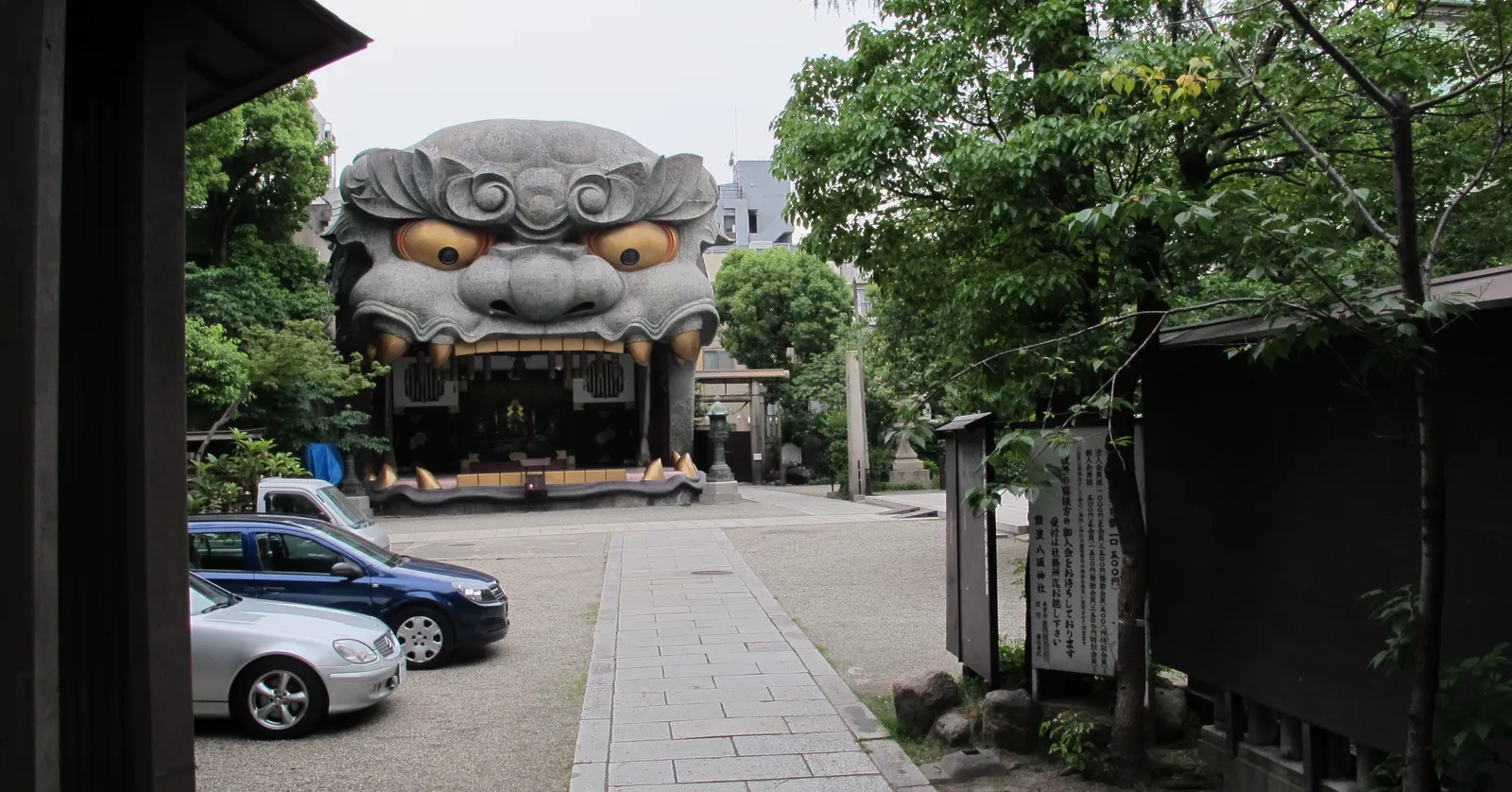
A shrine six minutes southwest of Osaka’s Namba station has a 12-metre lion’s head for a stage, and an eight-level roof garden climbs the outside of the shopping complex attached to the platforms themselves.
Namba Parks climbs eight levels of garden over a demolished ballpark
Osaka Stadium opened on this block in September 1950, held the Nankai Hawks until the team left for Fukuoka in 1988, closed in 1998 and came down two years later. What replaced it is shaped like a canyon: Jon Jerde ran a gorge of curved stone walls straight through the middle of a 120-tenant shopping complex, with the floors stepping back on either side as they rise, and a garden climbing continuously up all eight of those setbacks, planted with lawns, tree groves, streams and small waterfalls.
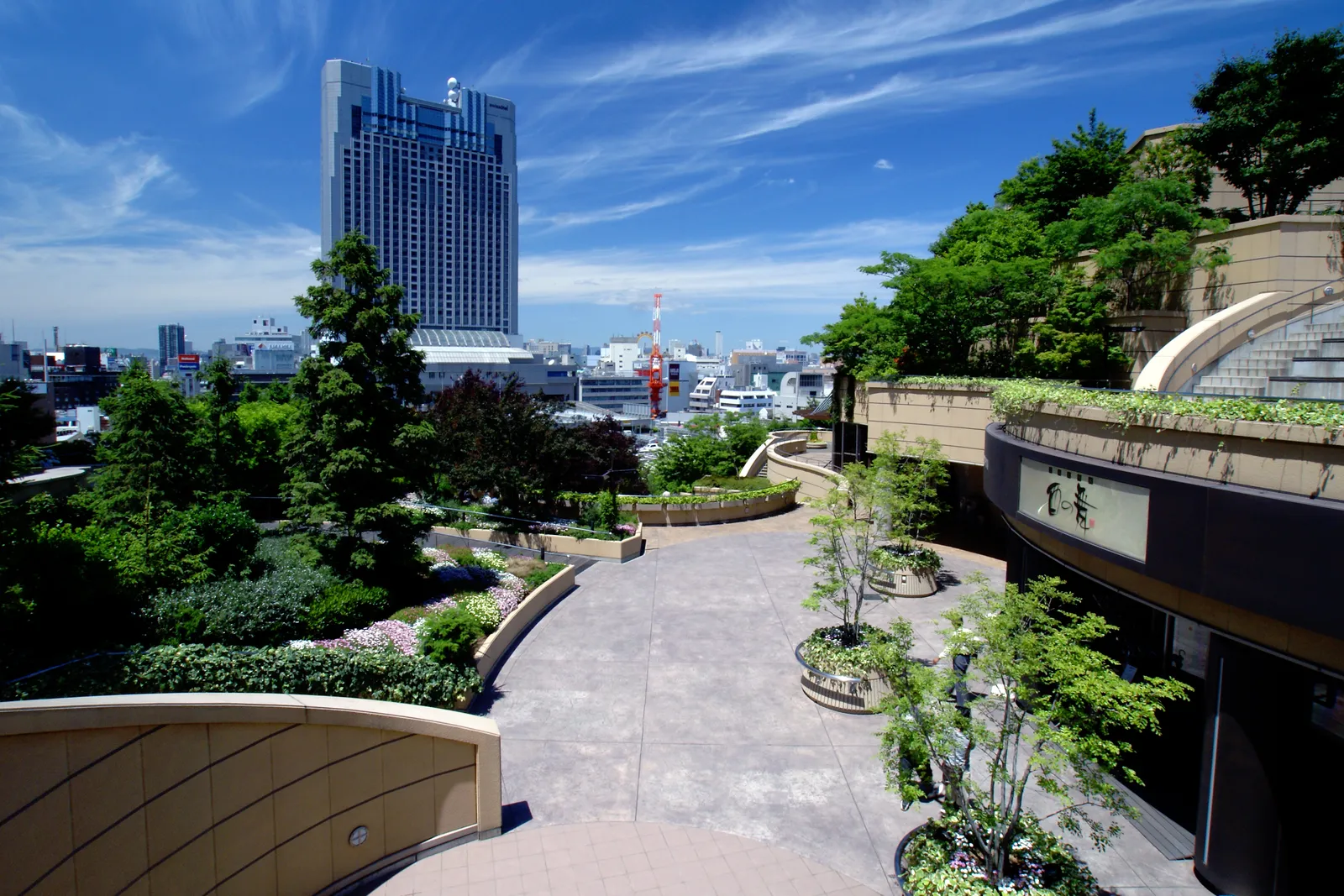
None of it costs anything and the entrance connects straight to the station, which makes it the highest-value twenty minutes available to anyone whose bag is already checked and whose train is already booked.
A 12-metre lion’s head is the stage at Namba Yasaka Shrine
Performances take place inside the jaws, and the open mouth is understood to swallow bad luck. It was put up in 1974 in reinforced concrete, steel and timber, 11 metres wide as well as 12 high, when the main hall was being rebuilt after the wartime air raids; the model was the lion dance long performed in this part of the city, and the shrine’s own account of the decision is that they wanted something that would startle Osakans.
Behind it is an ordinary, quiet precinct dedicated to Susanoo, free to walk into, six minutes southwest of the station on foot. People come for exam results and for business, and for the head, which photographs better than almost anything else within this radius.
Doguyasuji is 150 metres of restaurant supply shops
Sennichimae Doguyasuji is the street Osaka’s kitchens buy from: knives, pans, lacquer trays, noren curtains, paper lanterns, beckoning cats, and the plastic food samples that sit in restaurant windows the length of the country, sold individually to anyone who wants a bowl of ramen that never goes cold.
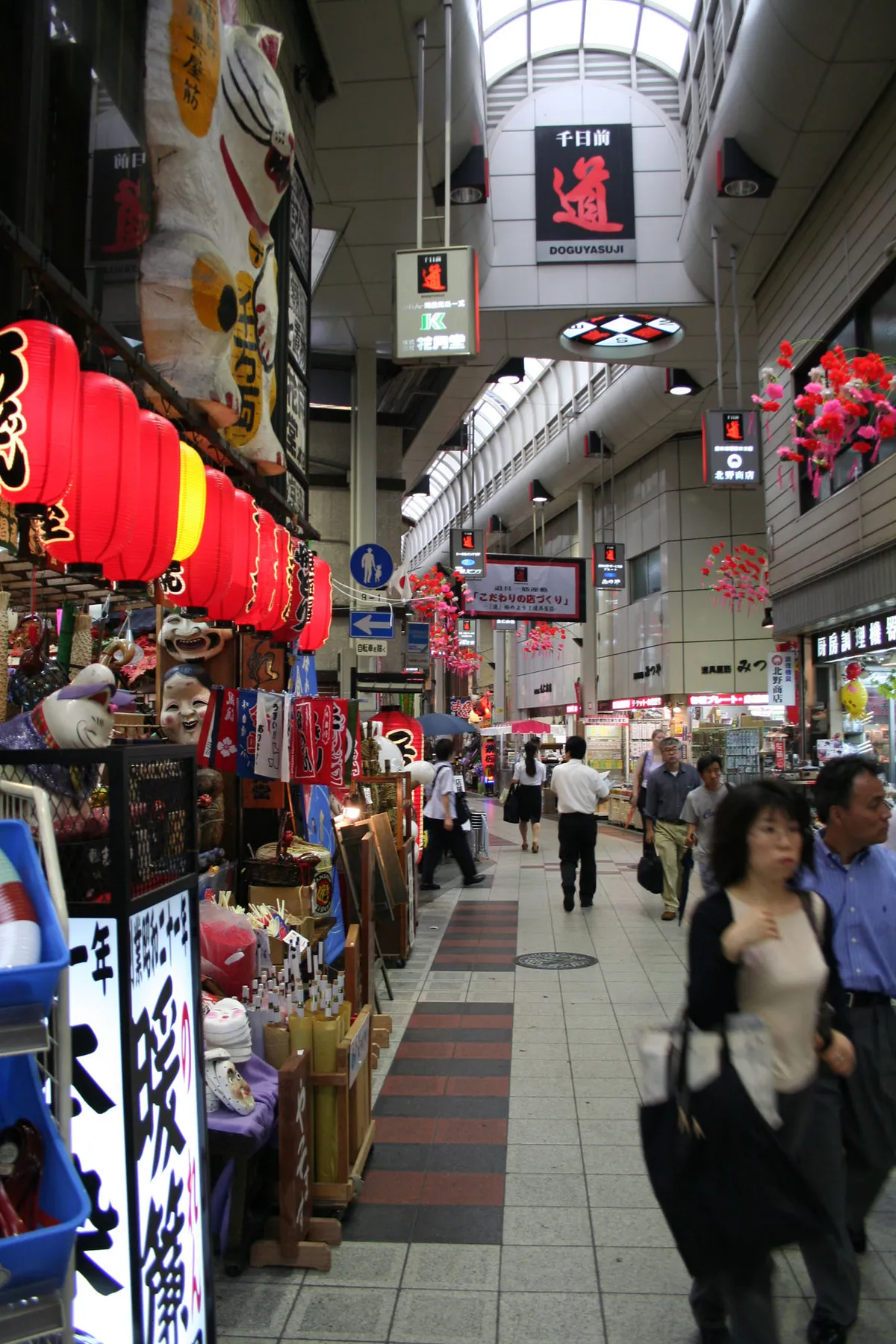
It runs under a roof between the canal district and the electronics blocks at Nipponbashi, which is the other reason to know about it: it is the covered route between two places you might want to be. The kitchens it supplies are three minutes north, and if the point of the stop is eating rather than looking, a half-day guided walk through those streets is bookable on a tours and activities platform. Most of the eating here happens standing at a counter or on a stool at a bar, where there is no floor space beside you for a suitcase.
The airport train leaves from the third floor, not the basement
Nine bay platforms and eight tracks sit above street level at the Nankai terminal on the east side, with gates on both the second and third floors, and everything to Kansai International Airport (KIX) goes from up there. The commuter Airport Express is ¥970 and 45 to 50 minutes; the Rapi:t, the reserved-seat limited express, is ¥1,670 and around 35.
Three separate stations answer to the name Namba
Only one of them is that Nankai terminal on the east side. Osaka Namba, shared by two other operators, is a different building and underground; JR Namba is a third, about ten minutes’ walk west. None of this is signed as one station, so a direction given as “meet me at Namba” is worth a follow-up question, and the ten-minute version of that mistake is the one that costs a flight.
The Osaka layover guide works outward from the canal a few minutes north of all three, which is the version to read if the gap is long enough to leave this radius at all.
Frequently asked questions
What should I do during a layover near Namba Station in Osaka?
Three things sit within ten minutes of the platforms and none of them charges anything. Namba Parks is attached to the station itself: an eight-level terraced garden climbing the outside of a shopping complex, which takes twenty minutes and needs no plan. Namba Yasaka Shrine is six minutes southwest and has a 12-metre lion's head with an open mouth serving as its stage. The Doguyasuji arcade, 150 metres of restaurant supply shops selling plastic food samples and beckoning cats, runs between the two. On two hours, do all three; on one, do the roof garden and go.
Which of the Namba stations does the airport train leave from?
The Nankai one, which is the elevated terminal on the east side with nine bay platforms and eight tracks on the third floor, and ticket gates on both the second and third. It is a different building from Osaka Namba, the underground station that Kintetsu and Hanshin share, and different again from JR Namba, which is about ten minutes' walk west. Airport departures and the Mount Koya trains both use the third-floor platforms. If somebody tells you to meet them at Namba station, ask which one.
Is Namba Parks worth it if it is raining?
It is one of the better wet-weather options here, with a caveat. The garden terraces themselves are open to the sky, so heavy rain rules out the top levels, but the whole complex is built as a covered canyon running through the middle of the shopping floors, which stays dry and is architecturally the point of the place anyway. The entrance is connected to the station, so you can reach it without going outside at all, and the Doguyasuji arcade a few minutes north is fully roofed. The shrine is the only stop here with no cover.
How early does the Doguyasuji arcade close?
Earlier than the streets around it, because it serves restaurant kitchens rather than tourists. Most of its shops keep daytime trading hours and start shutting from around 6pm, while the eating streets three minutes north run until well after midnight. That makes it a first-half-of-the-afternoon stop rather than an evening one, which is the opposite of how most of this district works. It sits between Dotonbori and the electronics blocks at Nipponbashi, so it is a two-minute detour from the route between them rather than a trip of its own.