Santorini's Caldera Rim on a JTR Layover
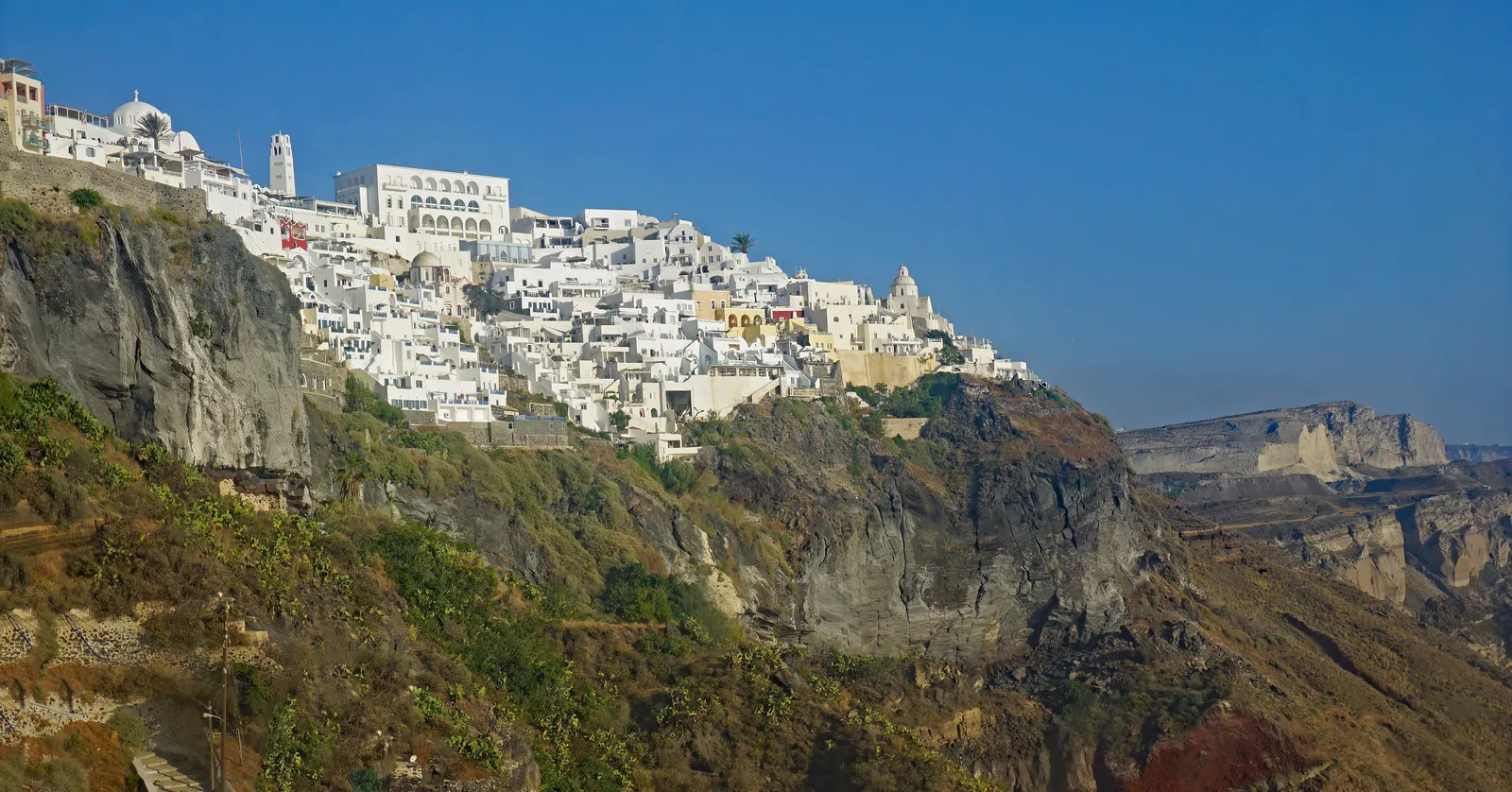
Fira sits on the lip of Santorini’s caldera, a clifftop town you can walk end to end in under half an hour, with a cable car dropping 220 metres to the Old Port in under five minutes from the middle of it and buses to Oia leaving from a yard behind the main street.
Fira’s cable car down to the Old Port was one shipowner’s gift
The Loula and Evangelos Nomikos Foundation, set up in 1979 by the Greek shipowner Evangelos Nomikos, paid for the line, and it started carrying passengers in 1982. Before that, anyone landing at the Old Port below Fira either climbed about 600 stepped switchbacks up the cliff face or hired a mule to carry them up instead.
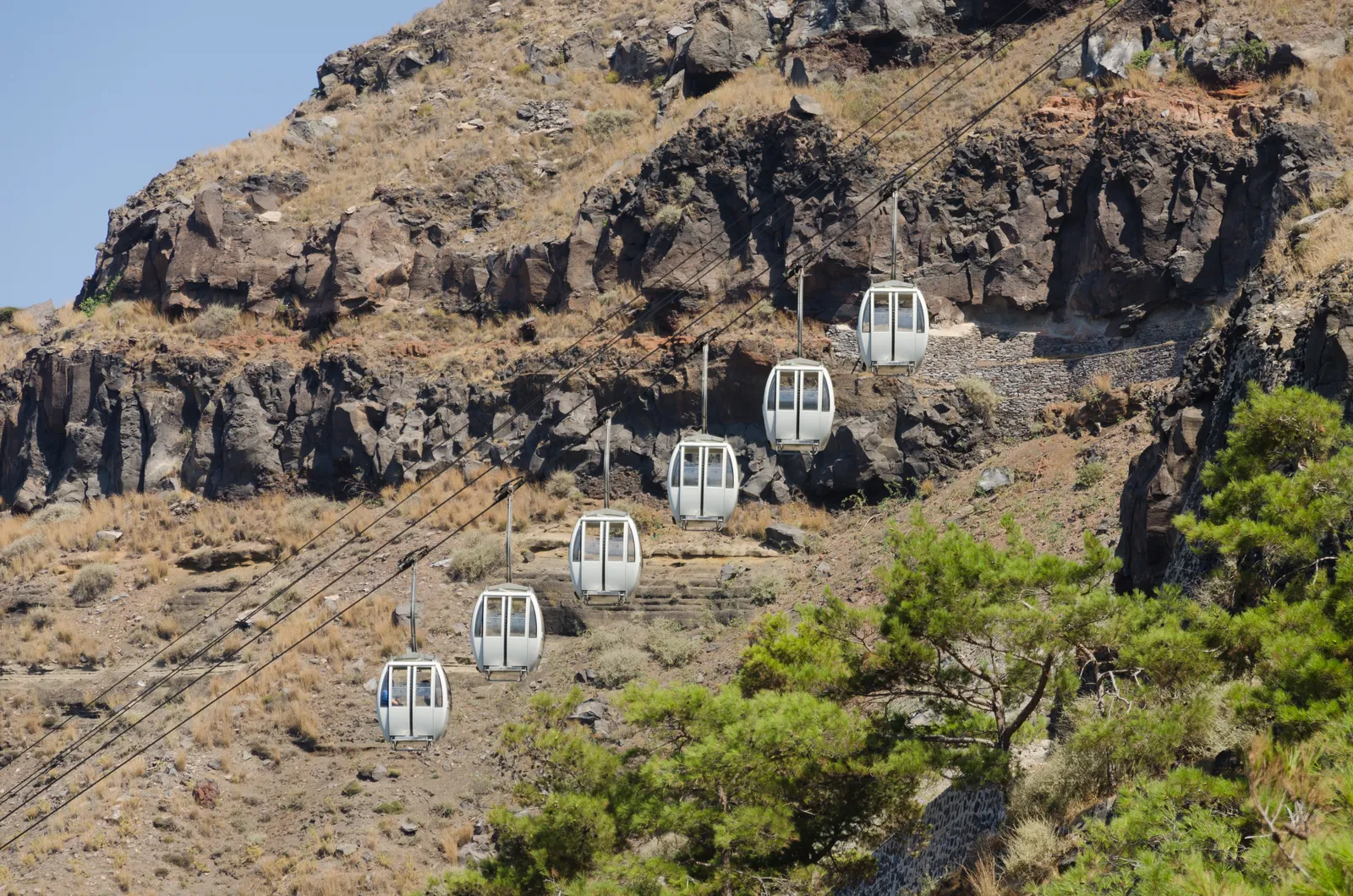
The cabins hold six each, three facing three, and the run takes three to five minutes for a stated capacity of 1,200 people an hour. Ten euros buys an adult a one-way ride, 5 covers a child between 6 and 12, and under-sixes go free. Peak summer hours run from 06:30 to 23:00, with the last cabin down from the top a little before closing; by November the timetable breaks into a morning and an afternoon block with a long gap in between. When a cruise ship is anchored out in the caldera, the queue at either end can run half an hour to an hour, which is the one thing that turns a three-minute ride into a real decision on a flight day.
At the bottom, the quay at Mesa Gialos is where the boats out to the volcanic islets in the middle of the caldera tie up. Nea Kameni, the black cone you can see from every terrace in Fira, is still an active volcano, and the standard trip walks you up to its crater and then stops at the warm sulphur springs off Palea Kameni on the way back; seats can be booked before you get there. Budget most of four hours for it.
The cable car charges 5 euros for a large suitcase on top of the fare, and the only free way up is the 600 steps.
The Castle of Agios Nikolaos at the western tip of Oia
Venetian builders put a lookout on the headland at the end of Oia in the 15th century, one of a series around the caldera meant to spot pirate sails early and shelter the village when they came. It held for something like 600 years and then the 1956 earthquake took most of it, leaving the base of the tower and a run of wall you can walk out onto.
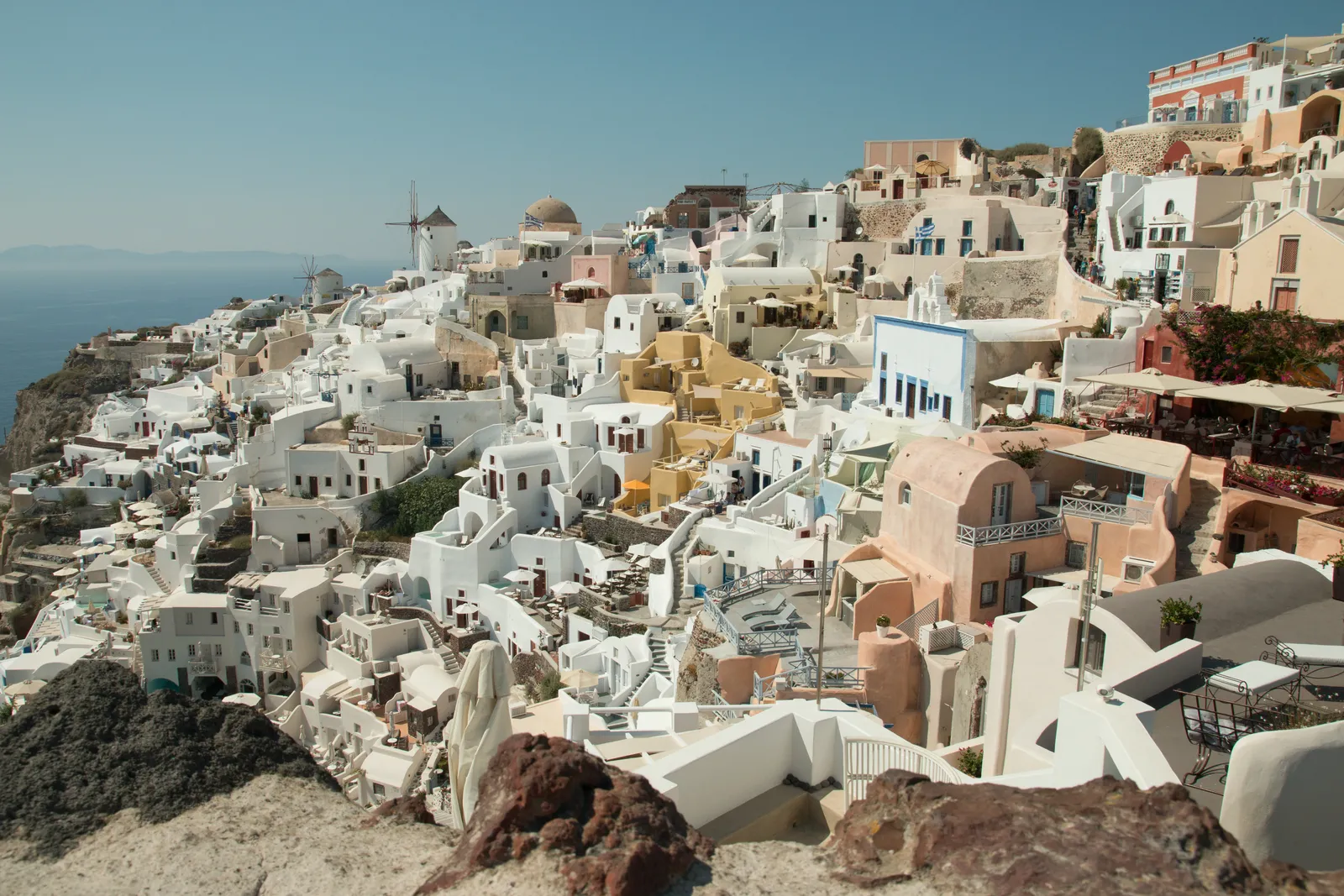
The ruin has never had a gate or a ticket, and that is exactly the problem: it is the island’s default sunset viewpoint, so in July and August the crowd starts building on it well over an hour before the sun actually goes down. Oia is about 11 kilometres from Fira and the bus takes 20 to 30 minutes for 2.20 euros, roughly every half hour through the summer, with the last run back leaving around 21:00. If you would rather not gamble on the return bus after dark, an afternoon coach that ends at the sunset and drives you back covers the same ground with the timing taken out of your hands.
Below the village, 278 steps drop to Ammoudi Bay, a strip of fish tavernas and a small quay wedged under a red cliff. There is a narrow road down to it as well, and a small car park that fills early.
Akrotiri’s wall paintings are in a museum in Fira, not at the dig
The Museum of Prehistoric Thera stands on the caldera side of Fira, on ground where a church stood until the 1956 earthquake brought it down. Inside is what came out of Akrotiri, the Bronze Age town on the island’s southern tip that a volcanic eruption buried under metres of ash around 1600 BC: pottery, tools, gold, Linear A tablets, and the wall paintings the site is known for. Some of the best-known pieces went to the National Archaeological Museum in Athens instead, so the two collections are split.
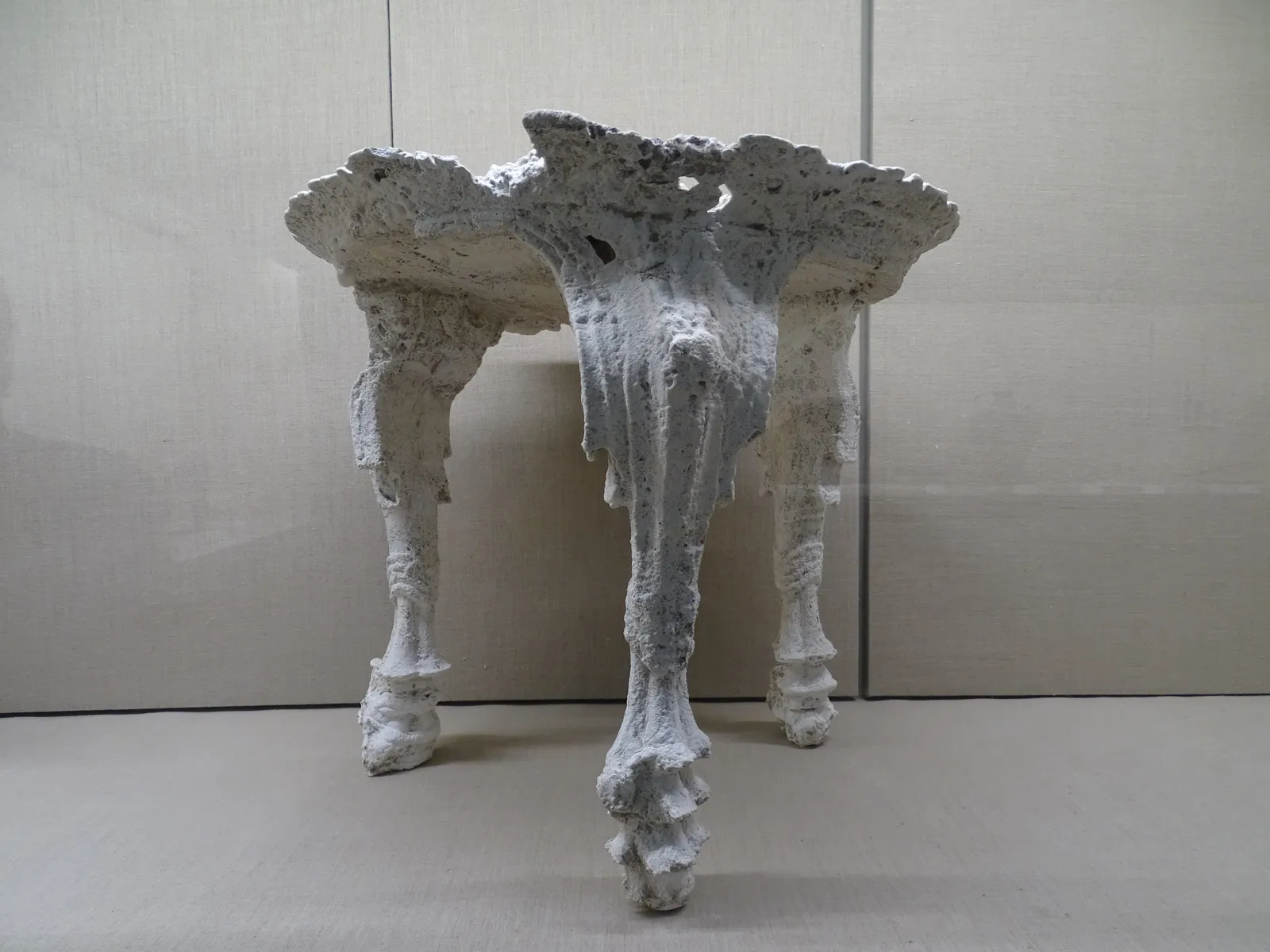
The oddest things in the room are the plaster casts. Wooden furniture burnt away under the ash and left clean hollows in it, and pouring plaster into those hollows brings back a table or a bed frame that has not physically existed for three and a half thousand years. What the excavation has never turned up is human remains, which is the detail that separates Akrotiri from Pompeii: the town appears to have been emptied before the eruption reached it.
Entry is 10 euros and the doors are open 08:30 to 15:30, closed Tuesdays, with last admission 20 minutes before the end. A 15 euro combined ticket covers this museum plus the excavation at Akrotiri and the ruins of Ancient Thera, and stays valid three days. Worth knowing before you buy the combined version: the Akrotiri site sits about 13 kilometres south of Fira, it was shut for months during the Cyclades earthquake swarm and only reopened on 11 April 2025, and it has closed again since for structural checks on its shelter, so confirm it is open before you pay for a ticket that assumes it.
The cathedral Fira finished rebuilding in 1968
The Amorgos earthquake of 9 July 1956 registered 7.7, the largest recorded in Greece in the twentieth century, and it flattened most of Fira, Firostefani and Oia between them. More than 500 houses came down across the affected islands and around 1,500 more were left badly damaged. Almost everything a visitor walks past on the caldera rim today is younger than that morning.
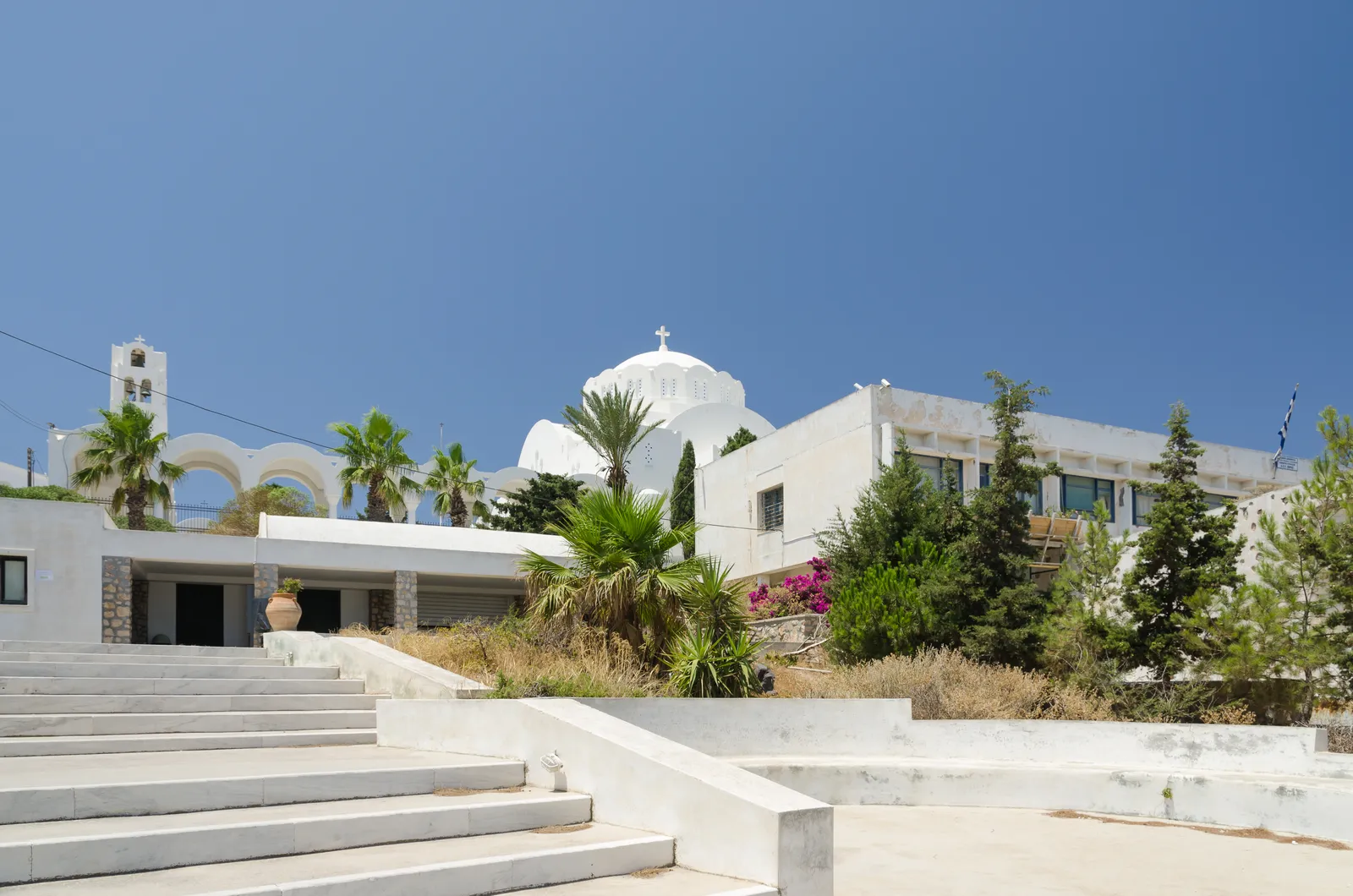
The Orthodox cathedral, first built in 1827, was one of the buildings wrecked, and the rebuild was not finished until 1968. What went up is unusual for a Greek island church: a whitewashed arcade of horseshoe arches wrapping the whole building, a low dome, a free-standing bell tower, and inside, frescoes painted by Christoforos Assimis, who lived and worked on the island. The cathedral has never charged for entry, and the terrace outside looks straight across the caldera.
A few minutes north, behind the Catholic cathedral, Megaro Gyzi occupies a 17th-century mansion that came through 1956 partly standing. It holds engravings, maps and manuscripts from the 15th century onward, and, more to the point on a short visit, rooms of photographs that include Fira before the earthquake and Fira immediately after it. The house keeps a season rather than year-round hours, opening from May to October, so it is a warm-months option only.
The clifftop path from Fira to Oia passes the ruins of Skaros
The whole rim from Fira to Oia is walkable, about 10.5 kilometres of it, and most people take three to five hours. The first section through Firostefani and Imerovigli is paved and lined with cafes; past Imerovigli the paving stops and the route crosses open, unshaded ground on loose gravel and rock, climbing and dropping the whole way.
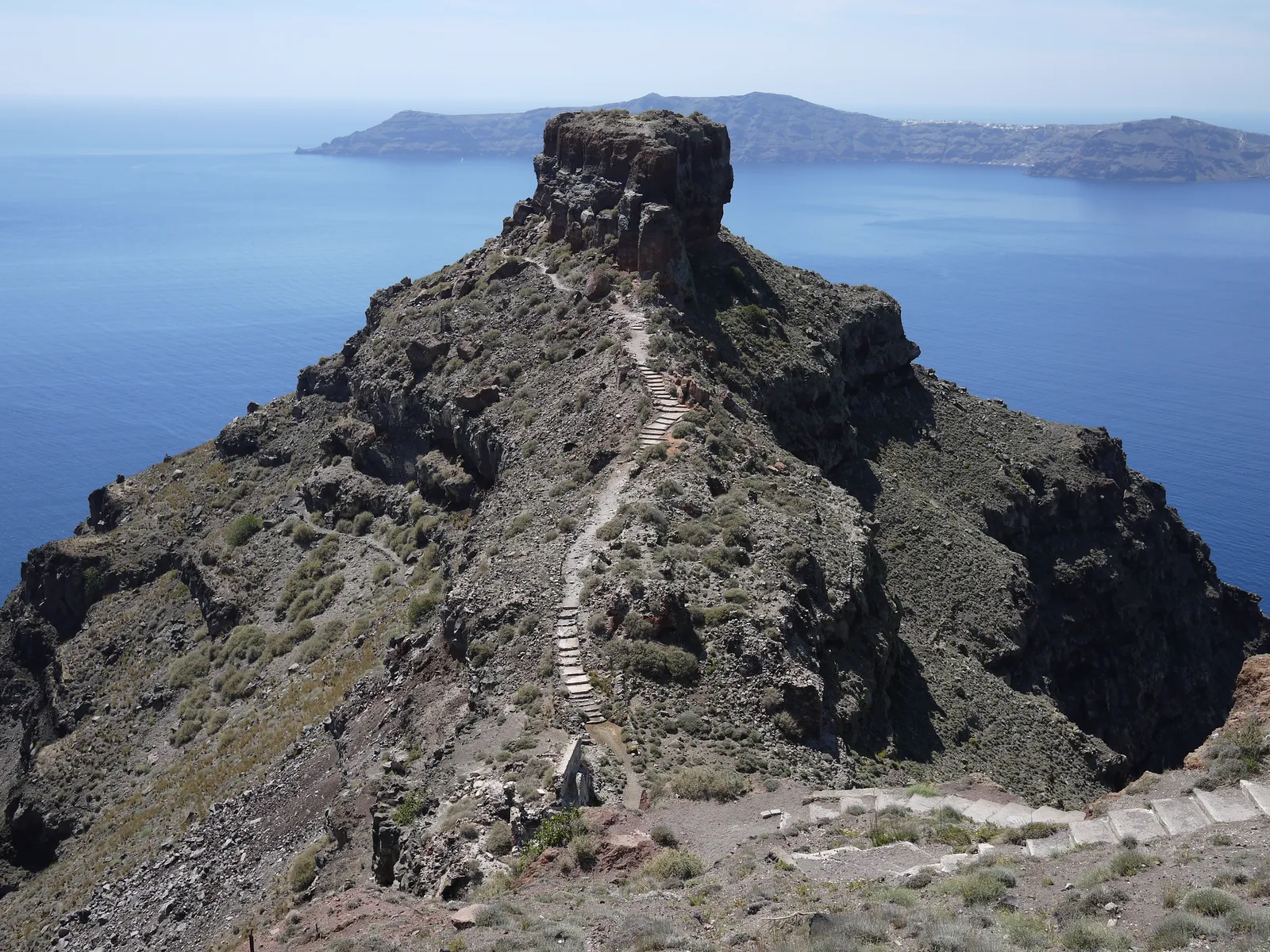
The detour worth taking is at Imerovigli, where a side path drops onto Skaros, the blunt headland sticking out into the caldera. Byzantine forces fortified it in the early 13th century and the Venetian architect Giacomo Barozzi finished the upper castle in 1207; by 1336 there were more than 200 houses on the rock and it was the island’s main settlement, its capital in everything but name. Eruptions and the earthquakes that came with them, worst between 1701 and 1711, dropped parts of the town into the water, and by the early 1800s people had moved off it for good. The chapel of Panagia Theoskepasti, tucked against the base of the rock, is still in use. Reckon on about 40 minutes down and back, plus a lot of steps.
The full walk to Oia plus the bus back takes most of five hours, which puts it out of reach unless you have close to seven in hand. With less than that, Fira to Imerovigli and back is the same view for a third of the effort.
Kamari’s black sand under Mesa Vouno
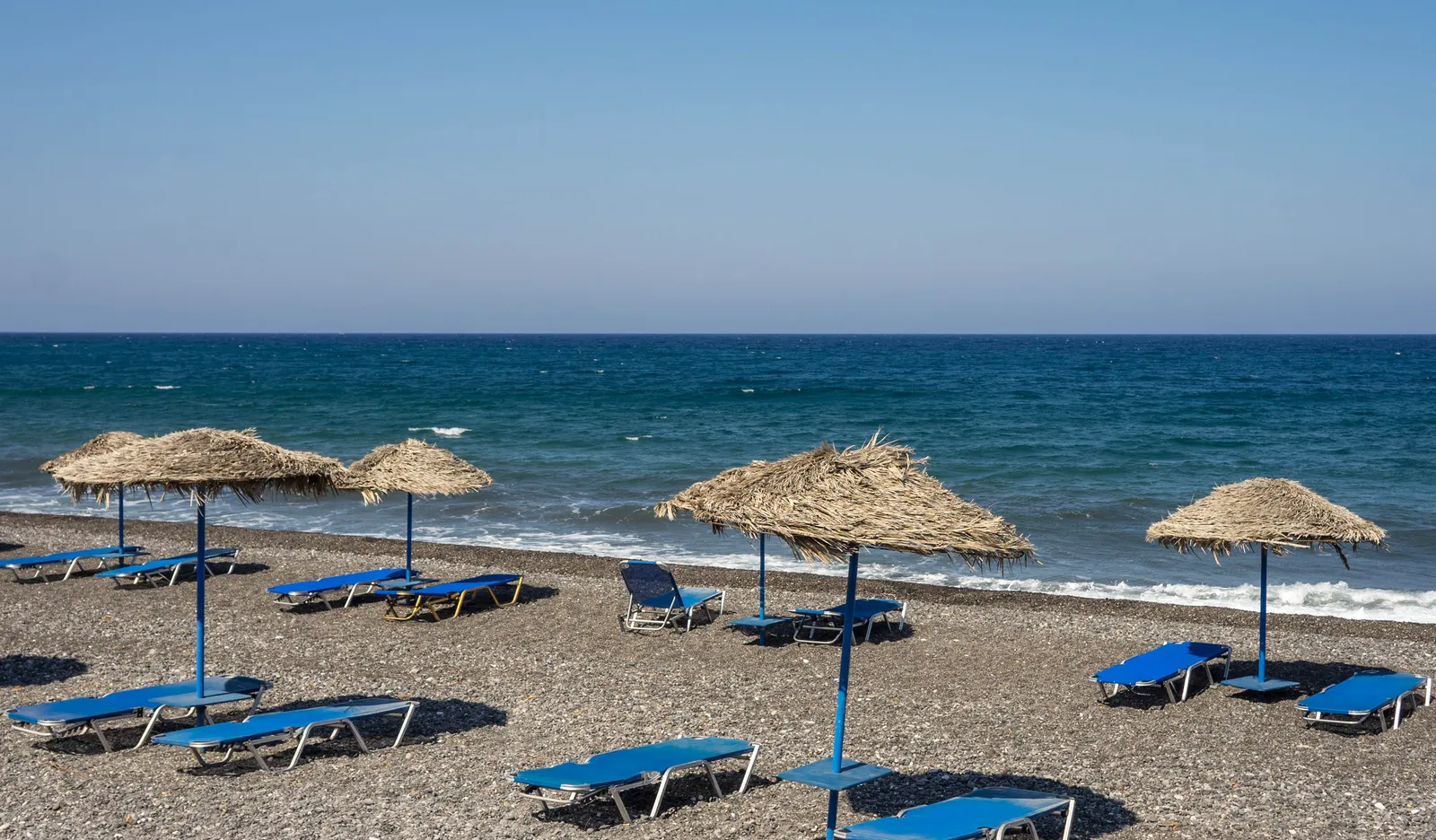
Kamari exists because of the 1956 earthquake too. The old village of Episkopi Gonias, inland and uphill, was almost entirely destroyed, and most of the people who had lived there moved down to the coast and built here instead. The beach they built behind runs several kilometres of coarse dark volcanic sand and shingle, lined with a paved promenade of tavernas and hire shops.
Closing the southern end is Mesa Vouno, a bare limestone ridge rising to around 360 metres straight off the sand. Ancient Thera is on top of it, the Hellenistic and Roman town that gave the island its other name, with a paved main street, a theatre cut into the slope and a terrace where the drop runs the whole way to the sea. Getting up means either a switchback road with limited parking at the summit, or a marked trail from Kamari that takes 45 minutes to an hour. Entry is 10 euros and the site is closed on Wednesdays, 08:30 to 15:30 otherwise, so it is a morning proposition rather than an afternoon one.
Santorini has no airport train, only a bus about once an hour
KTEL runs the only public route to Santorini (Thira) International Airport (JTR), between the terminal and Fira’s central bus station, at 2.20 euros paid in cash to a conductor who comes down the aisle after you board. There are no return tickets and no day passes. In season the first departure is around 06:00 and the last around 22:00, roughly hourly in between; outside the summer months the service thins to a handful of runs a day with gaps of 90 minutes or more, and the timetable changes through the year, sometimes more than once in a week.
The ride itself is short, about ten minutes on a clear road, and can stretch past twenty when August traffic backs up on the Fira approach. What actually costs time is the interchange, because nearly every route on the island begins and ends at that same yard in Fira: coming back from Oia or from Kamari means two buses and two separate fares, not one direct run. Kamari is the exception in one direction only, sitting about three kilometres down the coast from the terminal with no bus of its own between the two.
Working back from a flight, allow about two hours from the caldera rim: collecting the bag, the walk to the bus station, the wait, the ride and check-in. That walk is the argument for leaving the suitcase at a storage point in Fira for the afternoon rather than wheeling it around, since the rim path is steps and cobbles for most of its length and the cable car would charge you 5 euros extra for the privilege of bringing it down to the water.
Frequently asked questions
What should I do during a layover in Santorini?
Walk Fira's caldera rim first. It costs nothing, it runs the length of the town along the cliff edge, and the cable car station, the cathedral and the Museum of Prehistoric Thera all open off it within a few minutes of each other. The museum is the one indoor stop worth the 10 euros, holding the wall paintings and pottery dug out of Akrotiri, though it shuts at 15:30 and takes no visitors on Tuesdays, so it decides the shape of an afternoon. Oia is about half an hour north by bus for 2.20 euros, and its ruined Venetian castle is where the sunset crowd goes. Leave the 10.5-kilometre clifftop walk to Oia alone unless you have close to seven hours, because it takes three to five on its own.
How do you get between Santorini's villages without a car?
By bus, and almost always by changing in Fira. Nearly every route on the island starts and finishes at Fira's central bus station, so a trip from Oia to Kamari, or from a beach to the port, usually means two buses and two tickets rather than one direct run. Fares are about 2.20 euros a leg, paid in cash to a conductor who walks the aisle after you board rather than at a machine or a window. There are no return tickets and no day passes. Frequencies drop sharply outside the summer months, and the operator changes the timetable through the year, sometimes more than once in a week, so the board at the Fira station is worth a look before you commit to going anywhere with a flight to catch.
Is the Santorini cable car worth it, or is it better to walk up?
For anyone carrying something, the cable car. It covers the 220 metres between the Old Port and Fira in three to five minutes for 10 euros one way, 5 for a child between 6 and 12, and free below that, with six people to a cabin and a stated capacity of 1,200 an hour. The alternative is about 600 stepped switchbacks up the cliff, which takes an hour or more and is shared with the mules that still work the route. The catch is the surcharge: a large suitcase costs 5 euros of its own on top of the fare. The other catch is timing, because when a cruise ship is in the queue at either end can run half an hour to an hour.
Is the caldera walk from Fira doable in summer heat?
Yes, but only early or late. There is essentially no shade between Imerovigli and Oia, the ground is dark volcanic rock that holds the day's heat, and the middle of a July or August afternoon is the worst of it. Start close to sunrise if you are doing the full 10.5 kilometres, or save the walk for the last two hours of daylight and turn back at Imerovigli. Carry at least a litre and a half of water per person, because there is nowhere to buy any once you leave the built-up stretch through Firostefani. The paved section from Fira as far as Imerovigli passes cafes the whole way and is a much easier proposition in heat than the open ground beyond it.
Is the bus or a taxi better from Santorini airport?
The bus, unless the timetable has run out. KTEL runs Santorini (Thira) International Airport (JTR) to Fira for 2.20 euros, roughly hourly, with the first departure around 06:00 and the last around 22:00 in season; the ride is about ten minutes on a clear road and can stretch past twenty in August traffic. Winter drops to a handful of runs a day with gaps of 90 minutes or more. Santorini licenses somewhere around 40 taxis for the whole island against more than two million visitors a year, so one is not something to count on turning up at short notice, and a pre-booked transfer is the more reliable fallback if your flight lands or leaves outside the bus hours.