Santorini Layover Near Fira Bus Station
Part of the full Santorini's Caldera Rim on a JTR Layover
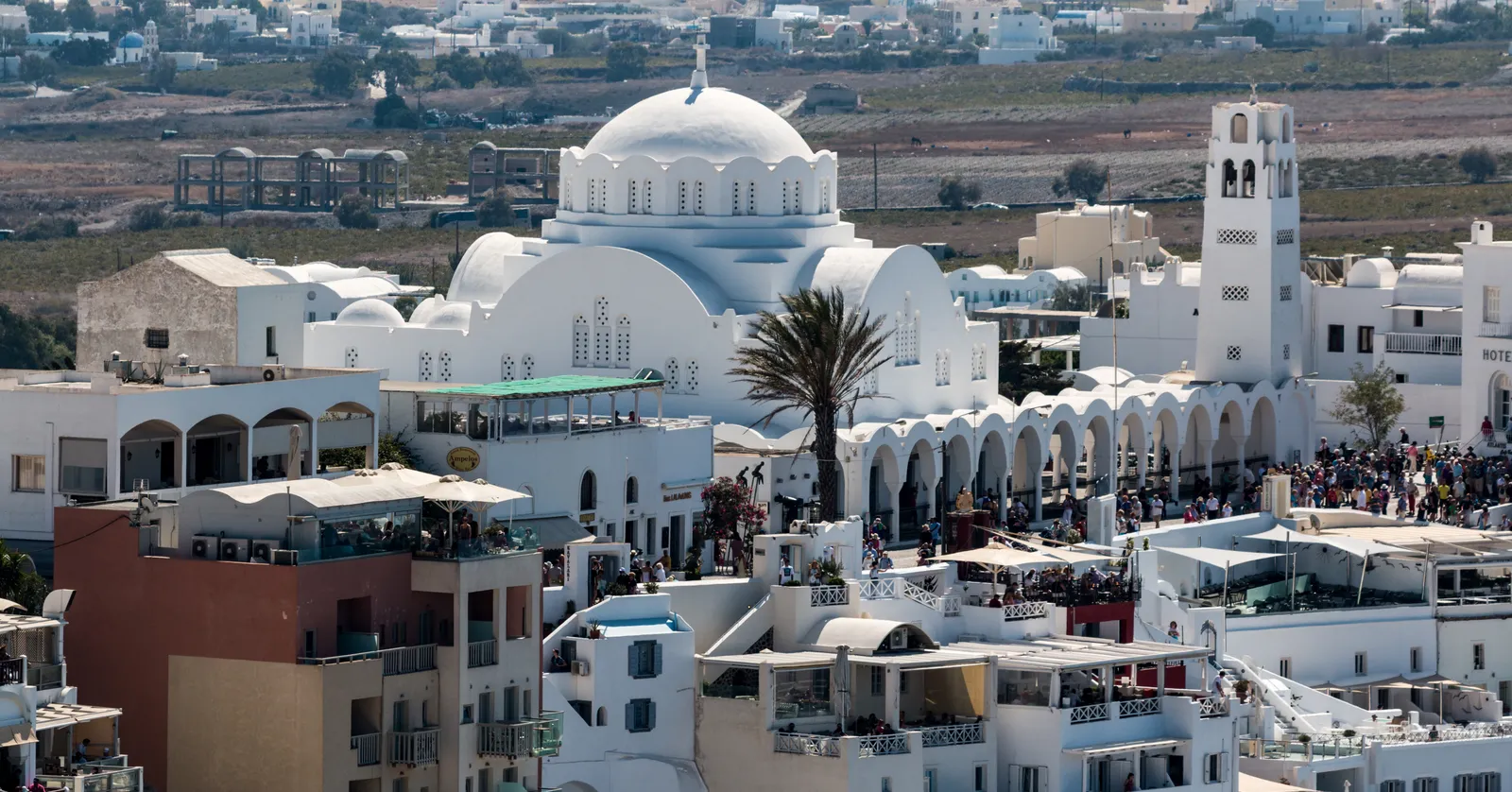
Fira’s central bus station in Santorini sits about five minutes’ walk from the Three Bells belfry on the caldera edge, the Catholic cathedral of Saint John the Baptist and an archaeological museum holding what the island produced long after the Bronze Age.
The Three Bells of Fira, a Catholic church of 1757
Three bronze bells hang in a stepped white arcade on the roof of the church of the Dormition, at the point where the town runs out and the cliff starts, and the blue dome next to them is the reason this particular building ends up on more postcards than anything else in Fira. The parish is Greek Byzantine Catholic rather than Orthodox, which is why the calendar on the door does not always match the one at the Orthodox cathedral two minutes away.
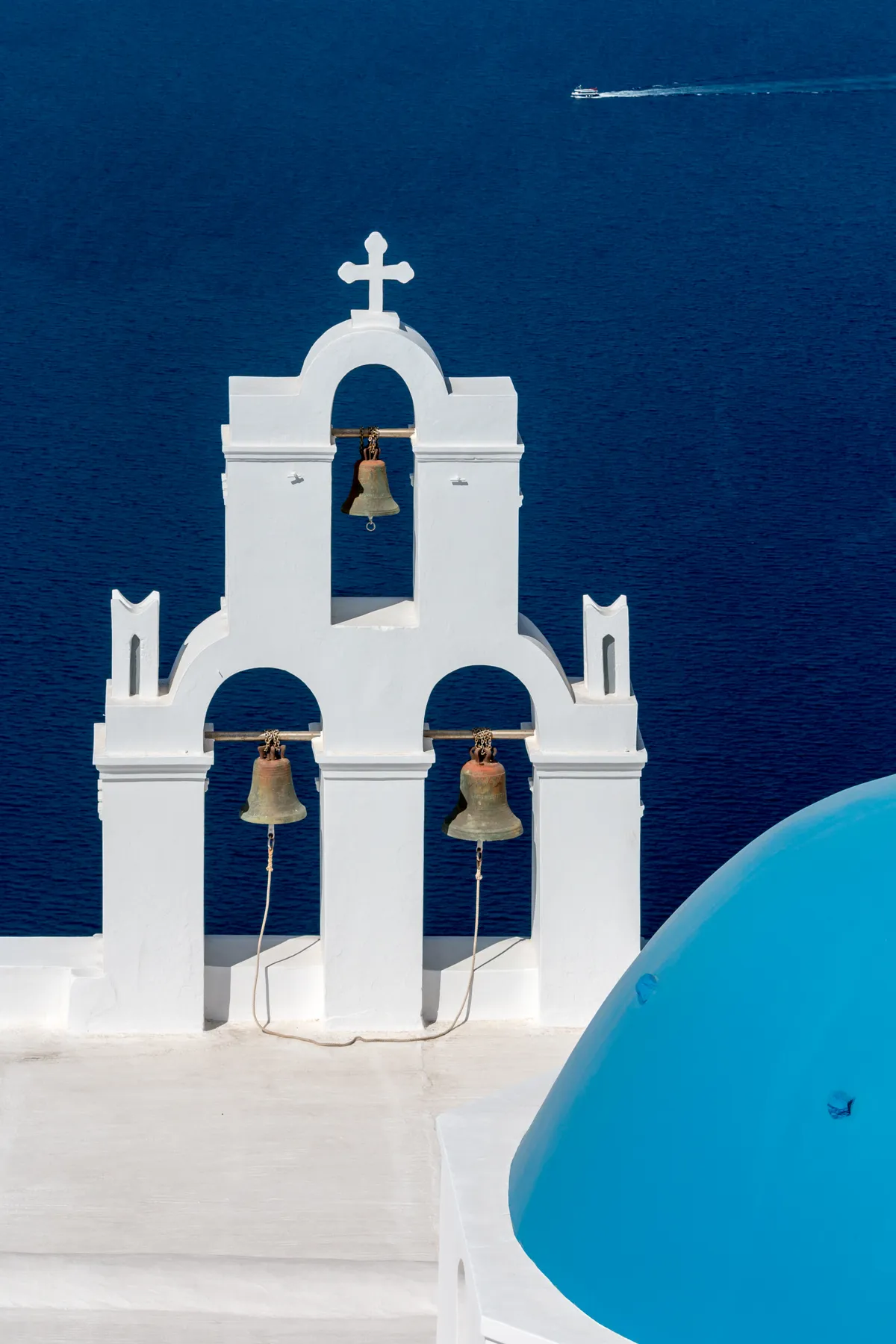
The building went up in 1757 and the 1956 earthquake damaged it badly enough to need a full restoration, which is the same story as almost every structure on this stretch of rim. Nothing here charges an entry fee and there is no gate to queue at; the belfry is on a rooftop below the walkway, so what you get is a view down onto it with the caldera behind, not a way inside. Coach itineraries built around this view exist, and a half-day run taking in this and the northern villages can be booked ahead if you would rather not work out the bus times yourself.
St John the Baptist, the Catholic cathedral Fira rebuilt in 1970
Centuries of Venetian and Latin rule left Santorini with a Catholic community big enough to still hold its own diocese, and the quarter those families settled sits immediately north of Theotokopoulou square, a knot of lanes and archways with a cathedral in the middle of it. Saint John the Baptist was finished in 1823 in blue-grey and cream Baroque Revival, has been the seat of the island’s Catholic diocese ever since, and was rebuilt from a wreck in 1970 after the 1956 earthquake.
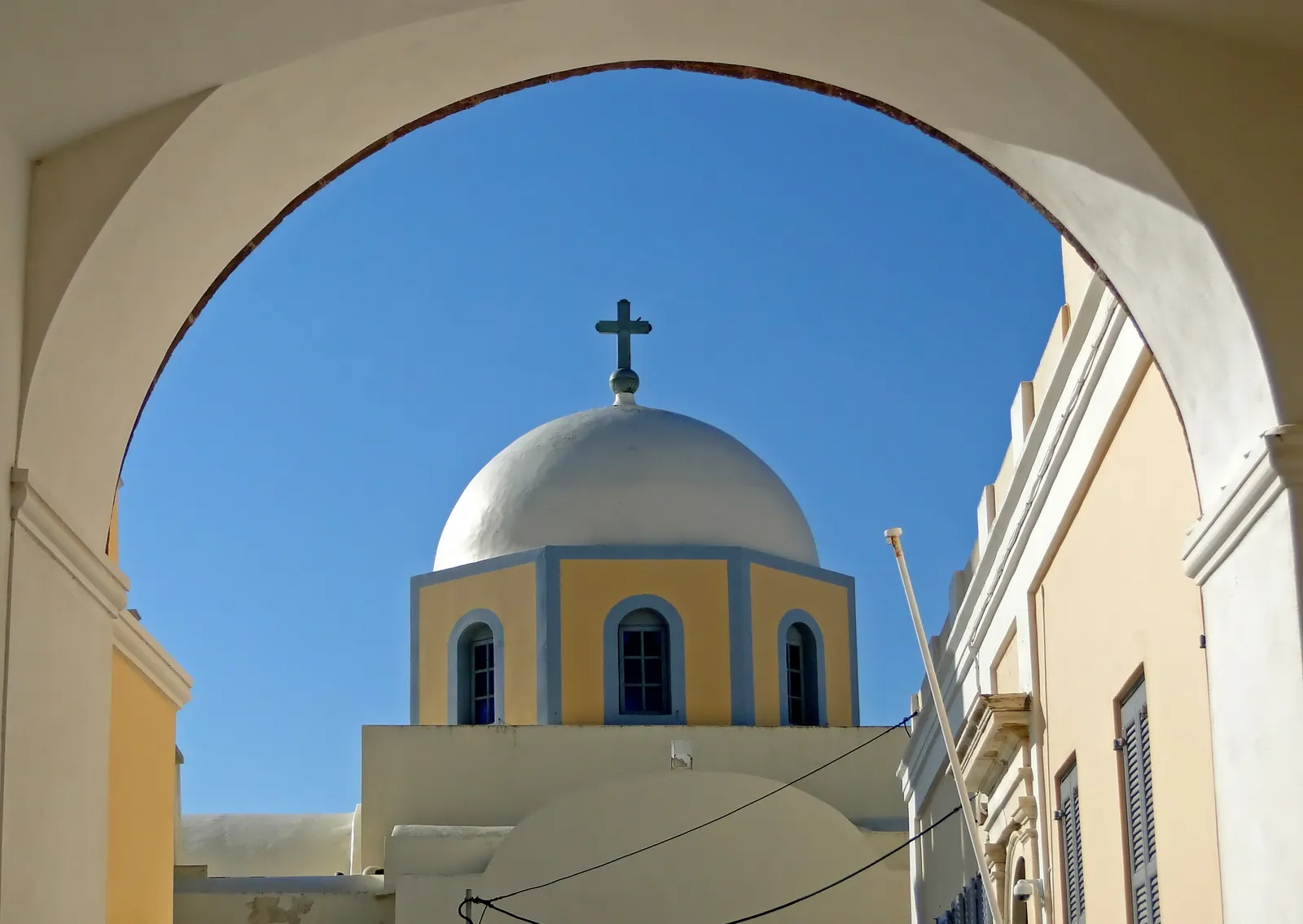
Behind it, on a lane that runs straight through the building, is the Dominican convent, founded in 1595 and so the oldest Catholic convent in Greece; the house it occupies now dates from 1864 and was patched up after 1956 like everything else. Twelve nuns live there. The convent itself is closed to visitors, but the church of Our Lady of the Rosary, consecrated in 1825, is not, and the lane through the property is a public right of way, so at the right hour you can hear Vespers being sung on the other side of a wall on your way past. A private half day around Fira covers this quarter properly if you would rather have the doors explained than guess at them.
The Archaeological Museum of Thera holds the island’s Greek and Roman finds
Two archaeological museums stand within a few hundred metres of each other in Fira and they do not overlap at all. The one on Erythrou Stavrou, near the top cable car station, starts where the volcano’s story stops: Geometric pottery, Archaic marble, Classical and Hellenistic material, Roman sculpture, almost all of it out of Ancient Thera and the burial ground below it on Mesa Vouno.
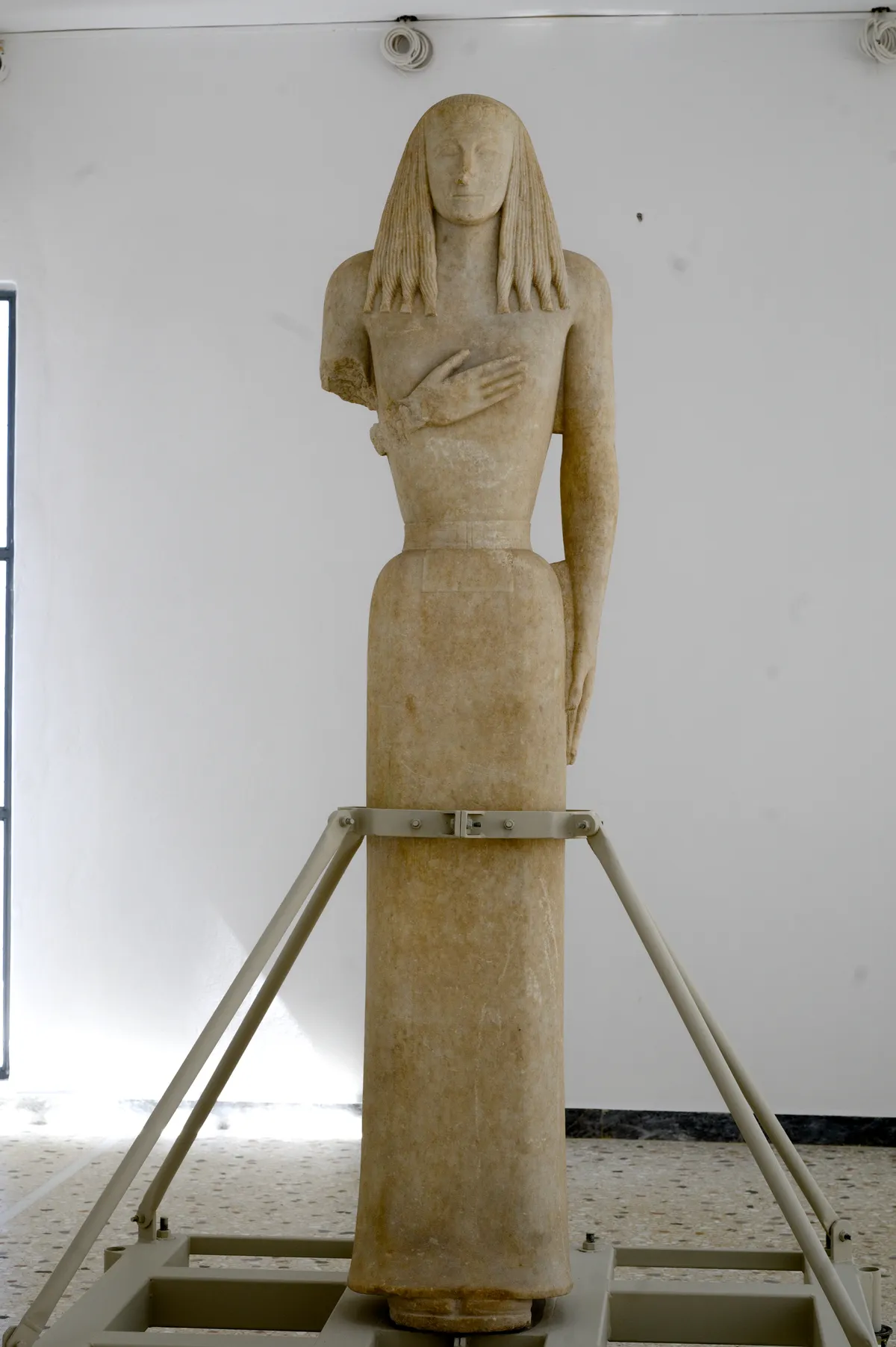
The piece to find is the Kore of Thera, a marble figure of a young woman from the second half of the 7th century BC, standing nearly her full height with braided hair falling in ridges to her shoulders. There are kouroi torsos in the same room and painted amphorae and pithoi around them. The building is a plain concrete box with a courtyard, put up by the Ministry of Public Works in 1960, and it costs a couple of euros against the ten the prehistoric collection charges. Hours run morning to mid-afternoon with one closing day a week, and published sources disagree on which day that is, so read the sign at the door rather than a schedule you found earlier.
Every route on Santorini starts and finishes in the same yard
Below Theotokopoulou square is a strip of tarmac where all eleven of the island’s bus routes terminate, and there is no way around it: there are almost no direct services between two outlying points, so a trip from Oia to a beach, or from the ferry port to anywhere but here, means arriving in this yard and boarding a second bus out of it. Fares are 2.20 euros a leg, cash, collected on board by a conductor who works the aisle once you are moving. No returns, no day passes, no machines.
That single-yard design is what makes the place tight: every route’s arriving passengers and every route’s departing queue occupy the same tarmac at the same time, and in the hour before the Oia sunset run there is not much floor left to stand a suitcase on.
If two hours is what you have, this radius is the whole trip and there is no need to go further. With five or more, the walk out along the rim and the ride down the cliff to the water open up, both covered in the full Santorini guide.
The last airport bus out of Fira goes at about ten
KTEL runs the terminal service from this same yard for 2.20 euros, roughly hourly, first departure around 06:00 and last around 22:00 through the season. Winter cuts that to a handful of runs a day with gaps of 90 minutes or more, and the operator revises the timetable through the year, sometimes more than once in a week, so the board in the yard is the only version that counts.
Santorini (Thira) International Airport (JTR) is about ten minutes away on a clear road and can take past twenty when August traffic backs up on the approach. There is no train and no metro anywhere on the island. Working backwards, ninety minutes from this square is enough on a normal day: the bag, the wait, the ride and check-in, with the walk from the caldera edge back up to the yard being the only climb in it, and the one part worth not doing with a suitcase in hand.
Frequently asked questions
What should I do during a layover near Fira Central Bus Station in Santorini?
Everything worth doing here is inside a five-minute radius, so the order barely matters. The Three Bells belfry on the caldera edge is free and takes as long as you want to give it. The Catholic cathedral of Saint John the Baptist and the Dominican convent's church behind it are both free and both quick. The Archaeological Museum of Thera is the one thing with a ticket and a closing time, holding the Greek and Roman material from Ancient Thera rather than the Bronze Age frescoes people come for, and it shuts by mid-afternoon with one closing day a week that different sources put on different days. Check its door before you plan around it.
How early should you get to Fira's bus station in summer?
Fifteen to twenty minutes for anything popular, and more for the last run of the evening. Nothing is reserved, seats are first come first served, and a bus that fills at the yard will leave people standing on the pavement rather than take them, which matters most on the Oia service in the hour before sunset and on the last departures of the evening. Buses do not always sit in the same spot in the yard either, and there are no numbered bays, so the destination on the windscreen is what you go by. Buy the ticket on board from the conductor after you sit down, in cash, one way only.
Is the walk from Fira's bus station to the caldera edge step-free?
Mostly, and then it stops being. The route from the yard up to Theotokopoulou square and along the shopping street is paved and gently graded, and the Catholic quarter's lanes are flat. The caldera edge itself is where it changes: the walkway along the rim is broken by short flights of steps in both directions, the terraces below it are reached only by stairs, and the paving is polished stone that gets slick when it rains. Anyone on wheels can reach the square and the cathedrals without difficulty, but the belfry viewpoints on the cliff involve steps.
Is there anything free to do near Fira's bus station?
Most of it, actually. The Three Bells belfry, the Catholic cathedral, the Orthodox cathedral, the church of Our Lady of the Rosary inside the Dominican convent and the whole caldera walkway cost nothing to look at, and the walkway is where the view people pay for on a boat is free from the land. What does cost money in this radius is the archaeological museum, a couple of euros, and the cable car down to the water, at ten. If you are counting every euro, a cash bus fare of 2.20 euros each way to a village and back is the largest expense the day needs.
Where does the airport bus leave from, and when does it stop for the night?
From the same yard as everything else. KTEL runs Fira's central bus station to Santorini (Thira) International Airport (JTR) for 2.20 euros in cash, roughly hourly, with the last departure around 22:00 in season and a much thinner service outside the summer months, sometimes with gaps of 90 minutes or more. The ride is about ten minutes when the road is clear and can pass twenty in August. There is no train and no metro on the island, so if the last bus has gone, a taxi or a pre-booked transfer is the only alternative, and Santorini licenses only around 40 taxis in total.