Santorini Layover Near Oia and Ammoudi Bay
Part of the full Santorini's Caldera Rim on a JTR Layover
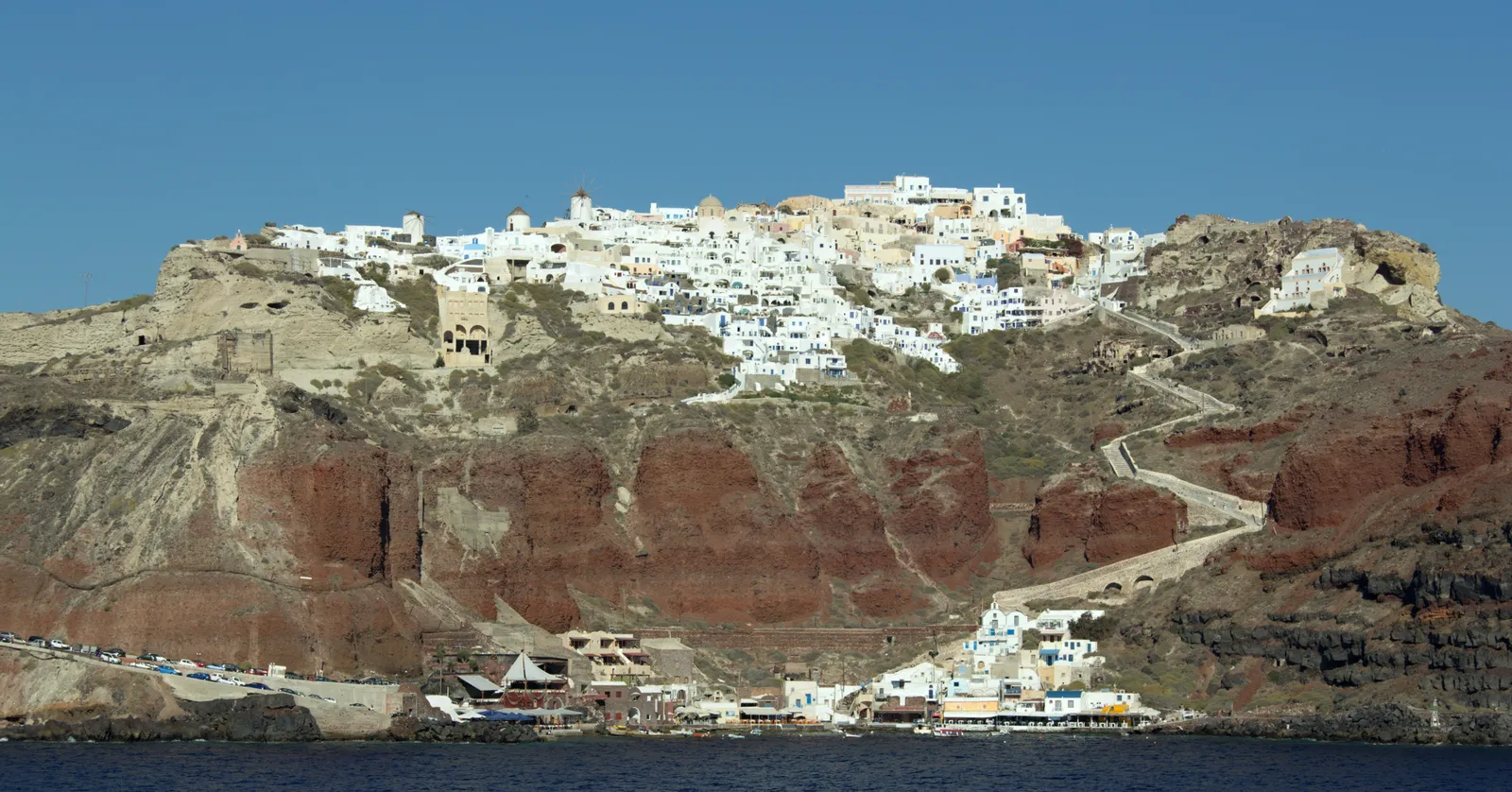
Oia, at the northern tip of Santorini, has a fishing quay called Ammoudi 278 steps below it, an 800-metre promenade from there to a chapel islet you can swim to, windmills on the ridge above the village, and a ruined castle at the western end that everyone watches the sunset from.
Ammoudi Bay sits at the foot of Oia’s red cliff
The stair down is cut into rock that is genuinely red, iron-stained volcanic layers stacked like sediment, and at the bottom is a working quay: fishing boats tied to the wall, a handful of tavernas with their tables set at the waterline, and the catch arriving in front of the people about to eat it. A narrow road reaches the same place for anyone not walking.
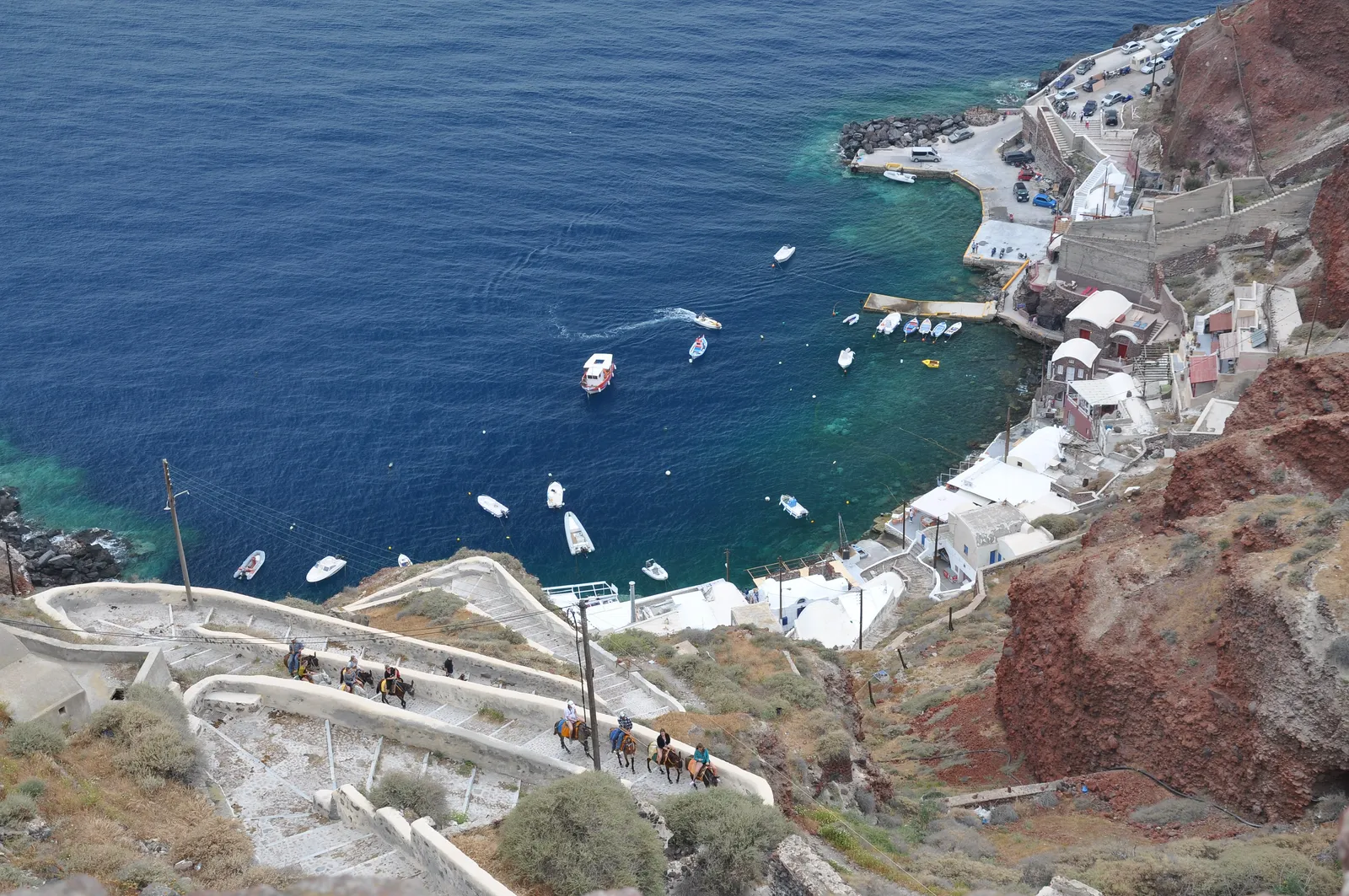
Keep going past the last taverna. A dirt path runs about five minutes around the base of the cliff to a flat rock platform with a ladder into deep, clear water, and roughly 800 metres of promenade from the bay ends at Agios Nikolaos Peramataris, the islet with a chapel on it that people swim across to and jump off. None of that costs anything and there is nothing organised about it: no lifeguard, no changing room, no shade. The bay is also where the small boats leave from, and a small-group sail that finishes off Oia at sunset is the version worth booking ahead, since the caldera boats sell out first in August.
The sunset crowd takes the castle ruin an hour early
Fifteenth-century Venetian builders put a lookout on the western headland to watch for pirate sails, the 1956 earthquake took most of it down, and what is left is a tower base and a run of low wall with no gate, no ticket and no limit on how many people stand on it. That last part is the problem: in July and August the ruin is occupied well before the sun starts moving, and the marble street feeding out to it narrows to single file with everyone walking the same direction at the same time.
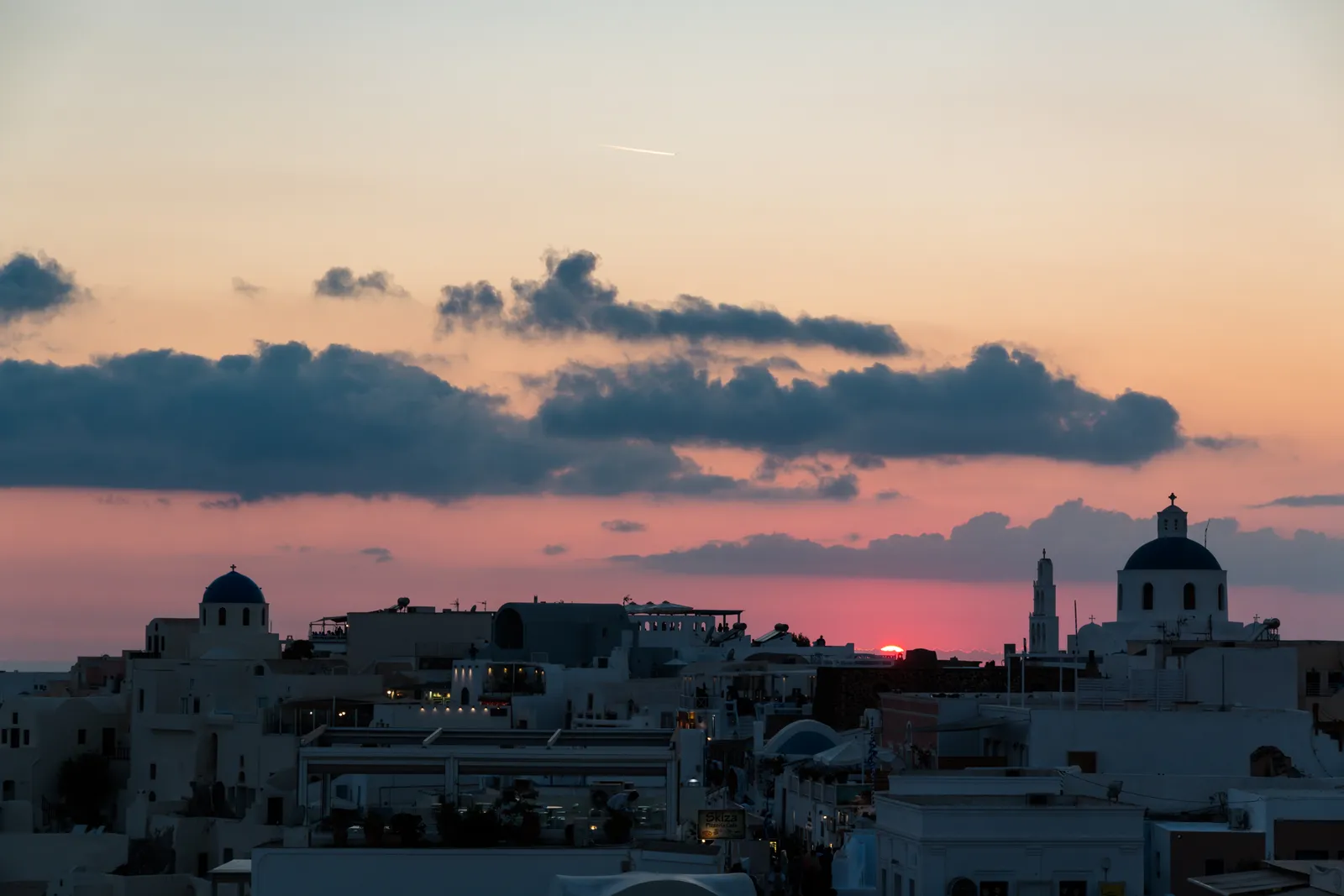
The sun sets over open water from anywhere along this side of the village, which is worth remembering before committing an hour to holding a spot. The terraces above Ammoudi and the ridge behind the windmills face the same horizon and take a fraction of the traffic. If you would rather have the timing handled and a seat back afterwards, a guided evening run with pick-up included removes the part of this that goes wrong on a flight day, which is the return journey rather than the view.
The windmills stand on the ridge at the top of Oia
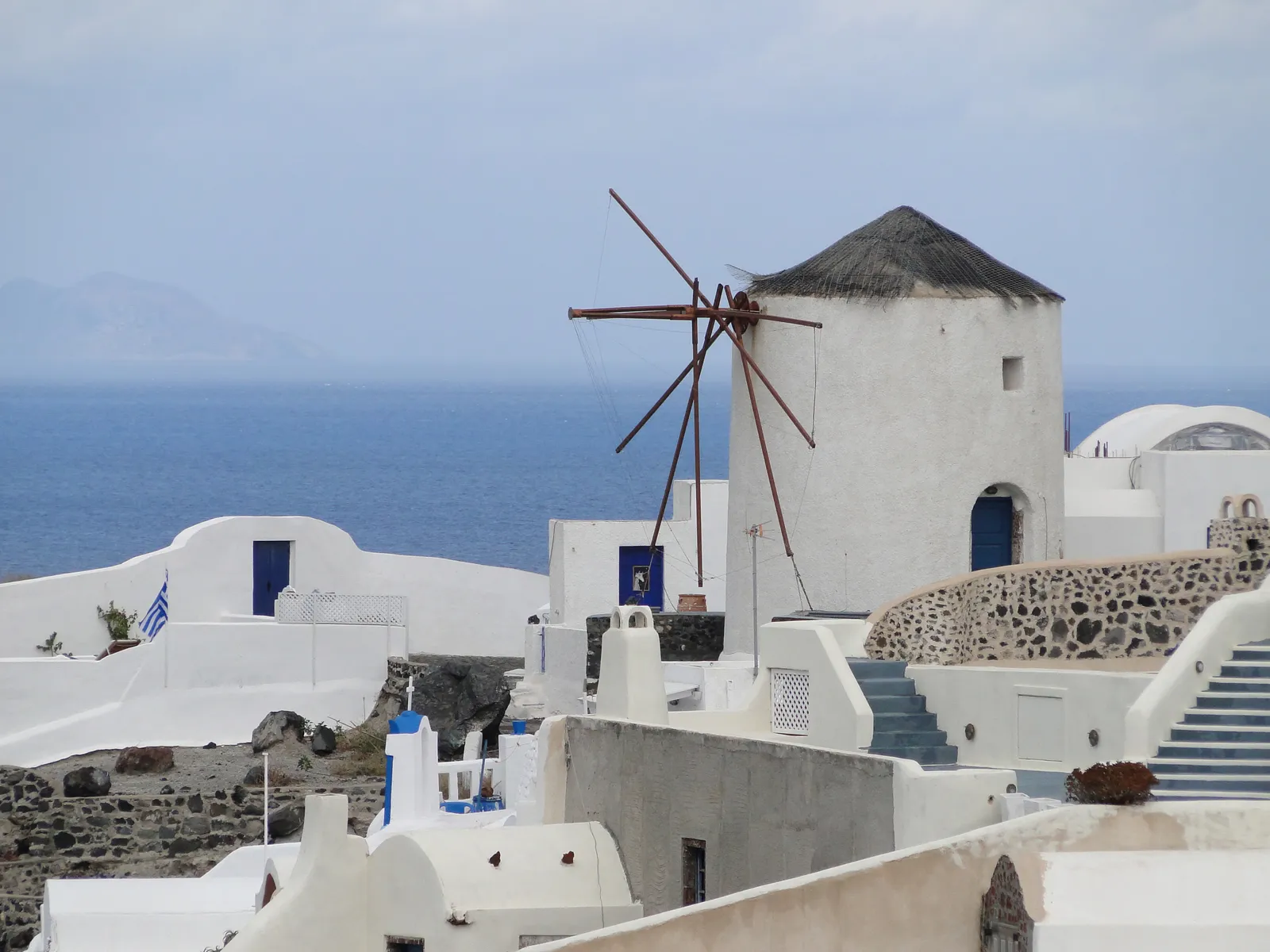
Three of Oia’s windmills are still standing, whitewashed cylinders with dark conical caps and their bare wooden sail frames intact. They ground grain when Oia’s money came off the sea rather than out of tourism: in the nineteenth century this was a shipping village, and the captains who owned the fleets built the two-storey mansions that still stand along the main street below.
That main street is the other thing to walk. It runs the length of Oia in broad, level marble, which is unusual here and the reason the crowds move along it rather than through the lanes, and the houses either side are cave dwellings dug back into soft pumice rather than built out of it. Almost all of it went down in 1956 and was put back afterwards.
The 278 steps back up from Ammoudi are where a suitcase costs time rather than just effort, and there is no ramp and no handrail for most of the climb.
Buses from Oia go to Fira and nowhere else
Fira’s central bus station is 20 to 30 minutes and 2.20 euros away, with departures roughly every half hour through summer and the last one around 21:00. On a flight evening that 21:00 run is the real deadline, because it lands well before the airport bus stops running but leaves no margin if the sunset crowd puts you at the back of a full bus.
At Fira’s central bus station you buy a second ticket and board the KTEL run to Santorini (Thira) International Airport (JTR), 2.20 euros again, about ten minutes on a clear road, roughly hourly and finishing around 22:00 in season. There is no train anywhere on the island and no direct service from here. Working backwards, leaving Oia two and a half hours before departure is the honest figure, and anyone with less than three hours in hand should stay on the caldera rim in Fira instead, which the full Santorini guide covers.
Frequently asked questions
What should I do during a layover near Oia in Santorini?
Go down before you go up. Ammoudi Bay is 278 steps below the village, and the promenade past the last taverna runs about 800 metres to a rock platform where people swim out to a chapel islet, which is the one thing here that costs nothing and takes as long as you let it. Come back up for the windmills on the ridge, then the castle ruin at the western tip for the sunset, arriving an hour early if it is July or August. Three hours covers all of it comfortably; a boat trip out of the bay needs more like five, and books out in high season.
Can you swim at Ammoudi Bay?
Yes, though not off a beach. There is no sand here, only the quay and then a dirt path that runs about five minutes past the last taverna to a flat rock platform with a ladder bolted into it and deep, clear water below. From there it is a short, easy swim across to Agios Nikolaos Peramataris, the rock islet with a chapel on it, and people jump off the rocks around it. The water is deep right off the edge and there is no lifeguard, no changing hut and no shade, so take what you need with you and check the depth yourself before anyone jumps.
How busy does Oia get at sunset, and when should you arrive?
Busy enough that position is decided well before the sun moves. The castle ruin at the western tip is the standard spot and it has no ticket, no barrier and no capacity limit, so through July and August people start settling on it more than an hour ahead and the marble street feeding it becomes single-file. The ridge with the windmills and the terraces above Ammoudi both look at the same horizon with a fraction of the crowd. If you are on a flight that evening, note that the last bus out of Oia leaves around 21:00 and it fills.
Is Oia manageable with a toddler or a pushchair?
On the main street, yes; below it, no. Oia's central lane is broad, paved and largely level, which is why it carries the crowds, and the shops, the churches and the castle approach all open off it. Everything else in the village is steps: the lanes drop away from that spine in flights of stairs with no ramps, terraces are reached by staircases, and the descent to Ammoudi is 278 uneven steps with a drop on one side and no barrier for much of it. The road down to the bay exists for cars, so the water is reachable on wheels, just not on foot with them.
When does the last bus leave Oia, and can you get to the airport from here directly?
Not directly, no. Buses from Oia run to Fira and only to Fira, taking 20 to 30 minutes for 2.20 euros in cash, roughly every half hour in summer with the last departure around 21:00. From Fira's central bus station you change onto the KTEL service to Santorini (Thira) International Airport (JTR), another 2.20 euros and about ten minutes, hourly, with the last run around 22:00 in season. Two buses, two fares, and a connection in the middle, so treat 21:00 out of Oia as the real deadline rather than the airport bus's own last departure.