Santorini Layover Near Fira's Old Port
Part of the full Santorini's Caldera Rim on a JTR Layover
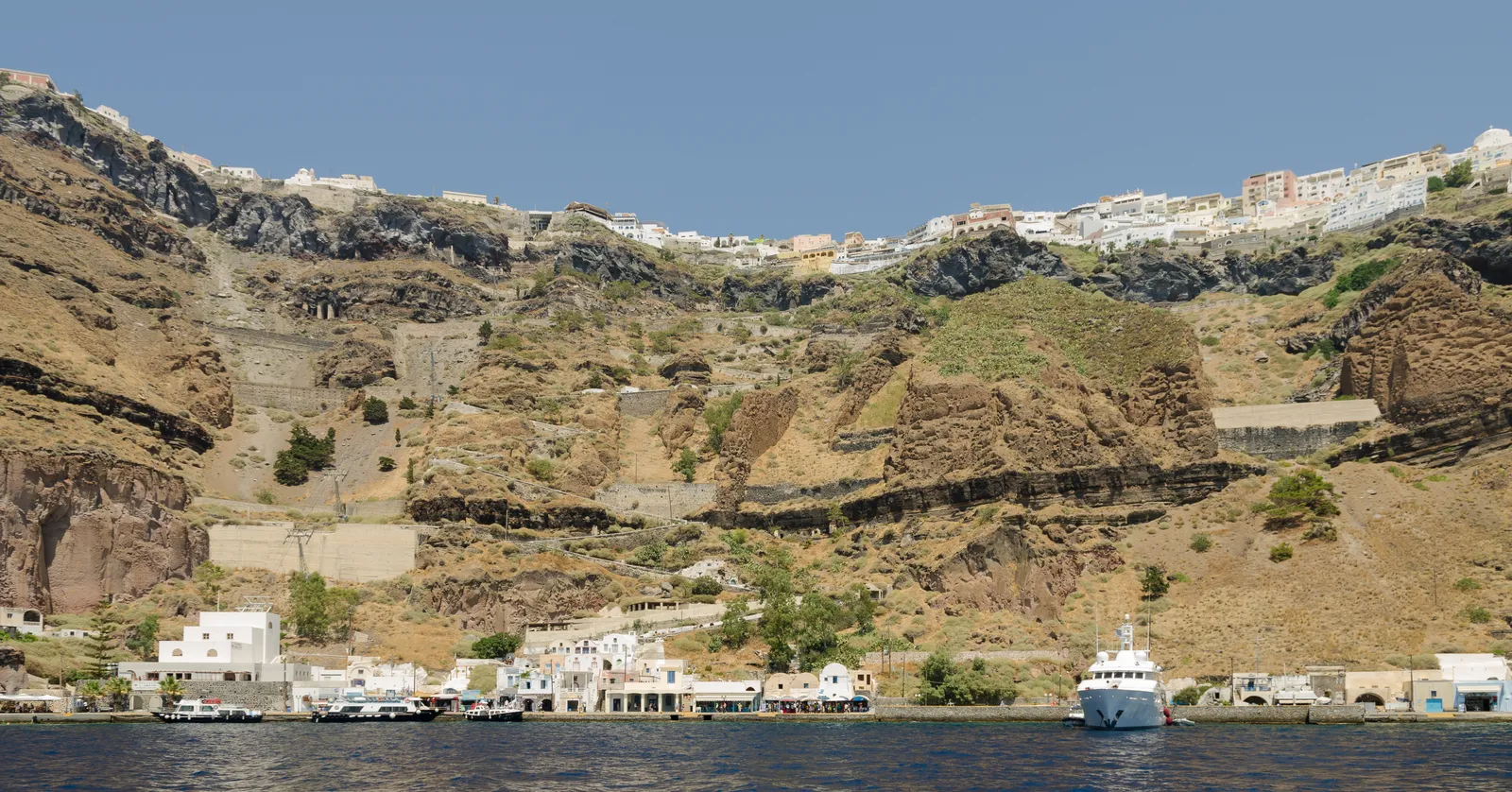
Fira’s Old Port in Santorini is a quay at the foot of a 220-metre cliff where the boats out to the Nea Kameni crater and the warm springs off Palea Kameni tie up, reached by cable car, by 587 steps, or by mule.
Nea Kameni is an active volcano you can walk the rim of
The dark cone in the middle of the caldera started building in 1573 and is still growing, and boats from the quay cross to it in 20 to 30 minutes. Five euros in cash gets you off the landing stage and onto the path, which climbs a mile or so of loose grey and rust-red gravel to the crater rim, where fumaroles push out steam you can feel and smell before you see it.
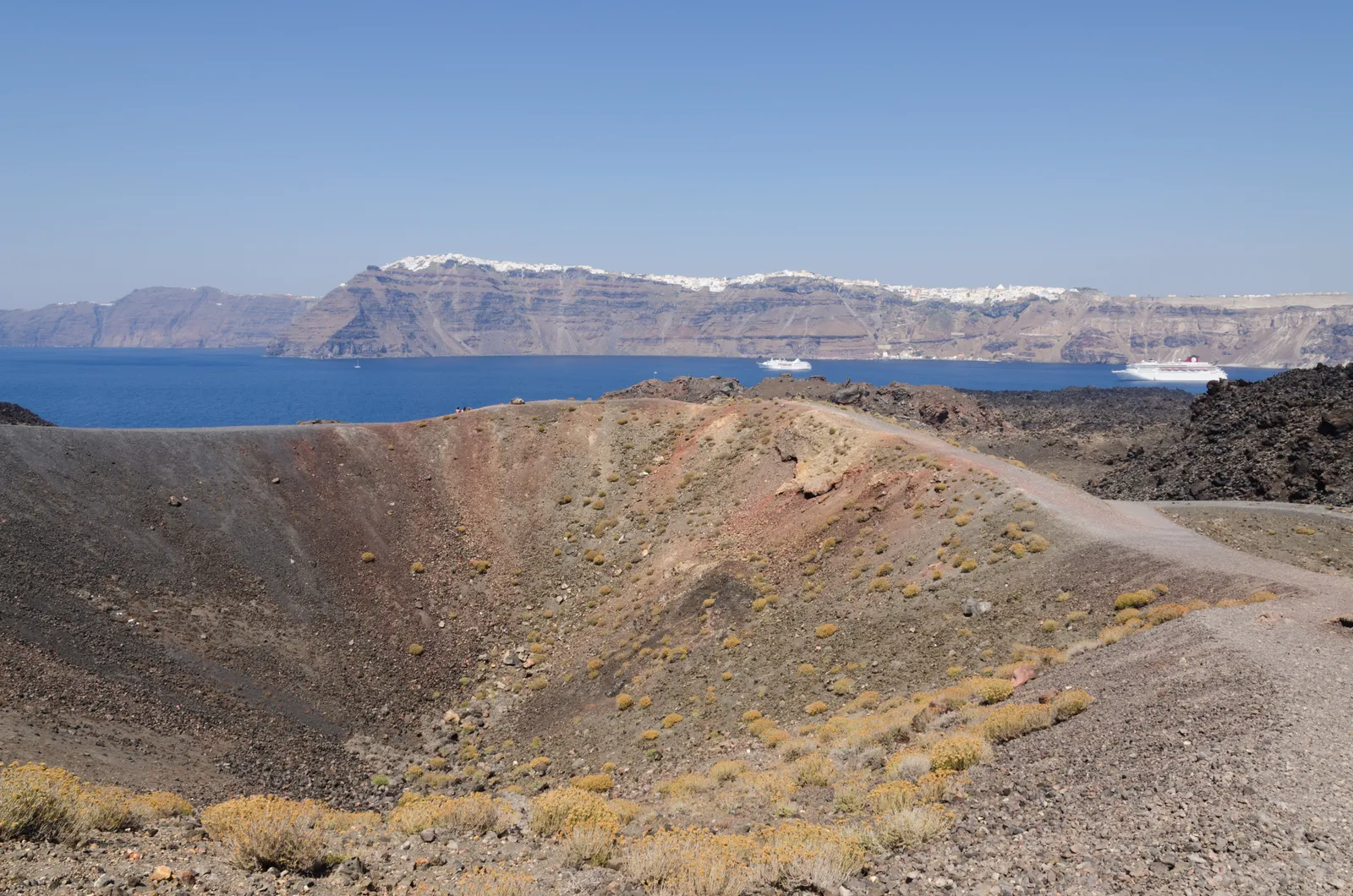
Nothing up there is shaded, and the surface holds heat, so the climb is unpleasant in the middle of a July afternoon and fine either side of it. The other half of the standard trip is the anchorage off Palea Kameni, the older islet next door, where mineral vents warm a cove and turn the water an opaque orange-brown; boats stop offshore rather than come alongside, so getting into it means swimming 30 to 50 metres. Longer runs add Thirassia, the fragment of the old island on the far side of the caldera, and that version can be booked before you arrive, which is worth doing in August when the morning departures fill.
The excursion boats tie up along Mesa Gialos
The quay is barely wider than the road that runs along it, a single line of tavernas, cafes and souvenir shops pressed between the water and the rock, and everything on it is aimed at people who arrived by sea. Every cruise ship anchored in the caldera lands its tenders here and takes them back from the same berths, which is why the strip empties and refills in waves through the day rather than filling steadily.
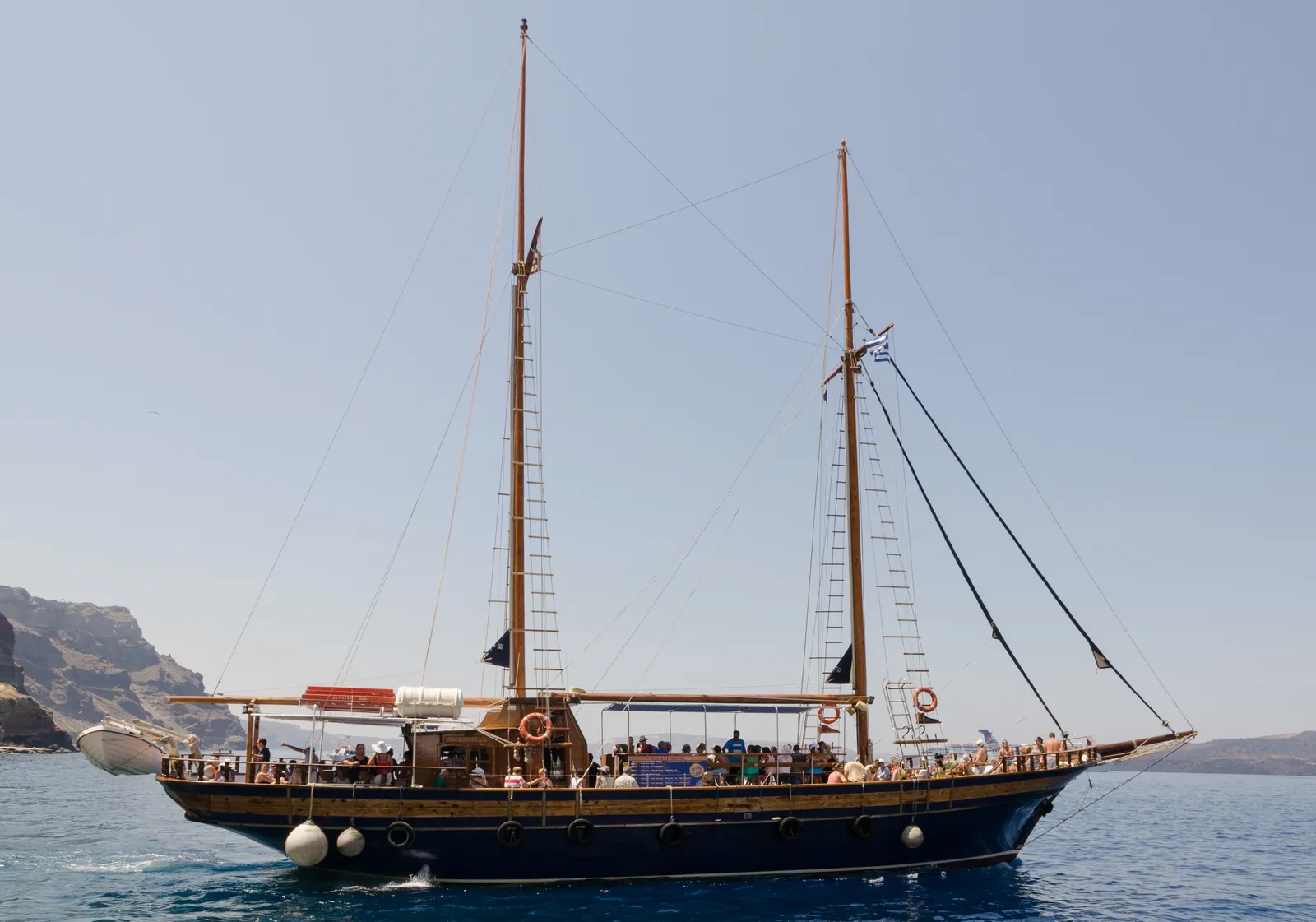
The boats themselves are worth a look before you pick one. Some of the caldera runs are on wooden two-masted gulets with open decks and no cover, others on faster modern launches, and the difference decides whether four hours out there is a pleasure or an endurance test in full sun. Nothing here sells supplies beyond food and drink, so water for the volcano walk is a thing to buy at the top of the cliff rather than the bottom.
The old path up the cliff is 587 steps and still worked by mules
Before the cable car opened in 1982 this was the only way between the harbour and the town, a zigzag stair cut into the caldera wall, and it is still open, still free, and still used by the donkeys and mules that carry riders up it. Greece’s Ministry of Rural Development and Food tightened the rules on those animals in 2018, capping any load at 100 kilos or a fifth of the animal’s own weight and setting requirements for daily exercise and water.
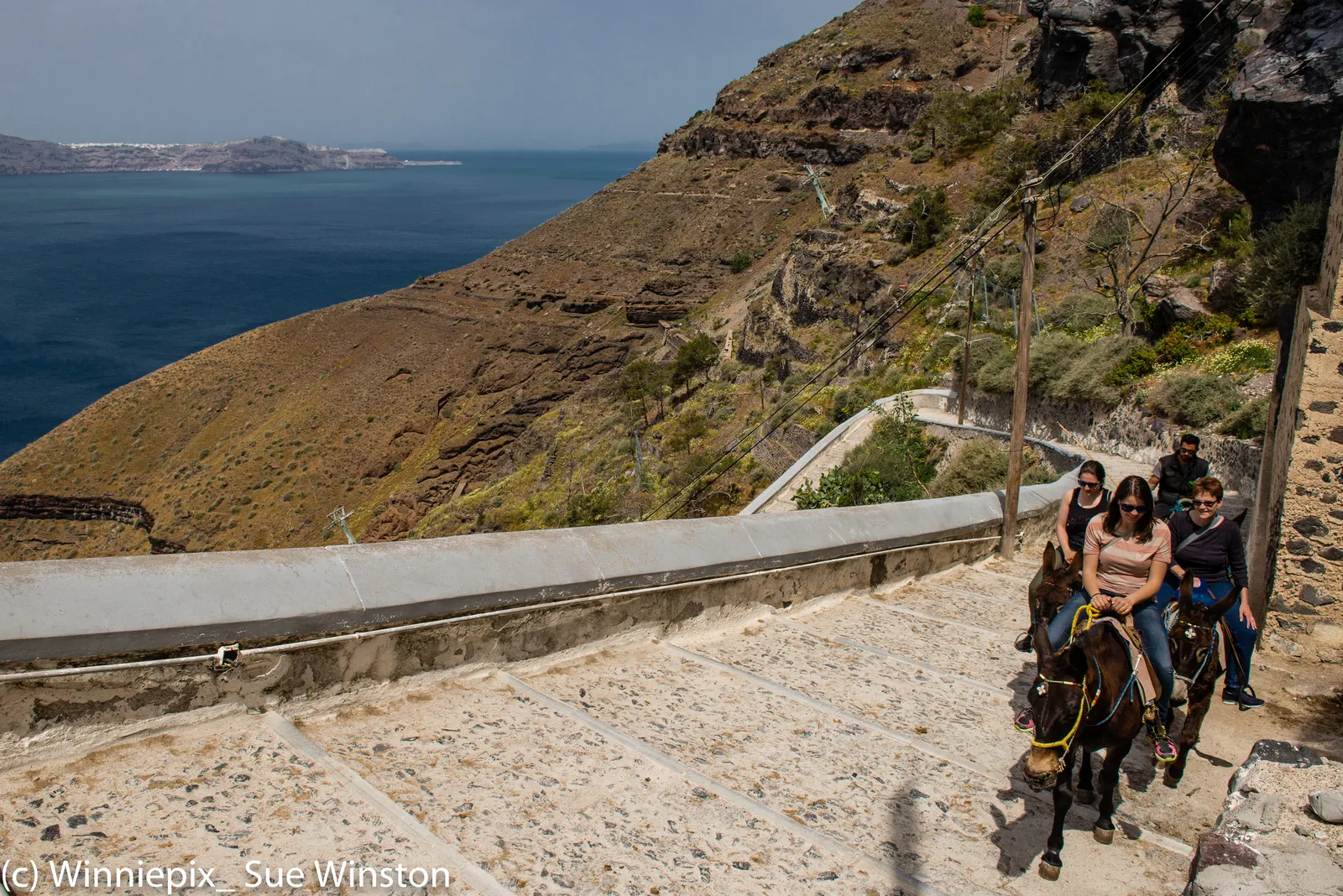
On foot it takes about an hour going up and the steps are uneven, worn smooth in places and fouled in others, with no handrail on the outer edge for much of it. The animals have right of way in practice whether or not they have it in principle.
Carrying a suitcase up 587 steps is not a realistic option, and the cable car charges 5 euros for a large one on top of its 10 euro fare.
Anyone with only a couple of hours should skip the water entirely and stay on the rim instead, where the walk and the town’s museums are covered in the full Santorini guide; this quay is worth the trip only if a boat is part of the plan.
Two separate journeys stand between this quay and the terminal
The cable car is the first of them: 220 metres in three to five minutes for 10 euros one way, six people to a cabin, running from 06:30 to 23:00 at the height of summer and on a much shorter split timetable in winter. When a cruise ship is in, the queue at the lower station can run half an hour to an hour, and that queue is the part of the day most likely to cost you a flight.
From the top station it is a few minutes’ walk through the town to Fira’s central bus station, where KTEL runs the only public service to Santorini (Thira) International Airport (JTR), 2.20 euros in cash, roughly hourly, last departure around 22:00 in season and far thinner outside it. The ride is about ten minutes on a clear road. Two hours from the quay is a sensible figure on a normal day, and more than that if a ship is anchored out in front of you.
Frequently asked questions
What should I do during a layover near Fira Old Port in Santorini?
Get on a boat. The quay at Mesa Gialos exists mainly to put people on the water, and the standard run crosses to Nea Kameni in 20 to 30 minutes, walks you up to the crater rim for a 5 euro cash entrance fee, then anchors off Palea Kameni so you can swim into the warm sulphur springs. Budget four hours for the round trip including the swim, or closer to six if the boat calls at Thirassia as well. If that will not fit, the quay itself is a short strip of tavernas and shops under the cliff, and the walk up the old stepped path is free and takes about an hour.
How long does the volcano and hot springs trip take from the Old Port?
Four hours is the honest minimum for the basic version and six for the longer one. The crossing to Nea Kameni is 20 to 30 minutes each way, the crater walk is a shadeless climb of roughly a mile out and back on loose volcanic gravel, and the hot springs stop needs you to swim 30 to 50 metres from the boat to reach the warm water, so allow for drying off. Boats that add Thirassia give you free time ashore on top of that. The volcano's own entrance is 5 euros in cash, usually bundled into the ticket price but worth carrying anyway.
Is riding a donkey up from Fira's Old Port a good idea?
It is regulated now, and it is still worth thinking about. After animal welfare campaigns, Greece's Ministry of Rural Development and Food amended Law 1197/81 in 2018 so that a working donkey, horse or mule cannot carry a load over 100 kilos or more than a fifth of the animal's own weight, with rules on daily exercise and water alongside it. The stepped path is also shared: the animals use the same 587 steps as everyone walking, and they are not always given room. If the point is getting up the cliff rather than the ride itself, the cable car does it in three to five minutes.
Is there anywhere to eat or get out of the sun at the Old Port?
Along the quay, yes, and nowhere else. Mesa Gialos is a single strip of tavernas, cafes and souvenir shops squeezed between the water and the cliff, so shade means a taverna awning or the shadow of the rock itself, and there is nothing behind it but the cliff face. Prices at the water reflect a captive cruise-tender audience. There is no supermarket, no pharmacy and no bank down here, so anything you might need buying is a cable car ride back up to the town.
How long does it take to get from the Old Port to the airport?
Allow two hours, because it is two separate journeys with a queue between them. The cable car covers the 220 metres up to Fira in three to five minutes for 10 euros one way, plus 5 euros for a large suitcase, but when a cruise ship is anchored out in the caldera the line at the bottom station can run half an hour to an hour. From the top it is a short walk to Fira's central bus station, and KTEL runs from there to Santorini (Thira) International Airport (JTR) for 2.20 euros in cash, roughly hourly, with the last departure around 22:00 in season.