Santorini Layover Near Athinios Ferry Port
Part of the full Santorini's Caldera Rim on a JTR Layover
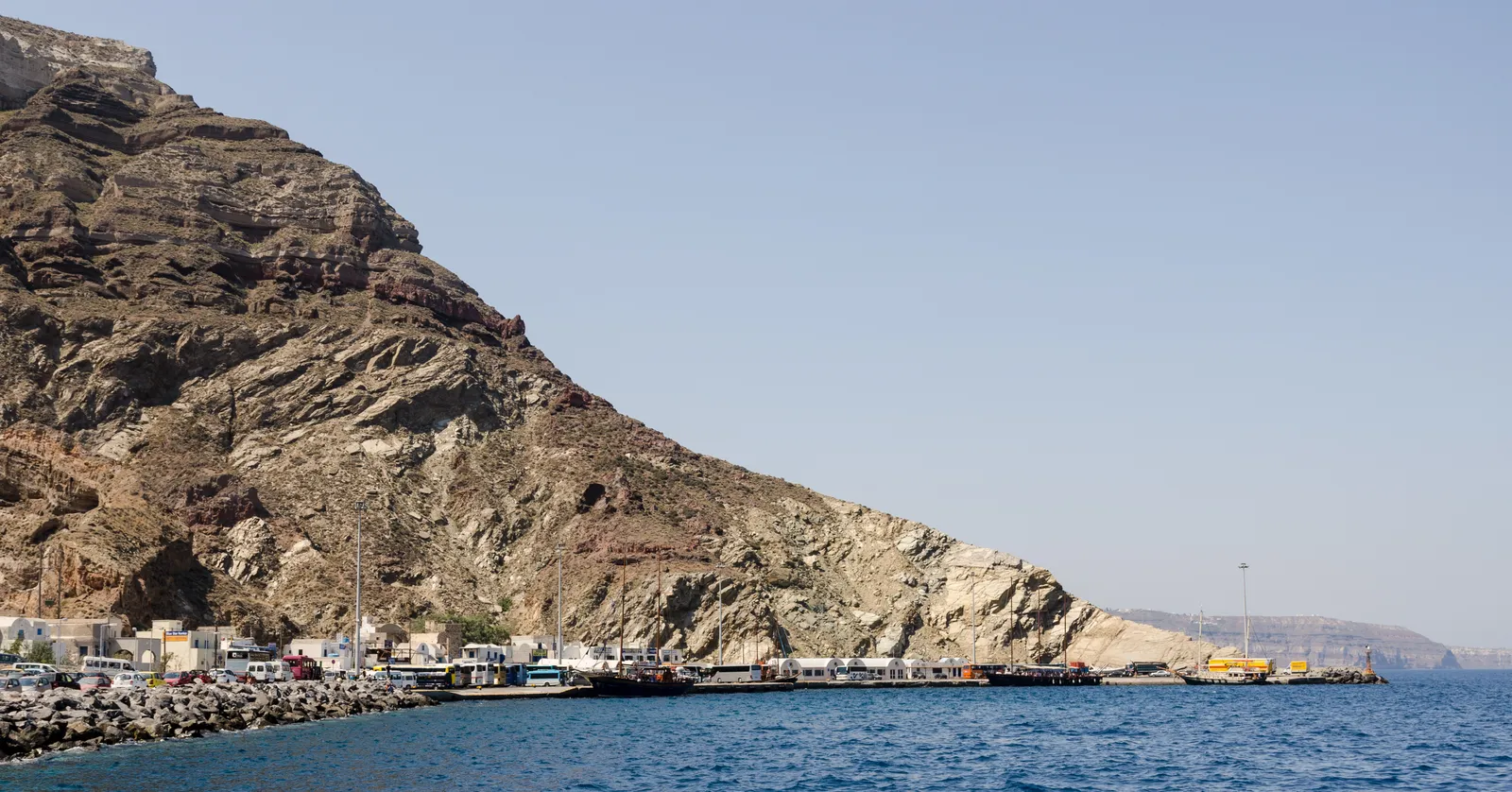
Athinios, the ferry port on Santorini’s southwest coast, sits at the bottom of a switchback road with Pyrgos and its Venetian castle about five kilometres up it, Megalochori’s bell towers a little nearer, and a 1947 winery cut into the cliff directly overhead.
One road leaves Athinios, and the buses go when the ferries do
The quay is a single strip of tarmac under a cliff: ticket offices, a few kiosks, a small covered waiting area, parking, and nothing else. No arrival hall, no baggage system, no lockers as standard, and no town behind it, because there is no flat ground for one. When several boats dock inside an hour, which is routine in July and August, that strip carries every arriving passenger, every departing one and every driver holding a name board, all at once.
Buses meet the ferries rather than running to a clock, which is why the schedule is posted only a day ahead: about 2.70 euros and 20 to 25 minutes up the switchbacks to Fira, which sits eight to ten kilometres north depending on which measure you take.
The thing directly overhead is worth knowing about. Santorini had no mains electricity in 1947, which is why Venetsanos, the island’s first industrial winery, is stacked on four levels down the face of the caldera wall rather than laid out flat: grapes went in at the top and the wine moved between each stage by falling, with no pumps involved, then travelled down a pipe more than 300 metres to this quay to be loaded straight onto ships. A rusted length of tube at the end of a tunnel is what survives of that. Its terrace looks down on the ferry berths, and an evening tasting run that stops here and at the wine museum inland is the version that solves the transport, which matters at a port with no bus of its own to anywhere but Fira.
Anything carried off a boat here stays with you until Fira, because the quay has nowhere to leave it and no bus out that is not tied to a ferry’s timing.
Pyrgos is built in rings around a Venetian castle of about 1580
Five Venetian fortresses went up on this island against pirate raids, and the one at Pyrgos was the last of them, still legible in the street plan: the village grew in concentric rings inside and around the Kasteli walls, so the lanes climb in circles rather than a grid. Agia Theodosia, blue-domed and dedicated to the patron saint of the island’s castles, sits in among them, and Theotokaki nearby carries Byzantine wall painting that predates the fortress by centuries.
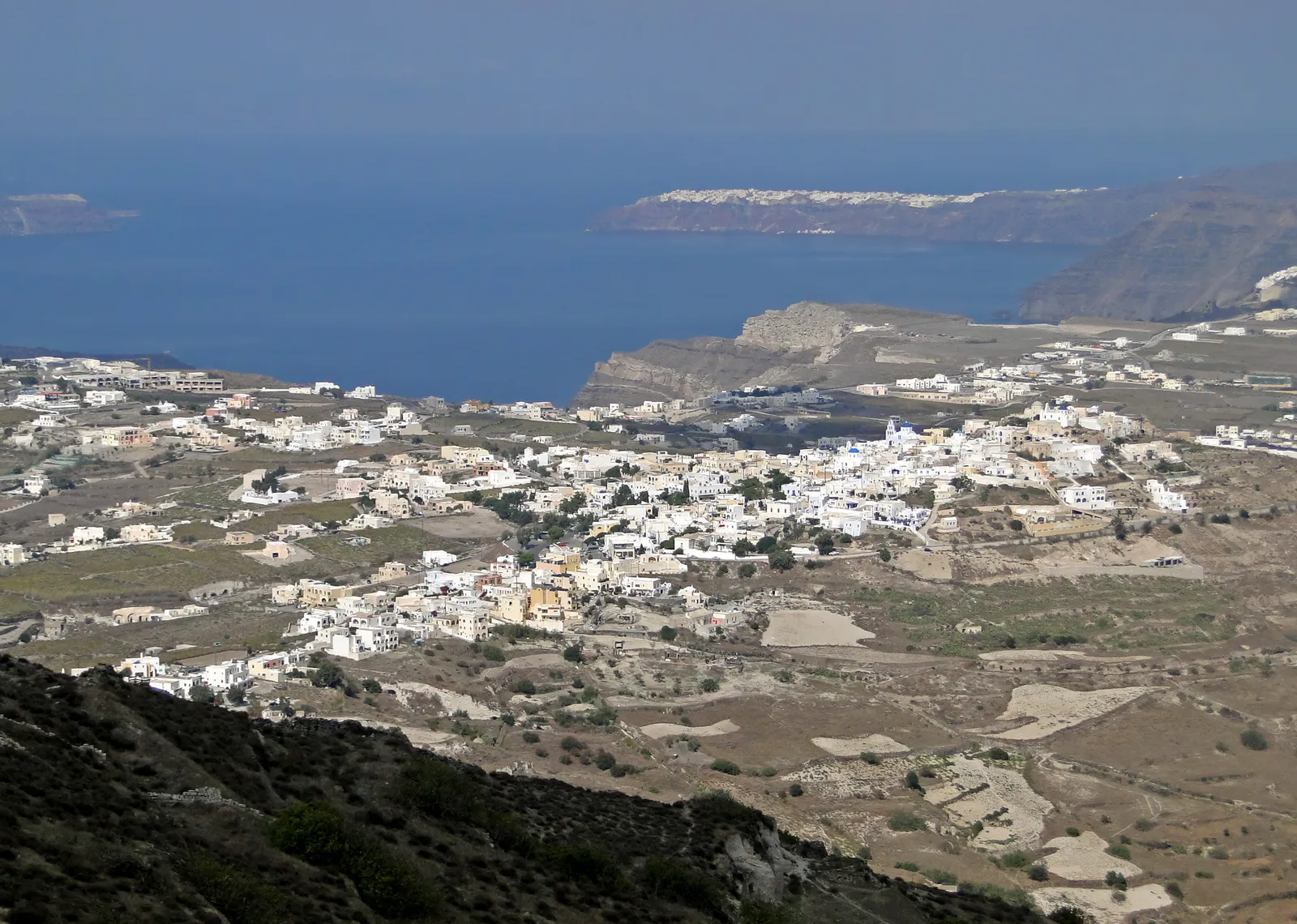
This is the highest village on the island, on a spur off Mount Profitis Ilias, and the payoff at the top of the Kasteli is both coastlines at once, the caldera on one side and the open Aegean on the other. The 18th-century monastery on the peak above is another climb again, by road or on foot, and it looks over the whole of Santorini from the summit. Nothing in the village charges admission.
Megalochori’s bell towers stand across the lanes rather than beside them
The village is the first settlement on the road up from the quay, and what makes it worth stopping in is how little happens there: vaulted lanes, cave houses, 18th-century mansions built by shipowners, and almost no through traffic, because the main road passes it rather than entering it.
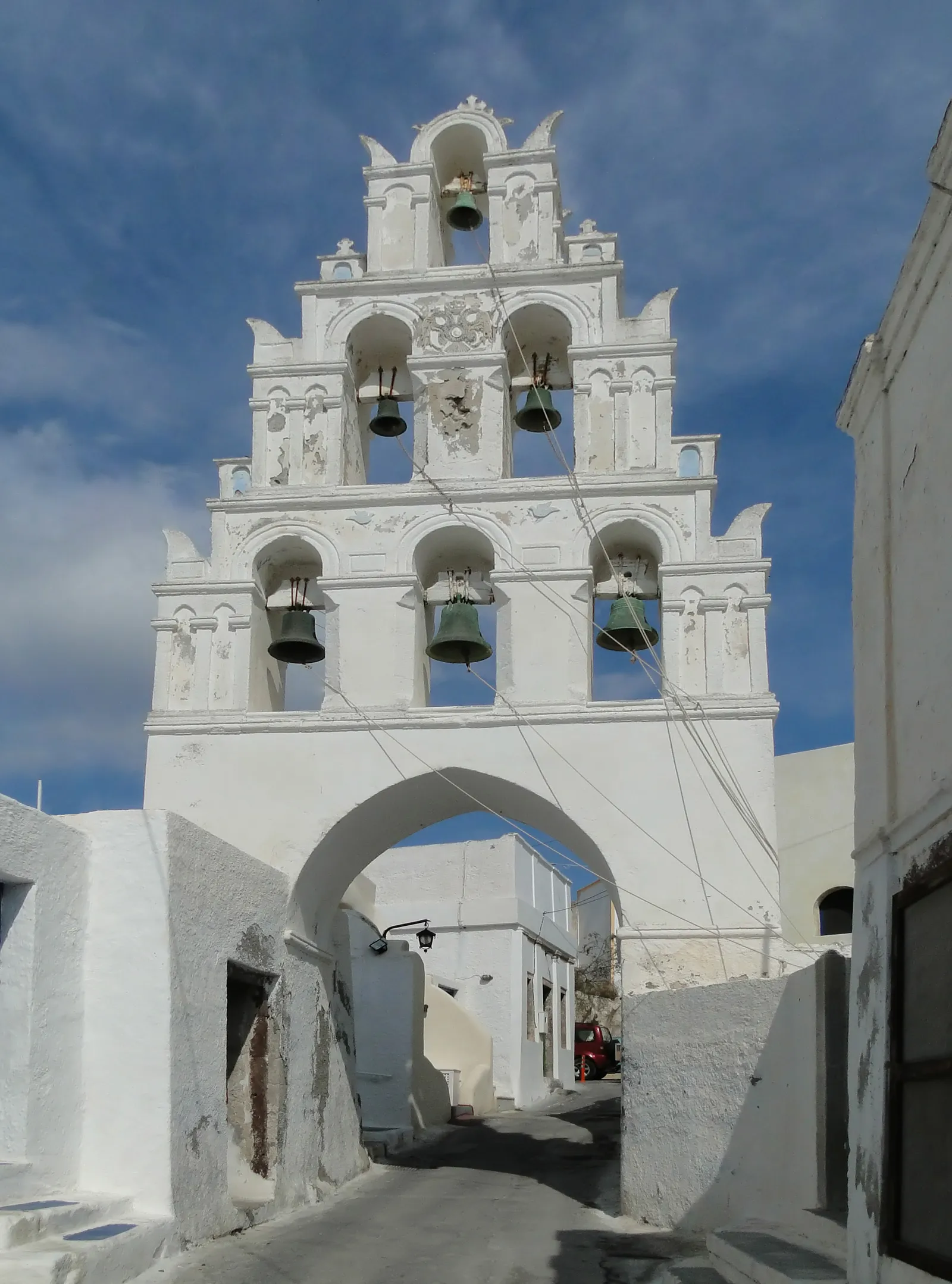
The bell towers are the local peculiarity. Rather than sitting on the churches, several of them are freestanding walls of tiered arches built straight across a lane, so the bells hang over the street and you walk under them. Wineries sit around the village edges, on the flat ground where the vines are trained in low coiled baskets against the wind.
Two and a half hours from the ferry ramp to the terminal
Every route out of the port ends at Fira’s central bus station, so the airport version of this trip is a port bus up the cliff, a second ticket bought in the yard, and the KTEL run out to Santorini (Thira) International Airport (JTR): 2.20 euros, about ten minutes on a clear road, roughly hourly, last departure around 22:00 through the season and much thinner outside it.
The two rides themselves come to about half an hour between them, and the rest of that allowance is the wait, because the first leg moves with the boats rather than a clock. If the gap is shorter, ride straight up to Fira and spend it on the caldera rim instead, which the full Santorini guide covers.
Frequently asked questions
What should I do during a layover near Athinios Port in Santorini?
Go up, and pick one village. Pyrgos is about five kilometres from the quay, the highest village on Santorini, built in rings around a Venetian castle finished around 1580, and from the top of it you can see both coastlines at once. Megalochori is nearer, about four and a half kilometres, and quieter: freestanding bell towers, 18th-century captains' houses and almost no through traffic. Neither has a direct bus from the port, so both mean a taxi or a change in Fira. Three hours is enough for one of them; two is enough for neither, and is better spent on a bus straight to Fira.
How do the buses at Athinios port work?
They run to the ferry timetable rather than a clock. Services meet arriving boats and leave when the passengers are off, which is why the Fira to Athinios schedule is posted only a day in advance and changes daily as the ferry departures do. The fare is about 2.70 euros, more than the island's other routes, and the ride up to Fira takes 20 to 25 minutes. Every route out of here terminates at Fira's central bus station, so anywhere else on the island means a change and a second ticket there.
Can you walk out of Athinios port?
In principle, and it is a bad idea. The only exit is the road that climbs the caldera wall in a series of tight switchbacks, and it is a working road carrying every coach, taxi, hire car and lorry that meets a ferry, with no pedestrian path and no verge worth the name. The climb is a few hundred metres of ascent before the ground flattens out toward the villages. Even without luggage this is a walk to avoid; with a suitcase in hand on a flight day it is not a plan.
Is there anywhere to wait at Athinios port?
Barely. Athinios is a working quay rather than a terminal: one road along the water with ticket offices, a few snack kiosks, a small covered waiting area and parking, backed by bare cliff. There is no arrival hall, no baggage system and nothing resembling a departure lounge, so people wait outside or in a kiosk. When several ferries dock inside the same hour, which is normal in July and August, the strip fills to standing room and the pick-up drivers hold name boards across the whole width of it.
How do you get from Athinios port to the airport?
Through Fira, in two legs. The port bus runs up to Fira's central bus station for about 2.70 euros in 20 to 25 minutes, timed to the ferries rather than to a fixed schedule, and from there KTEL's service to Santorini (Thira) International Airport (JTR) is another 2.20 euros and about ten minutes, roughly hourly, last departure around 22:00 in season. There is no direct link and no train anywhere on the island. Allow two and a half hours from stepping off a boat, because the first leg depends on a bus that only exists when a ferry has just docked.