Santorini Airport Layover: Messaria and JTR
Part of the full Santorini's Caldera Rim on a JTR Layover
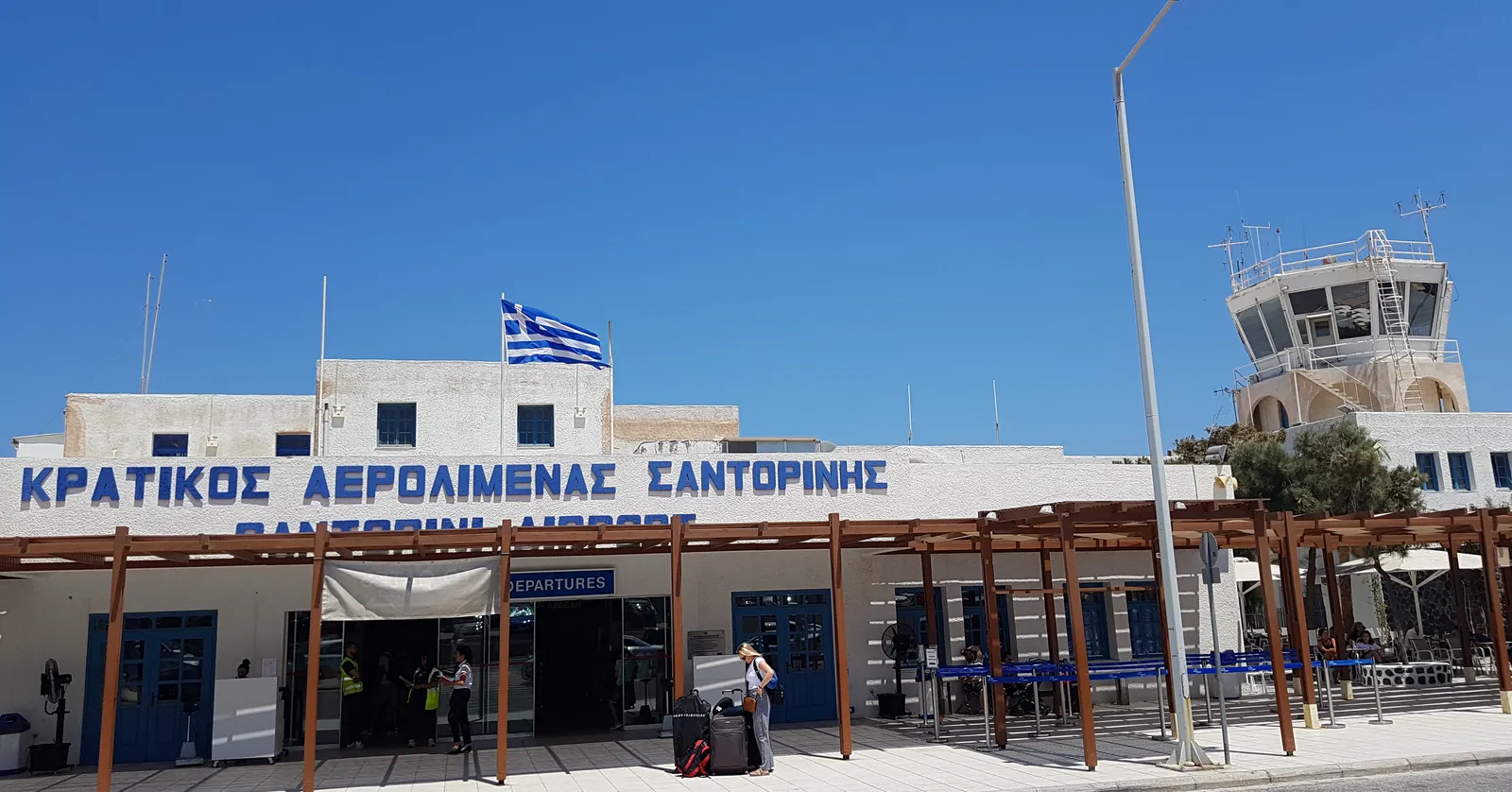
Santorini’s airport sits on the flat eastern side of the island, two kilometres from the village of Messaria and its restored 1888 mansion, and a similar distance from the black sand at Monolithos, where the water stays shallow a long way out.
The Argyros mansion at Messaria reopened as a museum in 1994
Georgios Argyros farmed, made wine and traded it, and in 1888 he had island craftsmen build him a house that looks nothing like the cave dwellings around it: a neoclassical front, painted panelling, a terrace floored in pebble mosaic and cast-iron railings along the open side. The 1956 earthquake damaged it badly and it stood empty for 35 years afterwards, until it was listed as a historic building in 1985 and restored between 1987 and 1994; that restoration won a Europa Nostra award in 1997.
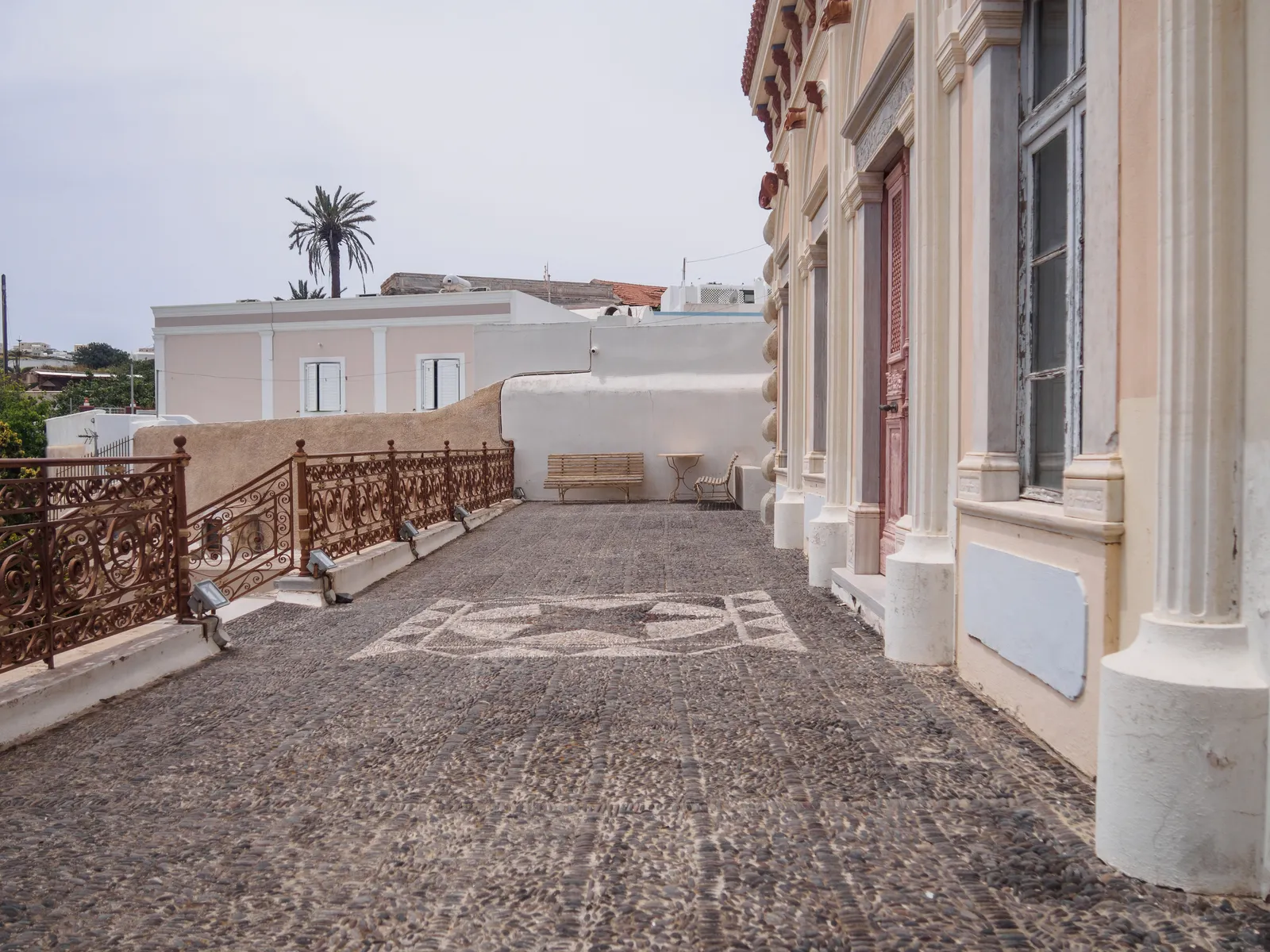
Inside is the family’s own furniture, photographs and papers, laid out as a house rather than a display, and the visit is by guided tour in Greek or English rather than a wander through. It opens May to October, closed Mondays and Thursdays. Two kilometres from the terminal makes it the closest thing to a proper sight anywhere near the runway, and the tours run short enough to fit a connection.
The Saliveros mansion next door was never put back
Messaria has two neoclassical mansions from the wine-trading years, and only one of them was rescued. The Saliveros mansion went up in 1893 in the same style for another of the village’s trading families, and it has been left exactly as the earthquake and the decades since made it: ochre plaster coming off the render, shuttered windows, a row of stone arches underneath, and trees growing up through what was the garden.
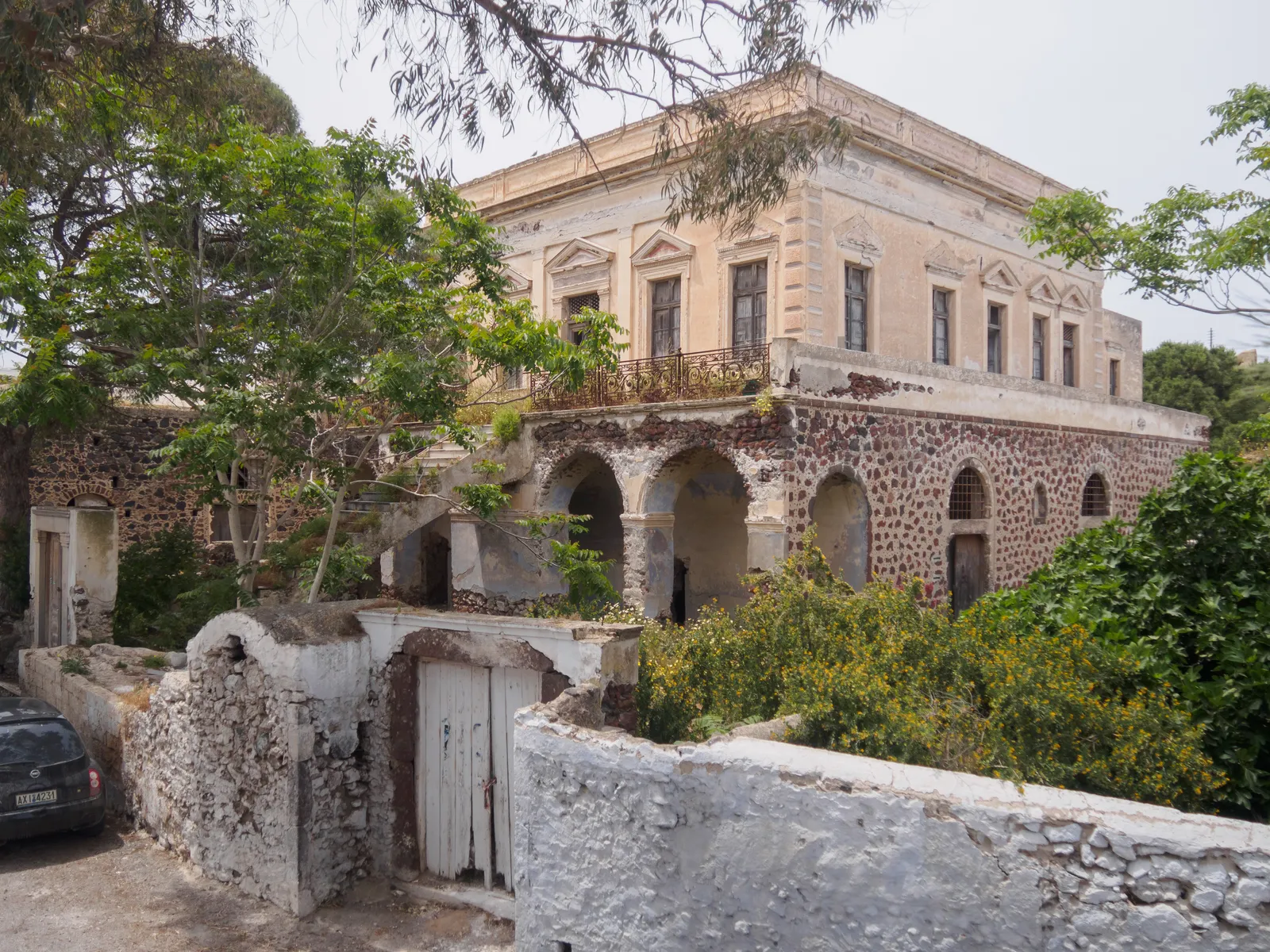
It is not open and there is nothing to pay, which is the point: you see it from the lane, and it does more than the restored one to explain what 1956 actually did to this island. Messaria itself is a working village rather than a tourist one, on the road between the airport and Fira, with bakeries and a square rather than boutiques. If your window turns out to be long enough for more than this, a full day covering the island’s main stops collects the caldera villages that the bus alone cannot reach in an afternoon.
One runway, laid along the flat side of the island
Everything about this airport follows from the geography: the caldera side is a cliff, so the runway went on the eastern shelf, a single strip parallel to the coast, shared by civil flights and the air force. There is one terminal for domestic and international departures together, arrivals and departures under the same roof, no shuttle between buildings and no internal walk worth the name, so getting from a seat to the forecourt takes a couple of minutes.
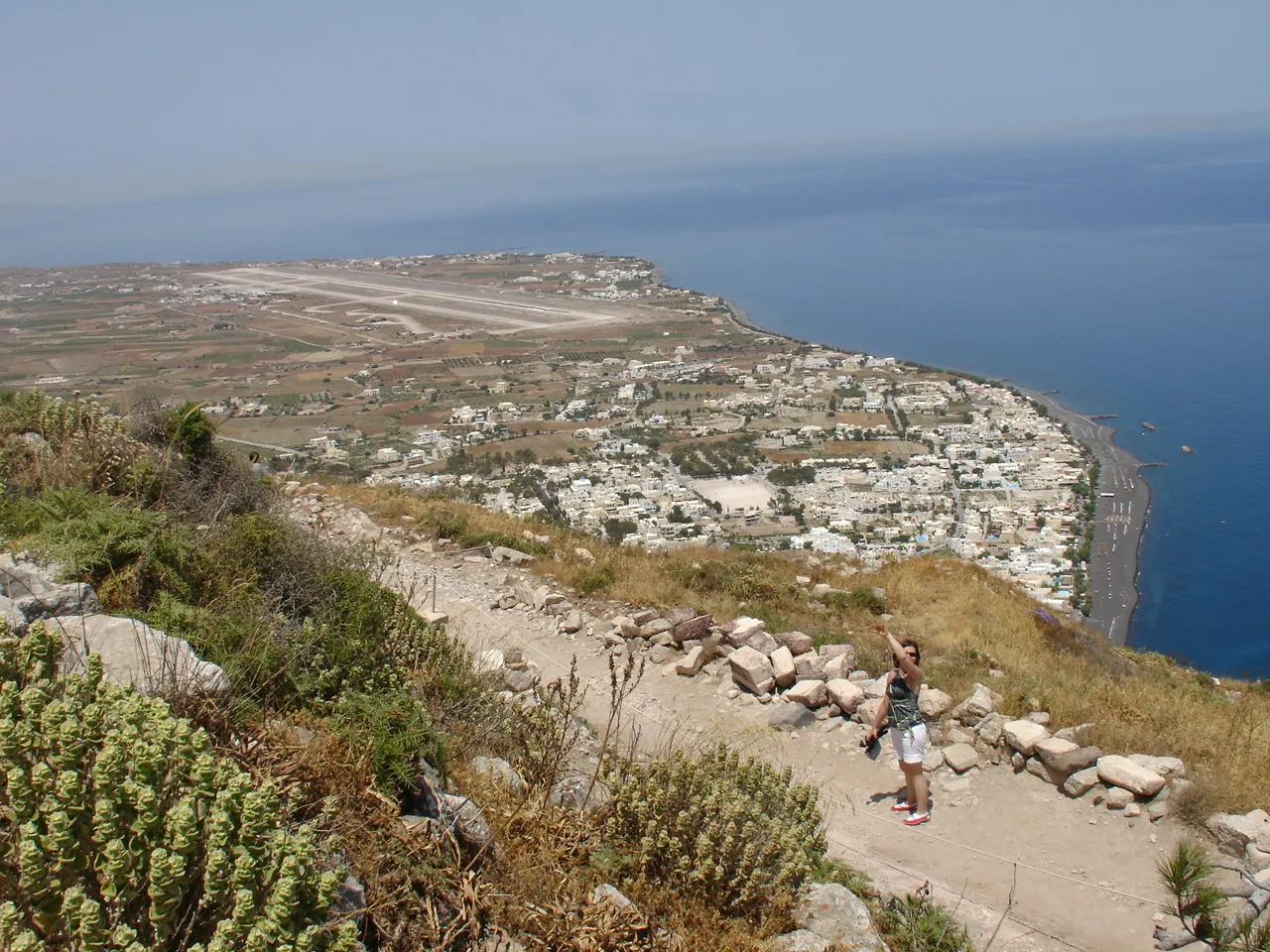
The nearest water is Monolithos, about two kilometres away: black volcanic sand with a seabed that shelves so gradually you can wade 20 or 30 metres out and still be waist deep, which is why it fills with families while the caldera beaches do not. Loungers, tavernas and a playground sit behind it. Getting there on foot means open road across farmland with no pedestrian path for much of it and no shade anywhere, which is a different proposition at two in the afternoon in July than it sounds on a map, and worse with anything to carry.
Two hours is the line between staying put and going anywhere
KTEL runs the only public route out, terminal to Fira’s central bus station, 2.20 euros in cash on board, roughly hourly, first departure around 06:10 and last around 22:10 through the season, and a handful of runs a day in winter. Ten minutes on a clear road, past twenty in August traffic. There is no train and no metro anywhere on Santorini.
That single route is what makes short connections here awkward: Messaria and Monolithos are both close enough for a taxi and neither is on a useful bus, while Fira’s caldera rim is a bus ride each way plus whatever you do when you get there. Under two hours, stay in the building. Over four, the rim and the boats out to the volcano are worth the trip, and the full Santorini guide lays out what fits.
Frequently asked questions
What should I do during a layover near Santorini (Thira) International Airport (JTR)?
Stay on the flat east side of the island. Messaria is about two kilometres from the terminal and holds the Argyros mansion, an 1888 house restored into a museum with guided tours in Greek and English, open May to October and shut on Mondays and Thursdays. Monolithos beach is a similar distance the other way, black sand with water shallow enough to wade 20 or 30 metres out, which is why families use it rather than the caldera beaches. Two hours covers either one with a taxi each way. Anything on the caldera rim needs a bus into Fira and back, so budget four hours before starting that.
Can you leave Santorini airport on a short connection?
Yes, and the building makes it easy: JTR has one terminal handling domestic and international flights together, with arrivals and departures under the same roof and no people mover, no shuttle between buildings and no long internal walk. Stepping outside puts you on the forecourt in a couple of minutes. What decides it is not the terminal but the road: there is no rail link, the bus service runs to Fira and only to Fira, and everything else within reach means a taxi. Anything under two hours is better spent inside.
Is there anywhere to eat at Santorini airport?
There is, though not much of it. The terminal has a couple of coffee shops selling pies, sandwiches, pizza, salads and pastries, a duty-free shop, a mobile phone counter in arrivals, ATMs, currency exchange, car hire desks and free wifi, plus a lounge. Most of the food and drink sits after security rather than landside. This is a small airport working well above its design capacity in July and August, so at peak departure times the seating and the counters both run short, which is a better argument for going outside than any of the sights are.
Can you walk from Santorini airport to Monolithos beach?
It is two kilometres, and it is still not a good walk. The route is open road across flat farmland with no pedestrian path for much of it and no shade at all, which in Aegean summer heat turns a 25-minute stroll into something you arrive at the beach needing to recover from. A taxi covers it in a few minutes. If you are walking anyway, go early or late in the day and carry water, because there is nothing to buy between the terminal forecourt and the beach tavernas.
How do you get from Santorini airport into Fira?
One bus route, and taxis. KTEL runs the terminal to Fira's central bus station for 2.20 euros paid in cash on board, roughly hourly with the first departure around 06:10 and the last around 22:10 in season, and far fewer runs outside the summer months. The ride is about ten minutes on a clear road and can pass twenty when August traffic backs up. There is no train or metro on the island, and Santorini licenses somewhere around 40 taxis in total, so the rank outside arrivals empties quickly when several flights land together.