Athens Layover: Acropolis and Plaka From ATH
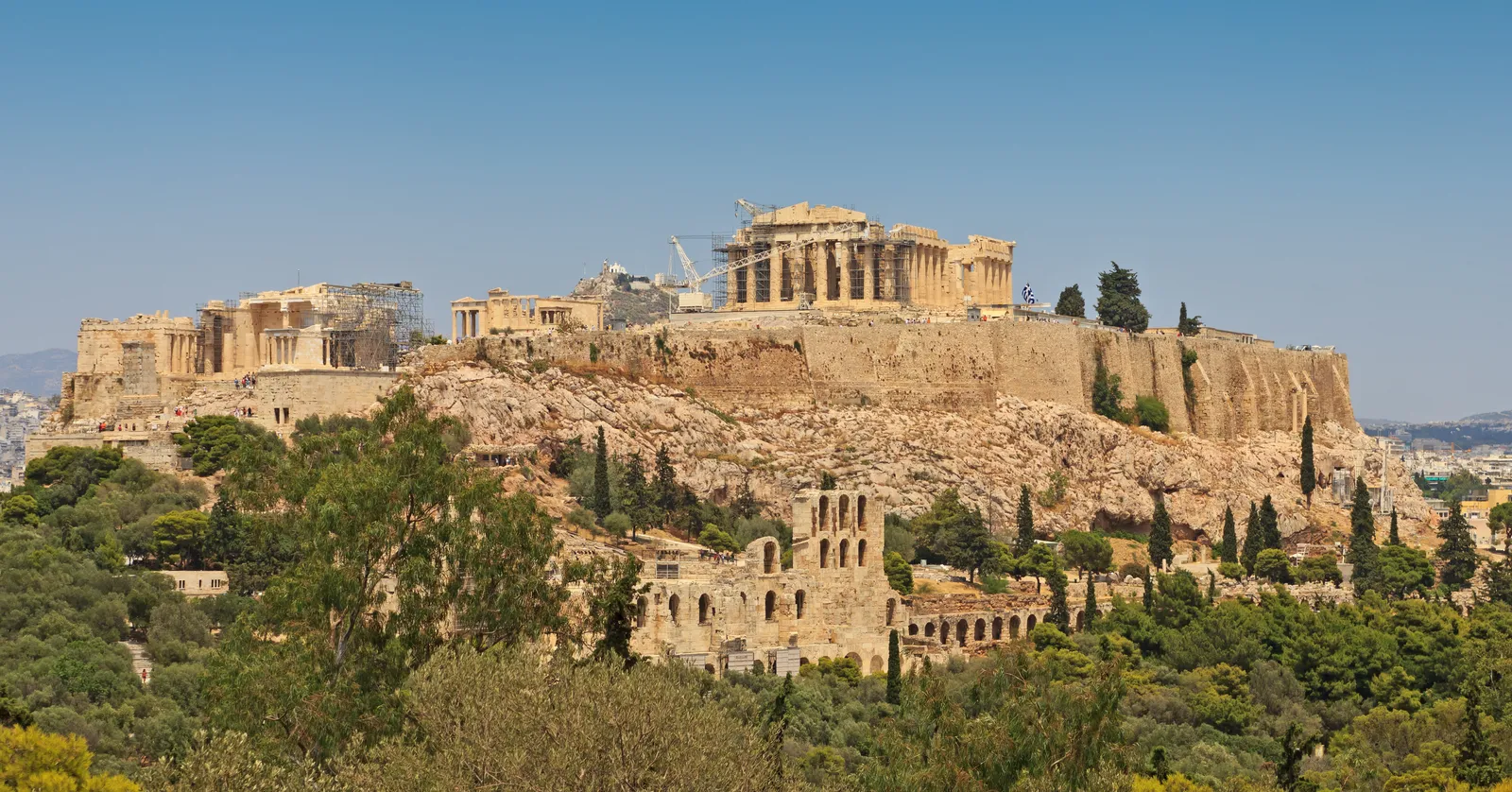
Monastiraki Square, at the foot of the Acropolis in central Athens, puts Plaka’s lanes, the free rock of the Areopagus and the Ancient Agora all within a fifteen-minute walk.
The Acropolis rises over Monastiraki Square
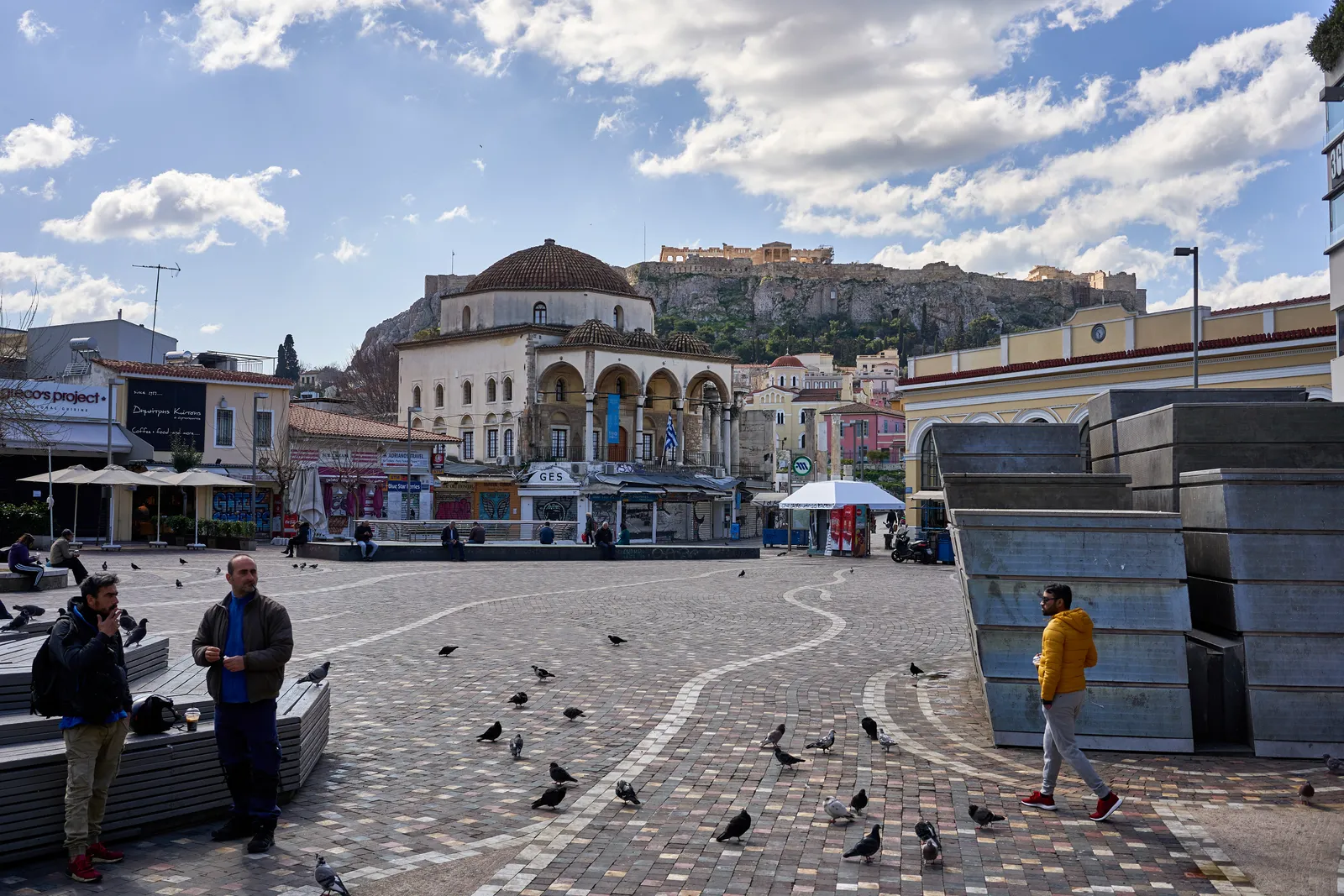
Monastiraki Square sits directly beneath the Acropolis, the Parthenon visible above the rooftops from the square itself. At its center stands the Pantanassa, a small Byzantine church that gave the whole district its name: it was once the church of a convent Athenians called the Big Monastery, and when the convent shrank, the name shrank with it, Monastiraki means “little monastery.”
Along the south side of the square, behind a railing at street level, stands a wall of tall Corinthian columns. That is the front of Hadrian’s Library, a Roman complex the emperor put up in 132 AD, and you can see the best of it without paying anything or going in. West of the square, Ifaistou and Pandrossou run off into the flea market, which is genuinely a market on weekdays and a crush of souvenir stalls at weekends.
Thirty-four columns still standing at the Temple of Hephaestus
The Ancient Agora is the flat green expanse below the Acropolis’s north-west corner, five minutes from Monastiraki along Adrianou. Ten euros gets you in, and the ticket covers the museum inside the Stoa of Attalos, a colonnade rebuilt to its ancient dimensions in the 1950s. You can buy the ticket ahead with an audio guide through a tours and activities platform if you would rather not queue at the gate.
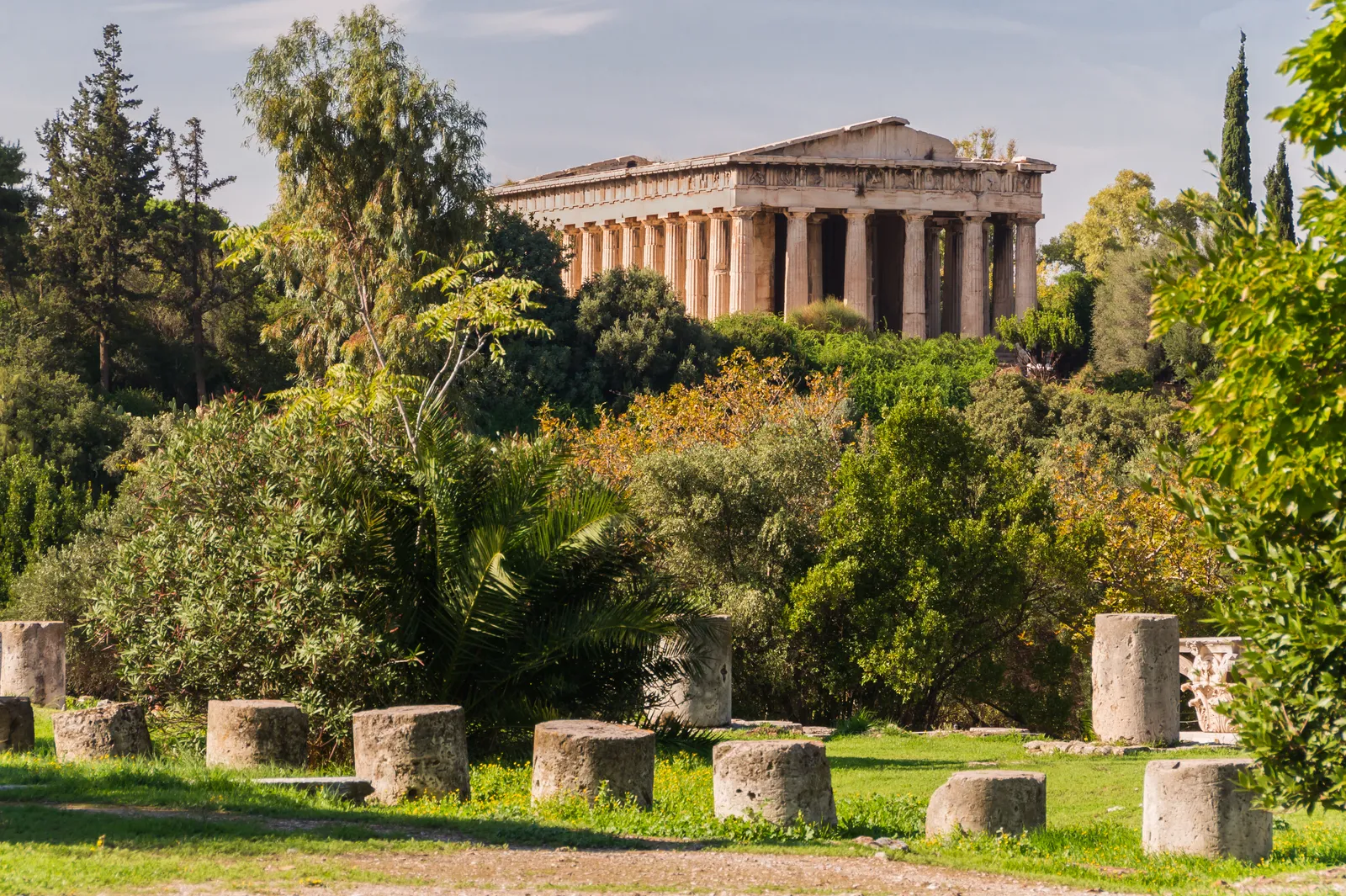
The reason to go in is on the low hill at the western edge. The Temple of Hephaestus still has all 34 of its Doric columns, its architraves, its pediments and most of its roof, which is more than the Parthenon can say. It survived because it was turned into a church around 700 AD and stayed one until 1834, so for more than a thousand years somebody was maintaining the roof instead of quarrying the stone. Seen from the Agora floor below it, the temple is the closest most visitors will get to seeing what these buildings actually looked like whole.
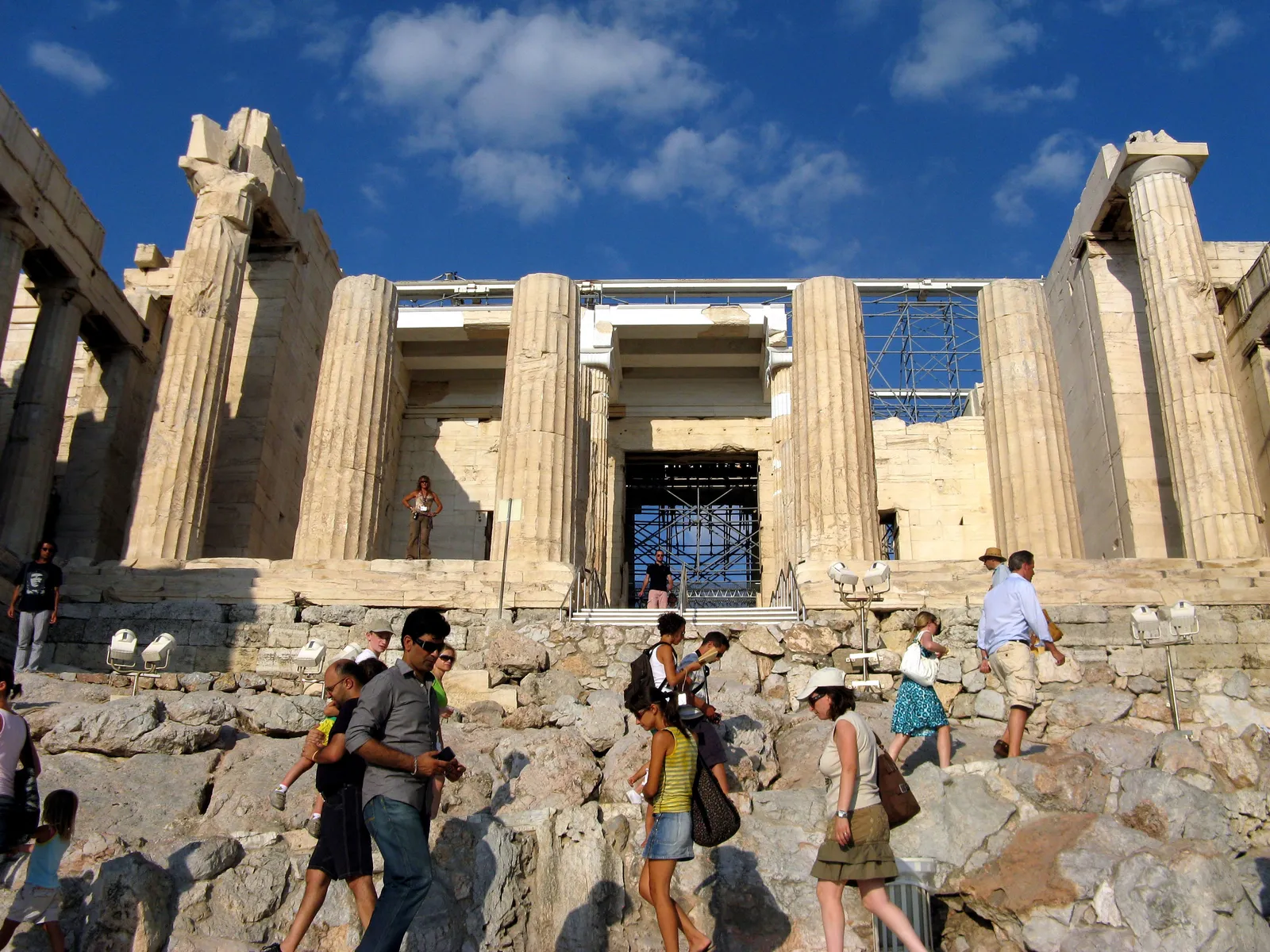
The Acropolis needs a time slot booked in advance
Going up the rock itself is 30 euros, year-round since the winter discount was dropped in April 2025, and entry runs on timed slots with a daily cap on visitor numbers. In summer those slots go days ahead, so arriving at the gate and hoping is not a plan. Allow 90 minutes once you are through it: the climb through the Propylaea is slow, the surface on top is polished bedrock, and there is no shade anywhere.
If that fits your day, book the slot before you land rather than on the day. This is how the big ancient sites work now; the Colosseum on a Rome layover releases its slots 30 days ahead on the same principle.
If it does not fit, the Acropolis Museum at the foot of the south slope sells its own ticket, 15 euros from April to October and 10 from November to March, and the top floor holds the Parthenon frieze laid out at the same dimensions and the same compass orientation as the building you can see through the glass. Tickets for that are also available in advance. Much of the old city climbing the Acropolis’s slopes runs over steps and worn marble rather than flat pavement, one of the reasons a bag is better left at a storage point near Monastiraki Square.
Anafiotika’s island cottages on the Acropolis slope
Above Plaka, tucked into the north slope of the Acropolis rock, the character of the old city changes abruptly: the buildings stop looking like nineteenth-century Athens and become something else entirely, cubic, whitewashed, single-storey, with painted shutters and pot plants crowding the doorstep. This is Anafiotika, a piece of the Cyclades islands in the shadow of the Parthenon.
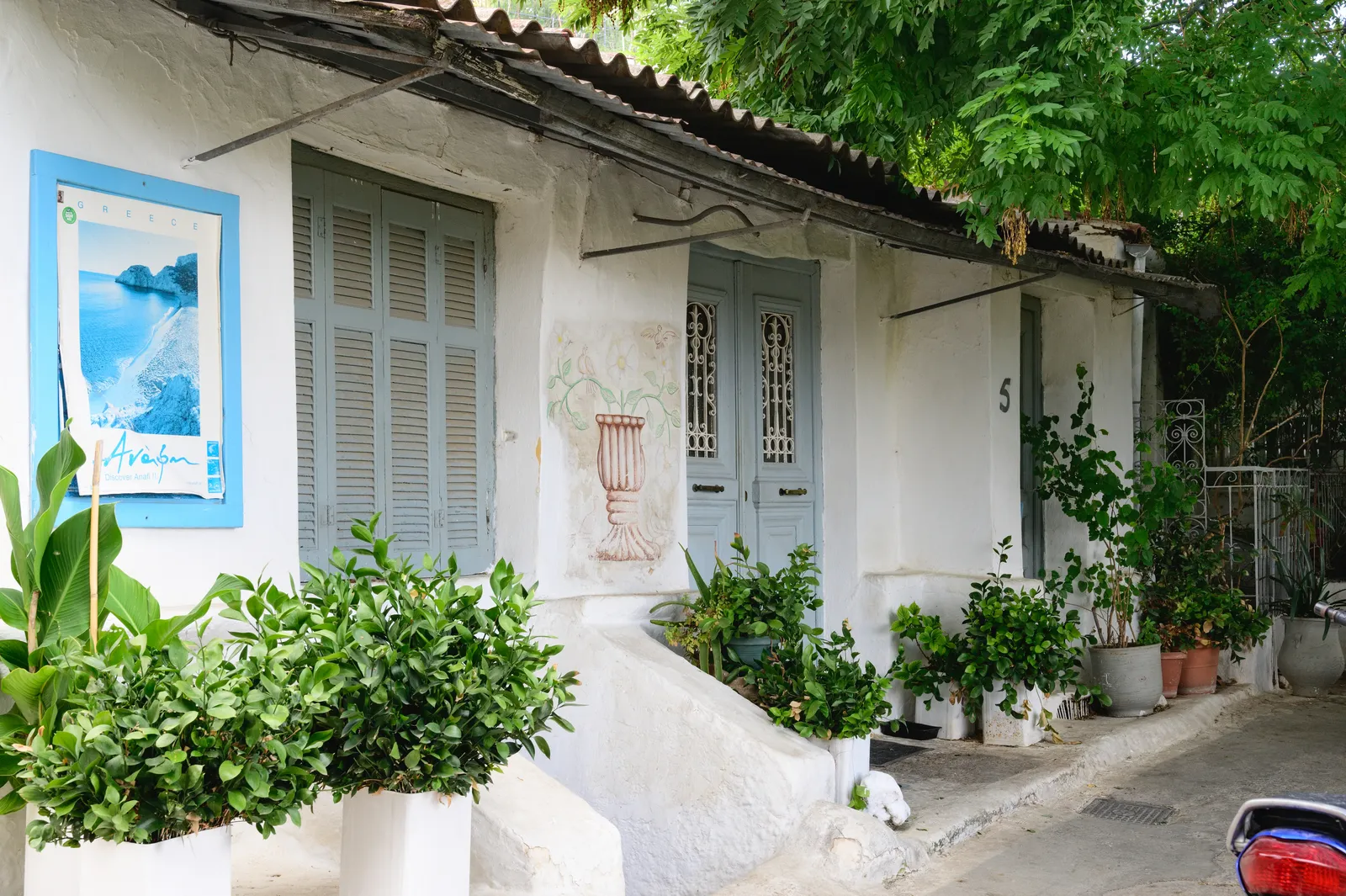
Masons and carpenters from the island of Anafi built it in the middle of the nineteenth century, during the reign of King Otto, when the new capital needed builders and Anafi had a reputation for supplying them. They put up houses in the style they knew. The story attached to the neighbourhood is that a structure raised between sunset and sunrise became the builder’s property, which is offered as the reason they went up so fast. Around 45 of the cottages are left, and the lanes between them still have no street names: the addresses are simply Anafiotika 1, Anafiotika 2, and so on.
The lanes between them are a metre or two wide in places, and people live here, so it is somewhere to walk through quietly rather than a set to photograph.
The Areopagus is free to climb
Beside the Acropolis’s main entrance road, a bare grey dome of limestone rises on its own: the Areopagus, the rock the classical city’s high court once met on. There is no gate, no ticket and no closing time, and the Parthenon is visible from nearly its own height, straight across the valley.
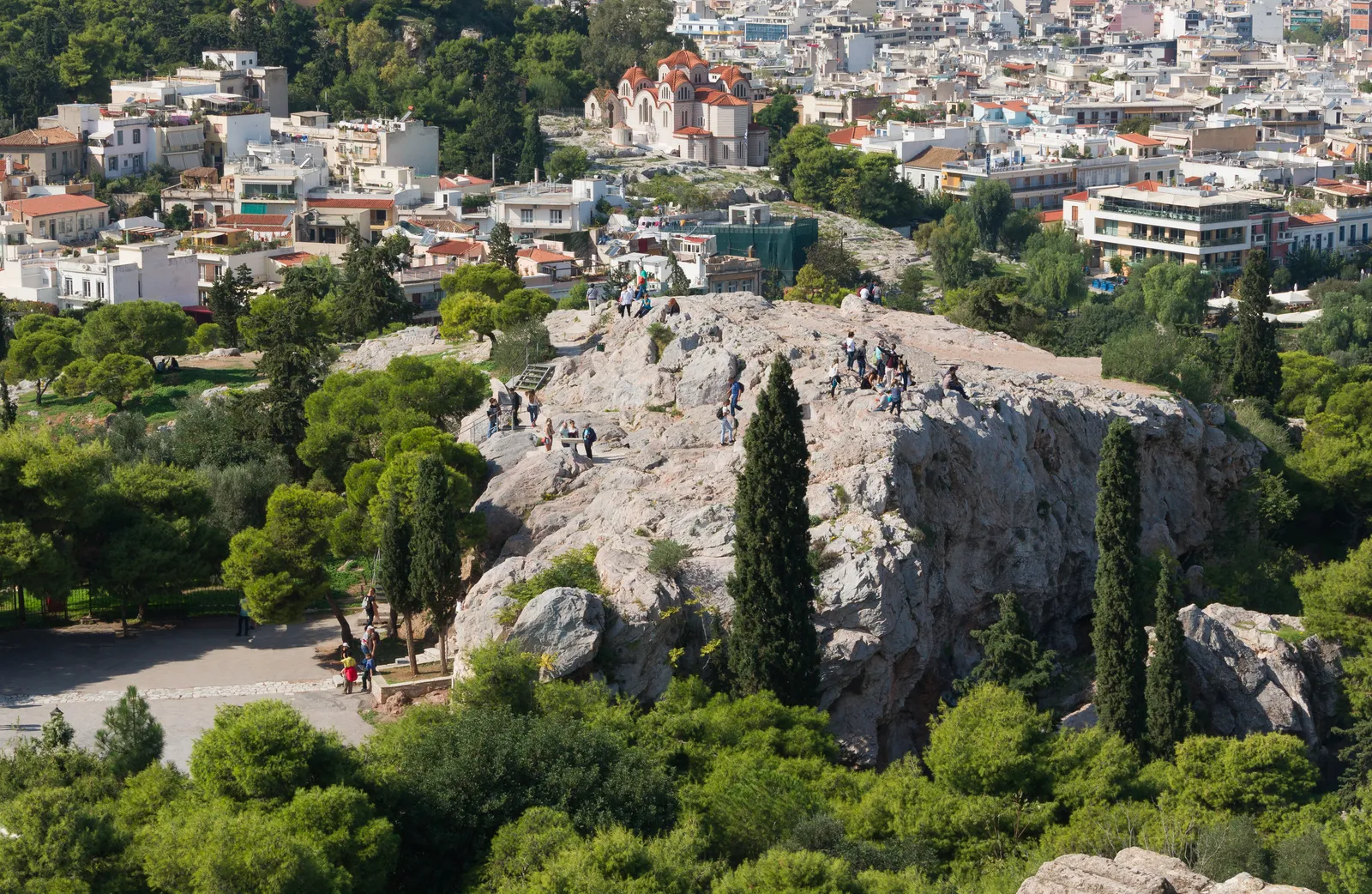
Two routes lead to the summit: a modern metal staircase bolted to the rock’s side, and the original rock-cut steps beside it. The ancient steps have been walked on for something like two and a half thousand years and have gone glassy, treacherous when wet and not much better dry; the metal staircase is the safer of the two. The summit itself is uneven and unfenced.
The guard changes on the hour at the Tomb of the Unknown Soldier
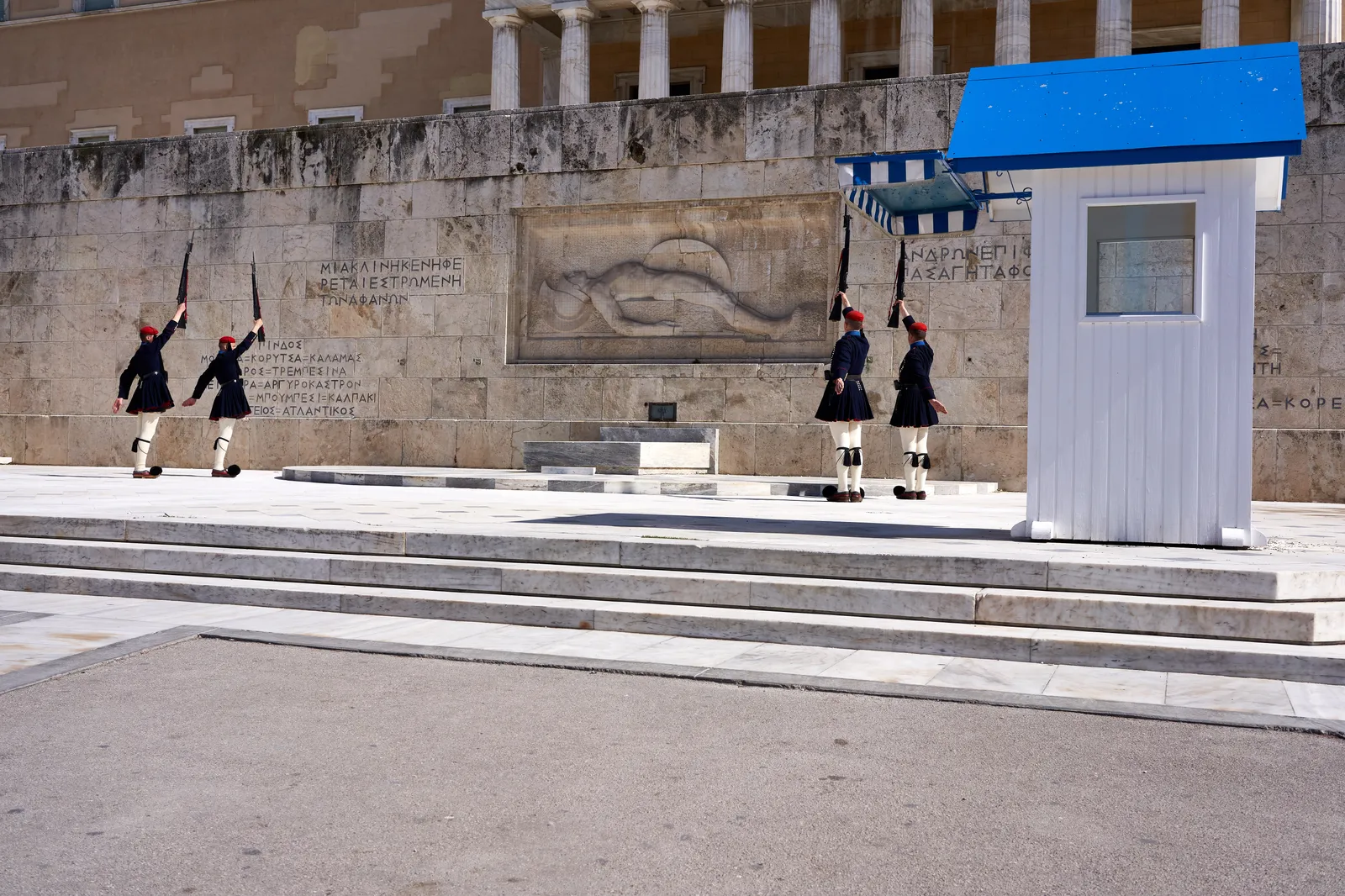
Syntagma Square, about ten minutes from Monastiraki along the flat, straight run of Ermou street, holds the Greek parliament and, on the terrace in front of it, the Tomb of the Unknown Soldier. Two Evzones of the Presidential Guard stand watch there in pleated kilts and shoes with pom-poms on them, relieved on the hour, every hour, in a slow, high-stepping routine that costs nothing to watch. The full ceremony, with a band and the whole platoon, runs Sundays at 11am.
Most visitors here miss something entirely underfoot: when Syntagma station was excavated in the 1990s, contractors cut through a classical sculpture foundry, a Roman bath, a burial ground, and a stretch of the aqueduct the tyrant Peisistratos built, and rather than clear the site, the metro built the finds into the station itself. The display is permanent, free, and open whenever the station is; the standout piece is a wall left as a raw vertical slice of the ground, its layers labelled, with gravestones and one skeleton still in the section where they were found.
The Panathenaic Stadium is built entirely of marble
With more than five hours to spend, a fifteen-minute walk south-east of Syntagma, near the National Garden, leads to a horseshoe of white Pentelic marble seating filling a fold in the hills: the Panathenaic Stadium, the Kallimarmaro. Built on the footprint of the ancient stadium of Athens, it was rebuilt entirely in marble in time to host the first modern Olympic Games in 1896.
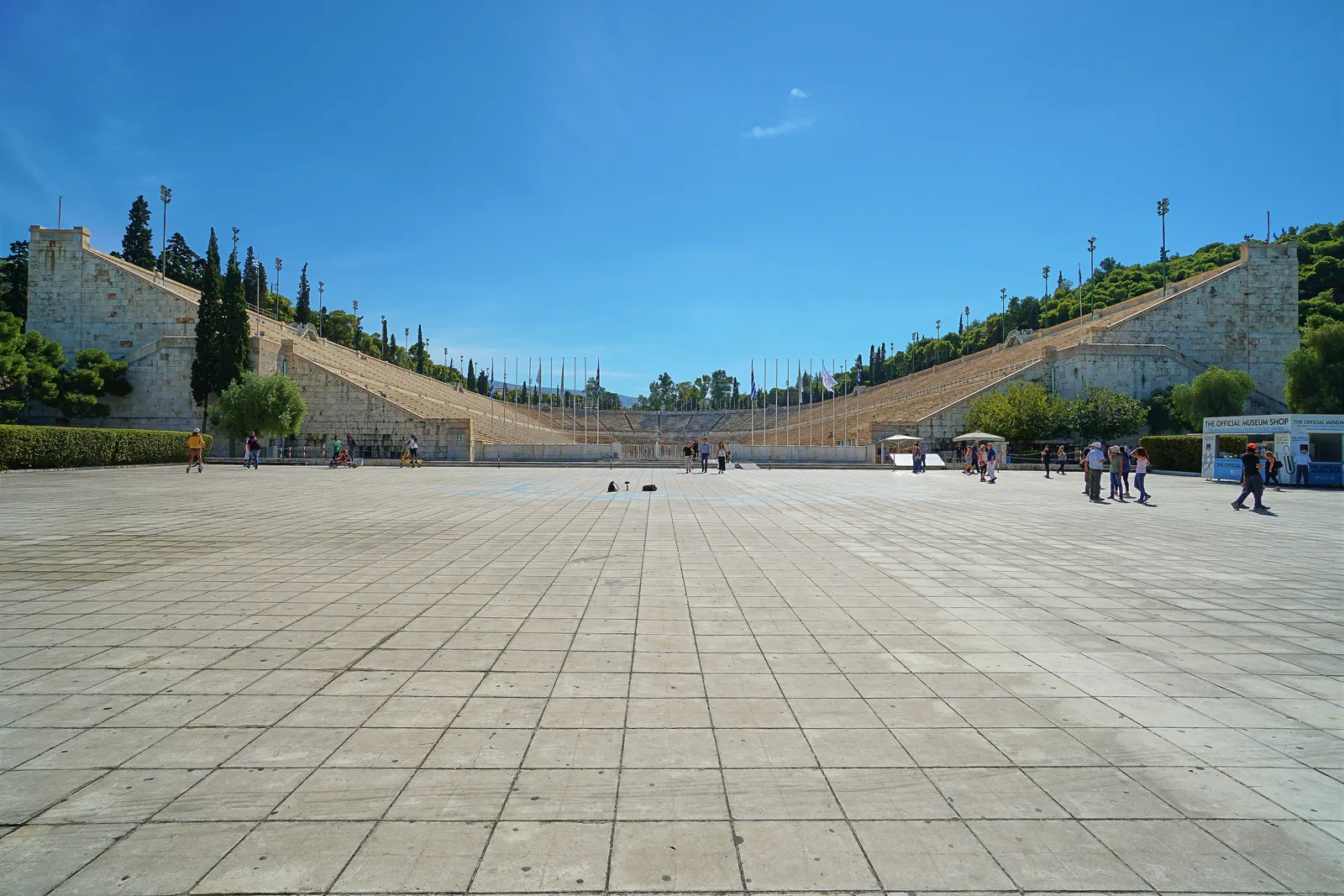
Ten euros gets you onto the track and up into the tiers, and the ticket includes an audio guide in ten languages that runs about twenty minutes. You can see most of the shape of it from the road outside for nothing, which is a reasonable call if the clock is against you.
Airport trains run only about twice an hour
Line 3 takes about 40 minutes from Monastiraki out to the airport, but the through services to the terminal leave only about every half hour, so a badly timed arrival on the platform can cost you 25 minutes standing still. Add the five-minute walk from the station up a level and over the footbridge to the terminal, which has a free archaeological museum of its own, and the sensible figure to leave the centre is two and a half hours before departure.
A one-way airport metro ticket is 9 euros, a return 16, and it has to be validated at the gates. If the last train has gone, or you have hit an awkward gap, the X95 airport bus leaves from Syntagma around the clock for 5.50 euros and takes about an hour when the traffic is behaving.
Which is the practical reason not to spend the day pulling a suitcase up Plaka’s steps and back down again: the whole route loops within a quarter of an hour of Monastiraki, and the storage points are on the same square the train back to the airport leaves from.
Frequently asked questions
What should I do during a layover in Athens?
With five to seven hours, walk from Monastiraki Square into Plaka's lanes, up the free Areopagus rock for a Parthenon view with no ticket, and through the Ancient Agora to the Temple of Hephaestus, the best-preserved ancient temple in the city. From there it's a flat walk to Syntagma to catch the Evzones changing the guard on the hour. The Acropolis itself adds to the route if you have time and have booked a slot in advance; skip it and the walk still holds together on its own.
How long before my flight should I leave central Athens?
Two and a half hours is the honest figure. The ride itself is about 40 minutes, but airport trains leave the city roughly twice an hour, so the wait can add most of another half hour before you have moved at all, and the station at the airport is a five-minute walk and one level up from the terminal doors. Check the next departure on the platform screen before you commit to one last stop; if it has just gone, the X95 bus from Syntagma is often the faster choice even though it takes longer to drive.
Which parts of this route cost nothing?
Monastiraki Square, the colonnade of Hadrian's Library that faces it, the lanes of Plaka and Anafiotika, the top of the Areopagus and the guard change at the Tomb of the Unknown Soldier are all free and have no gate. So is the permanent archaeological display built into Syntagma metro station, which you walk past on the way to the platform anyway. The paid stops are the Ancient Agora at 10 euros, the Acropolis at 30, the Acropolis Museum at 15 from April to October and 10 the rest of the year, and the Panathenaic Stadium at 10.
Is this walk realistic in a July or August heatwave?
Only in the early morning or the last hours of daylight. The Areopagus and the Acropolis rock have no shade at all, and the Greek culture ministry has closed the Acropolis and the other state sites, the Ancient Agora and Hadrian's Library among them, from midday to 5pm during heatwaves in June 2024 and again in July 2025. Those closures are called day by day rather than at a fixed temperature, so check the site's own notices that morning. Plaka's lanes are narrow enough to hold shade most of the day, which makes them the part of this route that still works at 2pm.
Can I do this with a wheelchair or a stroller?
Part of it. Monastiraki Square, Ermou street and Syntagma are flat and paved and the metro stations there have lifts, so the stretch between the two squares is fine. Anafiotika and the Areopagus are not: the first is reached by stepped lanes barely a couple of metres wide, the second by a staircase onto bare uneven rock. Inside the Ancient Agora the paths are compacted gravel rather than paving. The Acropolis has had a lift on its north slope since 2020 that goes straight up to the rock, but it has to be arranged with the site administration ahead of your visit rather than asked for at the gate.
Is the metro or the airport bus better from ATH?
The metro if you are travelling in daylight, the bus if you are not. A one-way airport metro ticket is 9 euros and the trains run from about 6.30am to shortly before midnight. The X95 airport bus costs 5.50 euros, runs to Syntagma around the clock, and takes about an hour outside the morning and evening rush, closer to 90 minutes inside it. If you are in Athens for three days rather than three hours, the 20-euro three-day tourist ticket covers the airport trip in both directions plus everything else, which is only four euros more than a return airport ticket on its own.