Thissio Layover: Athens' Free Hills and Pnyx
Part of the full Athens Layover: Acropolis and Plaka From ATH
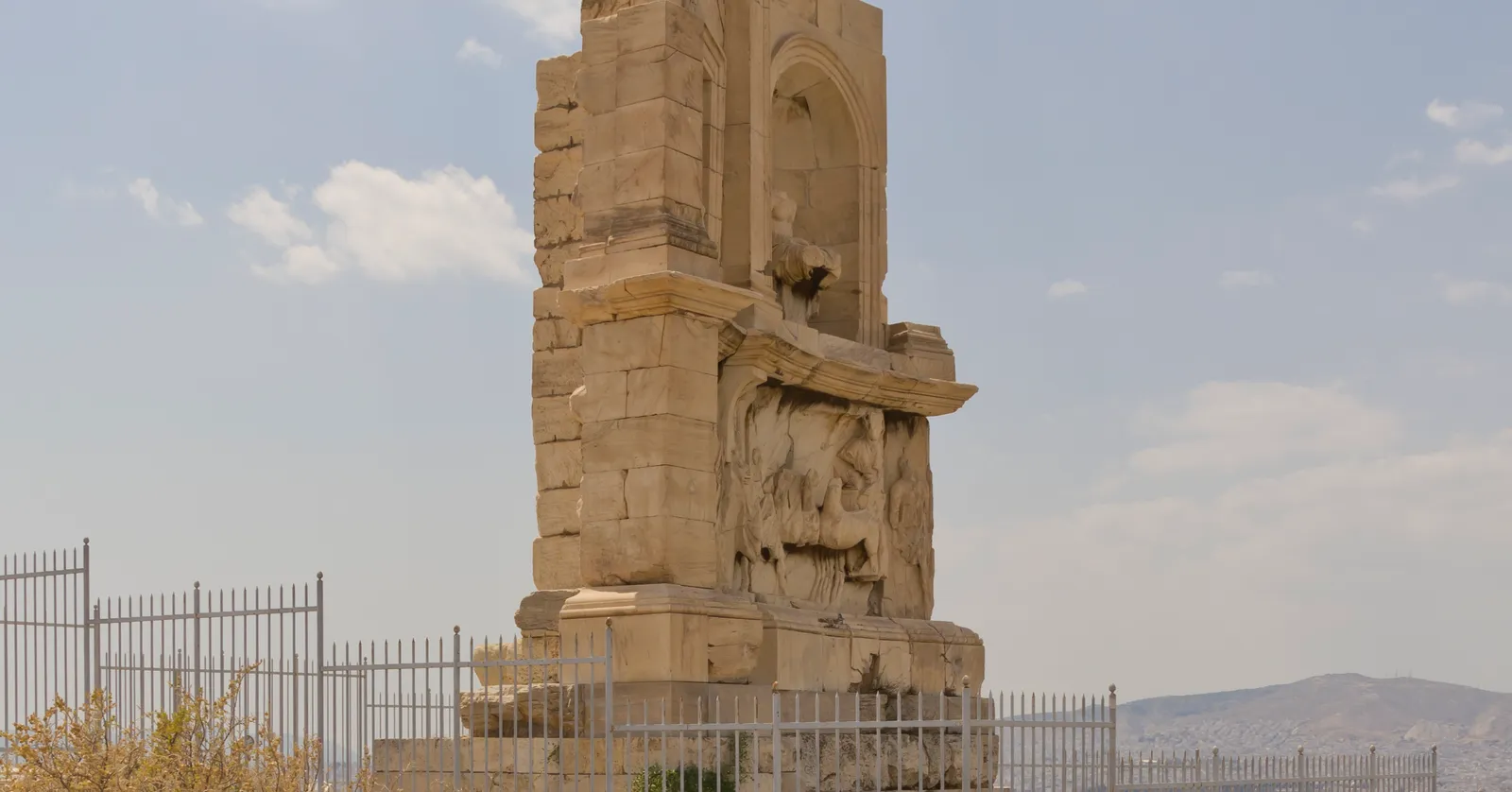
The three hills west of the Acropolis in Athens are a public park with no gate on them, and the walk up from Thissio station reaches all of them: the Pnyx, where the citizen assembly voted from 508 BC, the Philopappos Monument on the summit of Filopappou hill, and the observatory dome on the Hill of the Nymphs. None of it charges anything, and the Parthenon is across the valley the whole way.
The Philopappos Monument on the summit
The high point of the ridge carries a two-storey block of white Pentelic marble, about nine and a half metres on a side, with a curved facade, statues in niches and a carved frieze along its base showing a man riding in a chariot.
It is a tomb. Philopappos was a prince of the Commagene royal house in what is now southern Turkey, a family that had lost its kingdom to Rome; he ended up in Athens as a citizen and a benefactor, and in Rome as a consul. He died in 116 AD, his sister Julia Balbilla and the Athenians put the monument up on the skyline afterwards, and the frieze is him in the chariot, being led by lictors. It is the reason the hill has his name.
From up here the Acropolis is close to level with you across a wooded valley, and beyond it the whole basin of Athens runs out to the sea at Piraeus.
Trains have run out of Thissio since 1869
The station at the bottom is not an ordinary metro stop. Line 1, the green one, started life as a steam railway between Thissio and Piraeus that opened on 27 February 1869, which makes this platform older than most of the city around it.
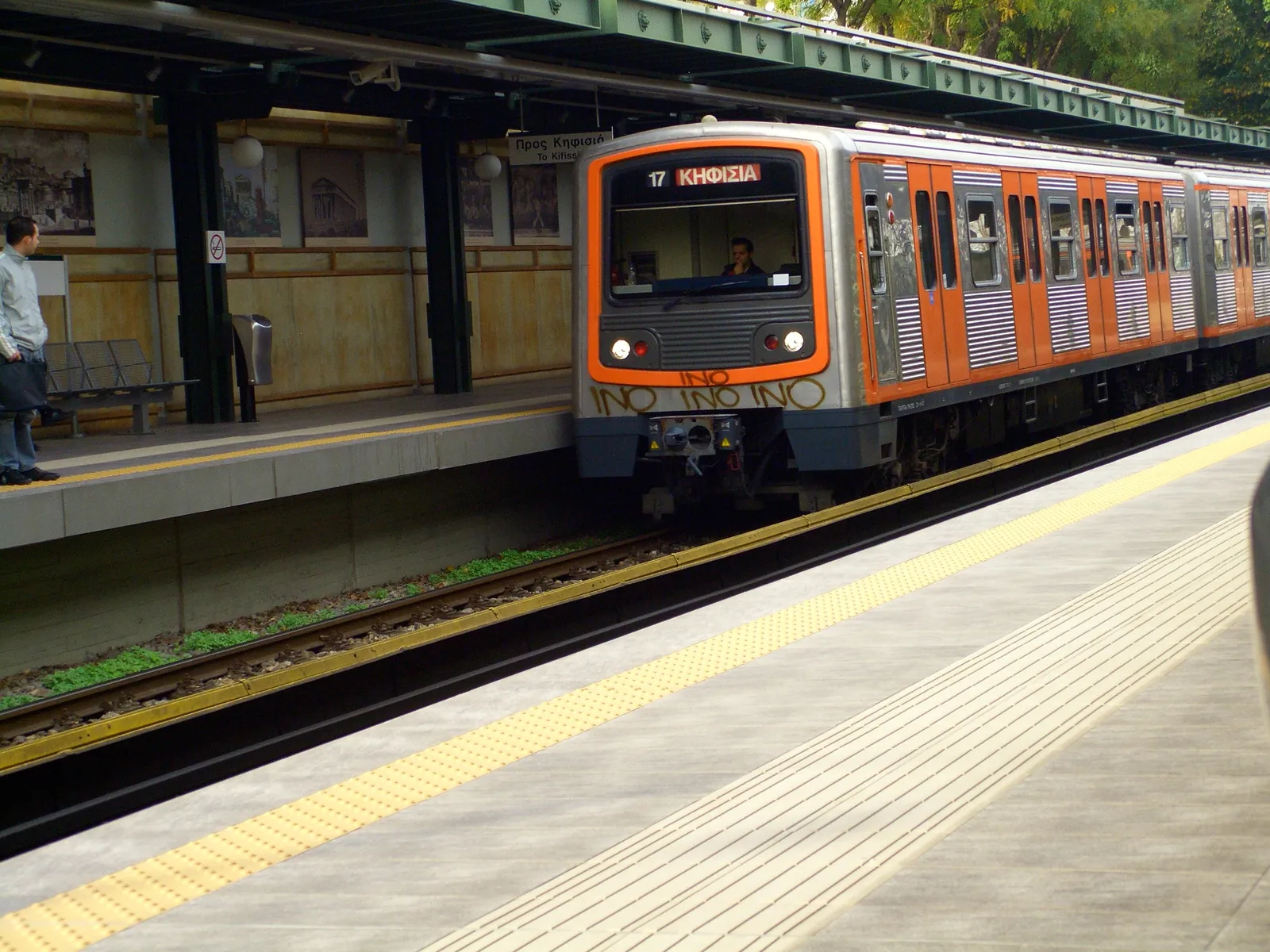
It still runs in the open air here, and the stretch between Thissio and Monastiraki is at ground level along the edge of the Ancient Agora, so from the window you get the excavation and the Acropolis with nothing in between.
Once you are off it, though, everything on this page is dirt path and loose stone rather than pavement, and a wheeled bag has to be carried up most of it, which turns a fifty-minute walk into an hour and a half.
The Pnyx, where the Athenian assembly voted
Halfway up the slope the trees open onto a wide, near-bare terrace of rock, backed by a huge curved retaining wall of fitted blocks, with a low platform cut into the bedrock at its centre.
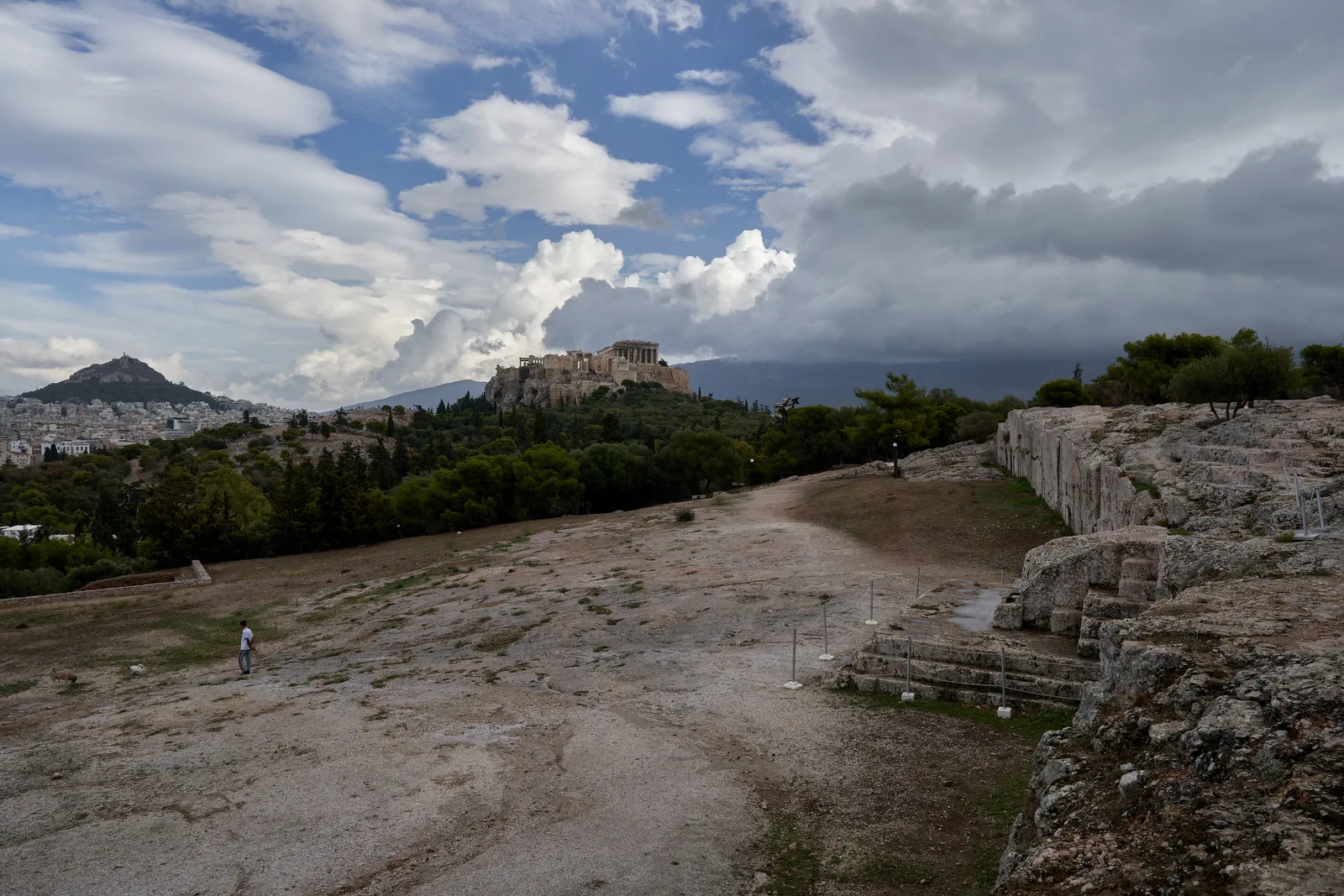
This is where the ekklesia, the assembly of Athenian citizens, met from 508 BC onwards to argue and vote, several thousand at a time, sitting on the slope. The cut step at the centre is the bema, the speaker’s platform, three shallow steps of bedrock, and Themistocles, Pericles and Demosthenes all spoke from it.
There is no fence, no ticket and no interpretation panel doing the work for you. You can stand on the bema. The Parthenon is directly ahead, and which way the assembly faced was itself once a decision: the whole terrace was rebuilt in the late fifth century BC with its orientation reversed, so the citizens sat looking the opposite way from before.
The observatory dome on the Hill of the Nymphs
North across a saddle, on a lower hill, sits a small white neoclassical building with a dome on it, half hidden in pines above the tiled roofs of the church of Agia Marina.
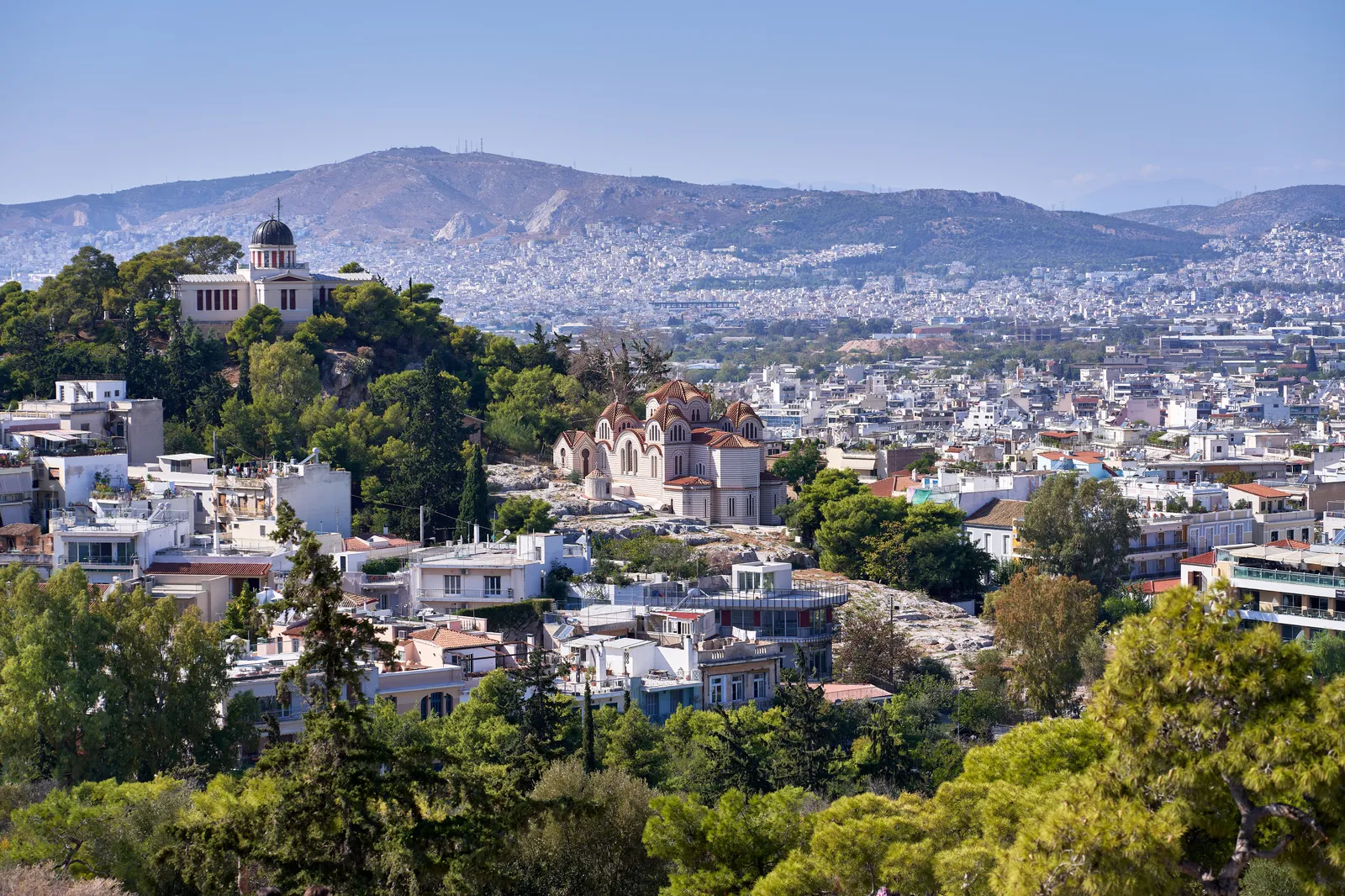
That is the National Observatory of Athens, founded in 1842 and the first research institution the modern Greek state built. The Sina building under the dome still holds nineteenth-century instruments, including the meridian refractor from 1846. The grounds are open to walk through in daylight; getting inside means booking one of the evening tours, which start at 10pm.
On the slope below, cut into the rock face, are three chambers with squared-off doorways that guides and signposts call Socrates’ Prison. There is no evidence Socrates was ever held there, they are more likely part of an ancient house, and they are worth two minutes on the way past for the rock-cutting rather than the story.
The promenade at Apostolou Pavlou fills up in the evening
The street from Thissio station up the western side is paved, wide, lined with pines and olives, and closed to cars, running along the fence of the Ancient Agora with the Acropolis above it. At the far end it joins Dionysiou Areopagitou under the south slope, and the two together make a continuous car-free walk right round the rock.
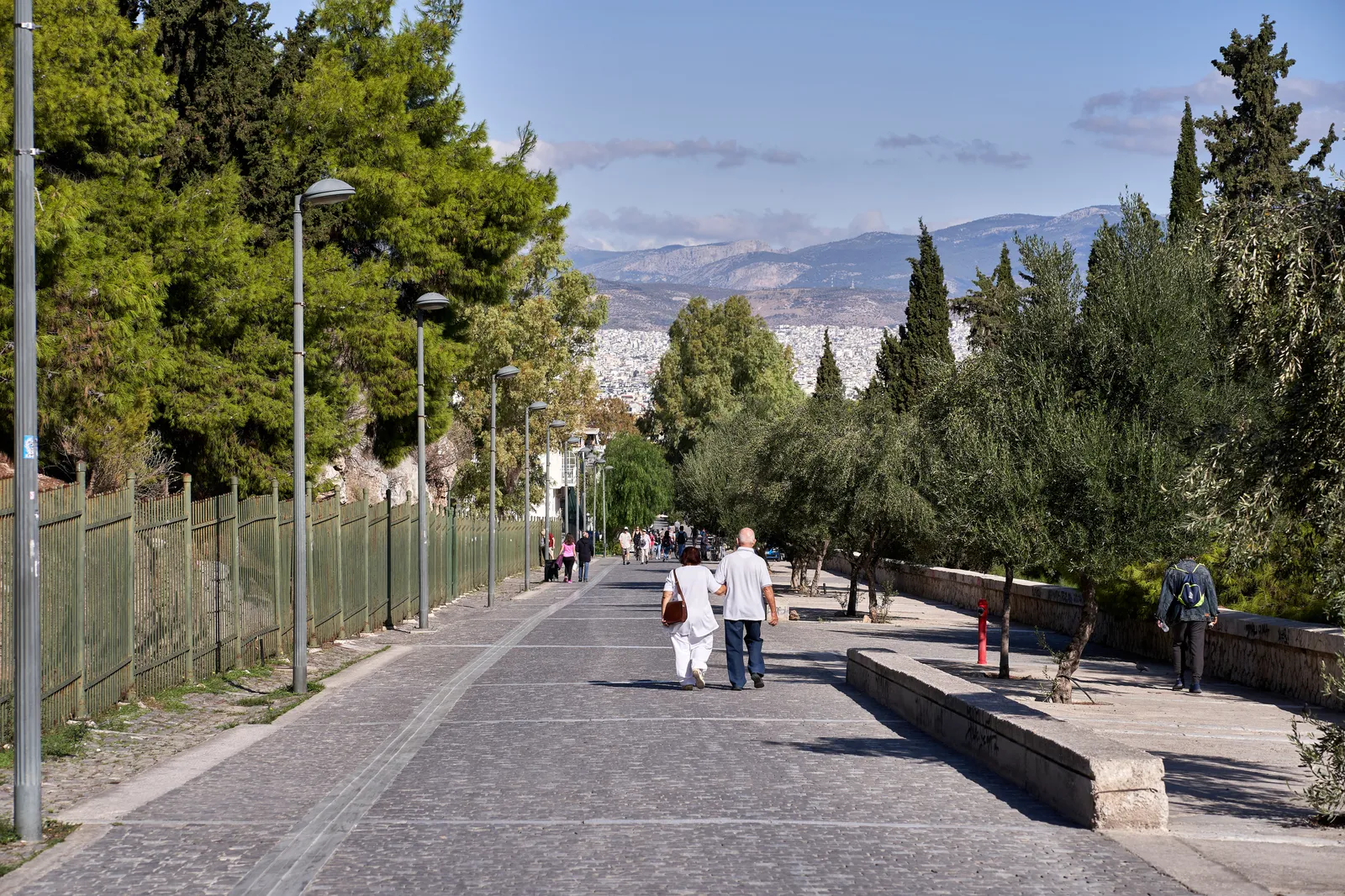
Cafes line the eastern side and the Thissio end fills up in the evening, and it is the one part of this route a suitcase could actually be wheeled along.
None of these hills charges anything
That is the point of coming here rather than going through a gate. The whole ridge is open at any hour, and on a few free hours before a flight it buys you the same view of the Parthenon that thirty euros and a booked time slot buy from the other direction, plus a piece of ground where the first democracy actually voted.
Getting back out is the one cost. Thissio is on the green line, which does not run to the airport: change at Monastiraki for the blue line, then about 40 minutes, with those through trains going only about twice an hour. Two and a half hours before departure is the figure to leave on.
Frequently asked questions
Is there really no ticket for any of this?
None. Filopappou hill, the Pnyx, the Hill of the Nymphs, Socrates' Prison and the summit monument are one open park with no gate, no booth and no posted closing time, and Apostolou Pavlou is a public street. The only paid things within sight are the Ancient Agora, whose fence you walk past, and the Acropolis above you.
What are the paths actually like underfoot?
Mostly packed dirt and loose stone once you leave the paved promenade, with some worn marble on the older stretches that gets slippery when wet. Trainers are fine, smooth soles are not, and a wheeled bag is carried rather than pulled for most of the climb. Nothing is steep for long, but nothing is flat either.
Can I go up the observatory?
Only on a booked evening tour. The Thissio visitor centre runs a 70-minute guided tour in English at 10pm on Wednesdays, Fridays and Saturdays, costing 5 euros and booked online in advance, taking in the geoastrophysics museum, the historic telescopes and, weather permitting, a look through portable ones outside. That start time rules it out of most flight days, but the grounds and the building are worth the walk up regardless.
Is the hill safe to walk alone in the evening?
The main paved paths up from Apostolou Pavlou and Dionysiou Areopagitou are busy until well after sunset, and sunset over the Parthenon is exactly what most people are up there for. The unlit side paths through the pines are a different matter once the light goes, and there is no lighting on them at all. Come down the way you went up.
What if I would rather see the ruins than the hills?
Then this is the wrong side of the rock. The Monastiraki route through Plaka and the Ancient Agora is two stops back up the green line and covers the ticketed sites, and the south slope round the Acropolis Museum is the indoor version. This page is for the afternoon where you want a view and would rather not pay for one.