Athens Layover: Syntagma to Olympian Zeus
Part of the full Athens Layover: Acropolis and Plaka From ATH
Everything south of Syntagma Square in Athens sits in one shaded strip: the National Garden, free and open from 6am, the Zappeion’s colonnaded courtyard at its far end, and then Hadrian’s Arch and the Temple of Olympian Zeus on the avenue beyond. It is the flat, green half of the centre, and it starts at the same square the airport bus and both metro lines reach.
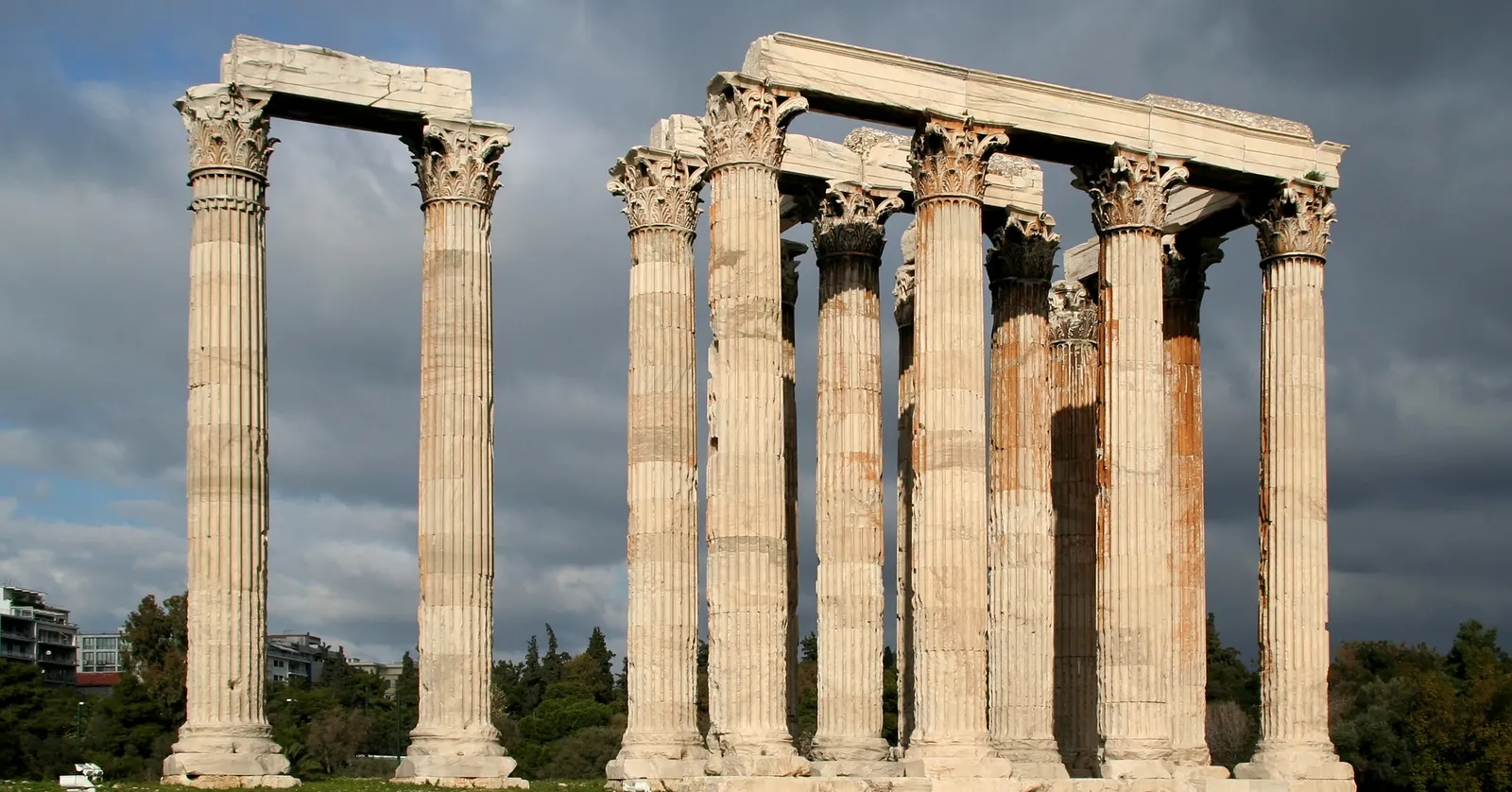
The Temple of Olympian Zeus was 650 years in the building
They started it in the sixth century BC and Hadrian finished it in 131 AD, roughly 650 years of on-and-off construction for a building that then spent the medieval period being quarried for stone. What is left of 104 Corinthian columns is fifteen of them, in a group, seventeen metres tall, on an open field with nothing else around them, which is why they look bigger here than the taller things on the Acropolis skyline behind.
The sixteenth is on the ground. A gale came over Attica on 14 October 1852 and knocked it flat, and nobody has stood it back up. Its drums lie in a neat line exactly as they came apart, which is the clearest look you will get anywhere in the city at how one of these columns was actually assembled.
Entry is 8 euros from April to October and 4 in the winter months, and there is no shade on the field at all. You can pick up the ticket with an audio tour through a tours and activities platform beforehand if you would rather not stop at the booth.
Hadrian’s Arch stands on the pavement outside the fence
Between the temple field and the road, and outside the ticketed area entirely, is a marble gateway about eighteen metres high with a second storey of thin columns on top of it. Hadrian’s Arch went up around the same time the emperor finished the temple, and it marked the line between the old Greek city and the new Roman quarter he was building.
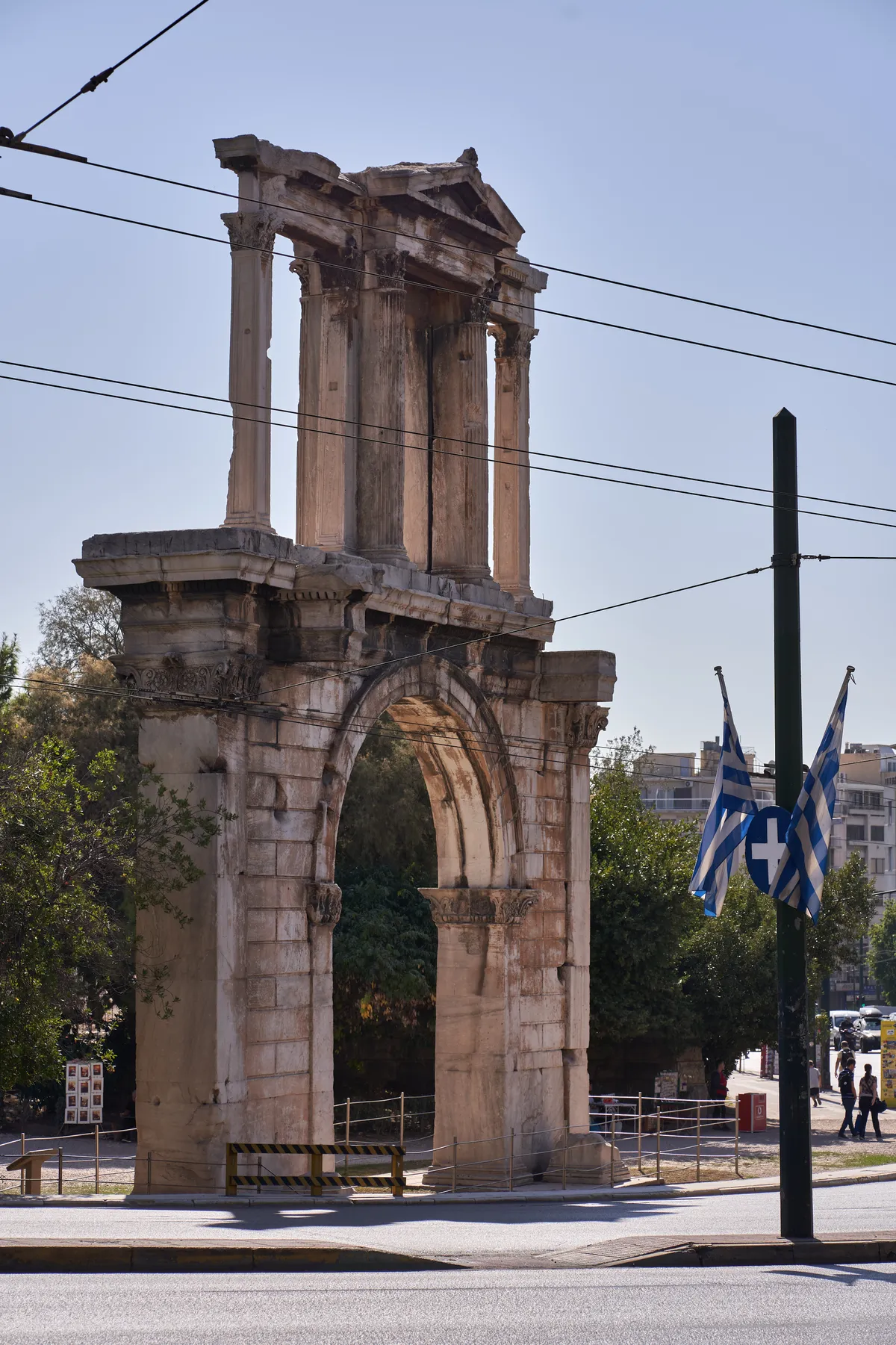
There are inscriptions cut into the architrave on both faces, one naming Theseus and one naming Hadrian, each claiming the city on its own side. The arch now stands a couple of metres from six lanes of traffic with tram wires strung across the view, which is either a disappointment or the point, depending on how you feel about ancient things being left where they were put.
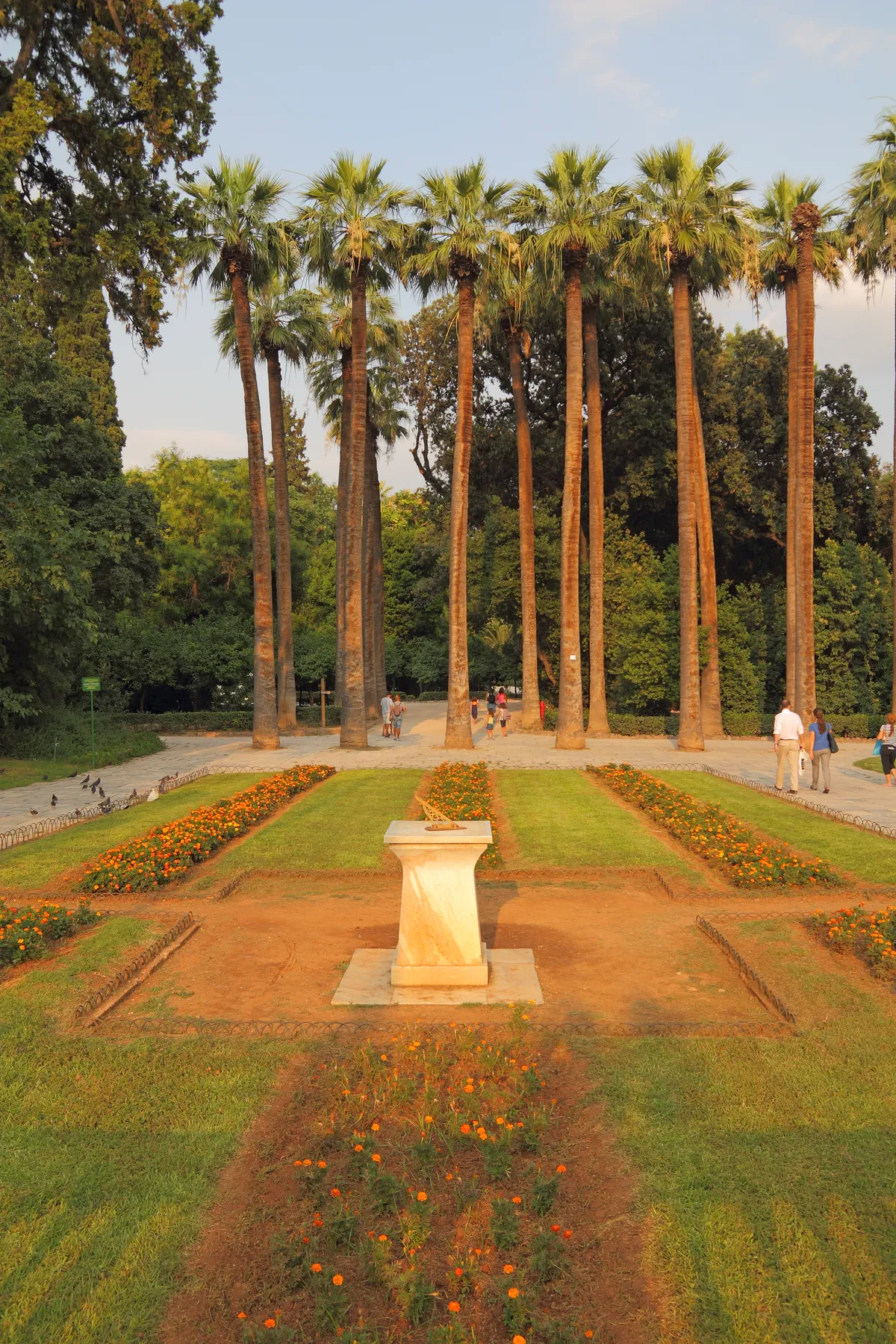
The National Garden was Queen Amalia’s private grounds
Amalia had it planted in 1838 as the royal palace’s garden, with a German agronomist running the planting and, the story goes, seedlings brought in by ship. It was closed to everyone but the court until 1923. Now it is fifteen and a half hectares of dense shade, over five hundred species, gravel paths, Roman mosaic fragments and busts of poets, running from the parliament building down to the Zappeion.
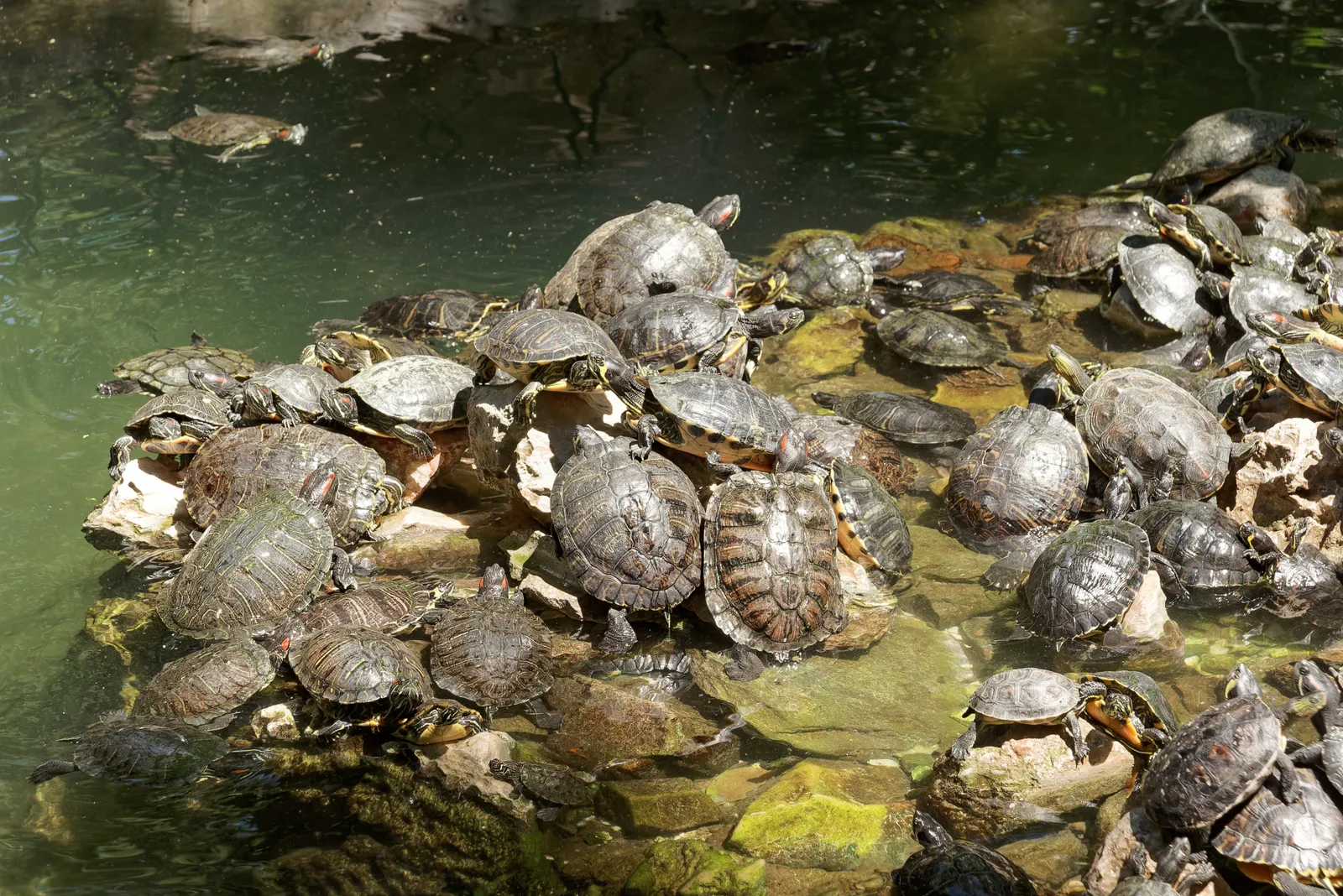
The thing worth walking to is behind the central lake: a circular pond with one big rock in the middle, and on that rock, most of the day, a heap of terrapins stacked on top of each other in the sun.
There is also a duck pond, a small enclosure with goats and hens near the presidential residence, a playground under the pines on the eastern side, and a children’s library that anyone can walk into for free. None of it is signposted from Syntagma, which is why the paths a hundred metres in are usually empty while the square outside is not.
Those paths are gravel and the garden has steps and slopes in places, so this is a walk that goes better without a wheeled bag; the station under the square is also the only point where Line 2 and Line 3 cross, and the ramps between the two levels carry that plus the airport bus crowd at once.
The Zappeion’s circular colonnaded courtyard
At the south end of the garden the trees give way to a long neoclassical facade with a portico, designed by the Danish architect Theophil Hansen and paid for by Evangelis Zappas, who died before the cornerstone was laid in 1874 and left his cousin to finish it. It opened in 1888 as a hall for the revived Olympic Games and has been pressed into service for almost everything since: the fencing venue in 1896, the press centre for the 2004 Games, and the room where Greece signed its accession to the European Communities in 1979.
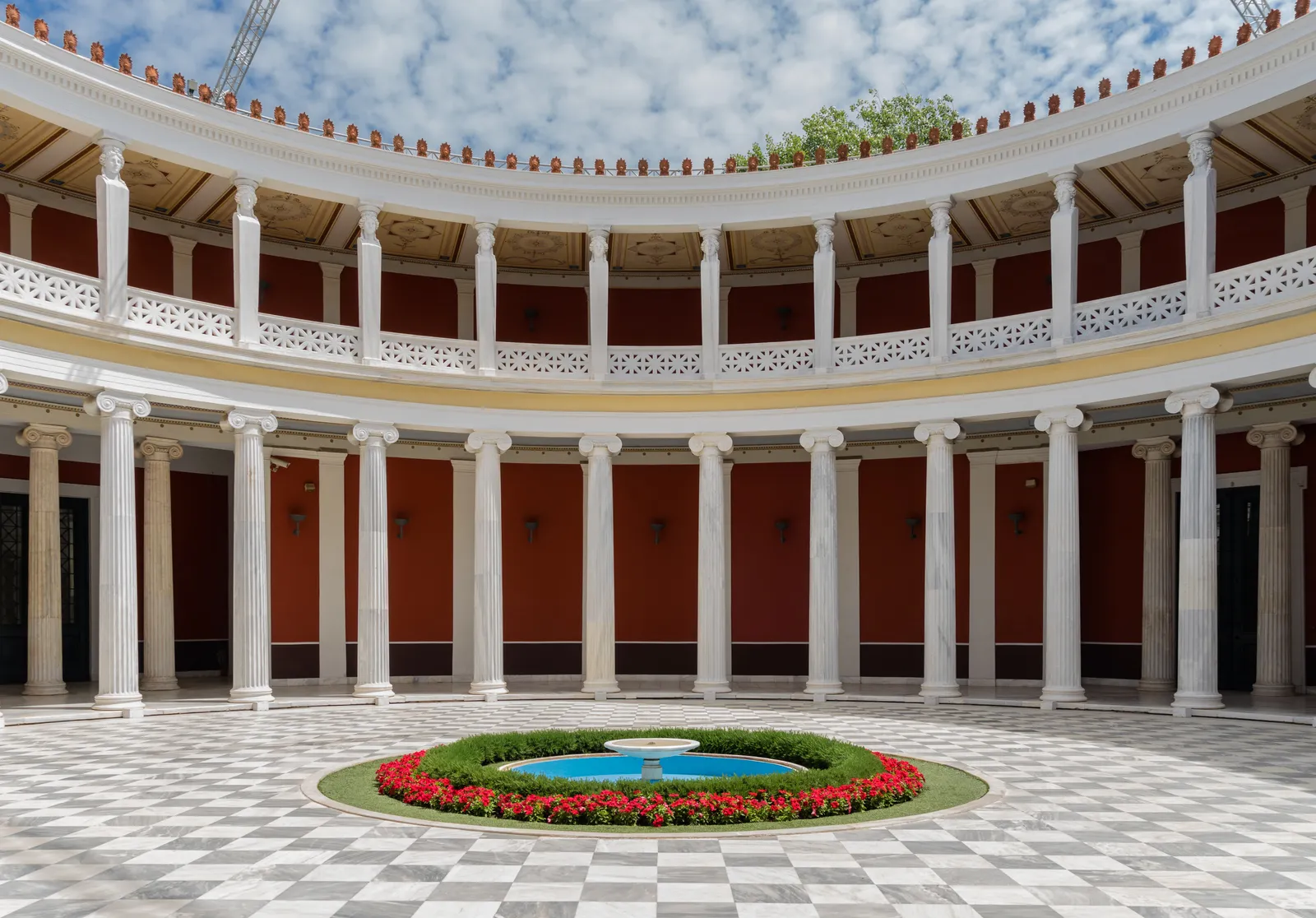
Walk through the portico and there is the round marble atrium that signing happened in: two tiers of white columns against dark red walls, a chequerboard floor and a fountain in a ring of flowers. Whether the halls themselves are open depends on what is on, but the atrium and the surrounding gardens are open to walk into, and there is a cafe on the terrace looking back up the garden.
The garden gates shut at dusk
That is the constraint on this half of the centre. The garden closes when the light goes, which in December means before six, and once it does, the direct route from Syntagma down to the temple is gone and you are walking the avenue instead. The temple and the arch keep their own hours: the site shuts at 8pm in summer and 5pm in winter, and the arch, standing on the pavement, is there whenever you are.
The advantage of starting here rather than in the old town is that all of it is flat and most of it is shaded, and the square you come back to is the one the airport bus leaves from around the clock. The disadvantage is that it is a smaller loop, so if you have five hours rather than three, walk west instead.
Frequently asked questions
When does the National Garden close?
The gates open at 6am and shut around sunset, so the closing time moves through the year: nearer 7.30pm in high summer and well before 6pm in December. There is no lighting on most of the paths, which is why it closes rather than staying open like a square. If you arrive at Syntagma after dark, the Zappeion's own grounds at the south end stay open and lit later than the garden proper.
Does this route work with young children?
Better than most of central Athens. The garden has a duck pond, a pond full of terrapins, a small enclosure with goats and hens, a large playground under the pines on the eastern side, and a children's library that costs nothing to use. It is also the one stretch of this part of the city that is flat, shaded and free of traffic, which matters more in July than any of the rest of it.
Do I need a ticket to see Hadrian's Arch?
No. The arch stands on the pavement of Vasilissis Amalias, outside the fence of the archaeological site, so you walk right up to it for nothing on the way past. The Temple of Olympian Zeus behind it is the ticketed part: 8 euros from April to October, 4 from November to March.
How busy does Syntagma station get?
It is the only station where Line 2 and Line 3 cross, and the airport bus terminates on the square directly above it, so all of that traffic funnels through the same ramps between the two platform levels. Around 8.30am and again between 5pm and 7pm those ramps are the tightest point of the whole trip, which is worth knowing if you are timing a return to the airport.
Is this enough for a five-hour gap, or should I go further?
For three or four hours it is about right: the garden, the Zappeion and the temple sit in a tight loop east and south of the square. With five hours or more you are better off walking the other way, along Ermou into the old town, where the Plaka lanes, the Ancient Agora and the Areopagus rock give you a fuller afternoon than anything on this side of Syntagma.