Fushimi Inari Layover: Kyoto's Gate Trail
Part of the full Kyoto Layover: Fushimi Inari Gates, KIX
Kyoto’s Fushimi Inari shrine is five minutes from Kyoto Station on a local train, its gate-lined trail climbs Mount Inari with no ticket and no closing time, and the sake warehouses of Fushimi are five minutes further south.
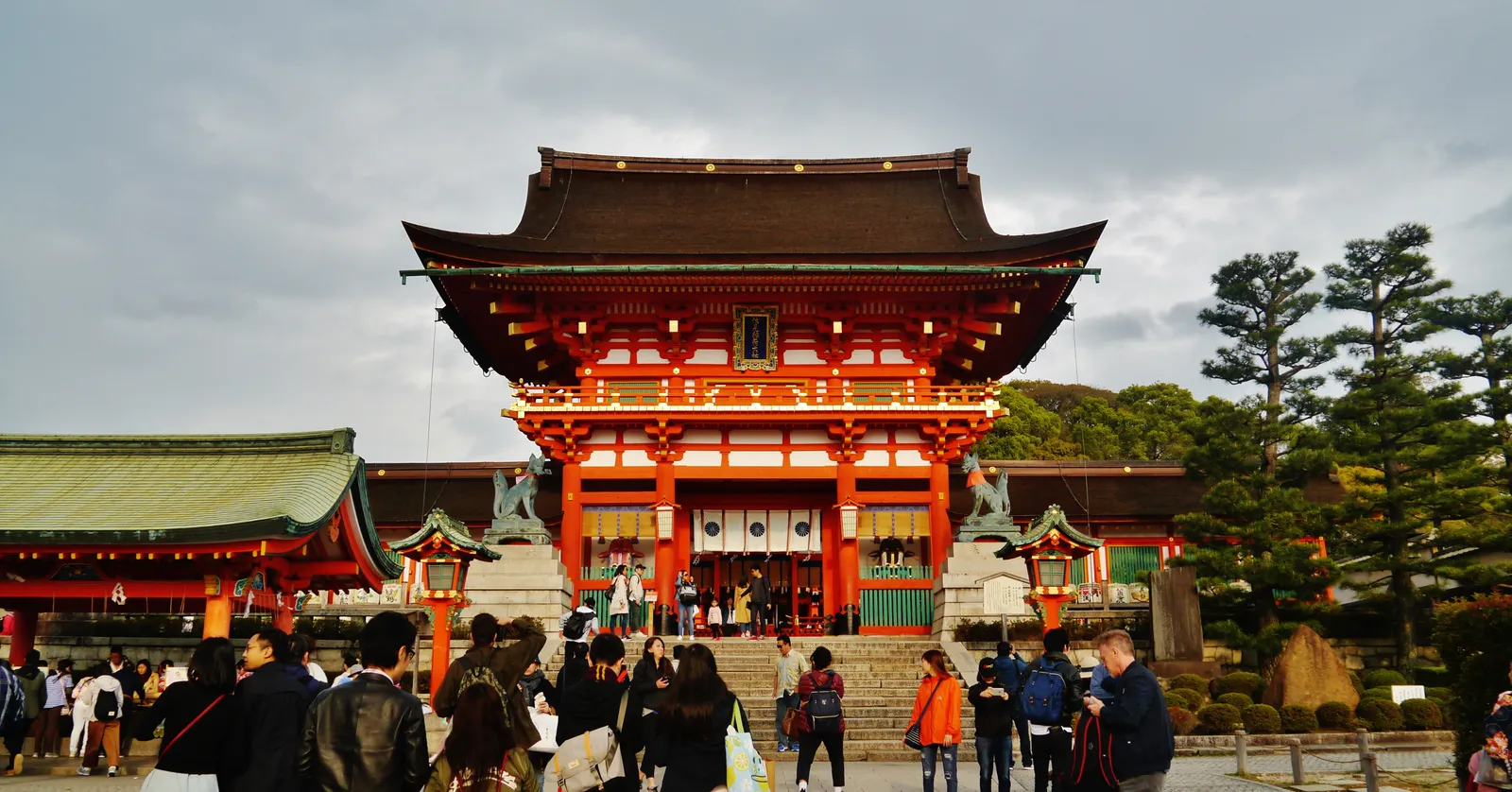
The vermilion gate and key-holding foxes at Fushimi Inari
Inari station puts you out roughly a hundred metres from the shrine’s front steps, and what stands at the top of them is a two-storey gate in bright vermilion, the Romon. Toyotomi Hideyoshi paid for it in 1589. The story is that he prayed here for his mother’s recovery from illness and pledged ten thousand koku of rice if it came, and the story turns out to be true: repairs later turned up an ink inscription from that year naming him. Paired stone foxes sit on plinths on either side, and they are worth ten seconds of attention because they are carrying things. One usually has a key in its mouth, read as the key to a rice granary, the other a round jewel; older figures elsewhere on the mountain hold scrolls or sheaves of rice. Foxes here are Inari’s messengers, not Inari.
The stalls on the approach below the gate grill quail and sparrow whole on skewers, which is a Fushimi thing rather than a Kyoto one and has been for something like four centuries. The usual explanation runs both ways: this is a shrine to the deity of the rice harvest, and sparrows are what eats the rice. Quail is on all year; sparrow is roughly mid-November to March. If you would rather have all of this explained than guess at it, a small-group walking tour of the shrine is bookable through a tours and activities platform and runs about three hours including as much of the mountain as the group wants.
The trail up Mount Inari is steps almost all the way
Mount Inari is 233 metres and the paths looping over it come to about four kilometres. Behind the main hall the Senbon Torii begins, two parallel rows of gates set close enough to roof the path completely, and this first stretch is the densest run of them anywhere on the mountain: whatever you have seen in photographs, you are standing in it within fifteen minutes of arriving.
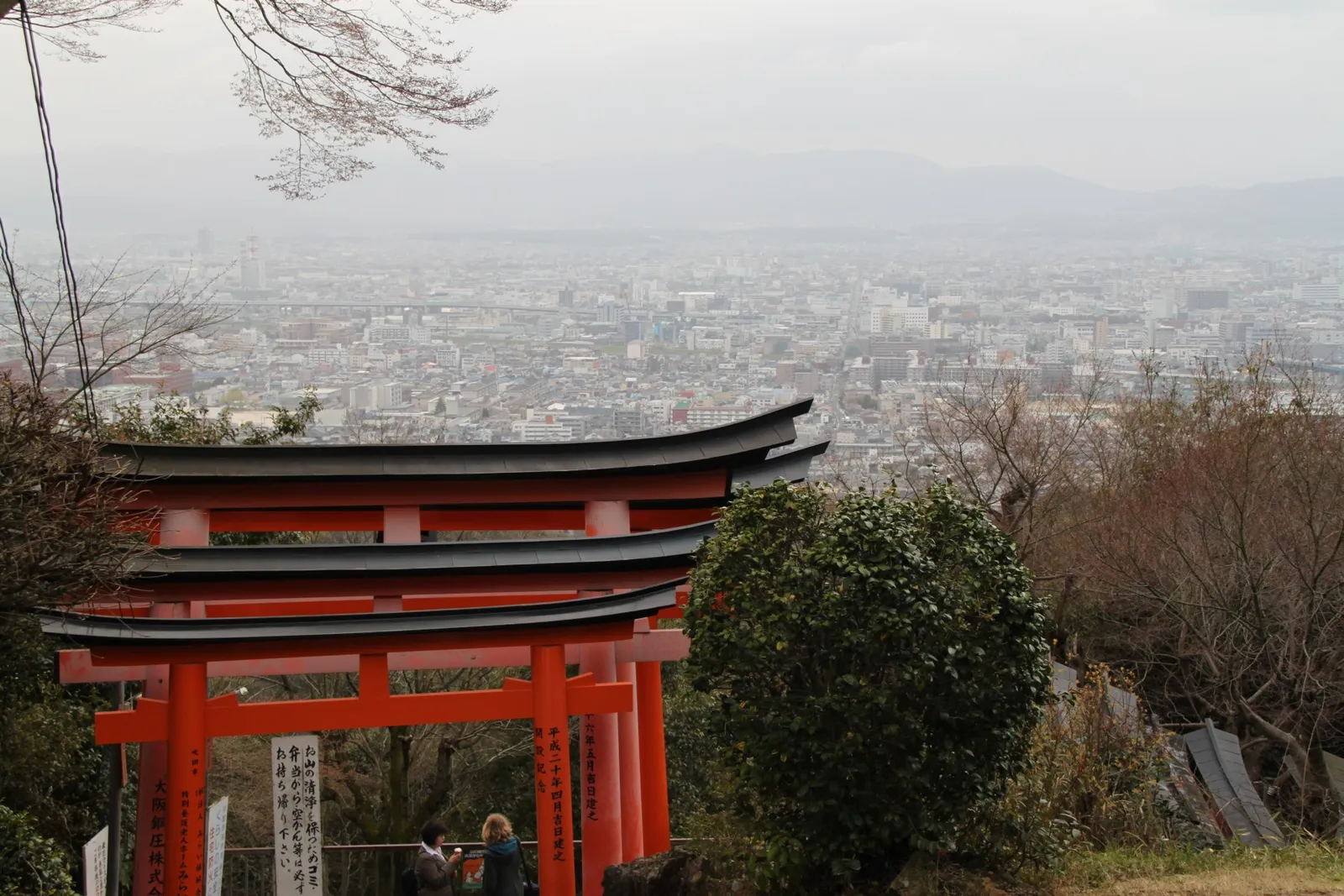
Above the Okusha prayer hall, where people queue to lift a stone lantern’s finial and judge whether it feels lighter or heavier than they expected, the crowds fall away and so does the gate density. Thirty to forty-five minutes of climbing reaches the Yotsutsuji intersection, roughly halfway, where the trees open and the southern half of Kyoto lies flat below you. The full loop to the summit and back runs two to three hours, and above Yotsutsuji it is mostly forest, small sub-shrines and stacked miniature gates rather than the tunnels. If a mountain is more than you had in mind for the afternoon, the main Kyoto guide covers the flat stops instead. Either way, everything above the Okusha is stone steps almost without a break, worn uneven, with no step-free route round them.
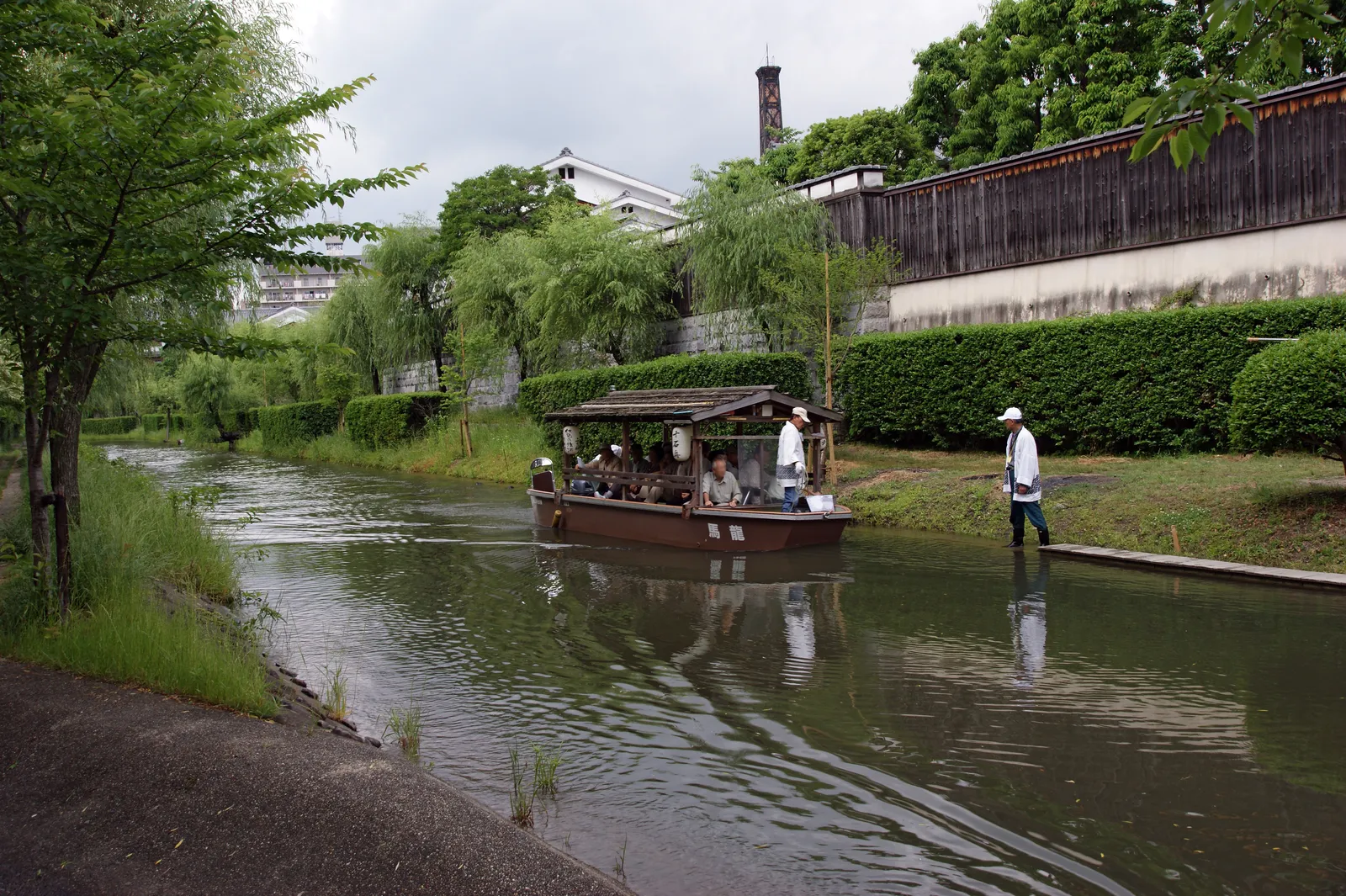
Sake warehouses along the canal at Chushojima
Fushimi, the district the shrine takes its name from, sits south of the mountain and has been brewing sake for roughly four hundred years on the strength of its ground water. Chushojima station is about five minutes down the line, and from there the streets turn into long timber and white-plaster storehouses, most of them still working, along a canal where flat-bottomed Jukkokubune boats carry passengers under the willows.
The Gekkeikan Okura Sake Museum is five minutes’ walk from the station across that canal, in one of the old brick-and-timber brewery buildings, and its 600 yen admission covers three tastings and a small bottle to take away; it is 100 yen for anyone aged 13 to 19 and free below that, and it opens 9:30am to 4:30pm daily apart from the New Year and Obon breaks. Walk-ins are usually fine but they cap numbers when it is busy, so booking ahead is the safer plan. A guided half-day that does the shrine and the brewery together is sold on a tours and activities platform if you would rather not work out the connection yourself.
The airport run from here needs a change at Kyoto Station
Inari station is five minutes and 150 yen from Kyoto Station on a local train, which is the only awkward part of leaving from this end: only local services stop at Inari, so a rapid or express train will carry you straight past it in both directions. From there the Kansai-Airport Express Haruka runs to Kansai International Airport (KIX) in about 75 minutes, roughly every half hour, at 3,060 yen non-reserved or 3,590 yen reserved, from platform 30 at the west end of the building.
Budget about an hour and forty minutes from the shrine gate to the terminal door, plus whatever the change costs you. The airport bus from the Hachijo exit on the station’s south side is the cheaper option at 2,800 yen and the later one, running to 9:10pm, though it takes an hour and twenty-five to an hour and thirty. Either way you come back through Kyoto Station, so a bag left at a storage point near the concourse is on the route rather than a detour from it.
Frequently asked questions
What should I do during a layover near Fushimi Inari Taisha in Kyoto?
Walk in through the vermilion gate, go as far up the trail as your clock allows, and turn round. The gates are at their densest in the first stretch behind the main hall, so fifteen minutes gets you the thing you came for; thirty to forty-five gets you to the halfway viewpoint and the city spread out below. None of it costs anything and none of it closes. With three hours or more, add the sake warehouses at Chushojima, five minutes south by train, which is the only part of this that keeps opening hours and the part to drop if your time shortens.
Can I see Fushimi Inari without climbing the mountain?
Yes, and more of it than you might expect. The approach, the vermilion Romon gate, the main hall and the first tunnels of the Senbon Torii are all on flat or gently graded ground, straight off Inari station, and that stretch holds the densest run of gates on the whole mountain. What you give up is the Okusha prayer hall and everything above it, which is stone steps almost without a break for four kilometres with no alternative route. Anyone with a pushchair, a knee, or a suitcase they could not leave behind should plan to stop at the bottom of the steps and not feel short-changed.
Why are there fox statues all over Fushimi Inari?
Foxes are Inari's messengers, not the deity itself, which is a distinction the shrine's own signage is careful about. They stand in pairs at almost every gate and hall, and they usually carry something in their mouths: a key, understood as the key to the rice granary, or a round jewel, with scrolls and sheaves of rice turning up on some of the older figures. Inari is the deity of rice, so a granary key is a fairly direct statement of what people came here to ask for, and the modern version of that is the businesses whose names are painted on the backs of the gates.
How do I get from Fushimi Inari to the Fushimi sake district?
From Fushimi-Inari station, a five-minute walk from the shrine's front gate and a different station from the one on the shrine's doorstep, it is about five minutes on the train to Chushojima. The sake warehouses start a few minutes' walk from there, along a canal where flat-bottomed Jukkokubune boats still run. Going back the other way, or on to central Kyoto, means returning to Inari station and taking a local train five minutes north.