Budapest Layover: Danube Promenade From BUD
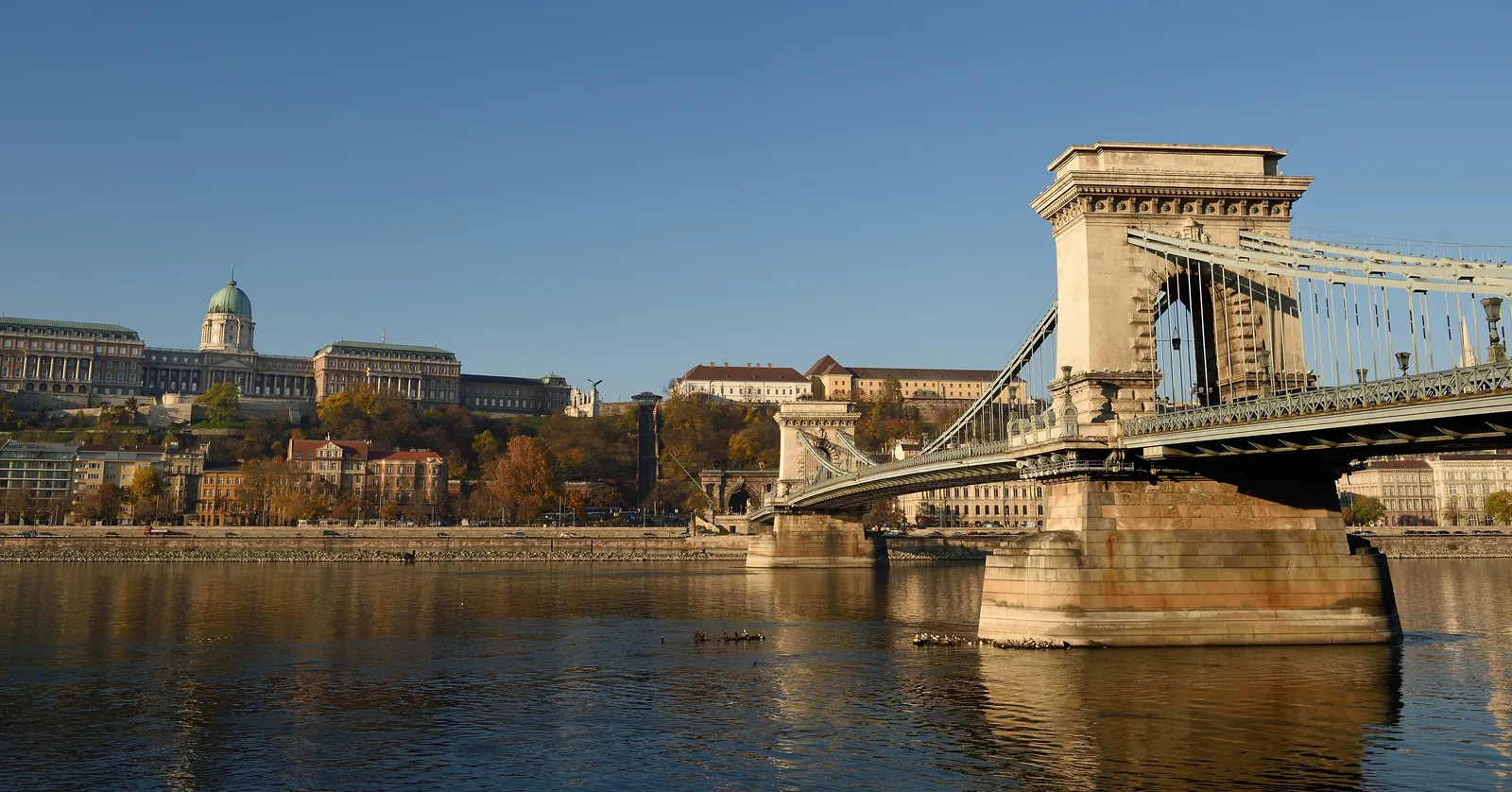
Deák Ferenc tér, where all three of Budapest’s metro lines converge, sits five minutes’ walk from St. Stephen’s Basilica, and from there it’s a flat, free stretch down to the Shoes on the Danube Bank memorial and across the Széchenyi Chain Bridge. Only the basilica’s own dome terrace charges admission.
The terrace around St. Stephen’s dome
St. Stephen’s Basilica stands five minutes north of Deák Ferenc tér, and it took fifty-four years to finish: begun in 1851, consecrated in 1905, with a collapsed dome partway through that sent the builders back to the start. Its replacement stands 96 metres high, exactly level with the Parliament building across the river. Inside, in a side chapel, is the mummified right hand of Stephen I, the king who Christianised Hungary a thousand years ago.
The reason to go, though, is the panorama terrace that runs around the base of that dome. It is a complete open-air circle, level with the rooftops, and it turns the city into something you can read: the Buda hills on one side, the flat grid of Pest on the other, the square directly below with its café tables laid out in rows. Counter prices have moved around a good deal in recent years, so booking entry in advance through a tours and activities platform settles it before you land.
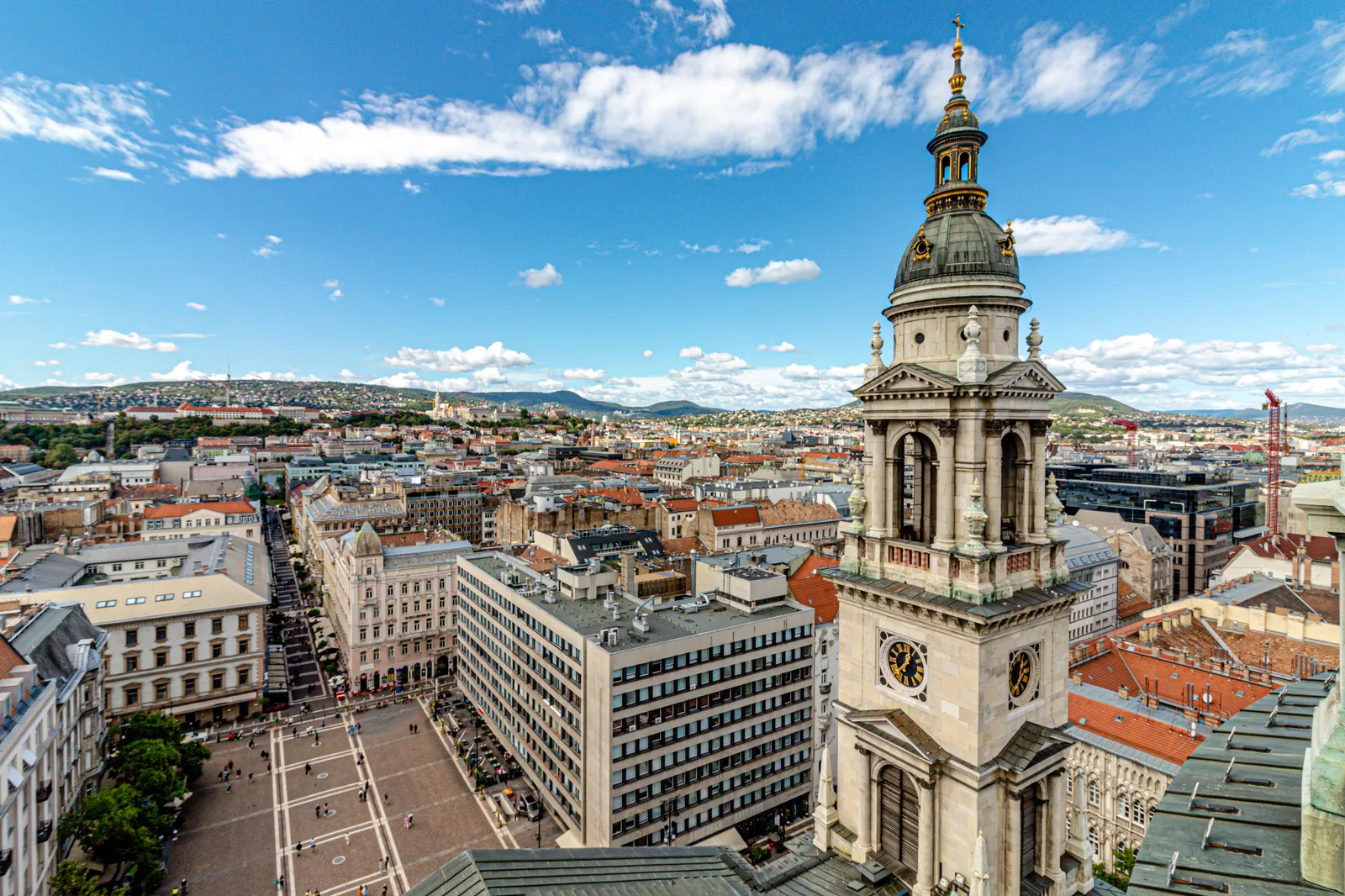
A lift covers most of the climb, as far as the drum, but the last stretch out to the open gallery is stairs regardless, and skipping the lift entirely means 364 steps from the ground. Those stairs are one of two places on this walk a wheeled suitcase cannot follow, the other being the steps down to the Shoes on the Danube Bank on the lower quay.
The church hall below opens 9am to 6pm Monday to Saturday and only from 1pm on Sunday, when the morning belongs to mass. The terrace and the treasury keep longer hours, daily from 9am to 7pm.
The Shoes on the Danube Bank
Ten minutes downhill from St. Stephen’s Basilica, on the stone quay below the promenade, sixty pairs of iron shoes stand at the water’s edge as though their owners had just stepped out of them. Men’s boots, women’s heels, a few pairs small enough to be a child’s. In the winter of 1944 and 1945 Arrow Cross militiamen marched Jews from the Budapest ghetto down to this bank, made them take off their shoes, which were worth money and could be resold, and shot them into the river. Three small iron plaques along the row say so in Hungarian, English and Hebrew.
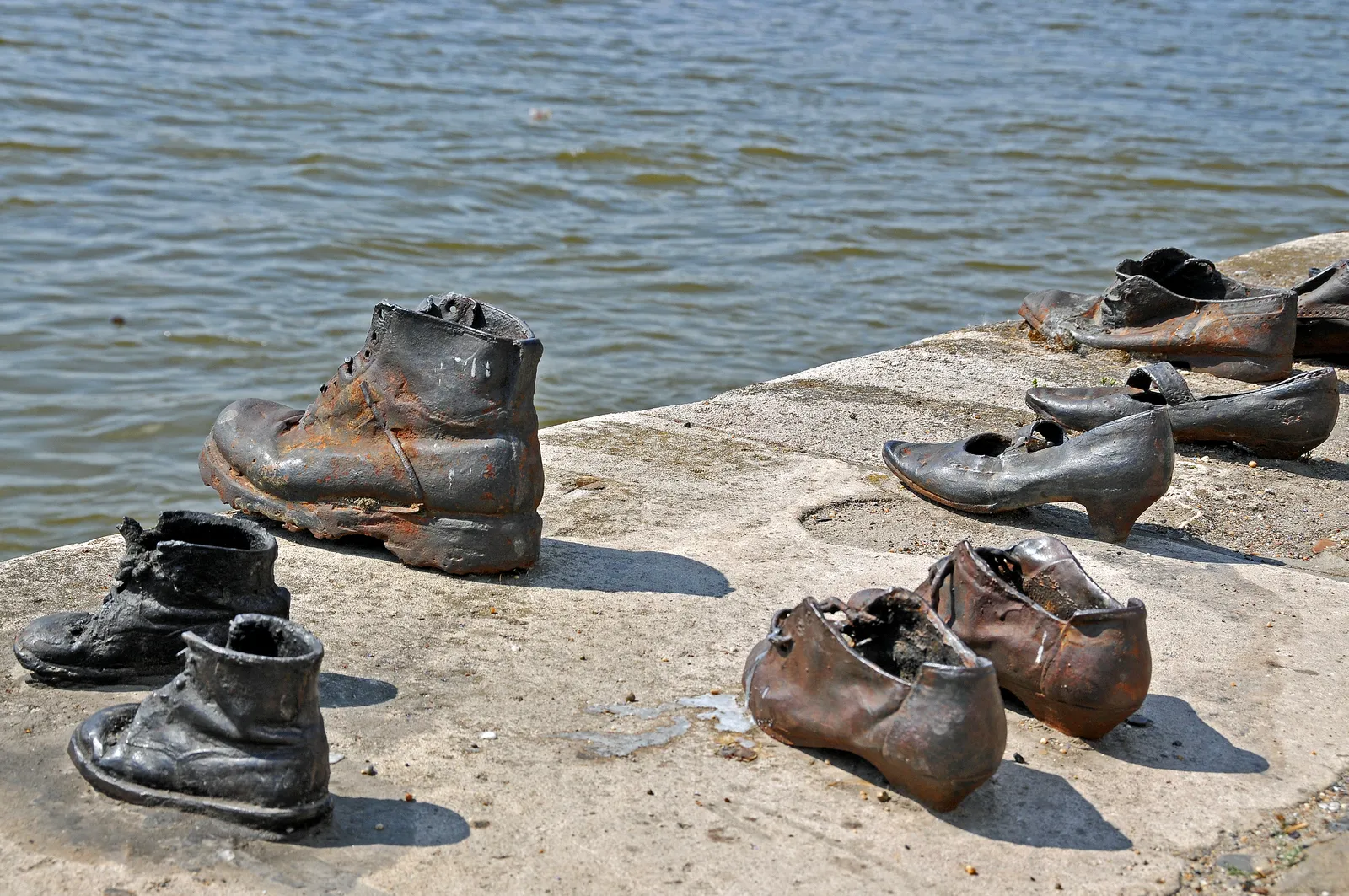
The film director Can Togay came up with it and the sculptor Gyula Pauer cast the shoes; they were set down here on 16 April 2005. The memorial sits on the lower quay, reached by steps down from the Danube promenade, and it goes under water when the river runs high in spring.
The lions at each end of the Chain Bridge
Four stone lions have sat at the bridgeheads since 1852, a pair on each bank, carved by János Marschalkó. A shoemaker’s apprentice is supposed to have shouted at the unveiling that they had no tongues, and the story went round the city fast enough that Marschalkó put up five hundred florins on it, took his friends to a menagerie to look at a real lion from below, and won the bet.
The bridge underneath them opened in 1849 as the first permanent crossing between Buda and Pest, and its 202-metre main span made it one of the longest suspension bridges in the world at the time. It came out of a two-year rebuild in August 2023 with wider pavements and without private cars, which are now banned from it: buses, taxis and bikes only. Walking across is a quieter proposition than it was before. From the middle you have Buda Castle on the hill ahead and the Parliament building upstream on your right.
Inside the Dohány Street Synagogue
Dohány Street sits about fifteen minutes inland from the Széchenyi Chain Bridge, at Astoria, where the synagogue was consecrated in 1859, seats close to three thousand and is the largest in Europe, built in a Moorish style with two onion-domed towers that look more like minarets than anything the architecture of European synagogues had produced before.
In the courtyard behind it stands a weeping willow in steel by Imre Varga, its leaves carrying the names of the dead. It grows over the graves of some two thousand people who died in the Budapest ghetto in that same winter of 1944 and 1945; a synagogue courtyard is not normally a burial ground, and this one became one only because of what happened there. Admission is not cheap, in the region of 9,000 forints, and covers the synagogue, the Jewish Museum next door, the ghetto exhibition in the cellar and the memorial garden. It is closed all day Saturday for Shabbat and shuts early on Fridays. A synagogue ticket booked ahead through a tours and activities platform skips the on-site queue, which can run long by midday.
With any spare half hour, there’s a quieter game to play around central Budapest’s railings and kerbs. Since 2016 the sculptor Mihály Kolodko has bolted bronze miniatures onto them without asking anyone first, roughly fifty of them by now, most just ten to fifteen centimetres tall. A T-34 tank with a drooping barrel is wedged into a wall niche on the Buda embankment; a Lisa Simpson in Joan of Arc’s armour was stolen from her first spot and recast near Fővám tér. Pieces disappear and reappear elsewhere often enough that a current map is worth considerably more than an old blog post.
No airport train, just a bus
The airport has been open since 1950 and has never had a rail connection. The government finally decreed one in October 2025, a 27-kilometre line that would put trains into Nyugati station, but construction is not due to start until 2027 and the first services are pencilled in for the early 2030s. Until then everyone leaving the city for a flight goes the same way.
The one to take is the 100E airport bus. It runs between the terminal and Deák Ferenc tér, the downtown square where all three of Budapest’s metro lines meet, calling at Kálvin tér and Astoria on the way. The ride is about 40 minutes, longer in the morning and late-afternoon traffic, and once you have walked to the stop and waited for the next departure, budget nearer an hour door to door. It goes round the clock: every six to ten minutes through the day, every half hour or so overnight.
The fare is the part that surprises people. The 100E has its own ticket at 2,500 forints, about six euros, and neither the ordinary 500-forint single nor the 850-forint 90-minute ticket is valid on it. If you already hold a travel pass or a Budapest Card, the airport add-on is 1,000 forints instead. The cheap route out is bus 200E to Kőbánya-Kispest and the M3 metro, the blue line, from there to the terminal: one 850-forint 90-minute ticket covers both legs, but the transfer stretches the trip to 50 or 60 minutes and the M3 stops running around 11pm.
Not every departure from Budapest is by air. Keleti station sends a Railjet or a EuroCity to Vienna roughly every hour, about two hours forty each way, for anyone whose own next leg is by rail rather than by plane.
The M3 shuts down around 11pm. The airport bus does not: it runs all night, thinning to every half hour or so after dark, which makes a late departure out of Ferenc Liszt one of the easier ones in Europe to reach. From central Pest, allow about two and a quarter hours to the gate, covering the bag, the walk back to Deák Ferenc tér, up to ten minutes on the pavement waiting, forty on the bus, and check-in and security at the far end.
That is also the argument for leaving the suitcase in the middle of Pest rather than walking it round the riverbank: every stop on this route ends within ten minutes of the square you started at, and the bus back to the airport leaves from that square too.
Frequently asked questions
What should I do during a layover in Budapest?
With four to six hours, an airport bus reaches Deák Ferenc tér in about 40 minutes, five minutes from St. Stephen's Basilica, whose panorama terrace circles the dome daily from 9am to 7pm. From there it's a walk down to the river for the free Shoes on the Danube Bank memorial and across the also-free Széchenyi Chain Bridge. Only the basilica terrace charges admission, and counter prices have moved around lately, so booking it before you land settles that ahead of time. The whole loop comes back within ten minutes of the square you started at.
Can I use an ordinary Budapest transit ticket on the airport bus?
No. The 100E airport bus between Ferenc Liszt airport and Deák Ferenc tér, the downtown square where the city's three metro lines meet, charges its own fare of 2,500 forints for a single, and the standard 500-forint single and 850-forint 90-minute tickets are not valid on it. Holders of a Budapest Card or a travel pass pay a 1,000-forint add-on instead. The cheaper way out is bus 200E out to Kőbánya-Kispest and the M3 metro line from there, which one 850-forint 90-minute ticket covers end to end, though it runs 50 to 60 minutes with the transfer and the M3 stops around 11pm.
Is going up St. Stephen's Basilica worth it on a short stop?
Yes, if you want a view without leaving central Pest. The panorama terrace is a full open-air circle around the base of the basilica's 96-metre dome, level with the rooftops, the Buda hills on one side and the flat grid of Pest on the other, and it is a five-minute walk from Deák Ferenc tér. It opens daily from 9am to 7pm, later than the church hall below it, which shuts at 6pm and does not open until 1pm on Sundays. A lift covers most of the way up, but the last stretch to the open gallery is stairs regardless, so it isn't a stop for a wheeled suitcase.
What is closed at the weekend in Budapest?
The Dohány Street Synagogue is shut all day Saturday for Shabbat and closes early on Fridays, so it belongs in a weekday stop rather than a weekend one. St. Stephen's Basilica keeps its church hall closed on Sunday mornings for mass and opens at 1pm, although the panorama terrace around its dome runs from 9am every day. The riverbank half of this walk keeps no hours at all: the Shoes on the Danube Bank memorial, the Danube promenade and the Széchenyi Chain Bridge are open ground and cost nothing, the same on a Sunday as on a Tuesday.
Does this walk work with a wheelchair or a pushchair?
Mostly. The airport bus into central Budapest uses low-floor articulated vehicles, the Danube promenade along the Pest bank is flat and paved, and the Széchenyi Chain Bridge came out of its 2023 rebuild with widened pavements on both sides. Two parts do not work. The Shoes on the Danube Bank memorial sits on the lower quay, reached by steps down from the promenade, with no ramp at the memorial itself, though the whole row is visible from the promenade above. And the panorama terrace at St. Stephen's Basilica has a flight of stairs between the lift landing and the open gallery, so the lift alone does not get you all the way up.