Budapest Layover Near Nyugati Station
Part of the full Budapest Layover: Danube Promenade From BUD
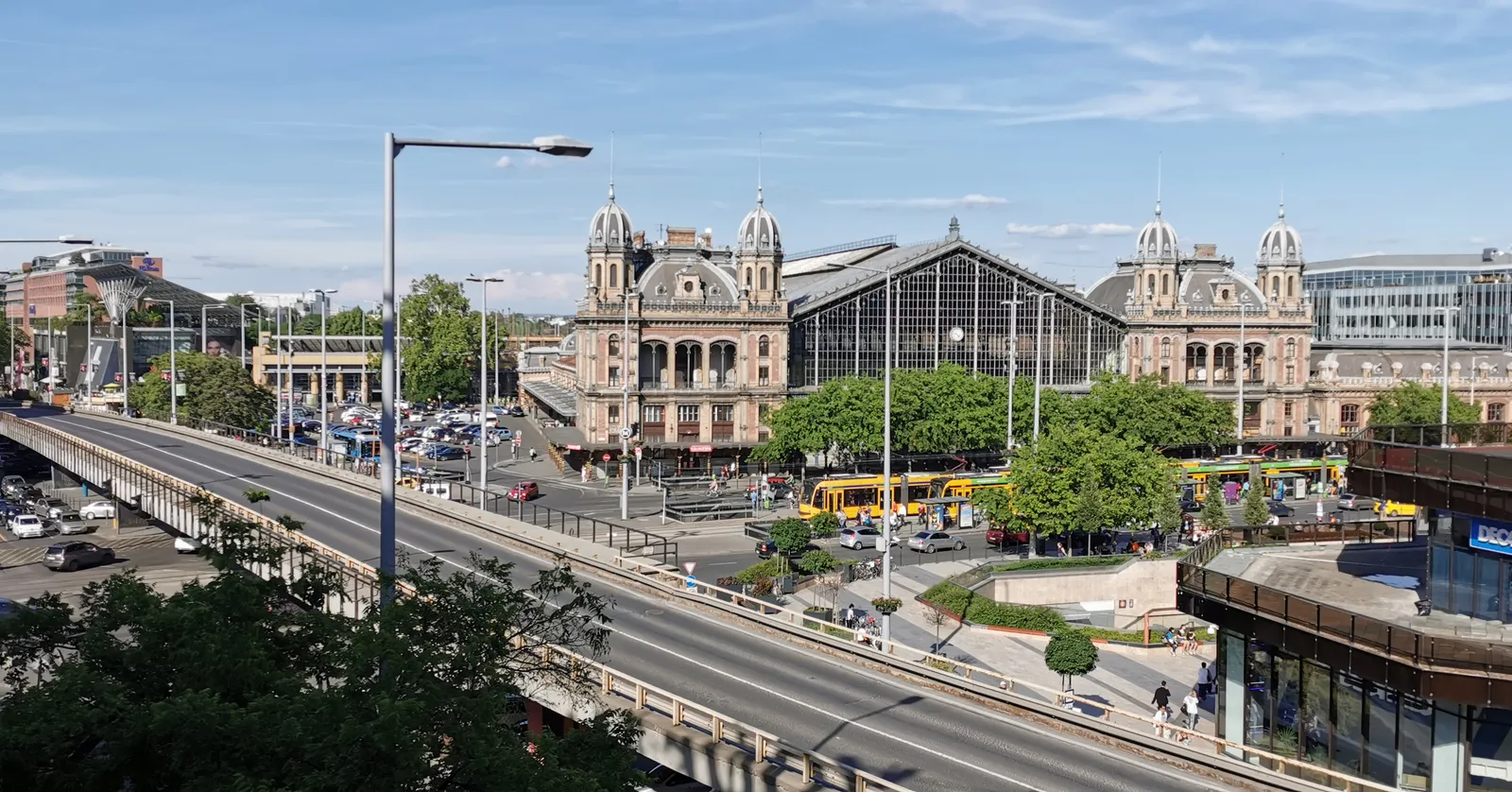
Budapest’s Nyugati station still has the iron and glass shed that Gustave Eiffel’s Paris office engineered for it in 1877, its original dining room is still a restaurant at the boulevard end, and the Hungarian Parliament is a twenty-minute walk south from the front door.
The iron and glass shed over Nyugati’s platforms
The hall runs 146 metres back from the boulevard, 42 metres across and just under 25 metres up at the ridge, and it opened on 28 October 1877 to a design by August de Serres, engineered and built by Gustave Eiffel’s Paris office. It covers platforms 10 to 13; the other thirteen tracks sit out in the open on either side, which is why the middle of the station looks like a cathedral and the edges look like a depot.
What it replaced was standing in the way. The terminus of Hungary’s first railway line, the 1846 route out to Vác, occupied this exact ground, so the new hall was raised around the old building and the old one came down only once trains could run through the replacement.
There are no ticket barriers anywhere in it. You can walk in off Teréz körút, stand at the buffer stops and look straight up the length of the shed without buying anything; tickets are checked on board instead. The daytime EuroCity and overnight services to Bratislava, Prague, Warsaw and Berlin were all moved here from Keleti station, so from late afternoon there is usually sleeper stock standing under the glass.
Inside the Hungarian Parliament at Kossuth tér
Kossuth Lajos tér is twenty minutes’ walk south-west of Nyugati, and the Parliament fills its western side: 268 metres of white neo-Gothic frontage facing the Danube, with a dome 96 metres high over the middle of it, opened in 1902 to Imre Steindl’s design. Steindl went blind towards the end of the work and died that same year.
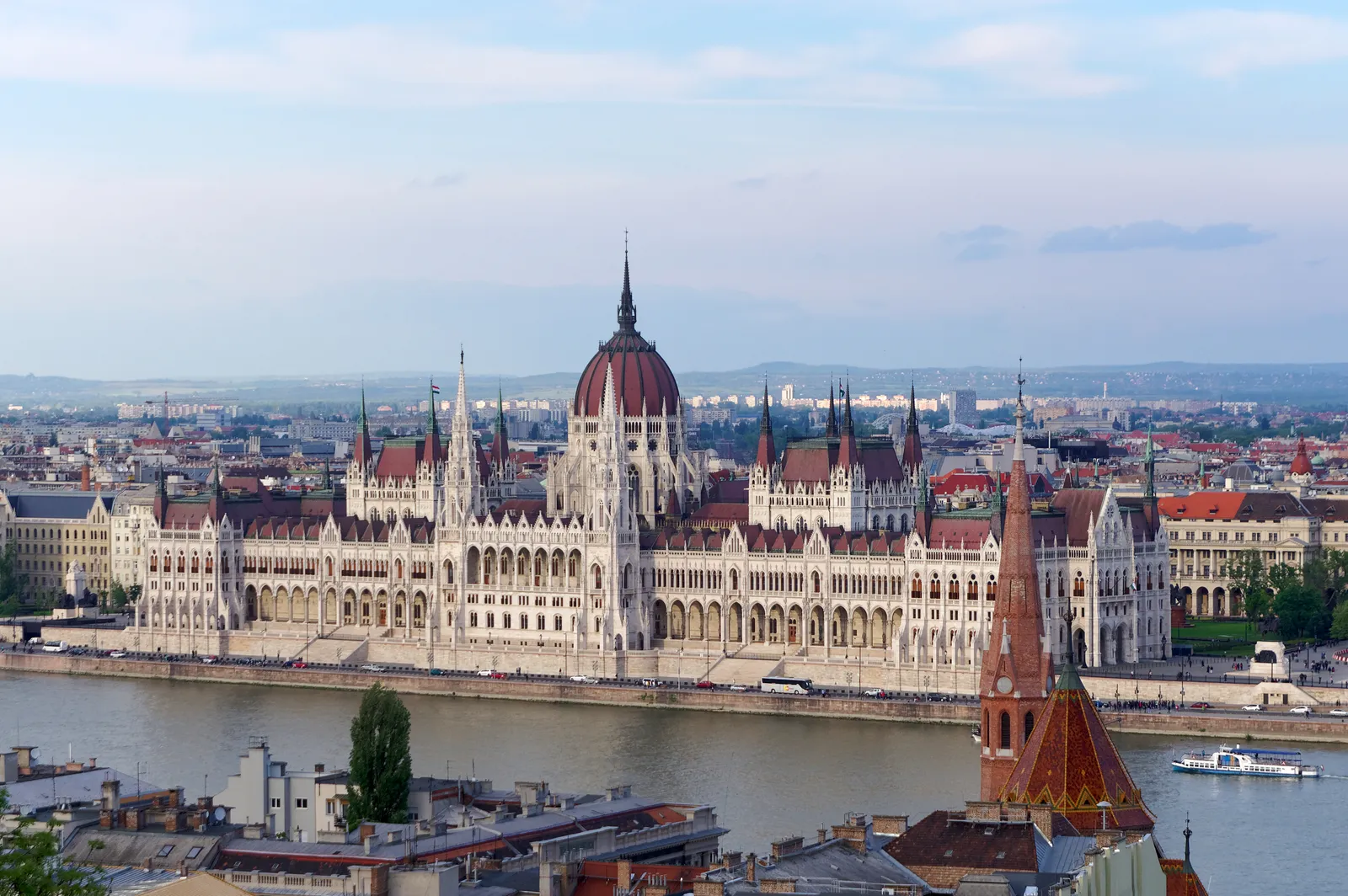
Nobody wanders in on their own. Everyone goes round on a 45-minute guided tour that takes in the grand staircase, the Dome Hall and the Holy Crown of Hungary standing under guard beneath it, where photography is not allowed. Tours run in English several times a day, and a ticket bought ahead through a tours and activities platform means walking past the counter queue at the visitor centre rather than joining it. EU and EEA passport holders pay half what everyone else does, currently in the region of 7,000 forints against 14,000.
Nyugati has no barriers to stop you wheeling a suitcase onto its platforms, but the Parliament’s visitor entrance screens every bag through a scanner and won’t pass a large one, and the cloakroom inside is built for coats.
Nyugati’s 1877 station dining room
The restaurant at the Teréz körút end of the station opened with the building and has kept its moulded plaster ceiling, its galleried upper floor behind iron railings and its hanging lamps through everything that has happened to it since, including becoming Hungary’s second branch of McDonald’s in 1990. A six-month refit finished in 2024 put the historic detailing back rather than boxing it in.
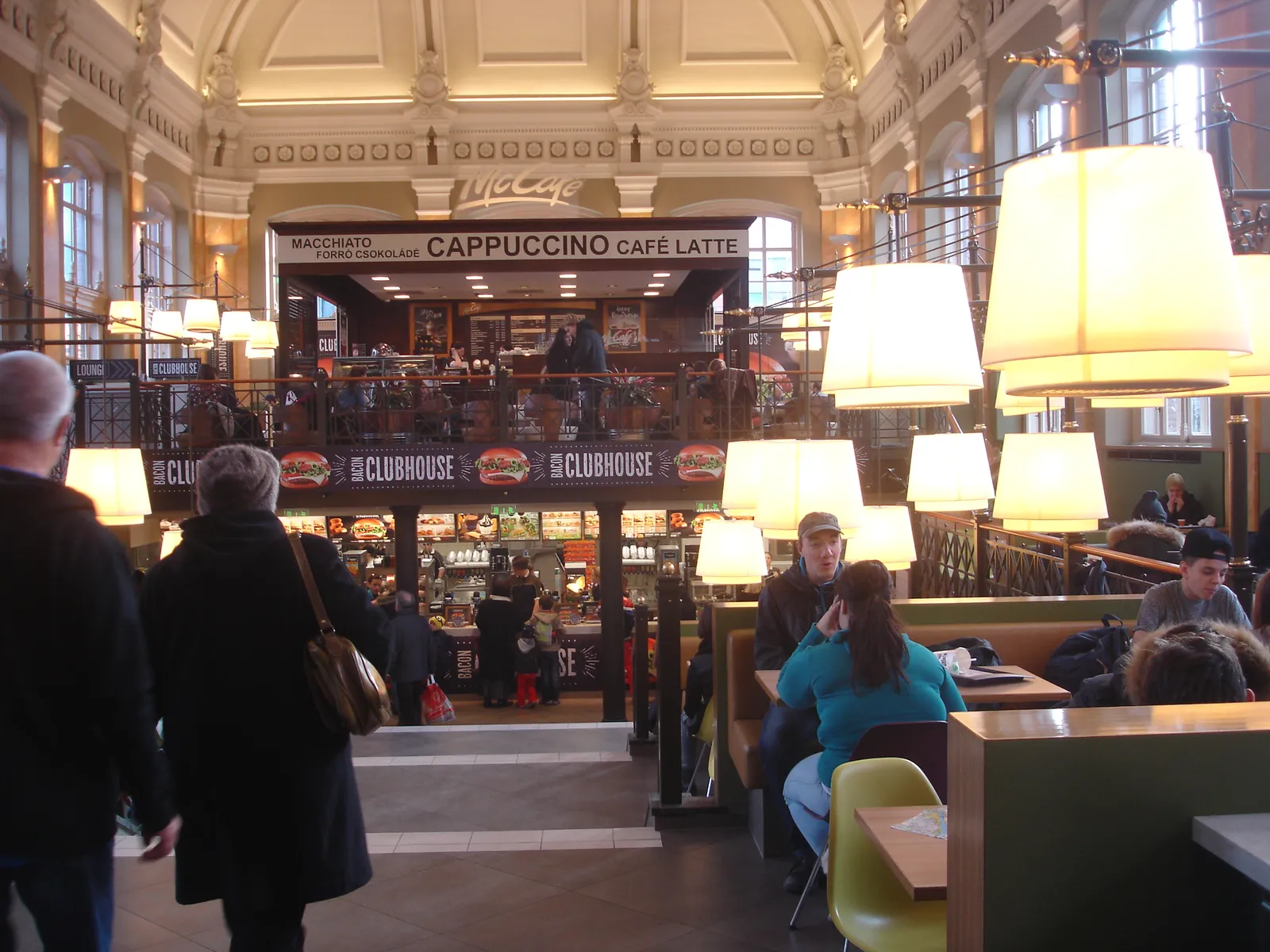
Nobody minds if you come in only to look up, and it has its own door onto the street, so it works as a sit-down stop without going near a platform. Late on Friday and Saturday nights the room currently runs as a lounge, with a DJ and light projected onto the stucco after 10pm, which is a strange thing to find in a railway restaurant of 1877 and worth knowing about if your evening here runs long.
The Comedy Theatre on Szent István körút
Szent István körút runs west from the station towards the river, and five minutes along it stands the Vígszínház, the Comedy Theatre, opened in 1896 to a design by Ferdinand Fellner and Hermann Helmer, the Viennese partnership responsible for more than forty theatres across Europe. It is French neo-baroque and it does not hold back: a dark dome over the centre, a carriage portico at the front, and carved figures and reliefs across the whole elevation.
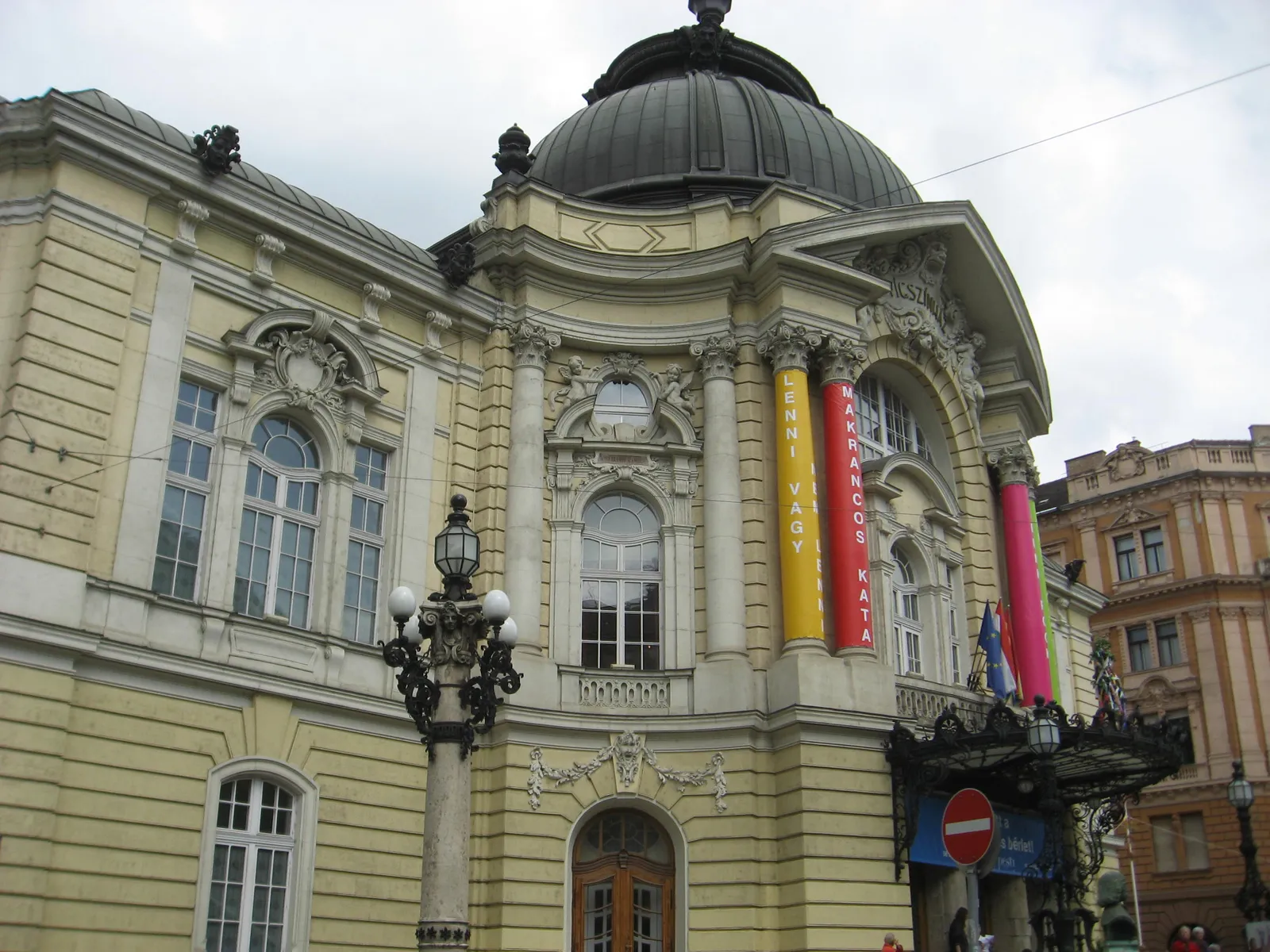
Shellfire on New Year’s Day 1945 took most of it out. What went back up by 1951 was a plainer building without the ornament, and the front you see now is the 1994 reconstruction, which put the sculpture and the dome back. Performances are in Hungarian and there is no standing daytime tour, so for a visitor passing through this is a facade rather than an interior.
That is the shape of a few hours based here: a tight rectangle of streets between the boulevard and the river, with one paid interior in it and everything else free. If you would rather have the Danube itself, the Shoes on the Danube Bank and the walk across the Chain Bridge, the main Budapest guide covers that route starting from the middle of Pest.
Metro line M3 covers most of the way to Ferenc Liszt
Nyugati has a station on metro line M3, the blue line, directly beneath it, and that is the cheap way out to Budapest Ferenc Liszt International Airport (BUD): south-east to Kőbánya-Kispest, then bus 200E to the terminal. One 850-forint 90-minute ticket covers both legs, and the whole thing takes 50 to 60 minutes with the change.
The quicker version is two stops on the same line to Deák Ferenc tér and the 100E airport bus from there, about 40 minutes on the road, but that bus has its own 2,500-forint fare and ordinary Budapest tickets are not valid on it. The M3 stops around 11pm and the airport bus does not, thinning to roughly every half hour overnight. From Nyugati, allow about two hours to the gate.
Both routes start underneath the station, which is the argument for leaving the suitcase here rather than walking it down to Kossuth tér and back: you come through this building either way.
Frequently asked questions
Which trains leave from Budapest Nyugati station?
Nyugati is the Budapest terminus for the Danube-side suburban lines up to Vác and Szob, for domestic services towards Szeged, and, since the international departures were moved across from Keleti, for the daytime EuroCity and overnight trains to Bratislava, Prague, Warsaw and Berlin. Seventeen tracks are numbered left to right as you face the buffers, with the long-distance departures usually on platforms 10 to 13 under the original iron shed and the rest out in the open on either side.
How far ahead should I book a Hungarian Parliament tour?
In summer, further ahead than most people expect. The Parliament in Budapest can only be seen on a 45-minute guided tour, the English-language departures through the middle of the day fill first, and turning up at Kossuth tér without a slot in July or August usually means the next free English tour is hours away or gone for the day. Reserving a specific time and language before you arrive through a tours and activities platform is what makes this workable on a short stop rather than a gamble.
Can I go inside Nyugati station without a train ticket?
Yes. Budapest's Nyugati station has no ticket barriers at all, so anyone can walk in from Teréz körút, stand at the buffer stops and look up the length of the 1877 iron and glass hall without buying anything. Tickets are checked on board the trains instead. The former station dining room at the boulevard end is a working restaurant with its own street door, and it costs nothing to walk in and look at the ceiling.
What is free to see around Nyugati station in Budapest?
Most of it. The 1877 train shed and the station's original dining room are both open to anyone. Kossuth tér, the square in front of the Hungarian Parliament, is open ground with no ticket, and the building's Danube frontage reads better from outside than any photograph taken indoors, where the Dome Hall bans cameras anyway. The Comedy Theatre on Szent István körút is a facade to look at rather than a paid attraction during the day. Only the Parliament's interior tour costs money, and its price depends on which passport you hold.