Budapest Layover Near Keleti Station
Part of the full Budapest Layover: Danube Promenade From BUD
Two things sit within walking distance of Budapest’s Keleti station and neither is what you would expect of a district best known for its railway terminus: the Fiumei road graveyard ten minutes south, 56 hectares of arcaded tombs that cost nothing to walk into, and the Uránia cinema fifteen minutes west, whose auditorium is a gilded Moorish hall from 1896.
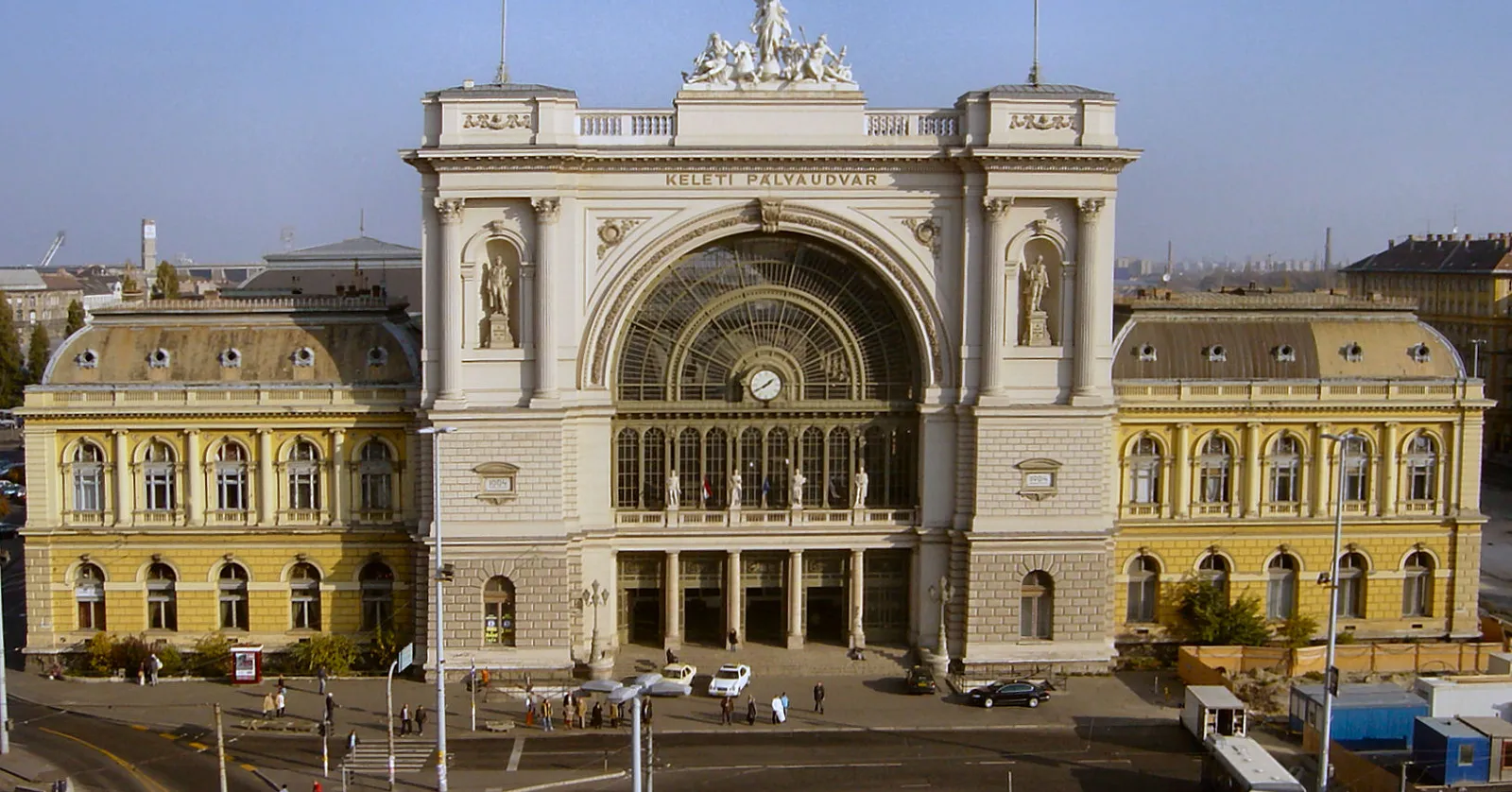
The statues over Keleti station’s entrance
The two figures standing in niches either side of the great arched window are James Watt and George Stephenson, carved by Gyula Bezerédi: real, named engineers rather than the allegorical figures most station facades reach for instead. Above them, on the roofline, Bezerédi’s other group here is allegorical, and together the two top out a facade 43 metres high. The whole thing went up between 1881 and 1884 to designs by Gyula Rochlitz and János Feketeházy, on three thousand piles driven into ground that turned out to be wetter than anyone expected, and it was called Budapest Central Station until 1892.
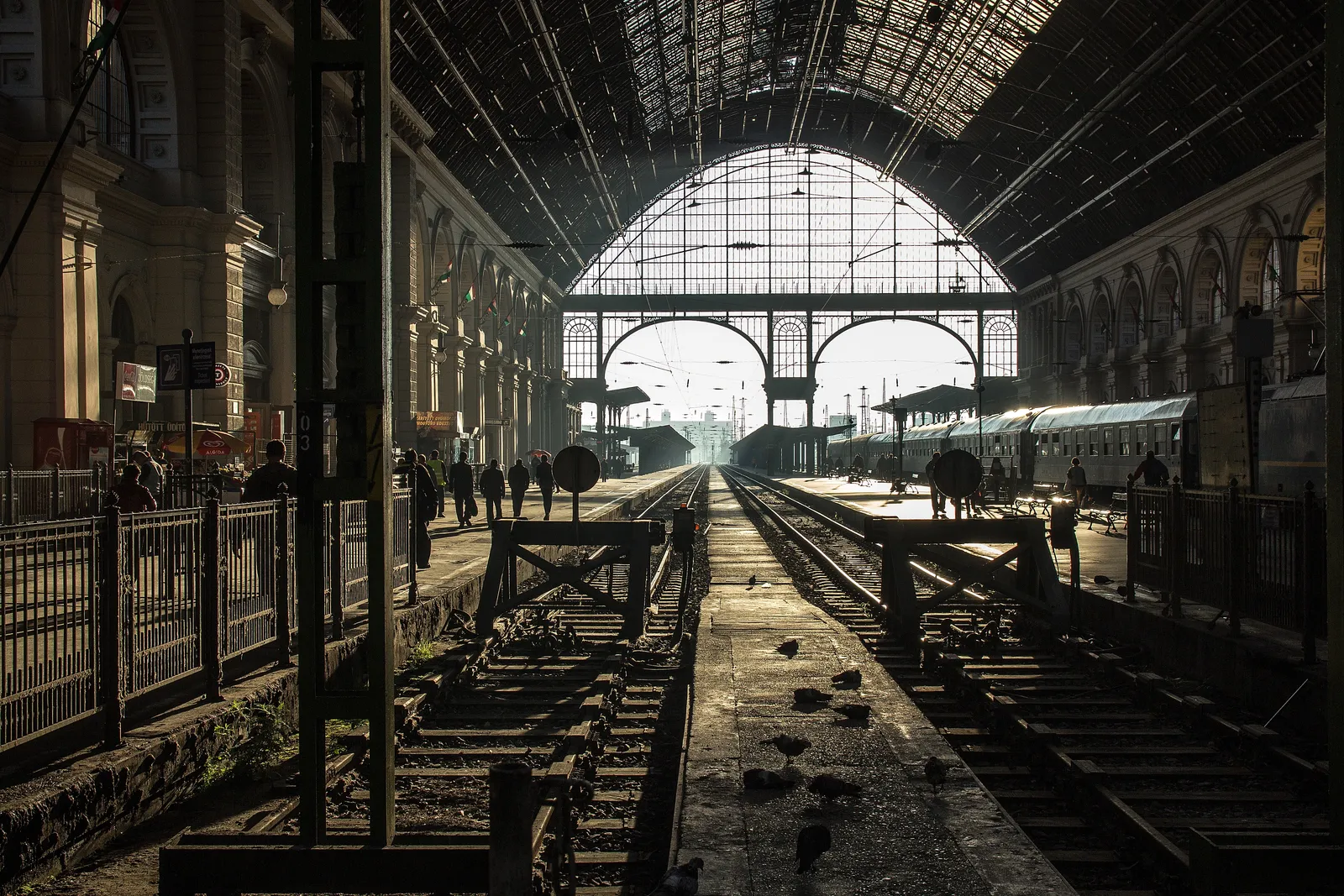
What was genuinely new in 1884 was the light. The station opened lit by electricity throughout, 70 arc lamps and 644 incandescent bulbs from the Ganz works, which was still a novelty in 1884. Walk to the end of the platforms and the arched glass wall does the same job by daylight; the hall behind you carries frescoes by Károly Lotz and Mór Than.
Seven platforms serve thirteen tracks, and arrivals from the international ones all funnel out through the same few doors under the arch, where a wheeled suitcase moves slowly for the half hour after a train berths.
One practical note before you plan around it: the state railway, MÁV, has spent several years rebuilding Keleti’s track and overhead line in phases, and one of those phases shut the platforms completely for four weeks in the summer of 2025, with the Vienna trains sent to Kelenföld instead. Further phases are still expected, so check which station your train actually leaves from rather than assuming it is this one.
Kossuth’s mausoleum at the Fiumei road graveyard
Ten minutes south of Baross tér, the square outside the station, Hungary’s national graveyard covers 56 hectares of what is effectively parkland with tombs in it. It opened in 1847, and the people buried here are the ones street names are made of: Lajos Kossuth, whose 1894 mausoleum by Kálmán Gerster sits at the centre with sculptures by Alajos Stróbl; Ferenc Deák, under an 1876 monument with stained glass by Miksa Róth; Lajos Batthyány, the prime minister shot in 1849. The poets János Arany and Endre Ady are here, so is the architect Miklós Ybl, and so is Ábrahám Ganz, whose foundry made the bulbs that lit the station you just walked out of.
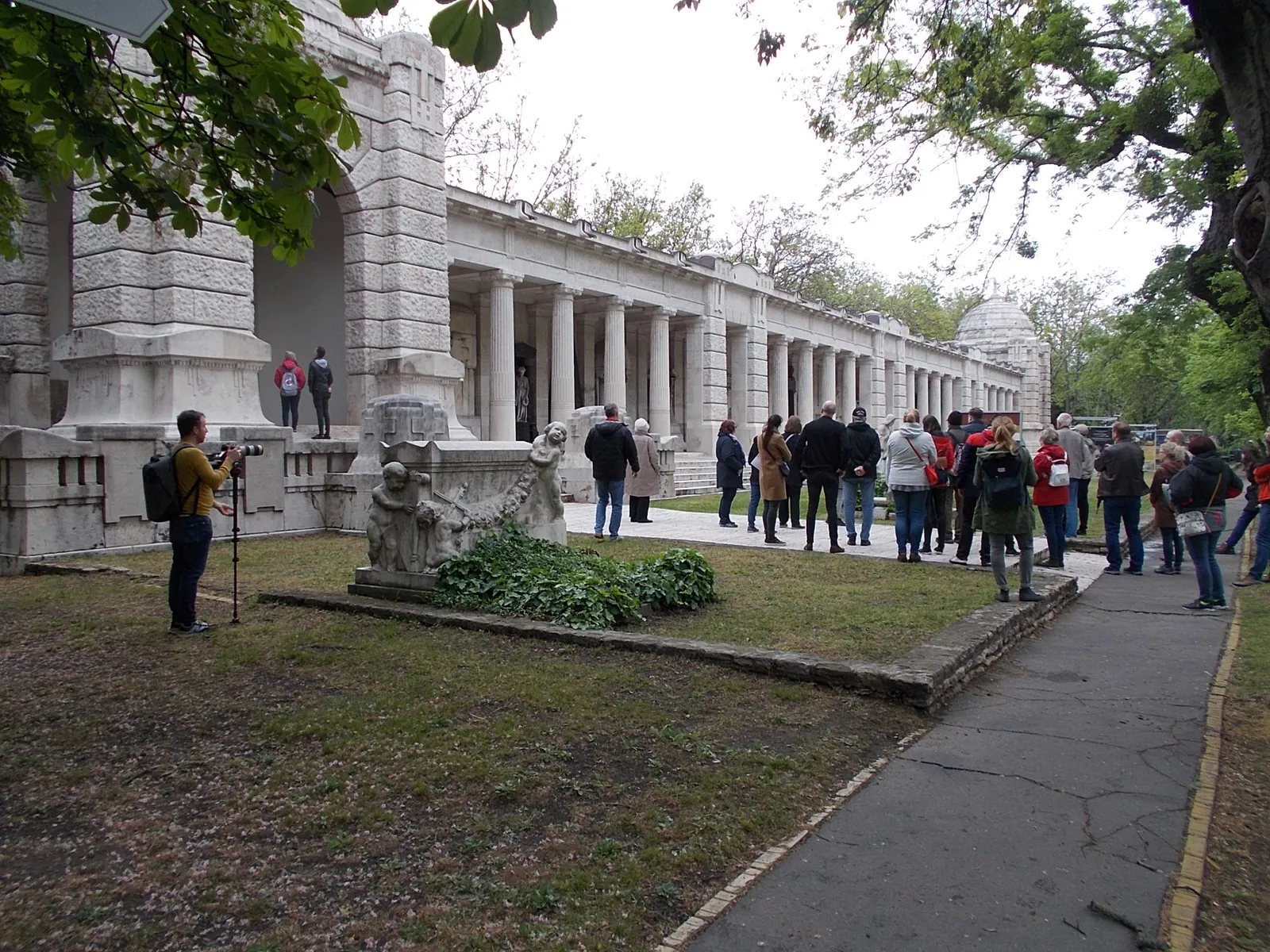
The arcades along the northern edge, built between 1908 and 1911 in the manner of northern Italian cemeteries, are the part to see if you only have an hour: a covered colonnade of family tombs running one into the next. Entry costs nothing and there are free maps at the gate marking the graves worth finding.
Through a wall on the far side is the Salgótarjáni Street Jewish cemetery, opened in 1874 and left to the trees for most of the twentieth century before restoration work began; it reopened to visitors in 2016, and the art nouveau and art deco tombs standing in the undergrowth are the reason to go through. It keeps its own hours, closes on Saturdays and Jewish holidays, and shuts at 2pm on Fridays, so check before you walk round.
The Moorish auditorium of the Uránia cinema
Fifteen minutes west of Keleti station along Rákóczi út, behind a Venetian Gothic front, is a room that has no business being a cinema. Henrik Schmahl built it in 1896 as a music and dance hall, and the auditorium is Moorish throughout: horseshoe arches on the balcony, gilt and red picked out across a vaulted ceiling, the sort of interior that makes people look up instead of at the screen.
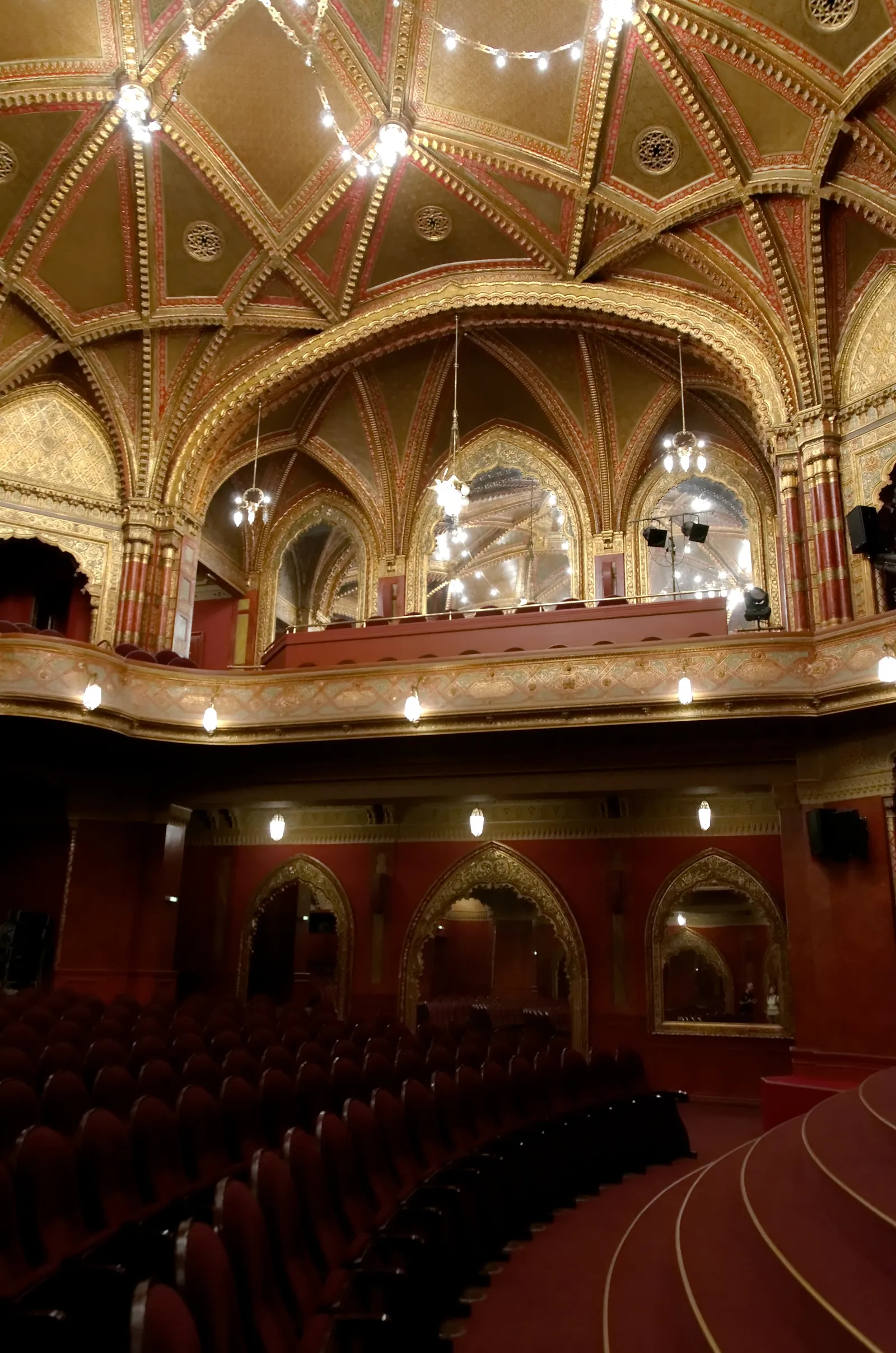
It has been a cinema since 1929, closed in 1999 when the money ran out, and came back after restoration as the national film theatre. It is still a working screen rather than a museum, so the way to see the room is to buy a ticket to whatever is on; the café in the foyer is open to anyone and gets you as far as the entrance hall.
The Art Nouveau pools at the Gellért Baths
Keleti is the eastern end of metro line M4, and the western end of it is worth knowing about: five stops without a change puts you at Szent Gellért tér, with the baths at the top of the exit stairs. Inside is a hall of Zsolnay tiles and stained glass, an indoor thermal pool under a vaulted ceiling, and an outdoor pool behind. Two hours is about the minimum once changing and drying off are counted, so this is the option for a longer stop rather than a quick one. Cabins and lockers go first on busy days, and a timed entry ticket booked through a tours and activities platform guarantees a spot without queuing at the counter.
That is the shape of a stop here in general: this is a working part of the eighth district rather than a set of sights, and the payoff is depth in one or two places instead of a sequence of them. If you would rather have the river, the Chain Bridge and the Danube promenade are a different afternoon entirely, and the main Budapest guide covers that route from the other side of town.
No direct bus to the airport from Keleti
Nothing runs straight from Keleti to Ferenc Liszt, so getting out takes two legs and 50 to 60 minutes. The neat version uses the M4: three stops to Kálvin tér, which is the last city stop the 100E airport bus makes on its way out. The alternative is metro line M2, three stops the other way to Deák Ferenc tér, where that bus begins its run, which is slower to reach but where you are far more likely to sit down. Whichever you pick, the airport bus has its own 2,500-forint fare and ordinary Budapest tickets do not cover it.
Both routes go back through the station, which is the argument for leaving the bag at Baross tér rather than carrying it round the graveyard: you are coming back this way regardless.
Frequently asked questions
How do I get from Keleti station to Budapest airport?
There is no direct bus, so it takes two legs and about 50 to 60 minutes in total. The quickest version is metro line M4, which starts at Keleti, three stops to Kálvin tér, where the 100E airport bus makes its last city stop before running out to Ferenc Liszt. The alternative is line M2, three stops the other way to Deák Ferenc tér, where that bus starts its run and where you are more likely to get a seat. Either way the airport bus charges its own 2,500-forint fare and ordinary Budapest single and 90-minute tickets are not valid on it.
Is the Fiumei road graveyard free, and when is it open?
Entry to Budapest's national graveyard costs nothing, and free maps marking the notable graves are handed out at the gate on Fiumei út. Opening hours shift with the season: the gates open at 7am from March to October and 7.30am in the winter months, and closing runs from 5pm in January and February out to 8pm from May to July. The 56 hectares take longer to cross than the map suggests, so if you only have an hour, head for the arcades and the Kossuth mausoleum rather than trying to see all of it.
Is the Gellért Baths worth the trip from Keleti station?
Yes, if you have the time to sit still for a couple of hours. Metro line M4 starts at Keleti station in Budapest and runs five stops to Szent Gellért tér without a change, and the baths are at the top of the exit stairs. Inside is an Art Nouveau hall of Zsolnay tiles and stained glass, and a thermal pool under a vaulted ceiling. Allow at least two hours for changing, soaking and drying off, which is why it suits a longer stop rather than a quick one. Cabins and lockers go first at busy times, so it is worth buying entry ahead of time through a tours and activities platform.
What is there to do near Keleti station in the rain?
Three of the four things worth doing around Keleti station in Budapest are indoors. The station's own hall has frescoes by Károly Lotz and Mór Than and a wall of arched glass at the end of the platforms. The Uránia cinema on Rákóczi út, fifteen minutes west, has a café in the foyer and a Moorish auditorium you can sit in for the price of a film ticket. And metro line M4 runs from Keleti to the Gellért Baths without a change. The Fiumei road graveyard is the exception: 56 hectares of open ground where the covered arcades are the only real shelter, so it is worth saving for a dry afternoon.