Budapest Layover Near the Great Market Hall
Part of the full Budapest Layover: Danube Promenade From BUD
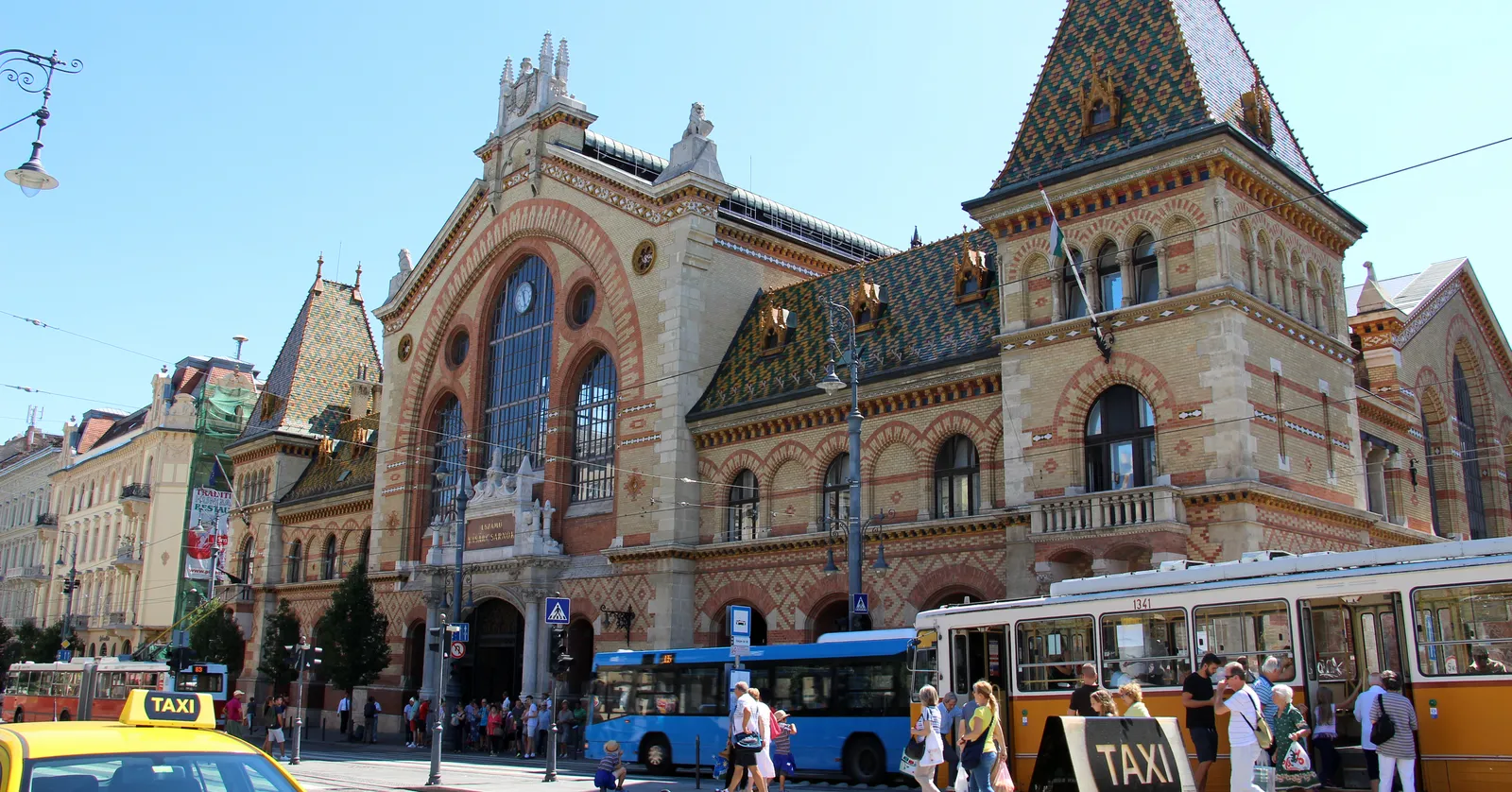
Fővám tér, at the Pest end of Liberty Bridge in Budapest, has a market hall on it that opened in 1897 and still trades on three floors, free to walk into and closed on Sundays; the Hungarian National Museum’s public garden is ten minutes inland from the same square.
Inside the Great Market Hall at Fővám tér
Samu Pecz built this in 1897, in brick and stone with a steel frame, and roofed it in glazed Zsolnay tiles laid in a diamond pattern, which is what you notice first from the square. It was one of five market halls the city opened in the same year, and the largest of them. Inside, the frame is exposed: riveted steel arches the length of the nave, daylight through the rose window at the gable end.
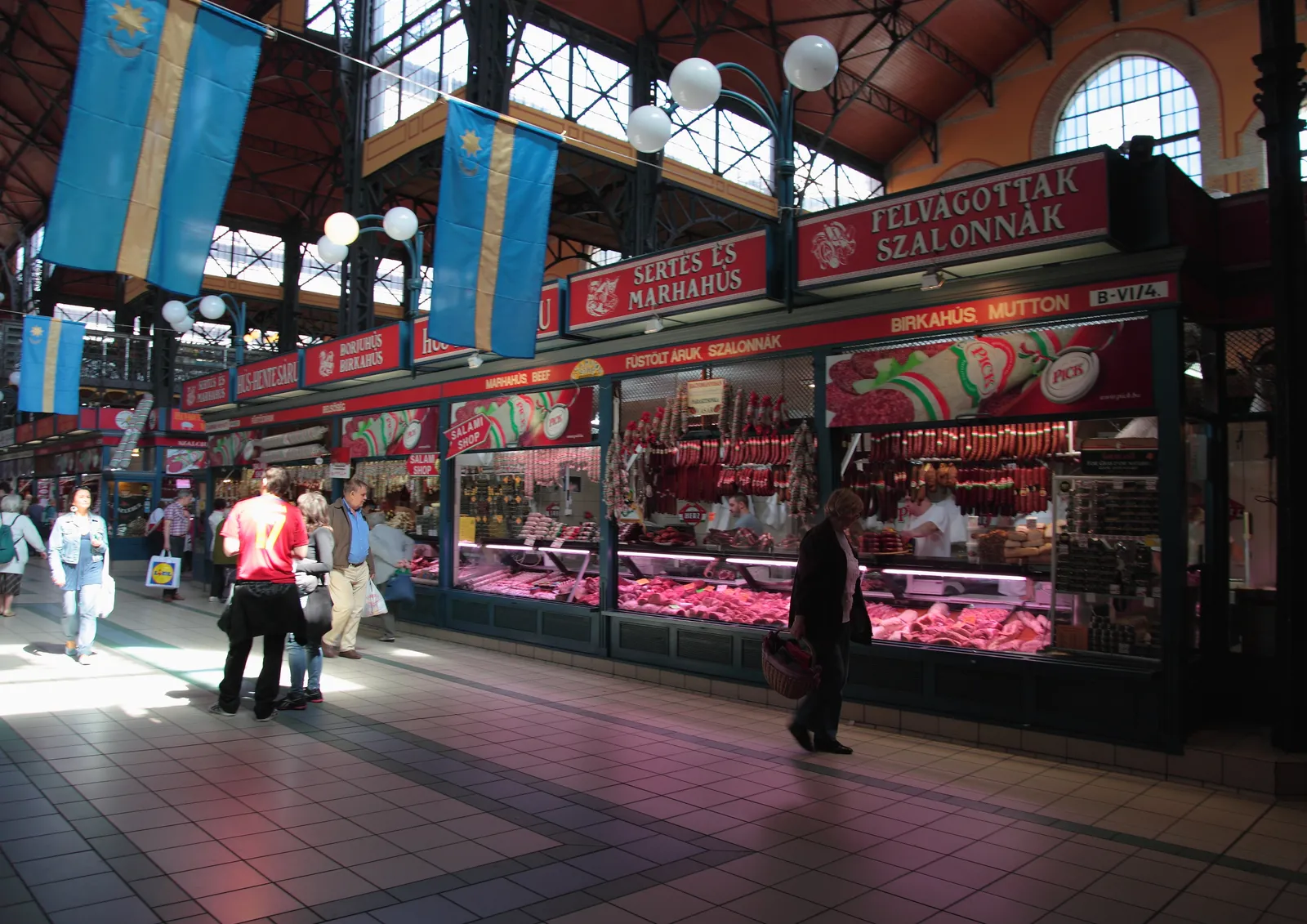
The trading is stacked. Ground floor is produce, butchers and the paprika stalls, strings of dried peppers hung across the front of half of them. The basement has fish, barrels of pickled vegetables and a supermarket. The gallery upstairs, reached by staircases at either end, is cooked food and craft stalls: lángos, stuffed cabbage, sausage plates, prices set for visitors rather than for people buying dinner. A guided tasting that starts here, booked through a tours and activities platform, is one way to get past the souvenir paprika to the things Hungarians actually buy.
Doors open at six every trading day and shut between 3pm and 6pm depending on the day. Sunday it does not open at all.
The aisles between the ground-floor stalls run two ways and are narrow by design, and the gallery is up a flight of stairs at either end of the hall.
The bronze birds on Liberty Bridge’s masts
The bridge starts at the same square and crosses to Szent Gellért tér under Gellért Hill. It went up between 1894 and 1896 for the millennium celebrations, painted green, and Franz Joseph, whose name it carried until after the First World War, hammered the last rivet in himself: a silver one, still marked on the Pest abutment.
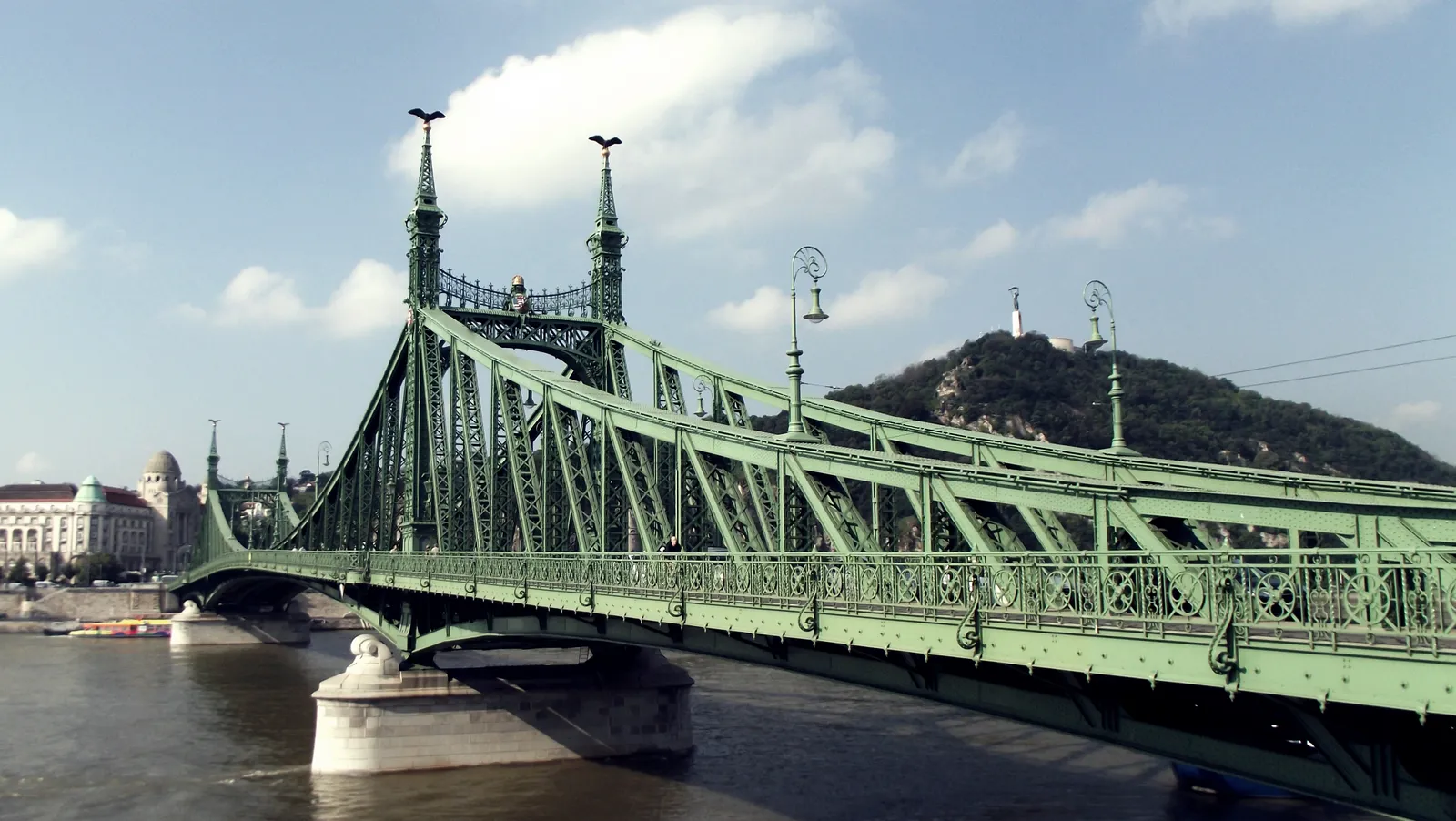
On top of each of the four masts stands a bronze bird with its wings out. It is a turul, the mythological hawk of the Hungarian origin story, and at that height it reads as a weathervane until you get close enough to see the wingspan. The ironwork below is curled brackets and painted lattice for the full 333 metres, free to walk at any hour, with the hill filling the view ahead.
The Hungarian National Museum’s garden on Múzeum körút
Ten minutes inland from Fővám tér, behind a run of railings on Múzeum körút, Mihály Pollack’s neoclassical block sits in a garden that anyone can walk into. The museum went up between 1837 and 1847 for a collection Ferenc Széchényi had given the nation in 1802, and the eight Corinthian columns and the crowded pediment above them were meant to look like exactly what they look like: the country deciding it had a history worth housing.
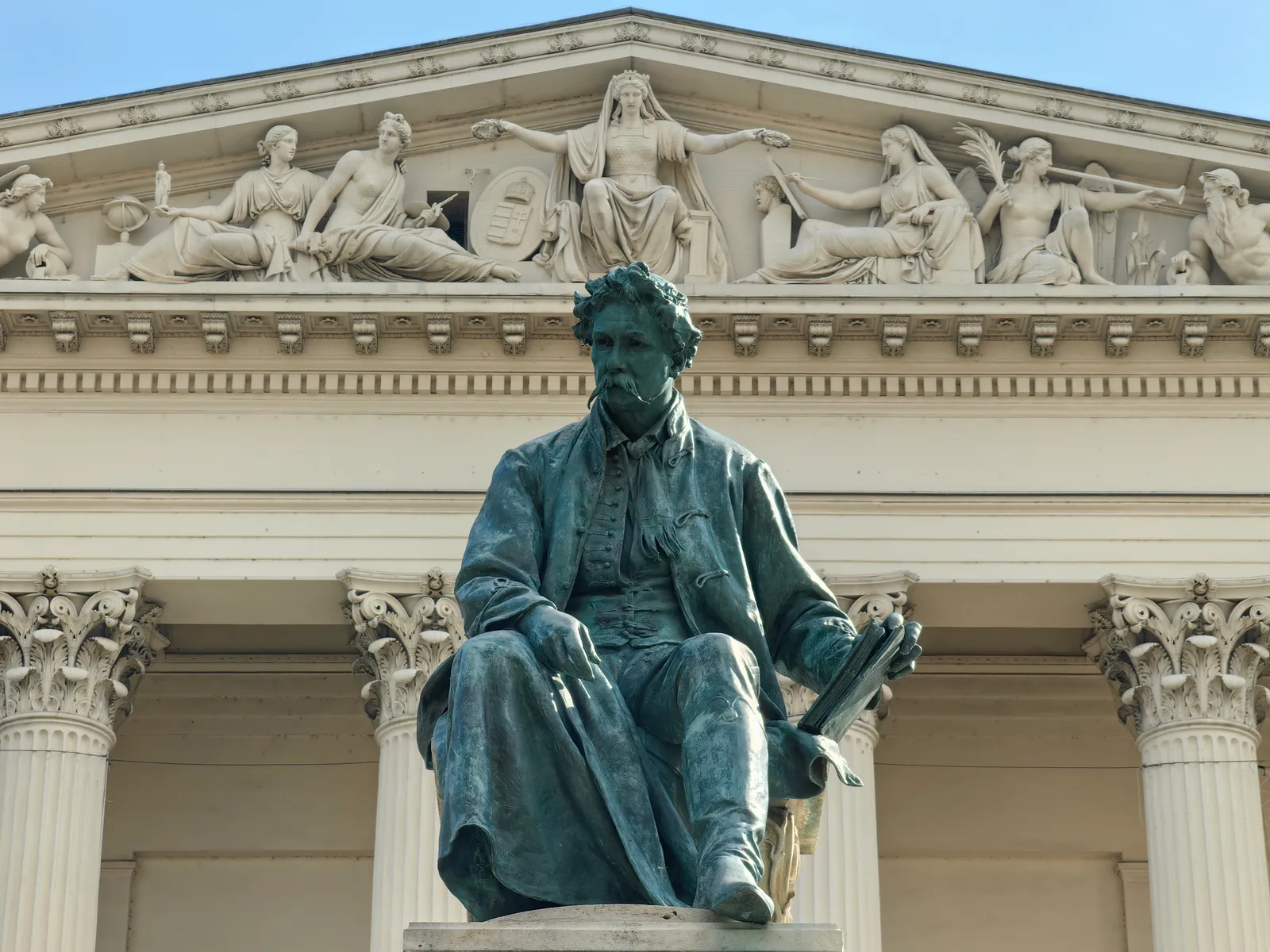
By tradition Sándor Petőfi read out the National Song from these steps on 15 March 1848 and set the revolution going. Historians are doubtful that it happened on this spot, but the anniversary is marked here every year regardless. The garden itself costs nothing and is full of monuments and old stonework; the collection inside charges. Five minutes north, Károlyi kert is a smaller walled garden behind the Károlyi Palace, hedged in on all four sides and used mostly by people who live nearby.
That is the whole of it: one covered market, one bridge and one garden, in a square kilometre that the riverbank route through the middle of Pest never reaches. The main Budapest guide covers that walk, further north along the same bank, and there is a Castle Hill version across the water for anyone who would rather be up a hill.
Kálvin tér is the last city stop the airport bus makes
The 100E airport bus runs to Budapest Ferenc Liszt International Airport (BUD) from Deák Ferenc tér, but it calls at Kálvin tér on the way out, and Kálvin tér is five minutes’ walk from the market or one stop on metro line M4. Boarding there rather than at the start of the route saves the walk north, at the cost of a lower chance of a seat.
The ride is about 40 minutes. The bus charges its own 2,500-forint fare and the ordinary 500-forint single and 850-forint 90-minute tickets are not valid on it; a Budapest Card or travel pass brings it down to a 1,000-forint add-on. Allow around two hours from the market to the gate, and note that the market shuts long before the last useful bus does, so this is a stop that ends early rather than one that runs late.
Frequently asked questions
When is the Great Market Hall in Budapest open?
Six in the morning is the start every trading day. It closes at 5pm on Monday, 6pm from Tuesday to Friday and 3pm on Saturday, and it does not open at all on Sunday, which is the single thing most likely to wreck a plan built around it. The stalls also thin out well before closing time, particularly on Saturday afternoon, so a mid-morning or early-afternoon arrival gets you the full hall rather than half of it.
Does it cost anything to go into the Great Market Hall?
No. The hall at Fővám tér in Budapest is a working market with free public access on all three of its levels: produce, meat and spice stalls on the ground floor, a gallery of cooked food and craft stalls above, and fish, pickles and a supermarket in the basement. You only pay if you buy something. Prices on the upper gallery are aimed at visitors rather than at people shopping for dinner, which is worth knowing before you order.
What is there to do near Fővám tér if the market is shut?
Plenty, because nearly all of it is outdoors and free. Liberty Bridge crosses the Danube from the square itself and can be walked at any hour. The garden of the Hungarian National Museum, ten minutes inland, keeps its own hours but the surrounding streets of the old university quarter do not, and Károlyi kert, a small walled garden behind the Károlyi Palace, is open to anyone. Sunday in Budapest is the day to spend on the riverbank rather than under a roof.
Is the Great Market Hall a good stop with a large group?
It works better than most indoor attractions, because there is no ticket, no queue and no fixed route, so a group can split up and meet at one of the entrances. The constraint is the aisles: the ground floor runs two-way between the stalls and gets tight in the middle of the day, and the upper gallery's tables fill at lunchtime. Arriving before eleven or after three gives a group room to move.