Arc de Triomphe Layover: Champs-Élysées, Paris
Part of the full Paris Layover Guide: Notre-Dame From CDG
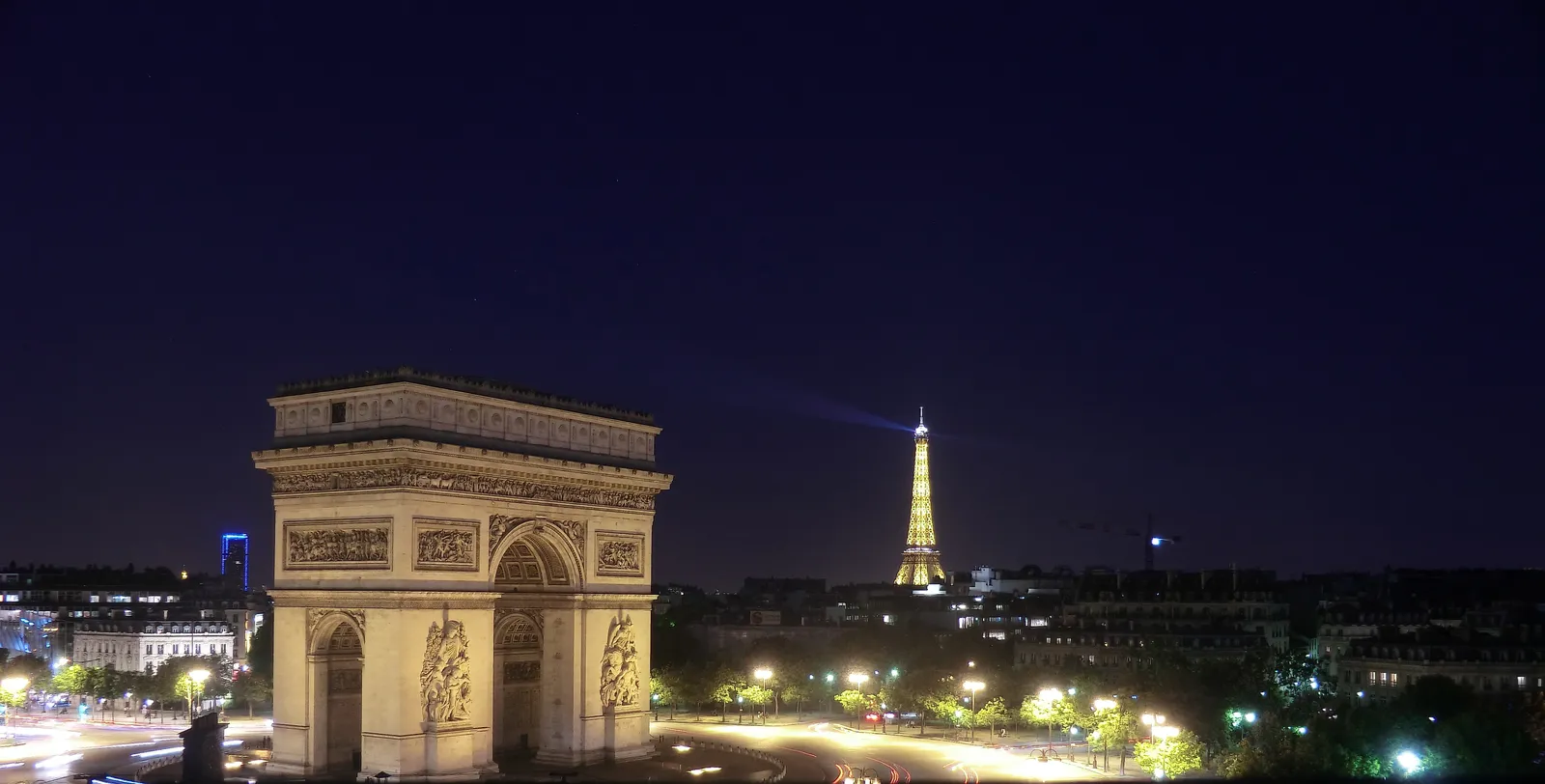
Paris’s Arc de Triomphe stands at the top of the Champs-Élysées, and the avenue runs 1.9 kilometres downhill from it through free public gardens to the Egyptian obelisk on the Place de la Concorde, with the arch’s own roof terrace 284 steps above the traffic.
Four rail lines meet underneath the roundabout at Charles de Gaulle-Étoile: metro lines 1, 2 and 6, and the RER A, the suburban express that also runs east to the airport connection. That makes this one of the easiest places in Paris to reach with an hour or two spare, and the whole itinerary below is a single straight line east, on the flat side of gentle.
The flame on the Tomb of the Unknown Soldier is relit at half past six
Twelve avenues converge on the Place Charles de Gaulle and not one of them has a crossing onto the island in the middle. You reach the arch through a pedestrian tunnel, the Passage du Souvenir, which starts on the pavement at the top of the Champs-Élysées. Under the vault at the end of it is a granite slab from Normandy, laid in November 1920 over an unidentified French soldier from the First World War, with a gas flame burning in a bronze shield at its head.
That flame was lit on 11 November 1923 and has not gone out since. Every evening at 6.30pm a delegation from one of the several hundred veterans’ associations that make up the Flame Committee rekindles it, in a ceremony that takes about twenty minutes, involves no ticket and no barrier, and is attended by whoever happens to be standing there. It is the one thing at this monument that nobody sells.
284 steps to the terrace on the roof of the Arc de Triomphe
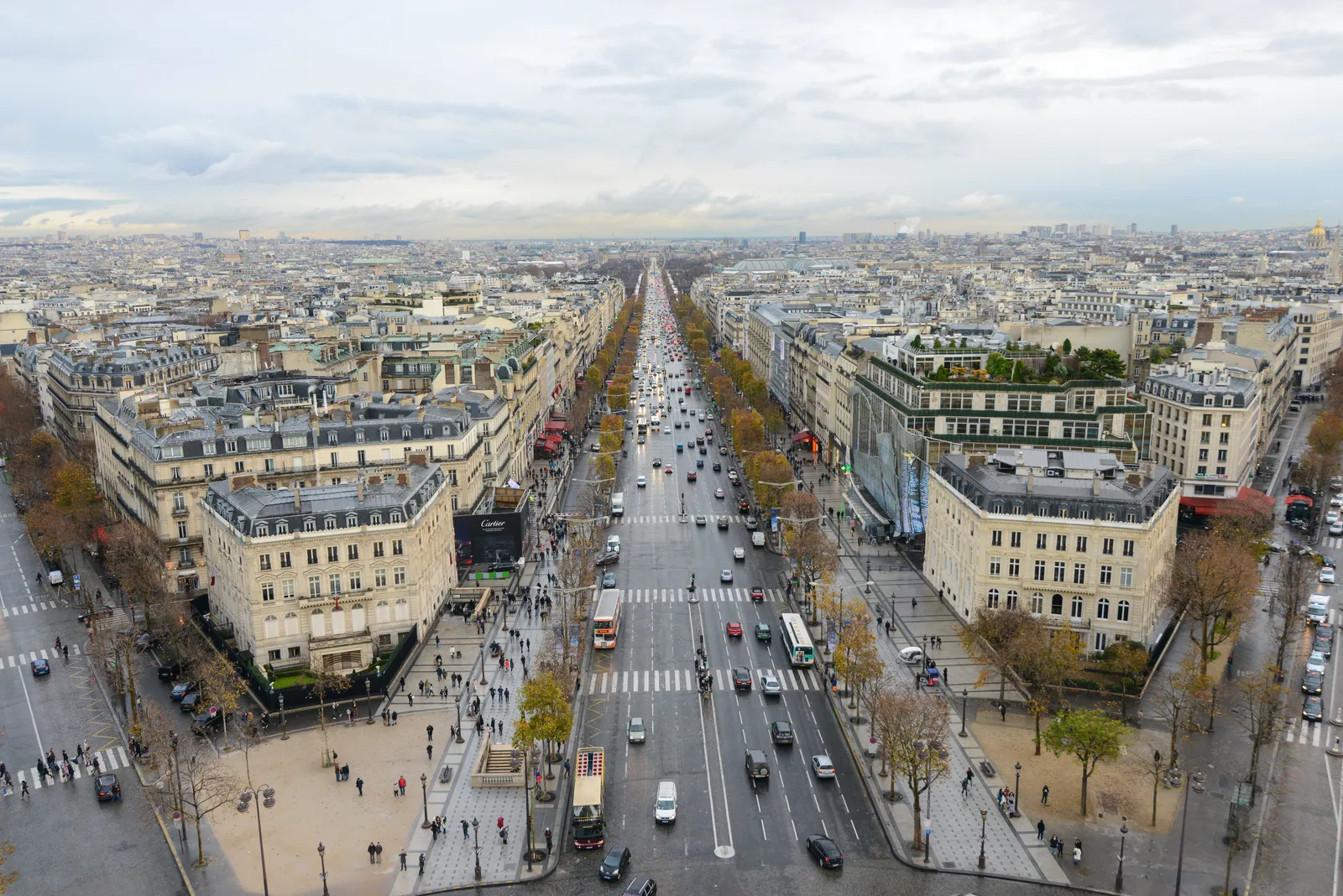
The climb is a stone spiral with the attic museum partway up and the roof at the end of it, 50 metres above the roundabout. What you get from the top is the reason to bother: the twelve avenues radiating out below like a diagram, the Eiffel Tower off to the southwest, and the Champs-Élysées running dead straight east to the Louvre.
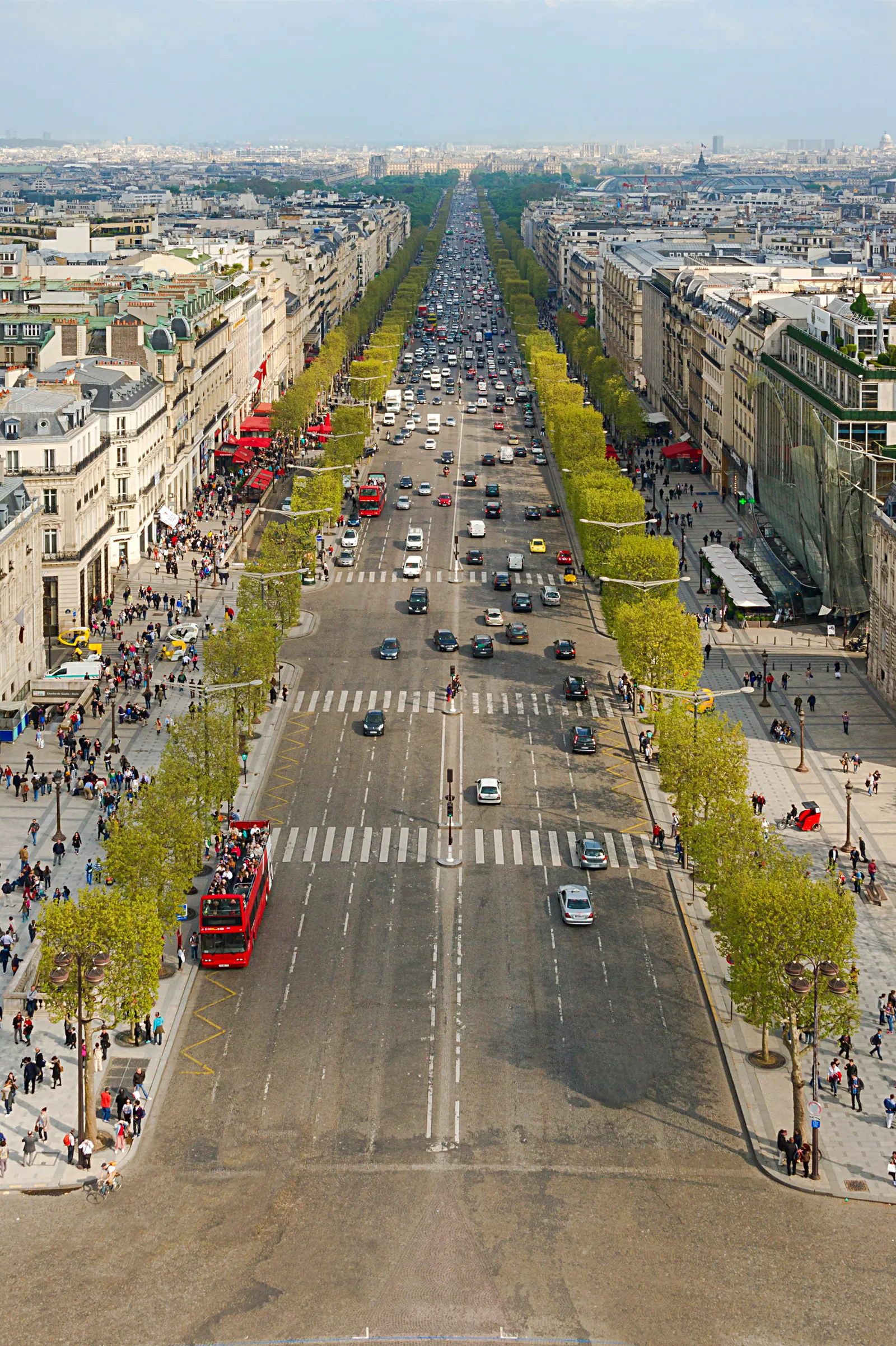
The same sightline carries on the other way too, west to the Grande Arche, the hollow cube that closes the sightline ten kilometres out at La Défense, whose own roof has been shut since 2023. Admission here is 22 euros from April to September and 16 from October to March, with Wednesdays charging 16 even in summer; under-18s and EU residents aged 18 to 25 go free, and tickets are sold for fixed times.
Neither half of the visit is step-free: the underpass has stairs at each end, the terrace is 284 more, and there is nowhere at the monument to leave a bag while you deal with either.
Shops at the top of the Champs-Élysées, plane trees at the bottom
The avenue is 1.9 kilometres long and 70 metres wide, and it falls about twenty metres between Étoile and Concorde, which registers as a gentle downhill and nothing more. The upper half, from the arch to the Rond-Point, is the commercial stretch: flagship stores, cinemas, and the car showrooms that have been a fixture here since the 1920s.
Below the Rond-Point it changes completely. The lower kilometre runs through the Jardins des Champs-Élysées, and the shopfronts stop: chestnut and plane trees, gravel paths, a bandstand, the Théâtre Marigny, and the two exhibition palaces built for the 1900 world’s fair facing each other across the Avenue Winston Churchill. Most people walking the avenue never leave the pavement to find out that part of it is a park.
One Sunday a month, usually the first, the city closes the whole avenue to cars and people walk down the middle of it. If your free day falls on one, that is the version to catch.
The Petit Palais gives away its collection and its garden
The smaller of the two 1900 palaces is a city museum, and the permanent collection costs nothing: Courbet, Monet, Cézanne, a room of Dutch painting, and an Art Nouveau dining room lifted whole out of a private house. It opens 10am to 6pm, Tuesday to Sunday, with last admission at 5.15pm, and it shuts on Mondays. Only the temporary exhibitions charge.
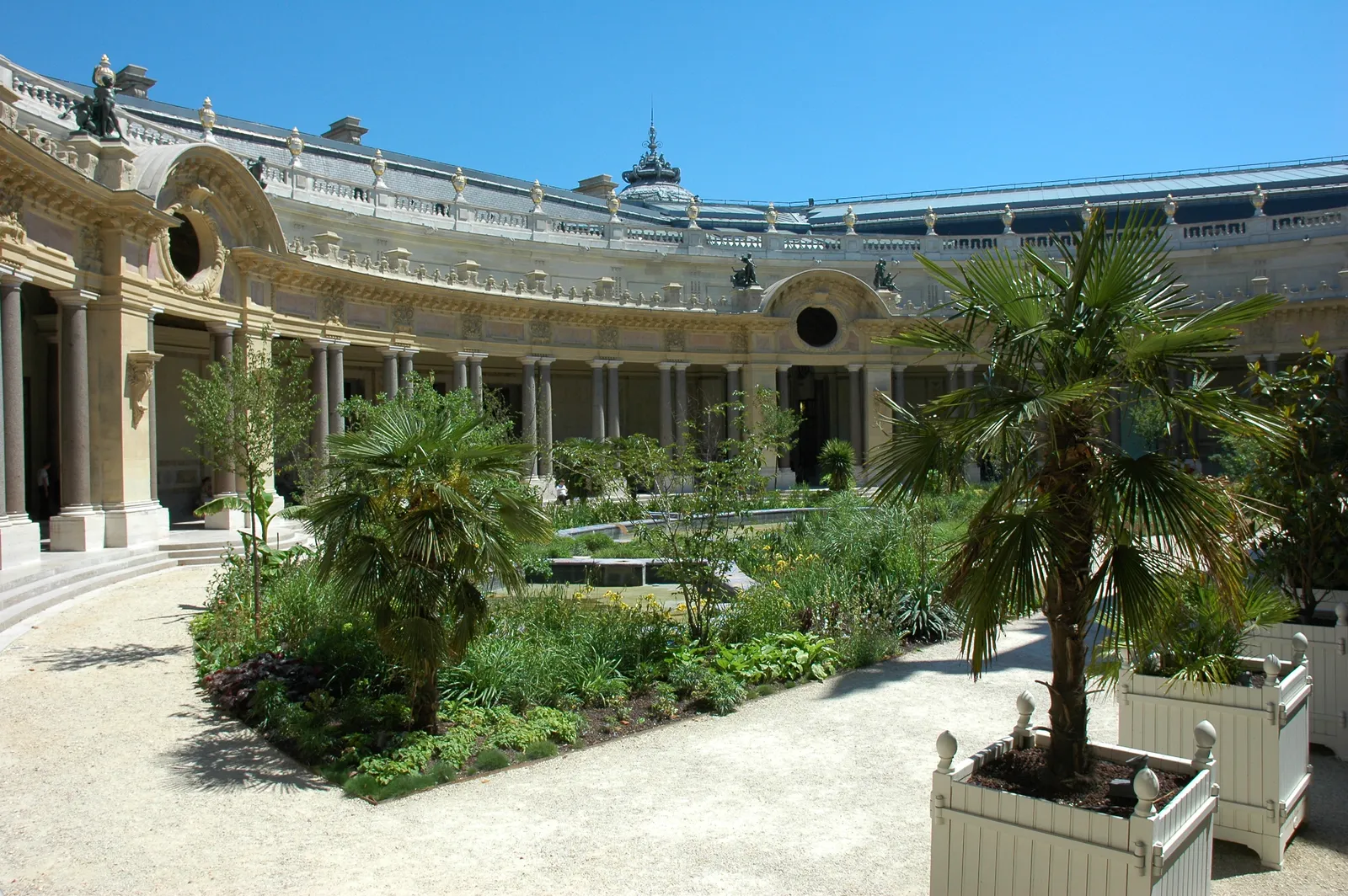
The part worth walking in for even if you skip the paintings is the garden in the middle. It is a semicircle of colonnade wrapped around palms, banana plants and grasses, with three pools lined in blue, turquoise and gold mosaic laid by the Facchina workshop for the building’s opening in 1900, and a fresco of the hours of the day and night running along the peristyle above the arcade. There are deckchairs, a café under the trees, and no admission desk between the street and any of it.
Across the road the Grand Palais reopened in June 2025 after a four-year restoration of its glass roof and its 77,000 square metres of floor, and it charges for whatever is on underneath.
The Luxor obelisk on the Place de la Concorde
Two minutes east the gardens end at the largest square in Paris, and the thing standing in the middle of it is 3,300 years old. The obelisk was cut for Ramesses II outside the temple at Luxor, given to France by the viceroy of Egypt, shipped up the Seine and raised here in 1836; with its pedestal and the gold-leaf cap added in 1998 it comes to a little over 33 metres. The gilded figures on the pedestal are not Egyptian at all: they are diagrams of the lifting apparatus Apollinaire Lebas built to lower the stone at Luxor and stand it back up here, worked by 350 sailors and gunners in October 1836.
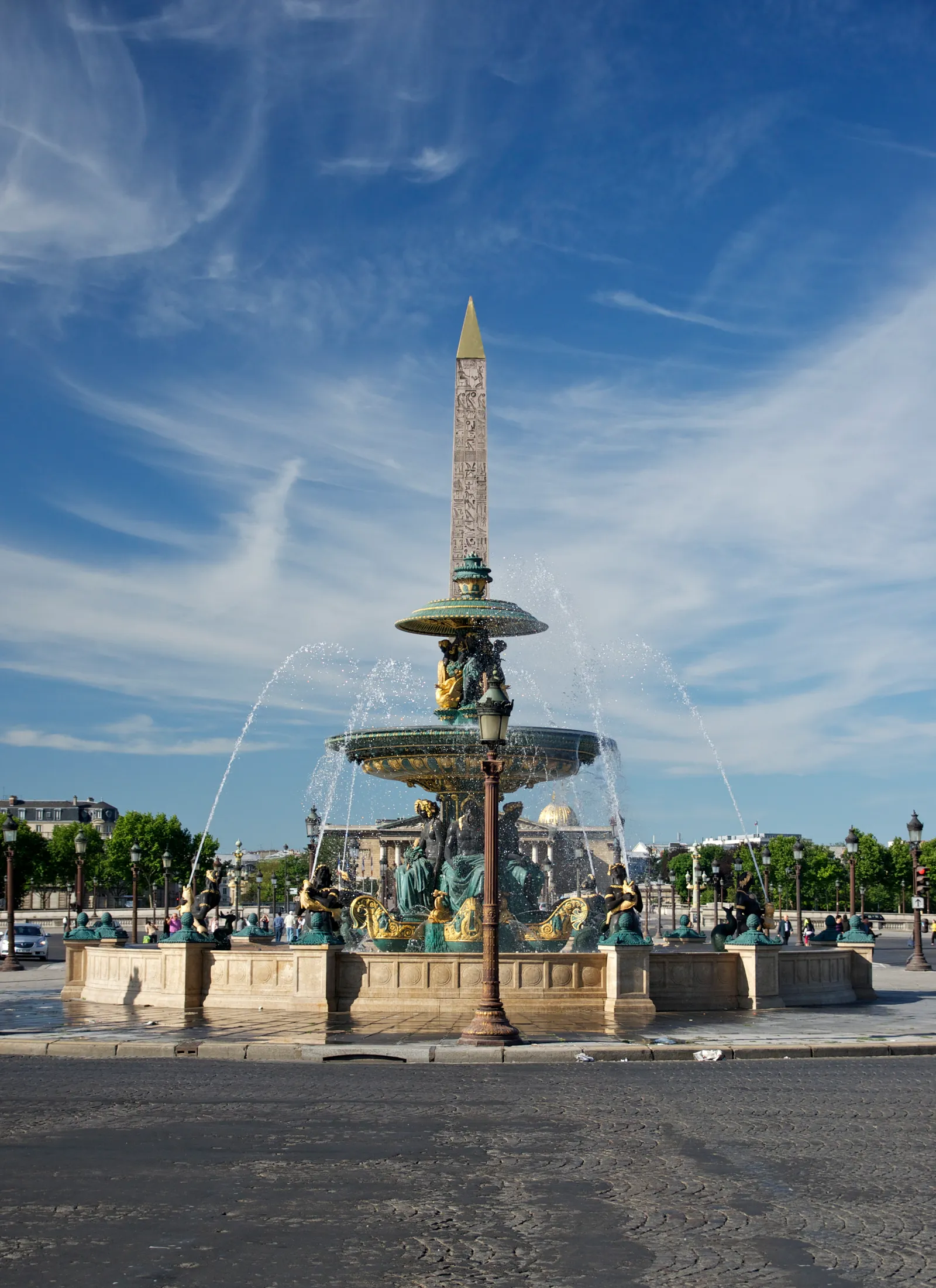
This is the natural end of the walk on a short afternoon, at about ninety minutes from the arch including the climb. With more time, keep going east through the gates into the Tuileries, which is free and open from 7am, and twenty minutes later you are at the Louvre and into the river-island itinerary the main Paris layover guide covers.
No direct airport train from the Arc de Triomphe
Étoile has no airport service of its own. The RER A takes about ten minutes east from Charles de Gaulle-Étoile to Châtelet-Les-Halles, and the RER B from that station reaches Charles de Gaulle in another thirty-five or so; count on an hour door to door, because the interchange at Châtelet is a long one underground. The flat 14-euro Paris Region to Airports ticket covers the whole journey including the change, and it loads onto a Navigo Easy card or a phone rather than existing as a paper single.
If you have walked all the way to Concorde, do not backtrack. Metro line 1 from the square runs to Châtelet in about six minutes and joins the same RER B.
Pick up the suitcase before you go down to the platform rather than after, and give yourself the door-to-door hour instead of the train time. Concorde and Étoile both bury their platforms a long way under the street.
Frequently asked questions
How do you get to the Arc de Triomphe without crossing the roundabout?
Through the tunnel, which is the only lawful way in. Twelve avenues meet at the Place Charles de Gaulle and none of them has a pedestrian crossing onto the island in the middle, so the monument is reached by an underpass called the Passage du Souvenir, signposted from the pavement at the top of the Champs-Élysées and from the Avenue de la Grande-Armée on the far side. It has steps at both ends. People do try to walk across the traffic and it is both illegal and a genuinely bad idea.
Do you need a ticket to see the Tomb of the Unknown Soldier?
No. The ground floor under the arch, where the tomb and its flame are, is free and open to anyone, including on days when the terrace above is shut. The tomb has been there since 11 November 1920 and the flame was lit on the same date three years later. What you pay for is the climb: the ticket covers the staircase, the museum inside the attic and the roof.
How far ahead should I book the Arc de Triomphe terrace?
The tickets are timed, and the slots that go first are the ones an hour or so before sunset, when everybody wants the avenue lit rather than flat. If your flight is late enough to make an evening visit possible, holding a timed slot a day or two out is worth doing; on a weekday morning in winter you can generally turn up. Note the annual closures on 1 May, 8 May, 14 July and the morning of 11 November, when the monument is given over to ceremonies.
Is there a lift to the top of the Arc de Triomphe?
There is one, reserved for visitors who cannot manage the stairs, and it stops short of the terrace itself. It has also been out of service for maintenance with no reopening date announced, so anyone relying on it should check the monument's own site before travelling. Everyone else takes the spiral staircase, 284 steps with no landings worth the name. The tomb and the flame at ground level are reached from the underpass and involve only its steps.
Is this walk worth doing after dark?
It is the version of this trip that suits a late flight best. The terrace stays open until 11pm from April to September and 10.30pm the rest of the year, with last admission 45 minutes before, and the view down the avenue is better lit than it is at midday. The flame ceremony at the tomb is at 6.30pm year-round. The Petit Palais, though, shuts at 6pm, so it has to come first or not at all.