Paris Gare de l'Est: Canal Saint-Martin
Part of the full Paris Layover Guide: Notre-Dame From CDG
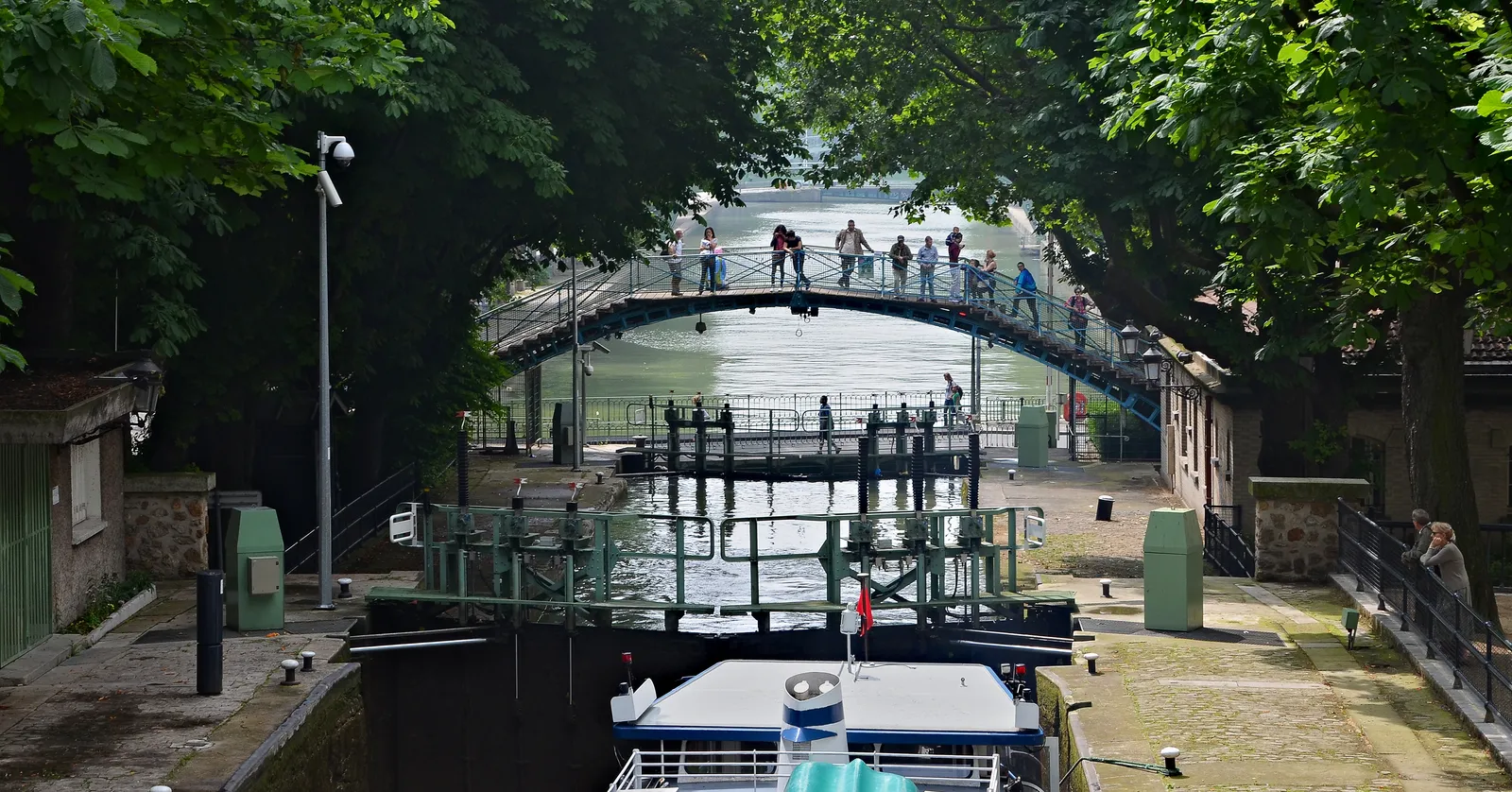
Paris Gare de l’Est is a flat ten-minute walk from the Canal Saint-Martin, where about two and a half kilometres of open water, nine locks and a line of arched iron footbridges run north to the Bassin de la Villette, none of it costing anything to look at.
This is the quiet end of central Paris. Nothing here queues, nothing here sells a ticket, and the whole route is a towpath.
The Marché Saint-Quentin’s iron-and-glass hall
Turn left out of the station and five minutes down the Boulevard de Magenta there is a covered market that has been trading since 1866. The Marché Saint-Quentin is the largest of the covered markets left in Paris, a long triangular hall of iron columns and glass under a roof that lights the aisles even on a grey morning, with something like 35 traders under it.
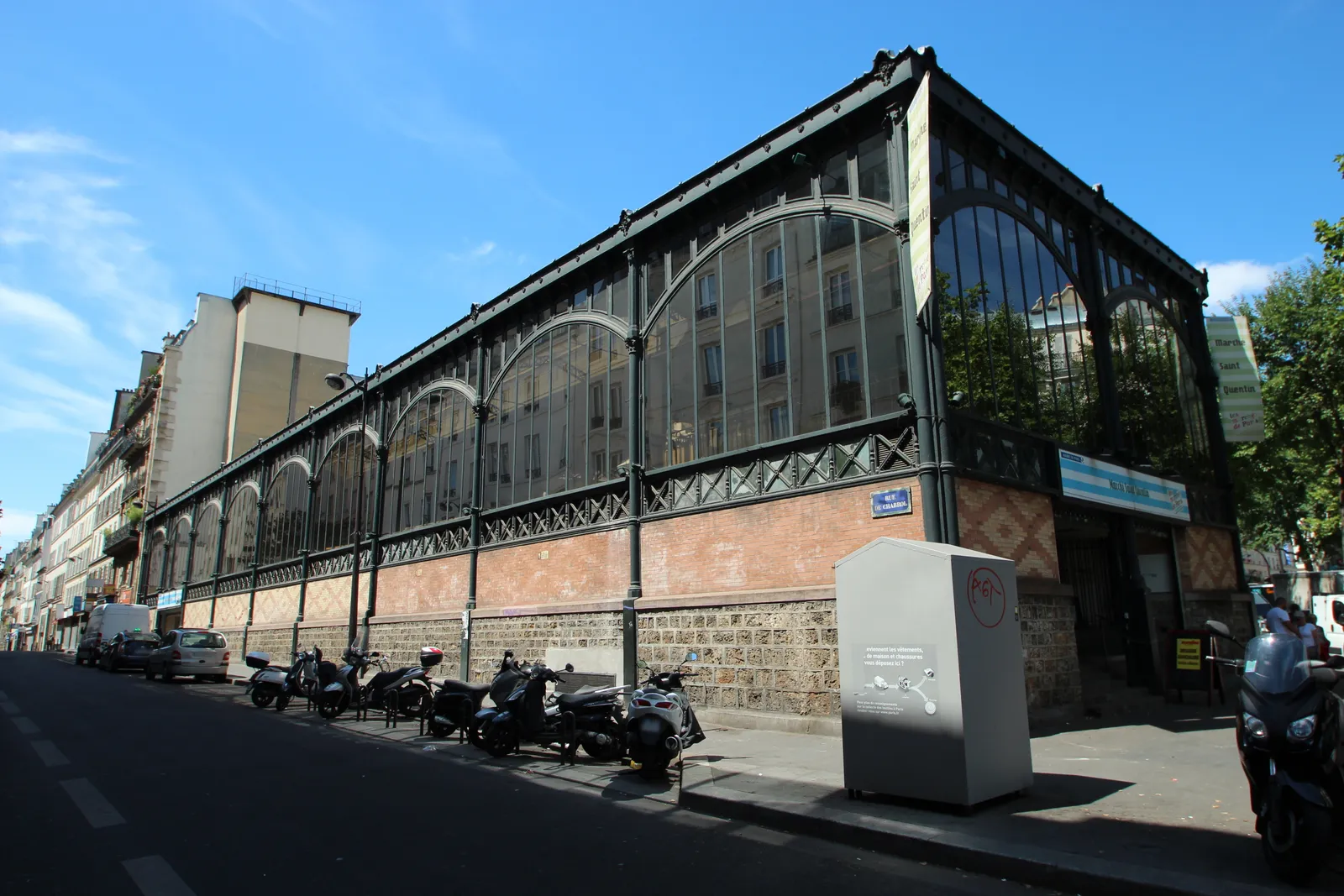
Butchers, fishmongers and cheesemongers take up most of it, but the reason to come in with a train to kill is the ring of small counters around the edges, where you can sit and eat what the stalls are selling. It opens Tuesday to Saturday and on Sunday mornings, and it is shut on Mondays.
Nine locks and a wine tax built the Canal Saint-Martin
Napoleon ordered the canal in 1802 to bring drinking water into the city, and paid for it with a new tax on wine. Construction dragged on until 1825. The finished waterway falls 25 metres between the Bassin de la Villette and the Seine, which is why there are nine locks in four and a half kilometres, and it still works: barges and tour boats lock up and down through them all day.
The stretch you walk starts about ten minutes east of the station. Both banks are named, the Quai de Valmy on one side and the Quai de Jemmapes on the other, and the iron footbridges between them date from the second half of the nineteenth century. Every one of them is a stepped arch with no ramp, and the two swing bridges pivot flat across the quay whenever a boat comes through, which is the practical argument for walking this with nothing behind you on wheels.
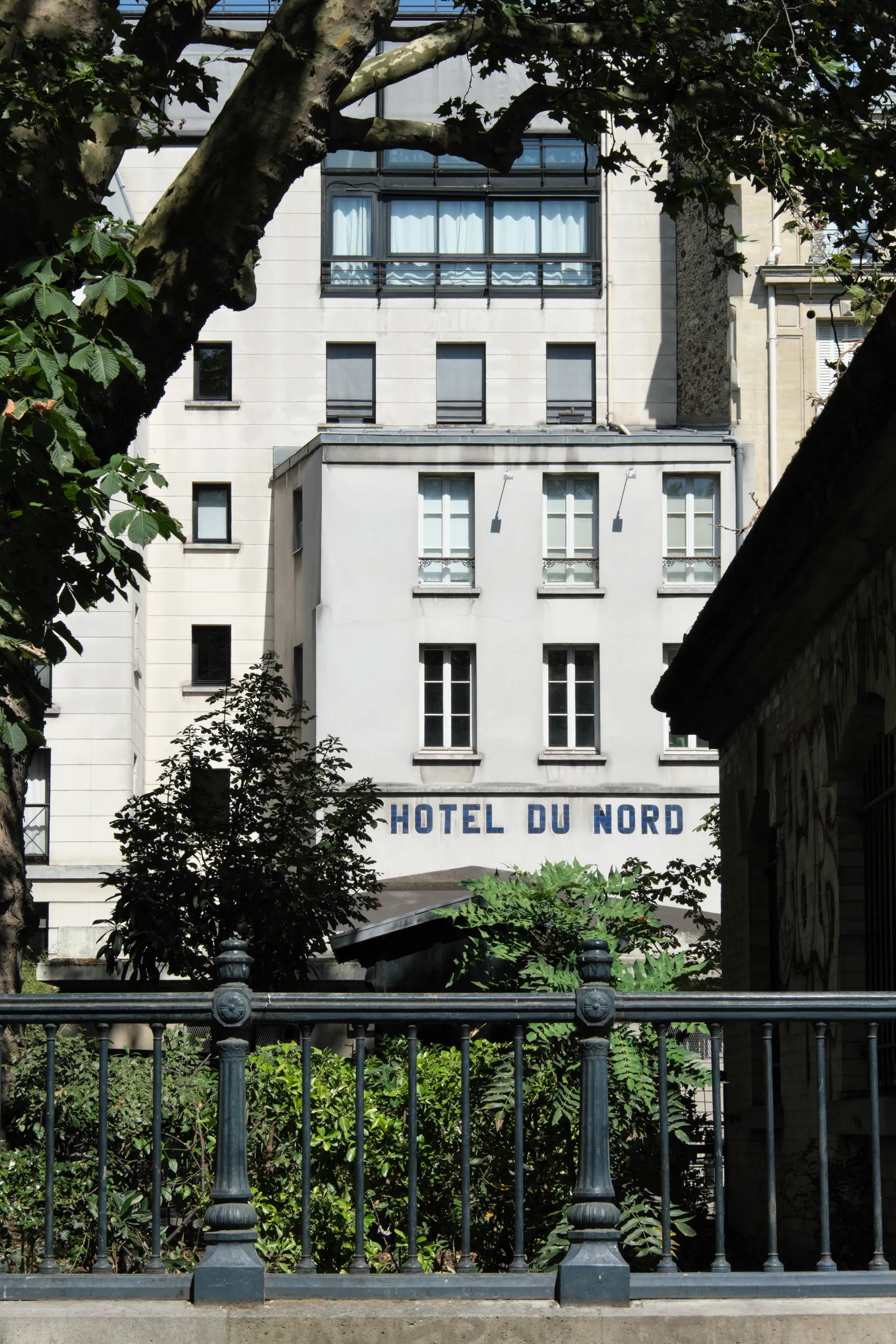
Halfway up, at 102 Quai de Jemmapes, is a plain white building with HÔTEL DU NORD painted across the front. Eugène Dabit grew up in it and wrote a novel about it in 1929; Marcel Carné filmed that novel in 1938, and Arletty’s “Atmosphère!” is still one of the most quoted lines in French cinema. The film was shot entirely on a full-size replica of this building and this canal, built in a studio out at Boulogne-Billancourt, because the producer thought shooting on the actual quay would be too difficult. The real one was saved from demolition in the 1980s and trades as a restaurant.
The Rotonde de la Villette at the head of the basin
With four hours or more, past the last lock the canal opens out into the Bassin de la Villette: 800 metres long, 70 wide, the biggest sheet of still water in the city, filled in 1808 and now lined with benches, pétanque pitches and a cinema on each bank facing the other across the water.
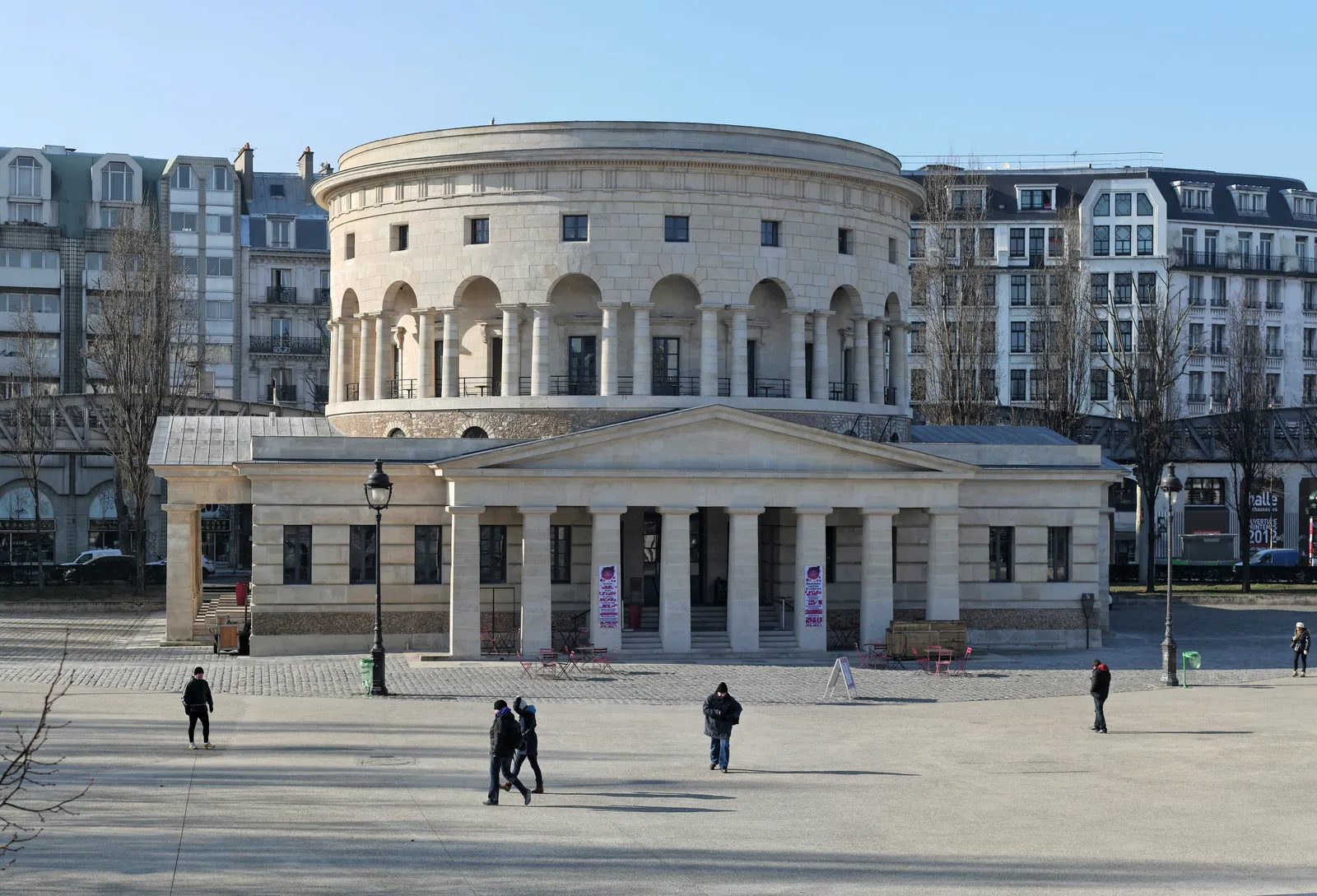
Standing at the southern end of it is a stone drum on a colonnade that looks like it was moved here from somewhere else. It was not. Claude-Nicolas Ledoux built it between 1784 and 1788 as the Barrière Saint-Martin, the grandest of the sixty tollhouses set into the wall that ringed Paris to tax goods coming in, and one of the handful still standing. Metro line 5 from Gare de l’Est stops at Stalingrad right beside it, which makes it an easy last stop before doubling back.
At the far end of the basin, the rue de Crimée bridge is the last hydraulic lift bridge in Paris, and it still goes up when a boat needs through. Whether you get to see that happen is luck.
No airport train leaves from Gare de l’Est
This is the one thing worth knowing before you plan the timing. Gare de l’Est has metro lines 4, 5 and 7 underneath it, and no RER at all. The airport train goes from Gare du Nord, which is 500 metres away, about seven minutes on foot or a single stop on line 5, and from there the RER B reaches the terminals in roughly half an hour.
Practically, that means budgeting two legs rather than one, and getting back to Gare de l’Est’s own platforms in time to collect your suitcase before that walk is not luck, so leave the water with more margin than the map suggests. If you want the ground-level version of Paris instead of this one, the main Paris layover guide runs from Châtelet along the Seine, reached on the same RER B without changing lines.
Frequently asked questions
How do I get to Charles de Gaulle from Gare de l'Est?
You start by moving stations. Gare de l'Est has metro lines 4, 5 and 7 but no RER platform, so the airport train is caught at Gare du Nord instead: 500 metres and about seven minutes on foot along the rue du Faubourg Saint-Denis, or one stop on metro line 5. From there the RER B takes about 30 minutes to the terminals on the flat 14-euro airport ticket. Allow more than the seven minutes if you are collecting luggage on the way, since the pavements between the two stations are narrow and busy.
Is the canal walk step-free?
The quays are, the crossings are not. Both banks, the Quai de Valmy and the Quai de Jemmapes, are flat paved towpath the whole way north, and you can walk the entire open stretch without a single step if you stay on one side. The iron footbridges are the problem: they are arched with steps up and down and no ramp anywhere. Cross at a road bridge instead, which is level. The two swing bridges also pivot right across the quay when a boat locks through, which shuts the path for a few minutes at a time.
What is the canal like in the rain?
Exposed. There is no cover on either towpath and the plane trees are no help once it is properly raining. The nearest indoor fallback is the Marché Saint-Quentin, five minutes from Gare de l'Est under a full glass roof, which is open Tuesday to Saturday and Sunday mornings. South of the rue du Faubourg du Temple the canal itself goes underground for just over two kilometres, so there is nothing to see on that stretch in any weather.
Can you get on the water rather than walk beside it?
Yes, and it is the only way to see the locks work from the inside. Boats run the length of the canal between the Bassin de la Villette and the Seine, passing through the nine locks and under the vaulted covered section, which takes around two and a half hours end to end. Half-day canal cruises are bookable ahead, though check the running time against your departure before you commit to one: it is long enough to eat most of a short stop.