Paris Gare de Lyon: The Coulée Verte
Part of the full Paris Layover Guide: Notre-Dame From CDG
Five minutes south of Paris Gare de Lyon, the Coulée verte René-Dumont climbs onto a disused railway viaduct and runs east ten metres above Avenue Daumesnil, with 71 craft workshops glazed into the brick arches underneath it and nothing to pay anywhere along it.
This is the corner of Paris built on top of things that stopped working: a railway line abandoned in 1969, and before that the wine warehouses that fed the city, half a mile south.
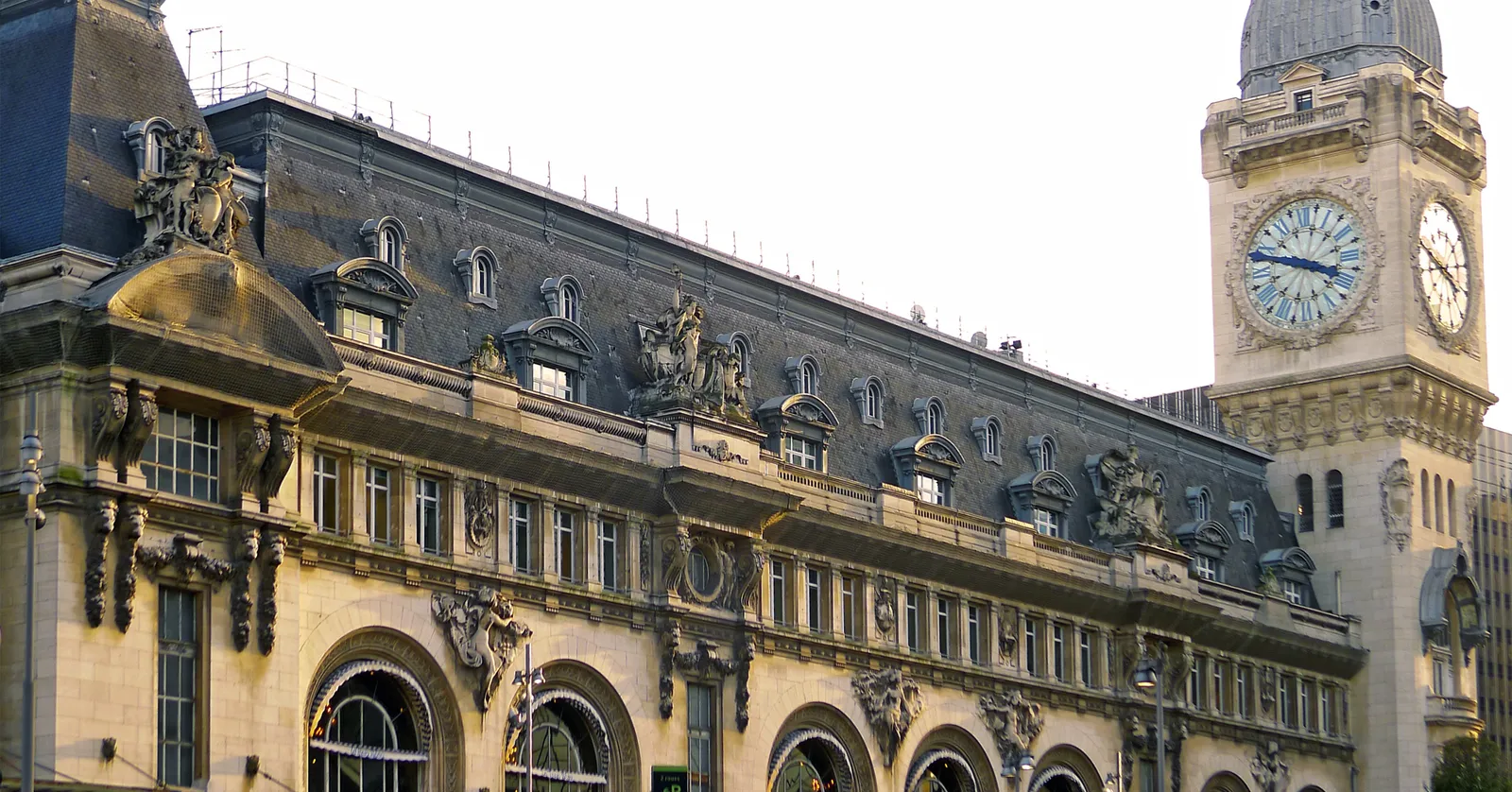
The clock tower over Gare de Lyon
The station was rebuilt for the 1900 Universal Exhibition and Marius Toudoire gave it a 67-metre belfry on the corner of the Boulevard Diderot. The four dials are 6.5 metres across, which makes them the largest clock faces in Paris, half a metre short of Big Ben’s. They are lit blue at night and visible from most of the twelfth arrondissement.
The station below handles around 113 million passengers a year, third-busiest in France, and the crowd under the Hall 1 departure boards packs solid every time a platform number goes up, which is the argument for leaving anything you are carrying at a storage point before you go looking at the architecture.
The 41 painted panels inside Le Train Bleu
Up the staircase off the main concourse, behind a door most people walk past, is a dining room that opened in 1901 and has barely been touched since. Le Train Bleu was built as the station buffet for the same Exhibition, and the Paris-Lyon-Méditerranée company covered its walls and ceilings with 41 paintings of the places its trains went: Marseille, the Riviera, the Alps, Burgundy at harvest. Gilt plasterwork, chandeliers, and a view down over the platforms through the arched windows.
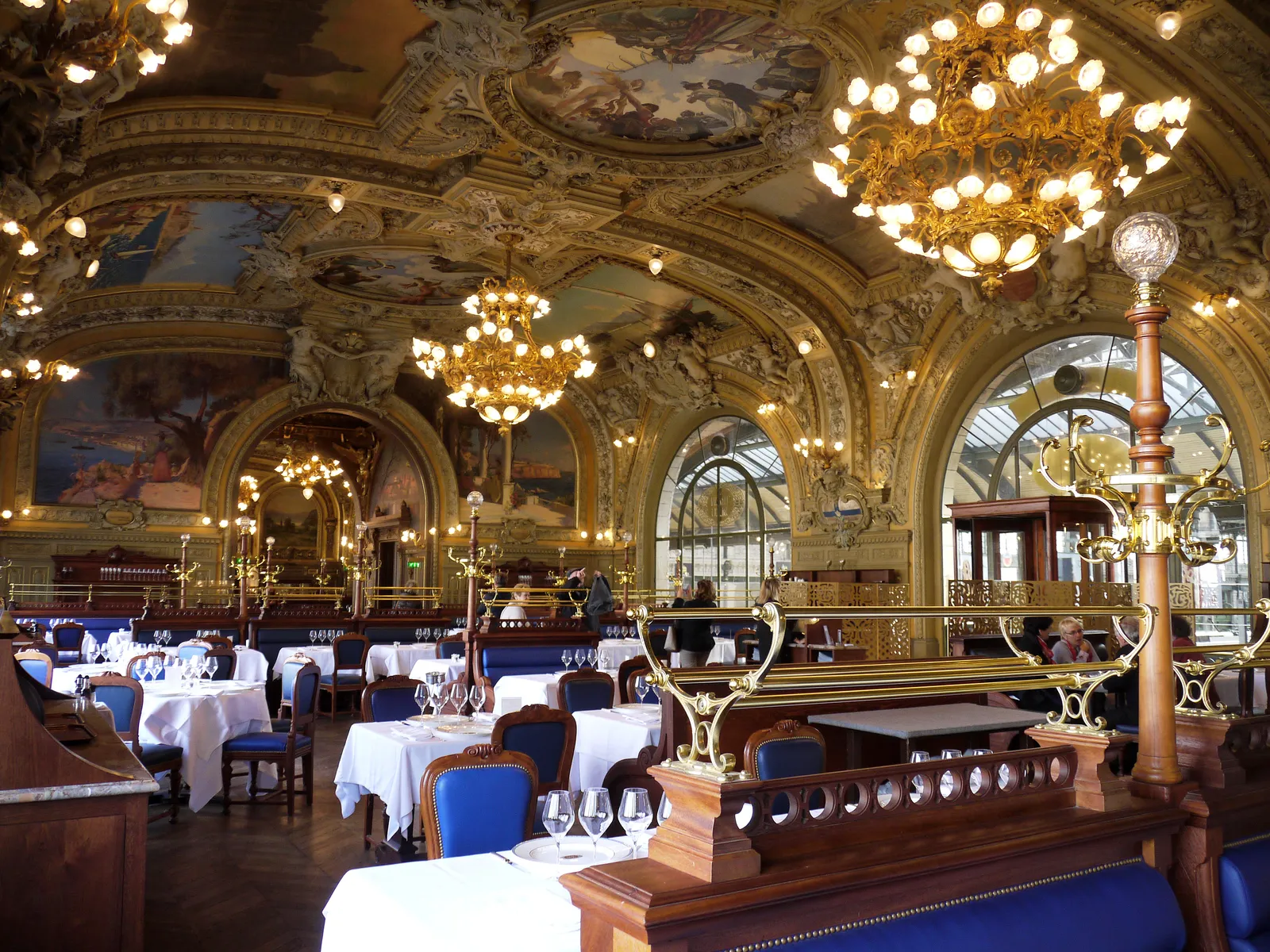
The dining room, the gold lounge and the two North African salons were listed as historic monuments in 1972. It is a working restaurant rather than a public building, so the way to see it properly is to sit down, at a table or at the bar, and the bar side is the cheaper way in.
The Coulée verte runs on top of a disused railway viaduct
The Vincennes railway shut in 1969 and the viaduct that carried it out of Bastille sat empty for twenty years. In 1993 the city planted a walkway along the top of it, 4.7 kilometres end to end, the first park in the world built on a viaduct, and the acknowledged model for New York’s High Line sixteen years later.
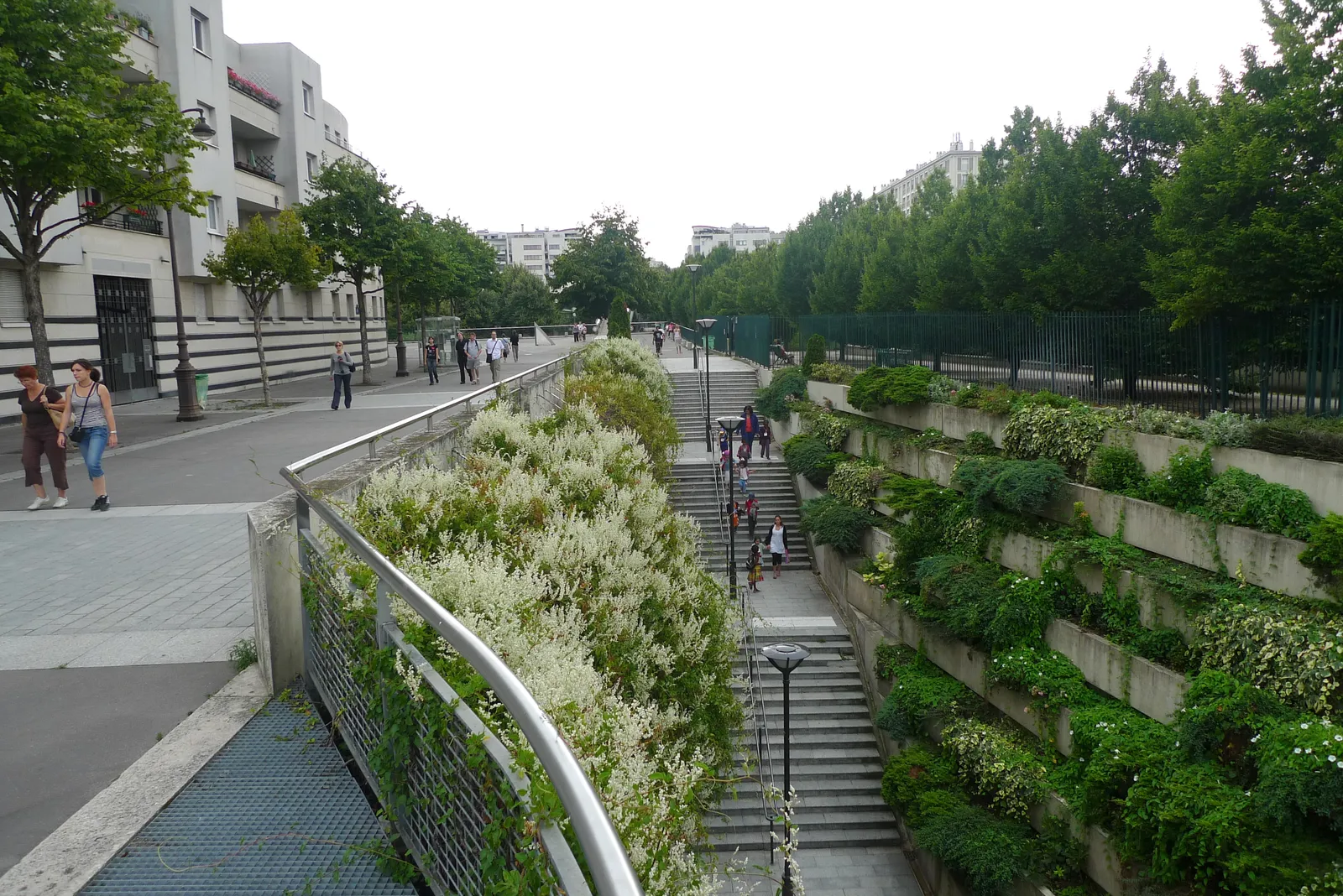
The elevated part is the part to walk. You are ten metres up, level with the second-floor windows of the apartment buildings on both sides, close enough to see into people’s living rooms and far enough above the Avenue Daumesnil that the traffic reads as background noise. Roses, bamboo, lime trees and long pergolas of climbers run most of its length, and in a few places the path threads between buildings through cuttings that feel like corridors.
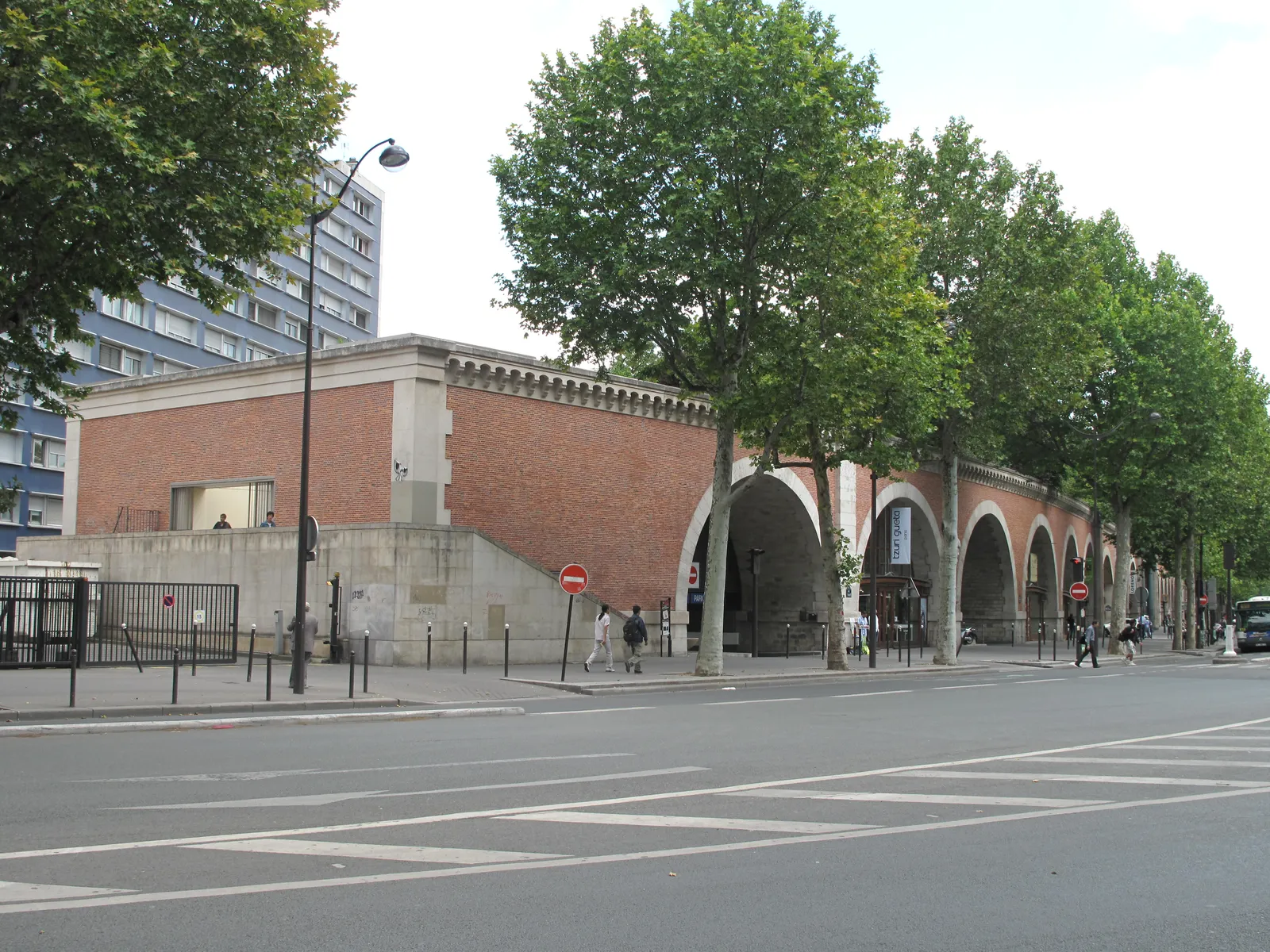
Underneath, all 71 arches of the viaduct have been glazed in and let to craftspeople: furniture restorers, violin makers, gilders, weavers, a couple of galleries. The Viaduc des Arts is a shopping street where most of the shops are workshops, and you can watch the work through the glass without going in.
The 42 wine warehouses on the Cour Saint-Émilion
With more than four hours, the Cour Saint-Émilion is two stops south on line 14. Bercy was where the wine came into Paris: for most of the nineteenth century the largest wine market in the world sat on this bank of the Seine, hundreds of stone warehouses on a grid of cobbled lanes, with rail tracks running between them.
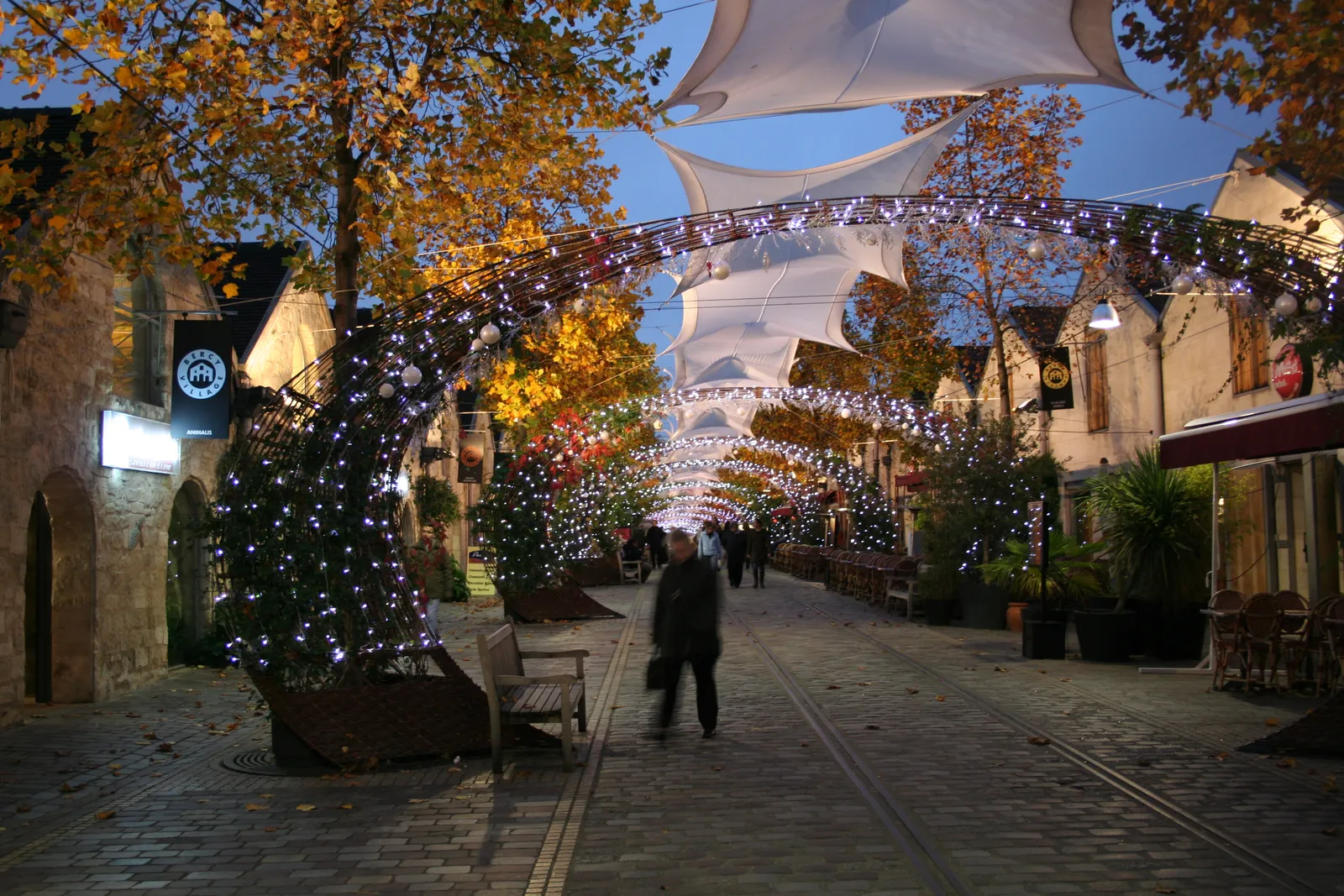
Forty-two of the warehouses survive, listed, on the Cour Saint-Émilion, converted in 2001 into shops and restaurants with the tracks still set into the cobbles between them. Next to it, the Parc de Bercy covers 14 hectares of the rest of the old market site, split into a romantic garden of fishponds, a run of formal flowerbeds and an open meadow, with some of the original warehouse walls and a few of the market’s old plane trees left standing in it.
The airport train means one change at Châtelet
Gare de Lyon has RER A and RER D underneath it and metro lines 1 and 14, and none of them go to Charles de Gaulle. The airport is on the RER B, which does not stop here, so the trip out is two legs: one stop north to Châtelet on line 14 or the RER A, then the RER B for about half an hour.
That is not a problem so much as a number to build in. The Paris layover guide starts from that same Châtelet interchange and covers the river islands, so if the viaduct sounds like the wrong kind of walk, you are one stop from the alternative.
Whichever end of this you do, work backwards from two changes rather than one when you head for the airport, and collect the suitcase before you go down to the platforms rather than after.
Frequently asked questions
Which hall does my train leave from at Gare de Lyon?
Look at whether your platform is a letter or a number. Hall 1 is the original 1900 train shed and its tracks are lettered A to N. Hall 2 is the modern extension alongside it and its tracks are numbered 5 to 23. The two are connected but not interchangeable, and walking from one to the other with a departure imminent is the classic Gare de Lyon mistake. The RER platforms are underground and separate from both.
How far does the Coulée verte actually go?
Four and a half kilometres, but you almost certainly want the first part of it. The stretch that makes it worth the walk is the elevated section along Avenue Daumesnil, ten metres up on the old viaduct, which runs from just east of the Opéra Bastille as far as the Jardin de Reuilly. After that it drops to street level, turns into a grass mall and eventually runs through cuttings and tunnels, finishing at a spiral staircase down to the ring road. Turning back at Reuilly makes it a comfortable hour.
Is the elevated walkway accessible without stairs?
In places. The western, elevated end has lifts as well as stairways up onto the viaduct, so the planted section above Avenue Daumesnil can be reached without climbing, though not from every entrance, and it is worth picking your access point before you set off rather than at the foot of the first staircase you find. The eastern half, once the route is back at ground level, uses ramps and stairways and is open to cyclists as well as walkers. The Viaduc des Arts underneath is ordinary pavement throughout.
Where does this itinerary go in summer heat?
Down off the viaduct. The planted walkway is shaded by its own trees for most of its length but sits above the traffic with no water and little shelter, and the arches below it hold heat. Parc de Bercy is the better bet on a hot afternoon: 14 hectares on the old wine-market land, with a Romantic Garden of fishponds and a meadow section under mature trees, and the shops and cinema at Bercy Village next to it are air-conditioned and open seven days.
How do I get from Gare de Lyon to Charles de Gaulle?
One change. There is no direct airport train from Gare de Lyon: take metro line 14 or the RER A one stop to Châtelet, then the RER B out to the terminals, which is about 30 minutes on its own. The flat 14-euro Paris Region to Airports ticket covers the whole journey including the change, and RER B trains run every 10 to 15 minutes until a little after midnight.