Eiffel Tower Layover: Trocadéro, Paris
Part of the full Paris Layover Guide: Notre-Dame From CDG
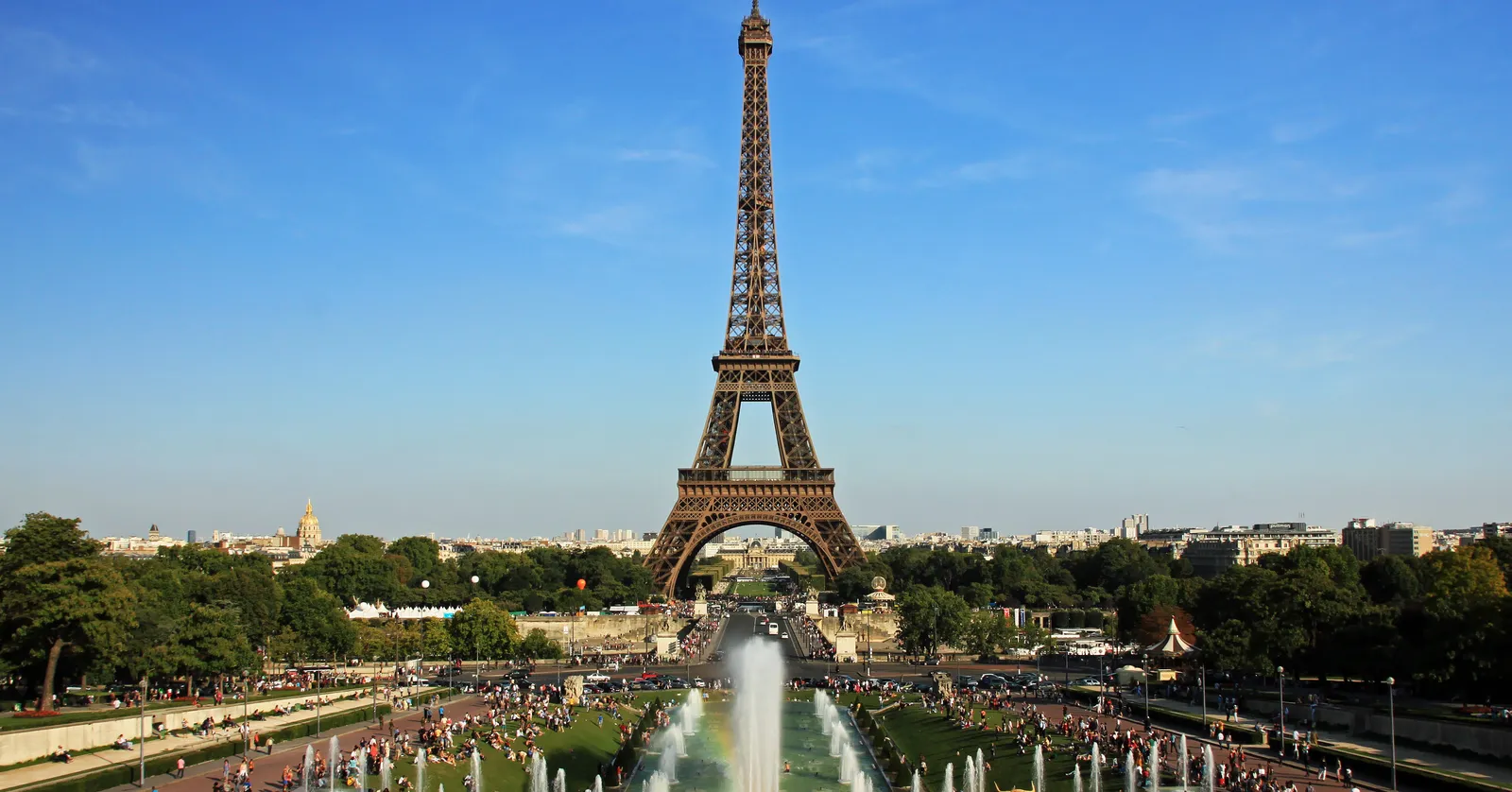
The Trocadéro terrace across the river gives you the Eiffel Tower head-on and costs nothing, and the ground directly under the tower in Paris is free to walk on too, once you have been through the bag check at the fence.
Almost everybody who comes here does the same thing in the same order and then leaves. There is about an hour more in this bend of the Seine than most people take.
The view of the tower from the Trocadéro terrace
Trocadéro’s metro exit puts the tower straight in front of you, framed between the two curved wings of the Palais de Chaillot, with the gardens and the river dropping away in between. The reason this particular spot works is geometry: from here the tower stands clear of everything around it and reads as a single object rather than a thing looming overhead.
It is free, there is no barrier, and it is two minutes from the platform. Before about ten in the morning you can have the balustrade to yourself. By lunchtime there are three rows of people at it and a queue of photographers waiting for a gap.
The Palais de Chaillot and its 1937 fountains
The two wings behind you went up for the 1937 International Exhibition, replacing an 1878 palace that Paris had decided it disliked. The paved terrace between them is officially the Parvis des Droits de l’Homme, named for the Universal Declaration of Human Rights, which the United Nations adopted in this building in December 1948.
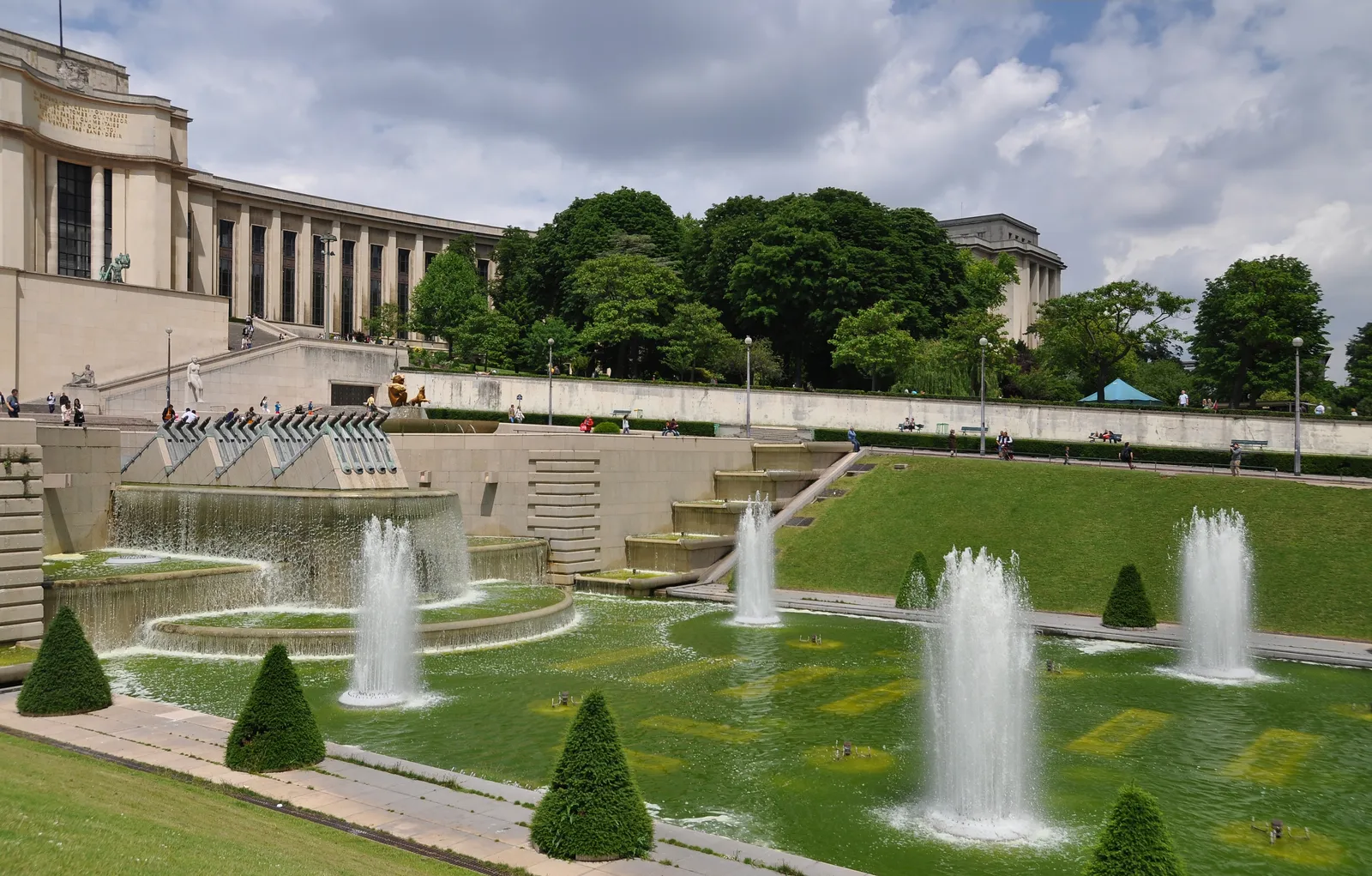
The gardens step down from there to the river, and the long basin running through them is the Warsaw fountain, also 1937: a row of water cannons angled flat down the slope towards the Seine, firing over the pool rather than up out of it. They run on a schedule rather than continuously, and the whole garden is open and free at any hour.
The esplanade under the tower is free to walk into
The tower has stood inside a permanent security perimeter since 2018, bulletproof glass along the two riverside faces and metal fencing on the others. You can still walk under the four legs and through the gardens at the base without a ticket; you just enter through one of two checkpoints and put your bag through a scanner.
That is where the practical problem comes in: nothing bigger than about 40 by 30 by 20 centimetres gets through, there is no cloakroom on the site, and no way to leave a suitcase anywhere inside the fence, so arriving here with luggage means not getting in at all.
Going up is what costs. The stairs to the second floor are the cheapest way in at 14.80 euros and the most interesting, because you climb through the ironwork rather than past it; the lift to the same floor is 23.50, and the summit by lift is 36.70, with summit tickets worth booking ahead since they sell out furthest in advance. If the sky is grey the second floor is the better value: the summit’s advantage is height, and height is worth nothing in cloud.
The two-deck iron bridge at Bir-Hakeim
Ten minutes downstream, and almost nobody walks to it. The Pont de Bir-Hakeim was built between 1903 and 1905 with two levels: a road and pavement at the bottom, and a steel viaduct above it carrying metro line 6 out over the water on a row of columns. Standing on the lower deck while a train crosses on the viaduct above puts the bridge’s two levels in the same frame, something most people walking past never stop to notice.
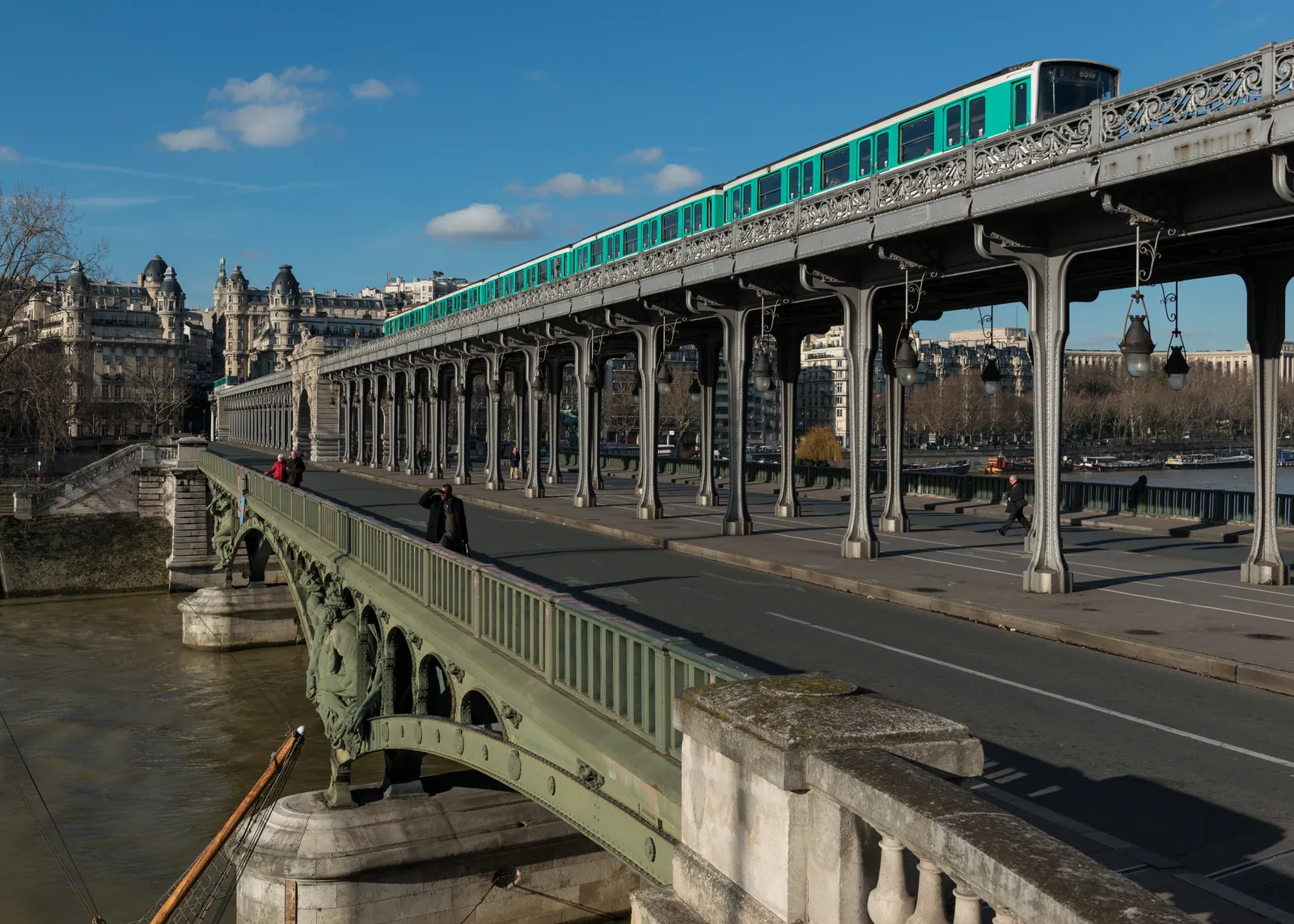
Halfway across, a staircase drops onto the Île aux Cygnes, an 1827 breakwater turned into a narrow tree-lined path down the middle of the Seine. Walk it to the far end and there is a quarter-scale Statue of Liberty, given to Paris by the American community here in 1889 and turned round in 1937 so that she faces west towards the original.
The lawns of the Champ de Mars under the tower
With four hours or more, the Champ de Mars is worth the detour south across the river. It is the long formal lawn running away from the tower’s feet towards the Ecole Militaire, and it is where Parisians actually sit, as opposed to the esplanade where visitors queue.
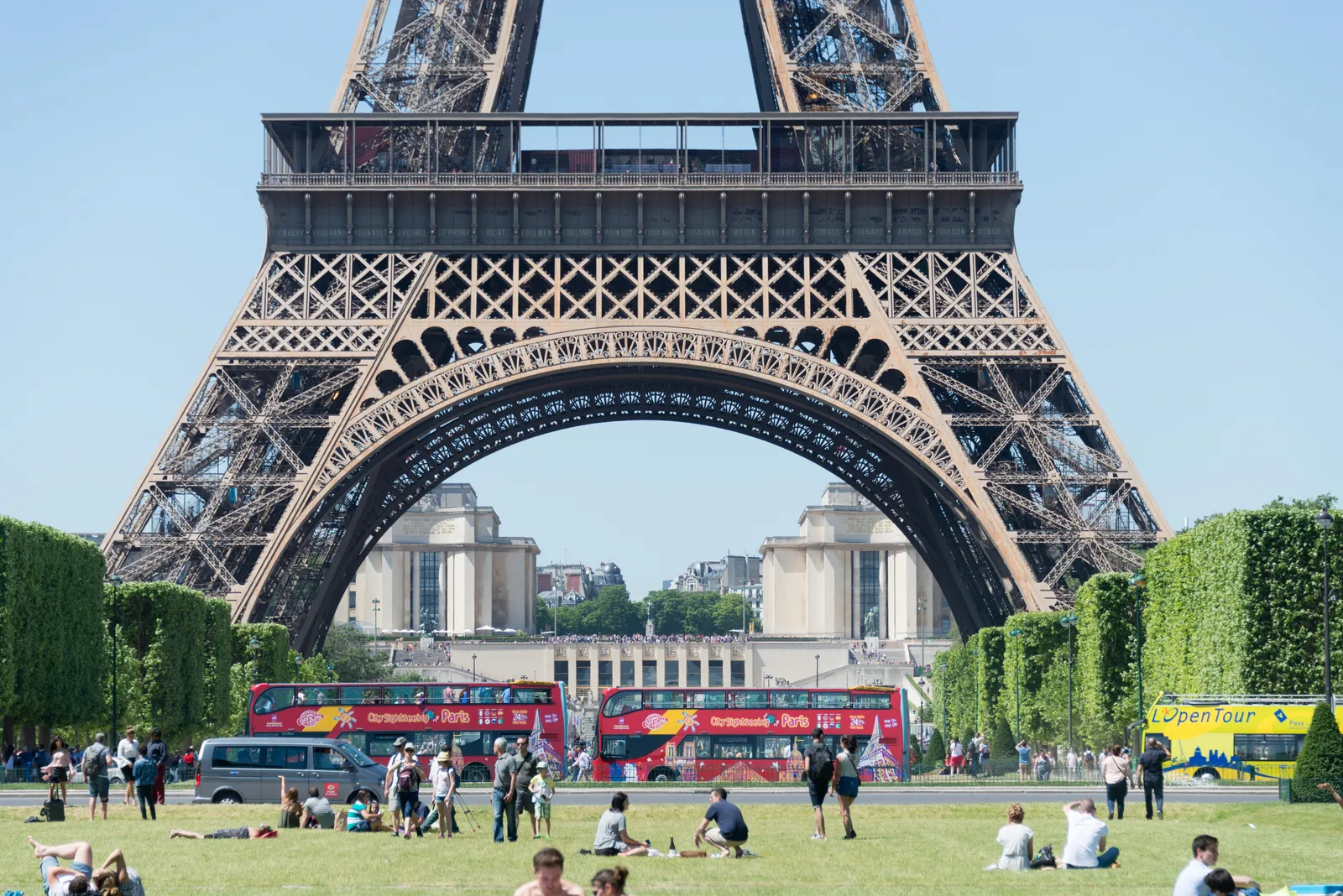
It is outside the security fence, so no bag check and no ticket, and the view up at the first arch from the grass is a better one than most of what you pay for. For the river islands and the older half of the city instead, the main Paris layover guide works from Châtelet, which is where the RER A takes you from Étoile.
Leave more time than the map suggests for the run back out: line 6 east, RER A, then RER B, and an hour and a quarter to the terminal is realistic. Pick the suitcase up on the way through the centre rather than doubling back for it.
Frequently asked questions
Can I bring my luggage to the Eiffel Tower?
Not a suitcase, no. The tower sits inside a fenced perimeter with airport-style screening at the entrances, and anything over roughly 40 by 30 by 20 centimetres is refused at the checkpoint. There is no cloakroom, no locker and no bag drop anywhere on the site, so a full-size case means turning round at the fence. Leave it at a storage point before you come out here. The screening itself adds five to ten minutes even when you already hold a timed ticket.
What do the different Eiffel Tower tickets cost?
Four options, and the gap between them is large. The stairs to the second floor are 14.80 euros for an adult; the lift to the second floor is 23.50; the stairs to the second floor plus the lift on to the summit is 28.00; and the lift the whole way to the top is 36.70. Under-4s go free and 12 to 24 year-olds pay about half. Summit tickets sell out furthest ahead, and the summit closes at short notice in high wind, which is the risk you carry on a flight day.
Is the Trocadéro view worth it if I skip the tower itself?
It is the better half of the trip for most people on a short stop. The terrace between the wings of the Palais de Chaillot is the one place the tower reads as a whole object rather than something looming over you, it costs nothing, there is no queue and no bag rule, and you are two minutes from a metro station on lines 6 and 9. Come before ten in the morning if you want the terrace to yourself; by midday it is three deep at the balustrade.
How do I get from the Eiffel Tower to Charles de Gaulle?
Two changes, and it is one of the slower corners of Paris for this. From Trocadéro, metro line 6 runs east to Charles de Gaulle-Étoile, where the RER A goes to Châtelet-Les-Halles and the RER B carries on to the airport. The alternative is RER C from Champ de Mars-Tour Eiffel to Saint-Michel and the RER B from there. Either way budget an hour and a quarter to the terminal, all of it on the flat 14-euro Paris Region to Airports ticket.