La Défense Layover: The Grande Arche, Paris
Part of the full Paris Layover Guide: Notre-Dame From CDG
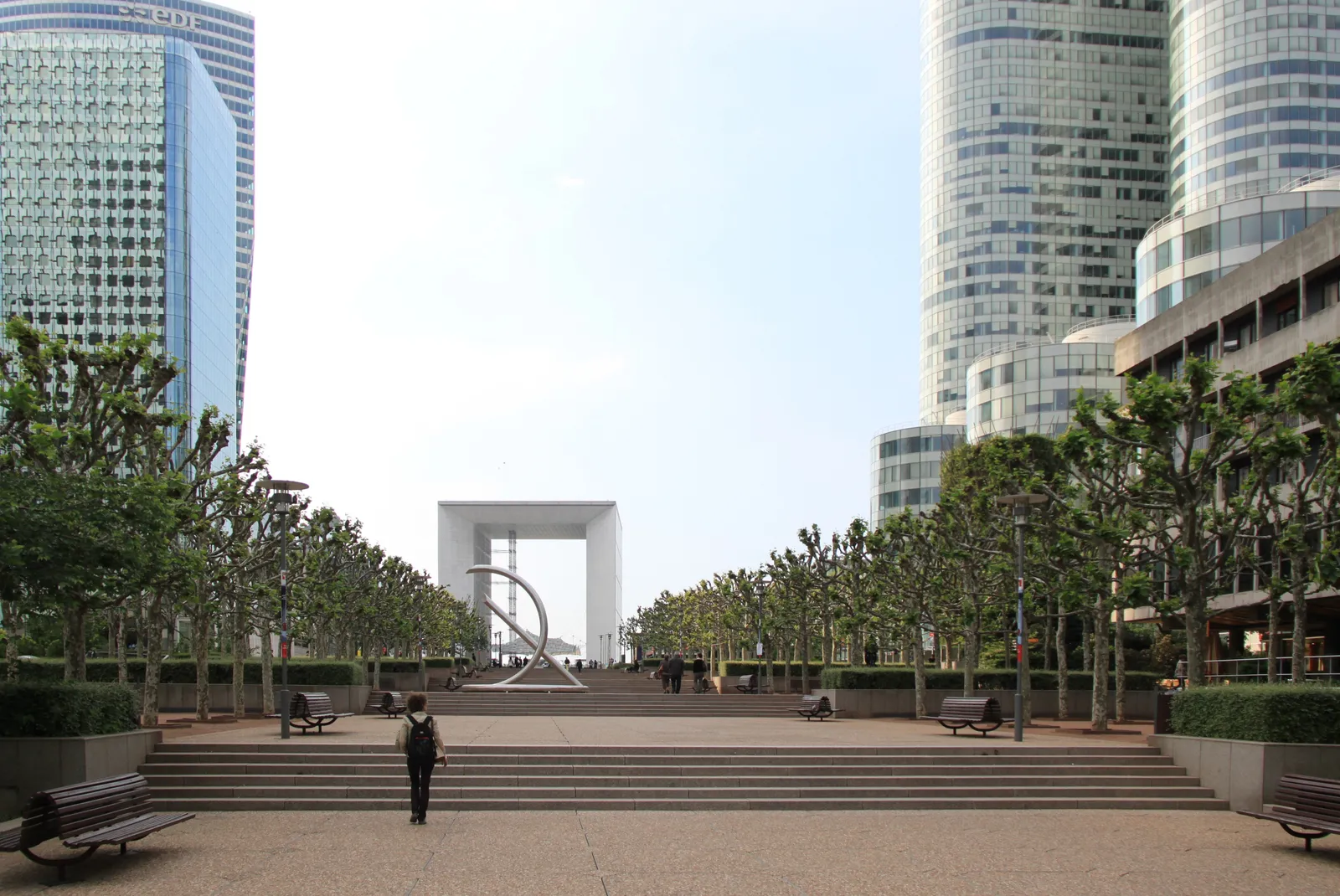
La Défense sits at the western end of the ten-kilometre sightline that starts in the Louvre courtyard, and the Grande Arche that closes it is a hollow cube 110 metres on every side, free to walk under and about fifteen minutes from central Paris on the RER.
Nothing here is old. That is the point: this is the one part of the Paris region built at a completely different scale from the rest, and it takes about two hours to see properly.
The hollow cube of the Grande Arche
Johan Otto von Spreckelsen, a Danish architect who had built almost nothing but churches, won the 1982 competition with a design he described as an open cube, a window on the world. He resigned from the project in 1986 and died the following year, and Paul Andreu finished it. It was inaugurated in July 1989 for the bicentenary of the Revolution.
The frame is prestressed concrete, originally faced in Carrara marble; the marble failed and was replaced with granite at enormous cost. Strung across the void in the middle is a tensile membrane canopy called the Cloud, which softens the wind coming through the opening and does so imperfectly.
The 10-kilometre sightline back to the Louvre
From the top of the steps under the Arche, the line runs east through the middle of the Esplanade, down the Avenue de la Grande Armée, straight through the arch of the Arc de Triomphe, the length of the Champs-Élysées, across the Place de la Concorde past the obelisk, through the Tuileries and into the Louvre’s courtyard, ten kilometres away.
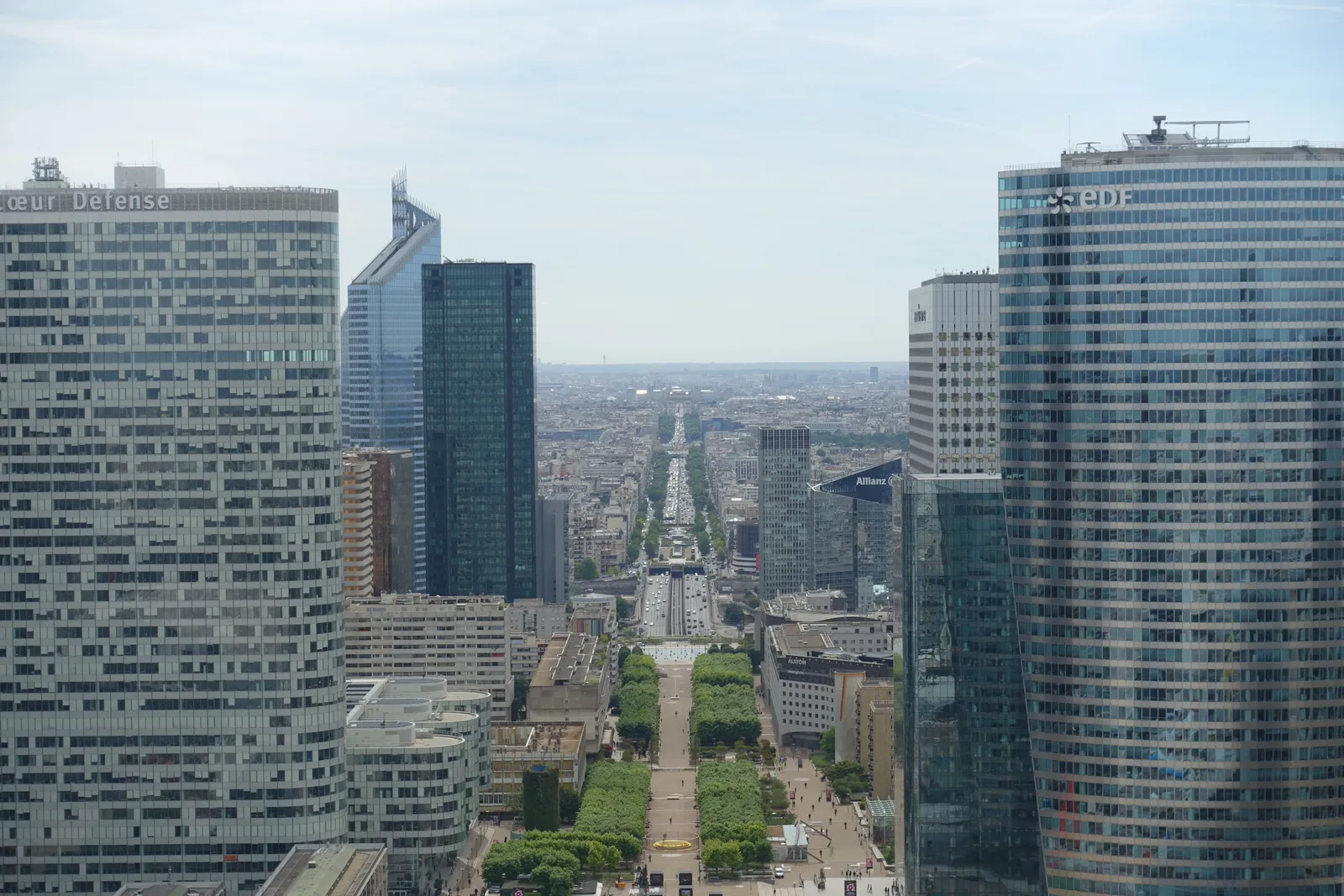
It has been assembled piece by piece since the 1660s, when Le Nôtre laid out the Tuileries, and the Arche is the most recent addition to it. On a clear day the Arc de Triomphe is plainly visible from here with no help, which is the single most worthwhile thing about standing on this particular set of steps.
The concrete deck the whole district stands on
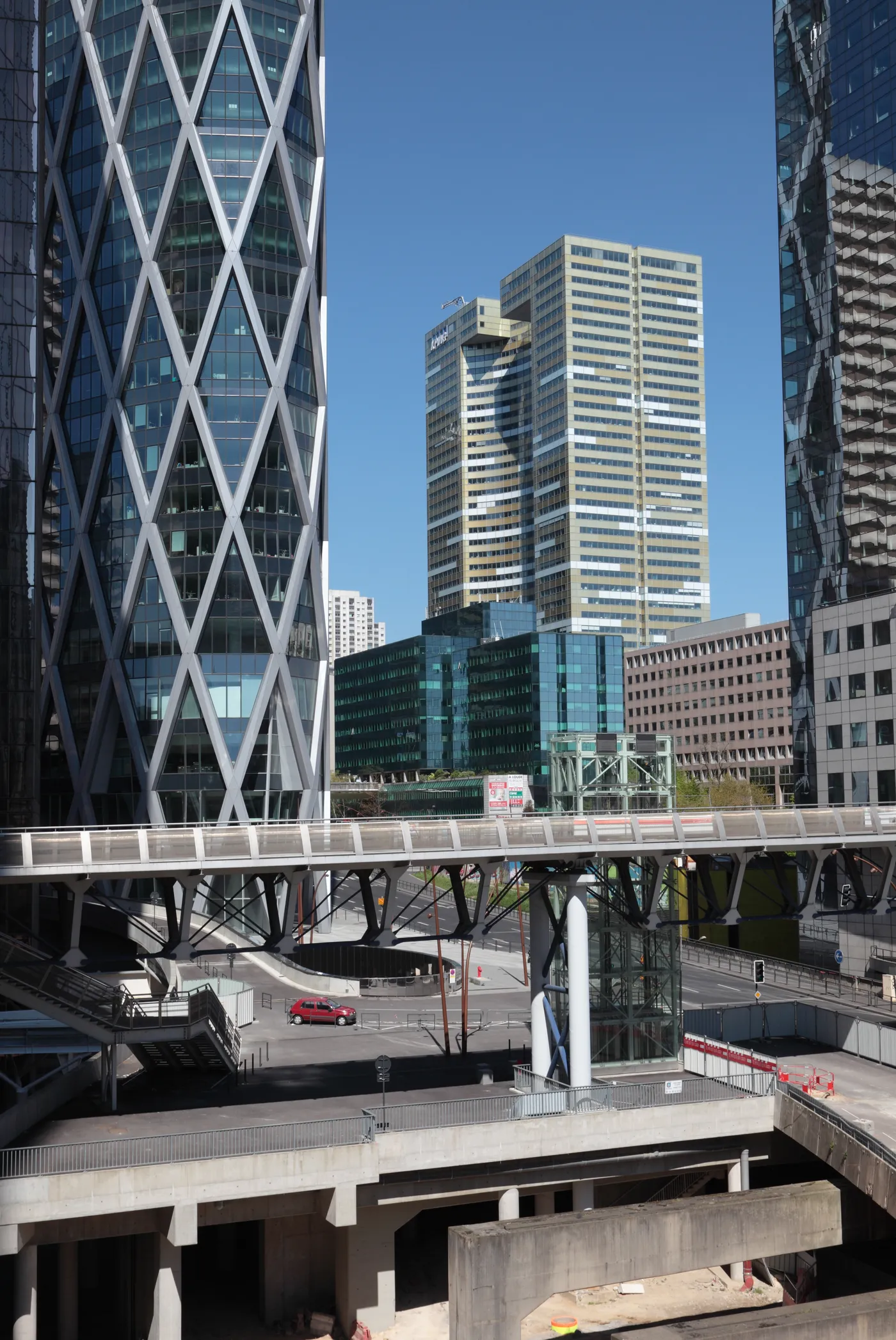
La Défense is not built on the ground. Roads, the RER, the metro, service access and car parks all run underneath a raised pedestrian slab, and everything you walk on up top is that deck. The Esplanade runs about a kilometre east from the Arche, with the district’s 61 high-rise buildings around it and 69 outdoor artworks set along the way, one of the larger open-air collections in Europe.
At the eastern end is the oldest thing in the district: the CNIT, finished in 1958, a concrete shell vaulting 218 metres between three points of support with nothing holding up the middle.
The deck also explains the practical warning. The station is several levels below the Esplanade, the way up is escalators and stairs, and the open slab funnels wind between the towers in a way that makes hauling anything across it unpleasant, so this is a walk to do with your hands free.
The rooftop of the Grande Arche is shut for good
Worth knowing before you plan around it. The Arche had a public roof terrace with a 360-degree view, and it closed on 28 April 2023 when the operator walked away after six years and about a million euros of losses. It had already been closed once, from 2010 to 2017. Nothing has been announced since, so unless that changes, the Arche is a building you stand under rather than one you go up.
If a view is what you came out here for, the Arc de Triomphe is one RER A stop east at Charles de Gaulle-Étoile, its terrace is open, and rooftop tickets can be held in advance. For the historic core rather than either arch, the Paris layover guide covers the island in the Seine at the other end of that same sightline.
Working back from a flight, this is one of the further corners of the region from Charles de Gaulle: RER A east, change at Châtelet, then the RER B. Collect the suitcase on the way through, not after you are already down on the platform.
Frequently asked questions
Can you still go up the Grande Arche?
No. The rooftop closed on 28 April 2023 when its operator gave up the concession, citing losses of around a million euros and the cost of running a building classed as both a high-rise and a public venue. It had already been shut once between 2010 and 2017. A new operator is possible but none has been announced, so treat the Arche as something to stand under rather than climb. The nearest working equivalent is the Arc de Triomphe terrace, one RER A stop east.
Why is the Grande Arche not square-on to the avenue?
Because of what is underneath it. The cube is turned 6.33 degrees off the historic axis, and that angle was not an aesthetic decision: a metro station, an RER station and a motorway all run directly below the site, and the rotation was the only way to get the foundations down between them. The same 6.33 degrees happens to match the offset of the Louvre's own courtyard at the far end of the axis, which is the kind of coincidence architects enjoy pointing out.
How long does this take?
Two hours covers it comfortably, which makes it one of the shorter options in Paris. The Esplanade is about a kilometre from the Grande Arche steps to the Pont de Neuilly end, and there is no interior to queue for anywhere along it. If you walk out and back with a stop at the CNIT you are looking at ninety minutes plus the trip in, and the district thins out badly after office hours on weekdays and all weekend, which is either the appeal or the problem depending on what you came for.
How do I get from La Défense to Charles de Gaulle?
Two legs, and no direct option. Take the RER A east to Châtelet-Les-Halles, about fifteen minutes, then change to the RER B for the airport, roughly another thirty-five. The flat 14-euro Paris Region to Airports ticket covers the whole thing including the change. Metro line 1 runs the same direction more slowly with a lot more stops, so the RER is worth waiting for if one is not immediately in front of you.