Lyon Perrache Layover: Ainay and Confluence
Part of the full Lyon Layover: Vieux Lyon, Fourvière From LYS
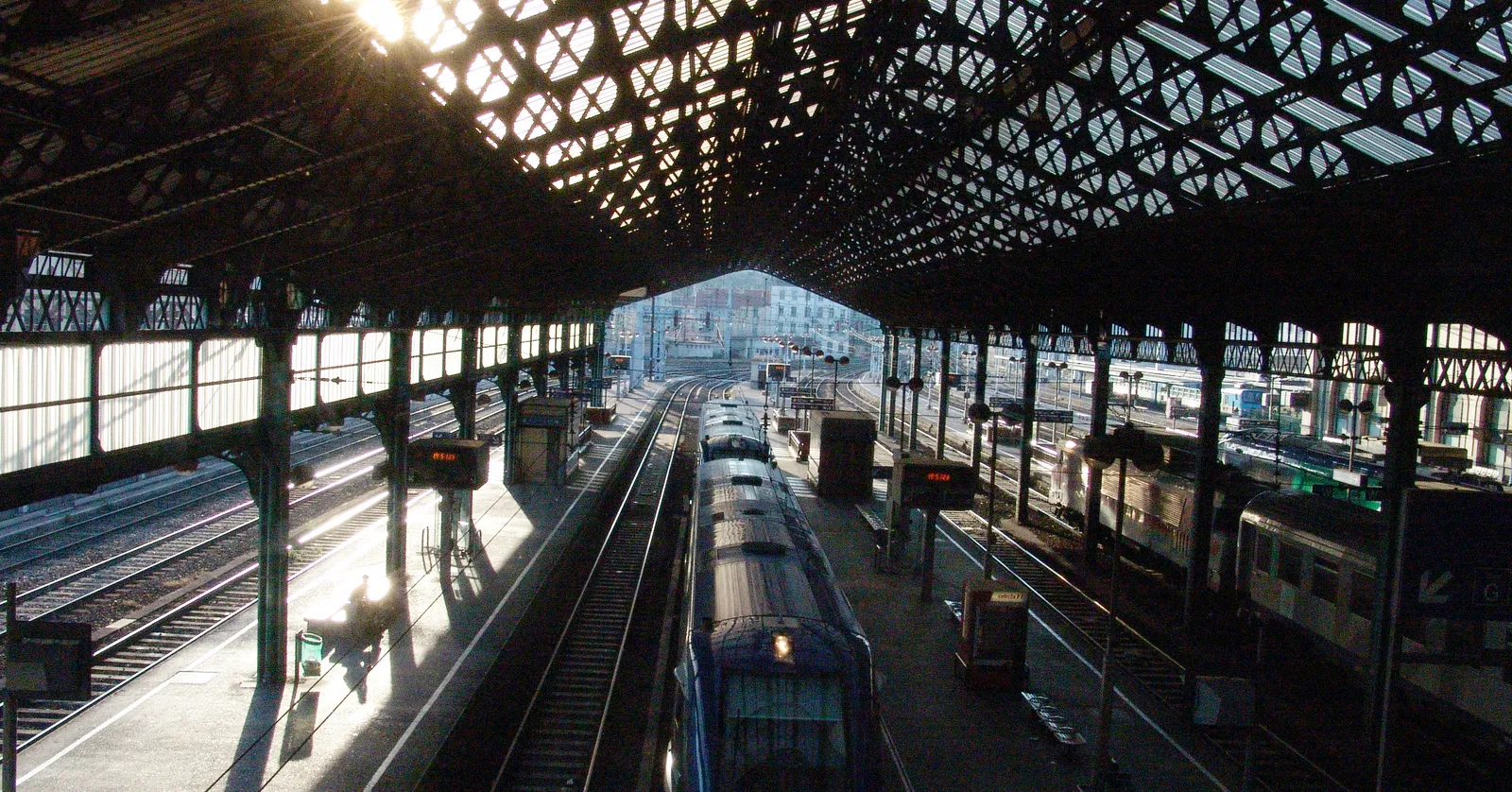
Perrache station in Lyon stands at the neck of the peninsula between the two rivers, a five-minute walk from a Romanesque basilica consecrated in 1107 and fifteen from the Confluence docks, where 1930s sugar warehouses have been turned into galleries.
Perrache station and the concrete deck built over it
The trainshed is the good half: an iron and glass hall from the 1850s, still with its original span over the platforms, so the light coming down onto the tracks on a bright morning is the best thing about arriving here. What went up over it in 1976 is the other half. The Centre d’Échanges stacked a bus station, car parks and walkways on a concrete slab across the top of the railway, cutting the peninsula in two, and it spent forty years as the piece of Lyon everyone agreed had gone wrong.
That is being undone in stages. The France-Péjot passage was opened through the base of it to pedestrians and cyclists in 2021, giving a level walk between Place Carnot on the north side and Place des Archives on the south; the pedestrian footbridge came down over seven months in 2025; the next phase cuts a twelve-metre opening through the lower floors so you can see the station facade from Place Carnot again. Work continues around the building, so signage on the day is worth reading rather than assuming.
Saint-Martin d’Ainay, a basilica consecrated in 1107
Five minutes north of Place Carnot, on Place d’Ainay, is the oldest church still standing in central Lyon. A Benedictine priory was founded on this spot in 859; the building you walk into was put up at the end of the 11th century and consecrated by Pope Paschal II on 29 January 1107.
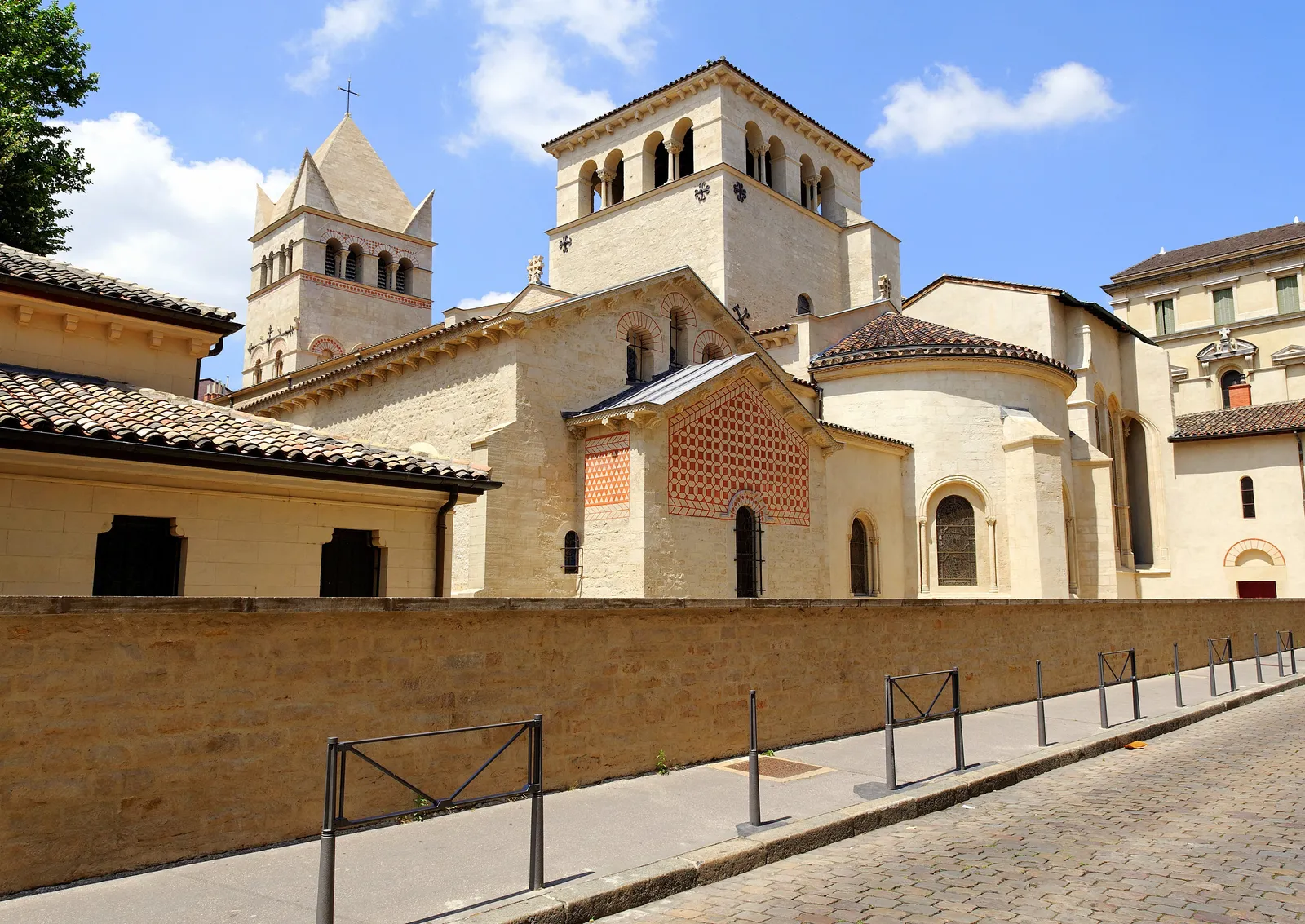
It is squat and heavy in the way Romanesque churches are, with a square bell tower over the entrance and panels of red brick set in diamond patterns across the apse, which is the detail worth going round the back for. It is free, it is a working parish church rather than a monument with a ticket desk, and it is on the UNESCO list along with the rest of central Lyon. Hours are 8.30am to noon and 2.30pm to 6pm, and it closes on Sunday afternoons.
La Sucrière, the sugar warehouse on quai Rambaud
Quai Rambaud runs south from below the station along the Saône, and the long grey block halfway down it with the concrete silos at one end is La Sucrière. Sugar was unloaded and stored here from the 1930s; the port trade died and the building was abandoned in 1990, then renovated in 2003 into three floors of exhibition space.
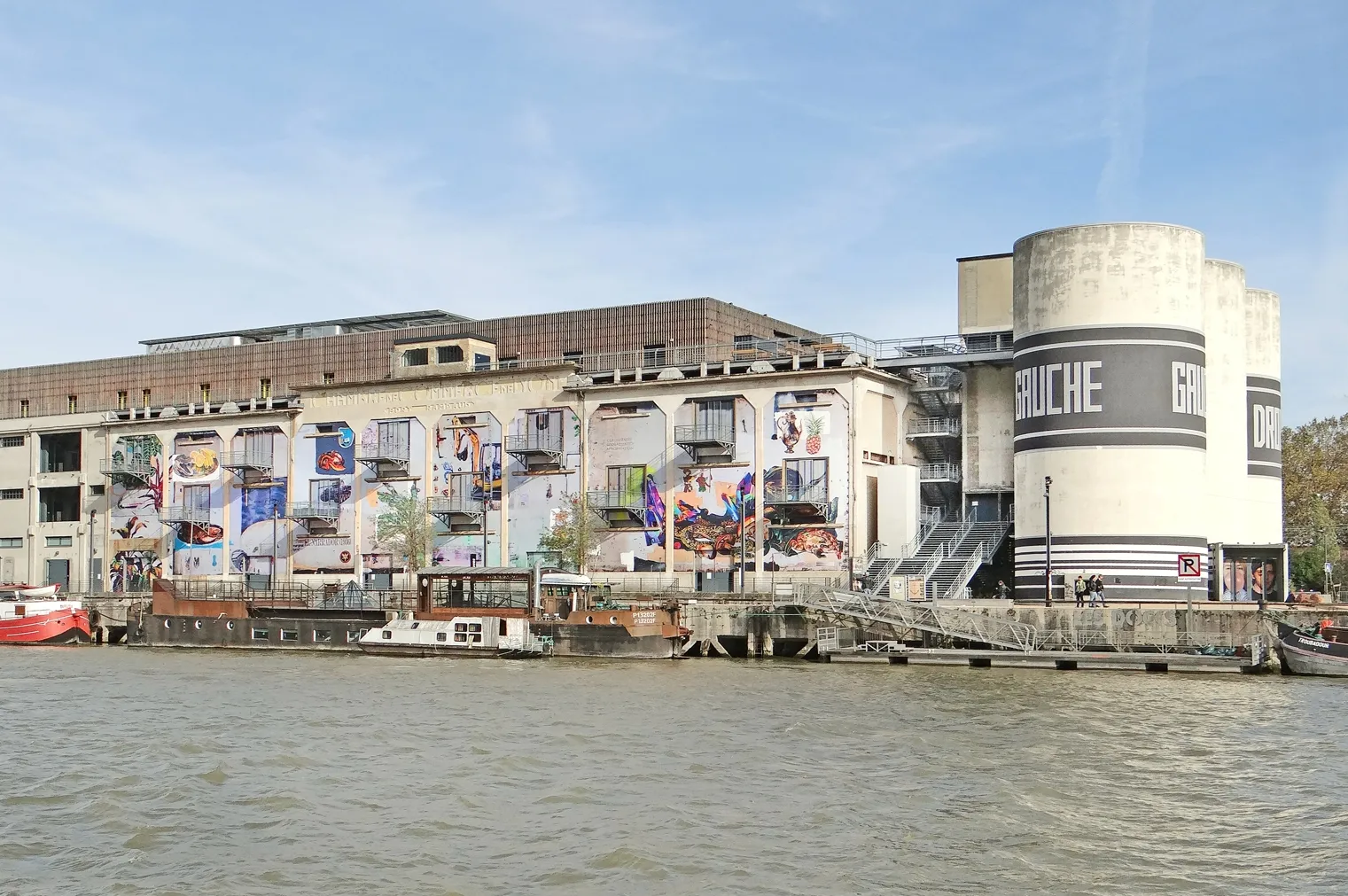
The renovation deliberately left the scars on it, so the inside still reads as a warehouse: raw concrete, huge unbroken floors, the loading structure intact. It is the main venue of the city’s contemporary art biennial, and between shows it takes trade fairs and events, so what is on when you arrive is worth checking rather than assuming. Standing outside it costs nothing either way, and the silos at the water’s edge are the photograph.
Getting down here from the platforms means crossing the interchange, and Perrache is stacked rather than flat: trains, trams, buses and the two squares each sit on a different level, so every change is a floor.
The Orange Cube on the Saône docks
Further along quai Rambaud, past the moored barges and the restored dock cranes, is a bright orange block with two round holes bored clean through it. Jakob and MacFarlane finished the Orange Cube in 2011 on a footprint of roughly 29 by 33 metres, its perforated skin scaled to look like the trail of a droplet on water.
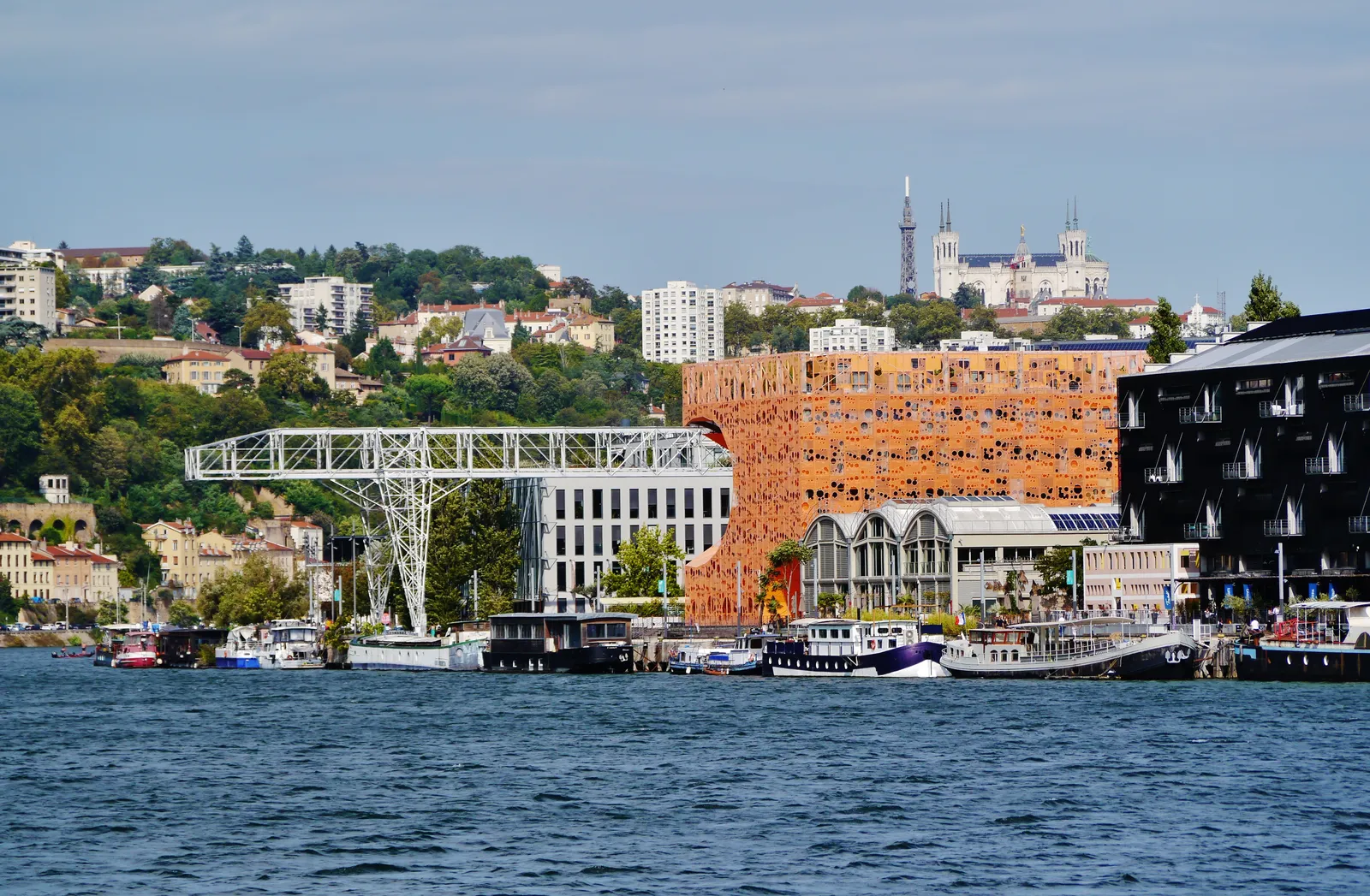
The colour is not decoration for its own sake: it is an abstraction of the lead paint used on harbour ironwork, which is why it sits so oddly and so deliberately against the grey water. Lyon calls it la Mimolette, after the orange cheese. It is offices inside, so this is a building to look at rather than enter, and the walk along the quay to it is flat, open and free the whole way.
This is the modern end of the city, and it is the reason to come out of Perrache rather than ride across town. The Renaissance streets and the hill above them are the other direction entirely, and that is what the main Lyon route is built around.
Perrache is a coach terminus as well as a rail station
Long-distance and regional coaches use the upper deck of the interchange here rather than Part-Dieu, which is why a fair share of the people on this walk arrived by bus rather than by train. If that is you, the connection to a flight is worth planning as two separate legs from the start.
Rhônexpress, the airport tram, runs only from Part-Dieu. The T1 tram links the two stations directly in about 15 minutes, then the airport tram covers the remaining 30 to Lyon-Saint Exupéry Airport for 16 euros online, 17.10 from the machine, running every 15 minutes through the day and every 30 minutes before 6am and after 9pm.
That first leg is what changes your arithmetic here. From the Confluence docks, allow two hours to the gate rather than the ninety minutes that would be enough from Part-Dieu: the walk back up quai Rambaud, the tram across, collecting the bag, the wait, the ride and check-in.
The advantage of spending the window on this side is that nothing here needs a hill or a queue. It is a flat kilometre of dockside, one small church and whatever is hanging in the warehouse, and you can turn round at any point on it without having committed to a climb.
Frequently asked questions
How do you get from Perrache to the airport?
Not directly. Rhônexpress, the airport tram, only starts from Part-Dieu, so from Perrache you take the T1 tram across town first, about 15 minutes, then the 30-minute run out to Lyon-Saint Exupéry Airport at 16 euros online or 17.10 from the machine. Allow two hours from the Confluence docks to your gate rather than the ninety minutes that would do from Part-Dieu itself.
Is Perrache station step-free from the platforms to the street?
There are lifts, but expect to use them. Perrache is stacked rather than flat: the railway platforms, the tram and bus stops and the two street-level squares are on different floors of one concrete structure, connected by escalators, ramps and lifts. The France-Péjot passage opened underneath it in 2021 gives a level walk between Place Carnot on the north side and Place des Archives on the south, which is the easiest route through if you are pushing or pulling anything.
Is there anything near Perrache for kids?
The Aquarium of Lyon is the obvious one, at the far end of the Confluence across the Pont de la Mulatière, open daily 10.30am to 6.30pm with the ticket desk closing an hour earlier; tickets booked ahead skip the window, which matters on a fixed schedule. Budget an hour and a half inside. The shopping centre on the docks has the other useful thing on a wet day, which is a roof.
Can you go inside La Sucrière?
Only when something is on, and what that something is changes. The building has no permanent collection: it runs the city's contemporary art biennial, then trade fairs, immersive shows and private events in between, so it is ticketed when it is open and closed to the public when it is being turned around. Check what is showing before you build an afternoon around going in. The quayside outside it, the silos and the dock cranes are public at any hour.