Croix-Rousse Layover: Lyon's Silk Quarter
Part of the full Lyon Layover: Vieux Lyon, Fourvière From LYS
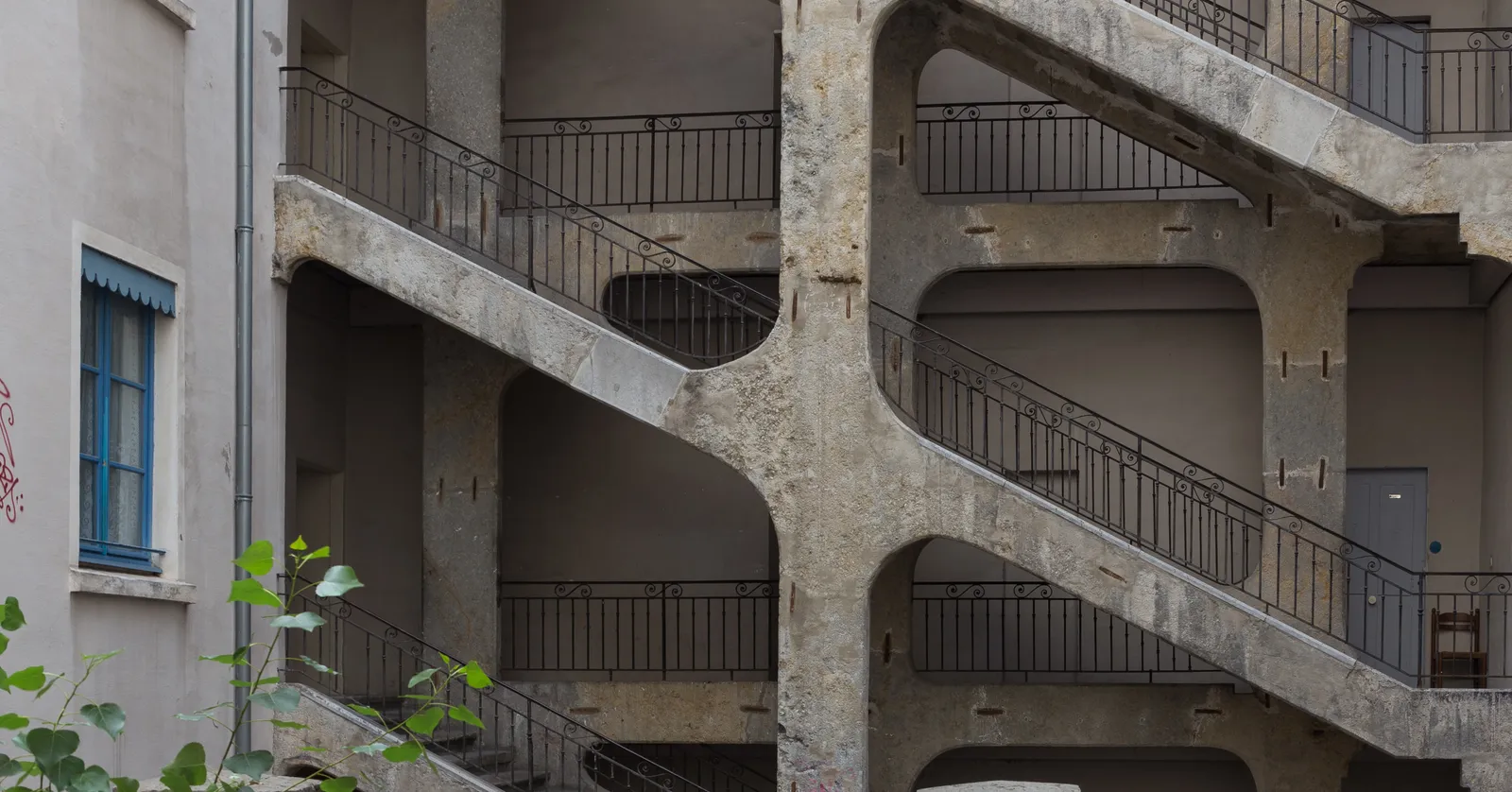
Croix-Rousse is the hill north of central Lyon where the city’s silk weavers lived and worked, and its two best things cost nothing: the open six-storey staircase in the Cour des Voraces, and a Roman amphitheatre sitting in a public garden on the slope.
The six-storey open staircase in the Cour des Voraces
The Cour des Voraces opens off Place Colbert, and what is inside it is a stair: bare stone flights zigzagging up the open face of a courtyard building through six storeys, with no wall in front of them. It was built around 1840 for silk weavers, and it is a passage as much as a courtyard, cutting through to montée Saint-Sébastien and rue Imbert-Colomès on the other sides.
Lyon calls these passages traboules, and this is the most photographed of them. It is one of the small number covered by an agreement between the city and the people who live in the building, which keeps it unlocked to the public every day from 7am to 7pm, 8pm in summer, for nothing. People live behind those doors, so the deal is that you keep your voice down and do not linger in the courtyard.
The reason any of this is here is the loom. Croix-Rousse was rebuilt in the 1830s with four- and five-metre ceilings specifically so Jacquard looms would fit, which is why the buildings are so tall and the windows so large. The Maison des Canuts at 10-12 rue d’Ivry still runs a 19th-century hand loom for its guided visits, Tuesday to Saturday at 11am and 3.30pm, 10 euros, 7 for students, and the demonstration is the part worth going for: the noise a single loom makes explains a great deal about what a street of them was like.
The Roman amphitheatre in the Jardin des Plantes
Halfway down the southern slope, off rue Lucien Sportisse, a sunken oval of sandy ground sits inside a public garden. This is the Amphitheatre of the Three Gauls, finished in 19 AD, where delegates from sixty Gallic nations came once a year to renew their oath to Rome at the federal altar.
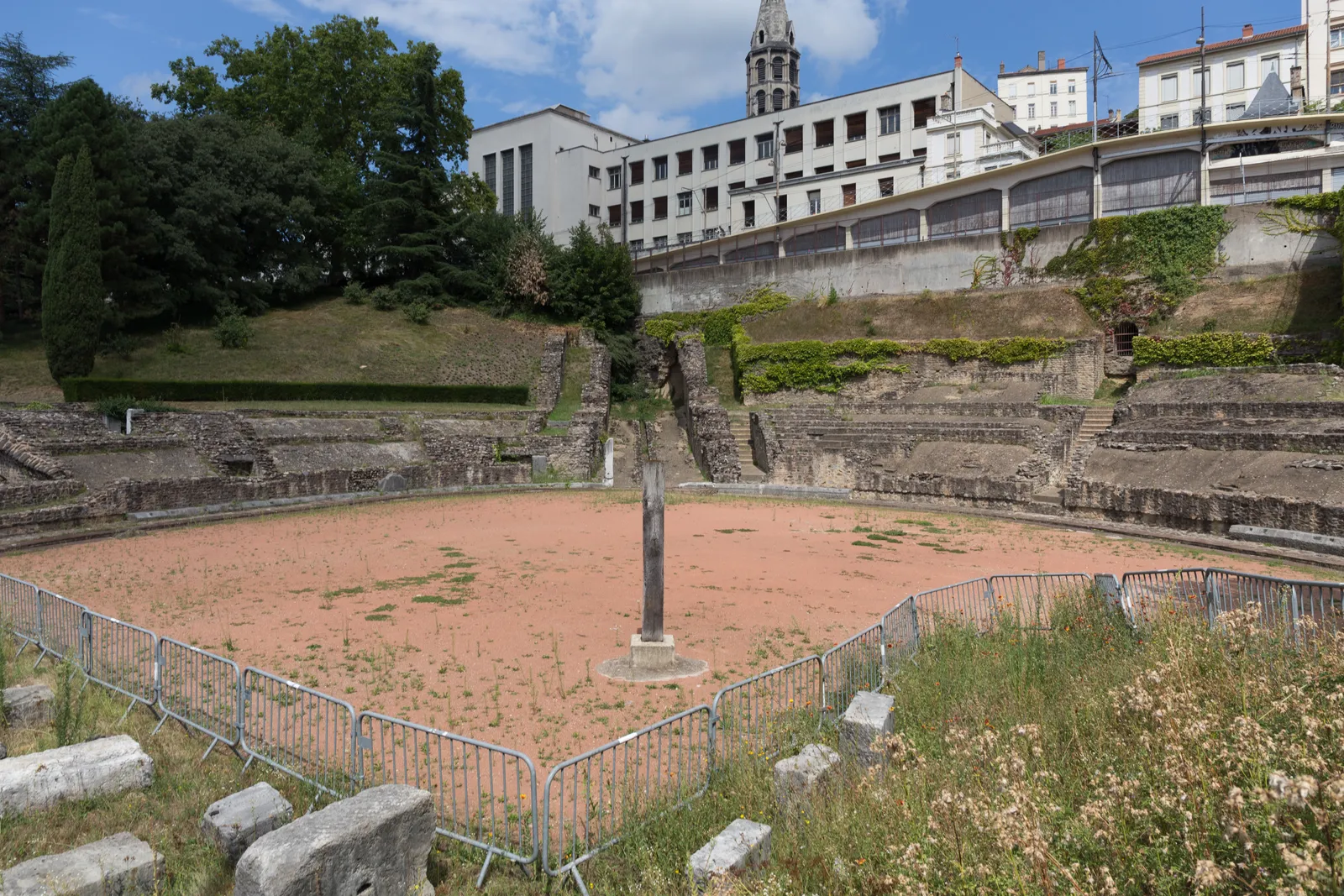
It is also where, in 177, a group of Christians including a slave named Blandina were killed in front of a crowd, which is the event the plain post in the middle of the arena marks. Only the retaining walls of about half the structure survive, and they are set into the terraces of the garden around them, so this is a quiet, unticketed patch of grass with a very long memory rather than a monument with a gate. It is open like any city garden and costs nothing.
The Gros Caillou, a boulder that stopped the tunnel
At the eastern end of the hill’s plateau sits a pale rock roughly the size of a small car, standing on its own beside the boulevard. It came out of the ground in 1861, when crews digging the funicular tunnel underneath hit something they could not drill through and had to haul it out whole.
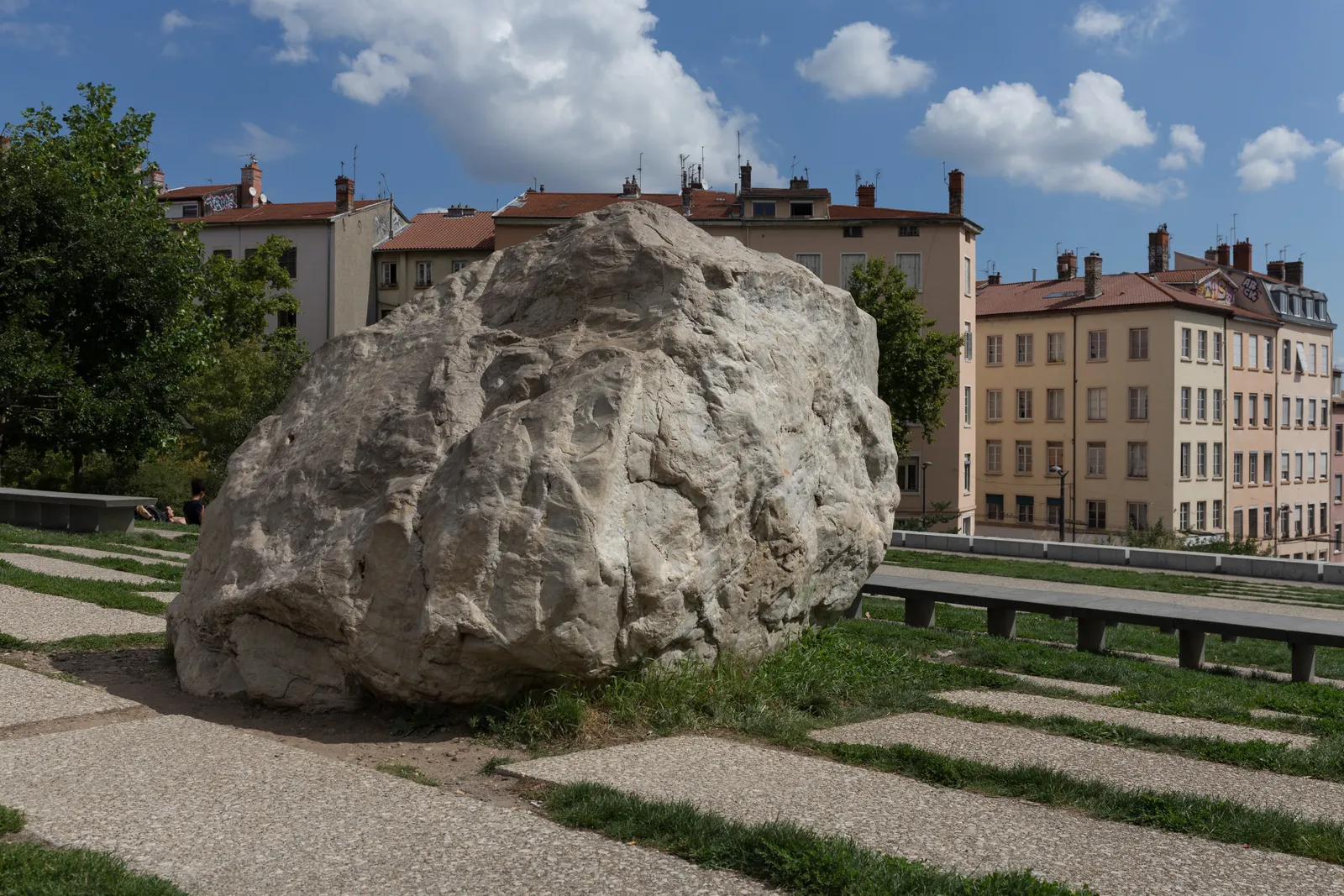
It turned out to be Triassic quartzite from the Maurienne valley in the Alps, carried here by a glacier, and the district adopted it as its emblem: proof, roughly, that Croix-Rousse gets through things. It was shifted about thirty metres in the early 2000s when an underground car park went in, and it now sits just inside the 1st arrondissement rather than on the boundary it used to mark. The view over the city opens up from the terrace beside it.
A market of 105 stalls along Boulevard de la Croix-Rousse
Boulevard de la Croix-Rousse runs flat along the top of the hill, and for most of the week the middle of it is a market. Around 105 traders set up on Tuesday, Friday, Saturday and Sunday from 6am to 1.30pm, and about 29 on Wednesday and Thursday, finishing at 1pm; Monday is the day nothing happens.
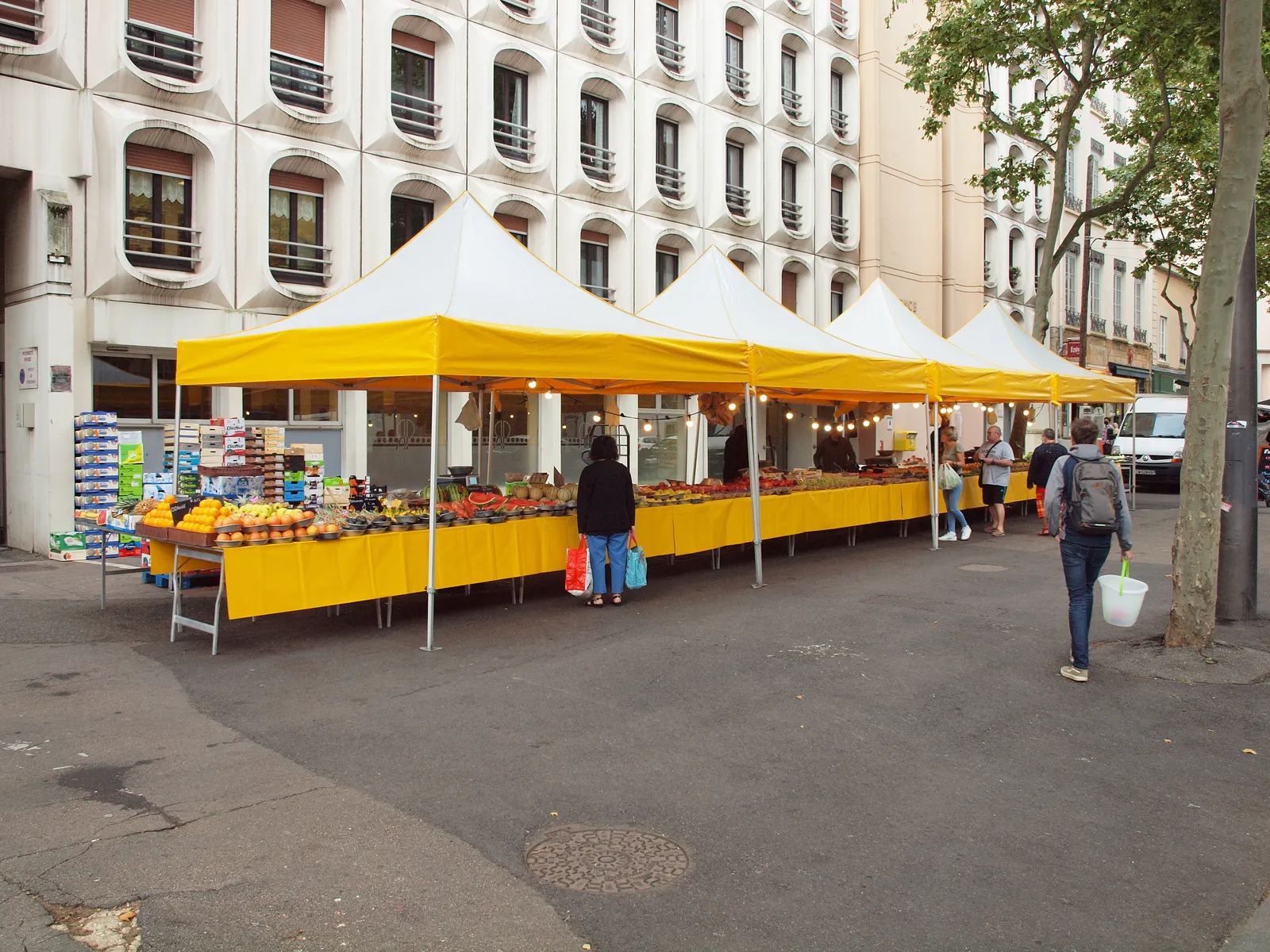
It is a working food market rather than a tourist one: fruit and vegetables, cheese, charcuterie, tripe, whole roast chickens, fish, bread, wine and flowers, sold to people doing their shopping. That makes it the best hour on this hill if you time it right, and a stretch of empty tarmac under plane trees if you do not.
Montée de la Grande Côte, the stepped street back down
The Montée de la Grande Côte drops from the plateau to the Presqu’île in a series of wide cobbled stages, tall shuttered weavers’ buildings on both sides and the city laid out in front of you the whole way down. It was the main road up the hill before the boulevards existed, and it is still the most direct way to walk between the two.
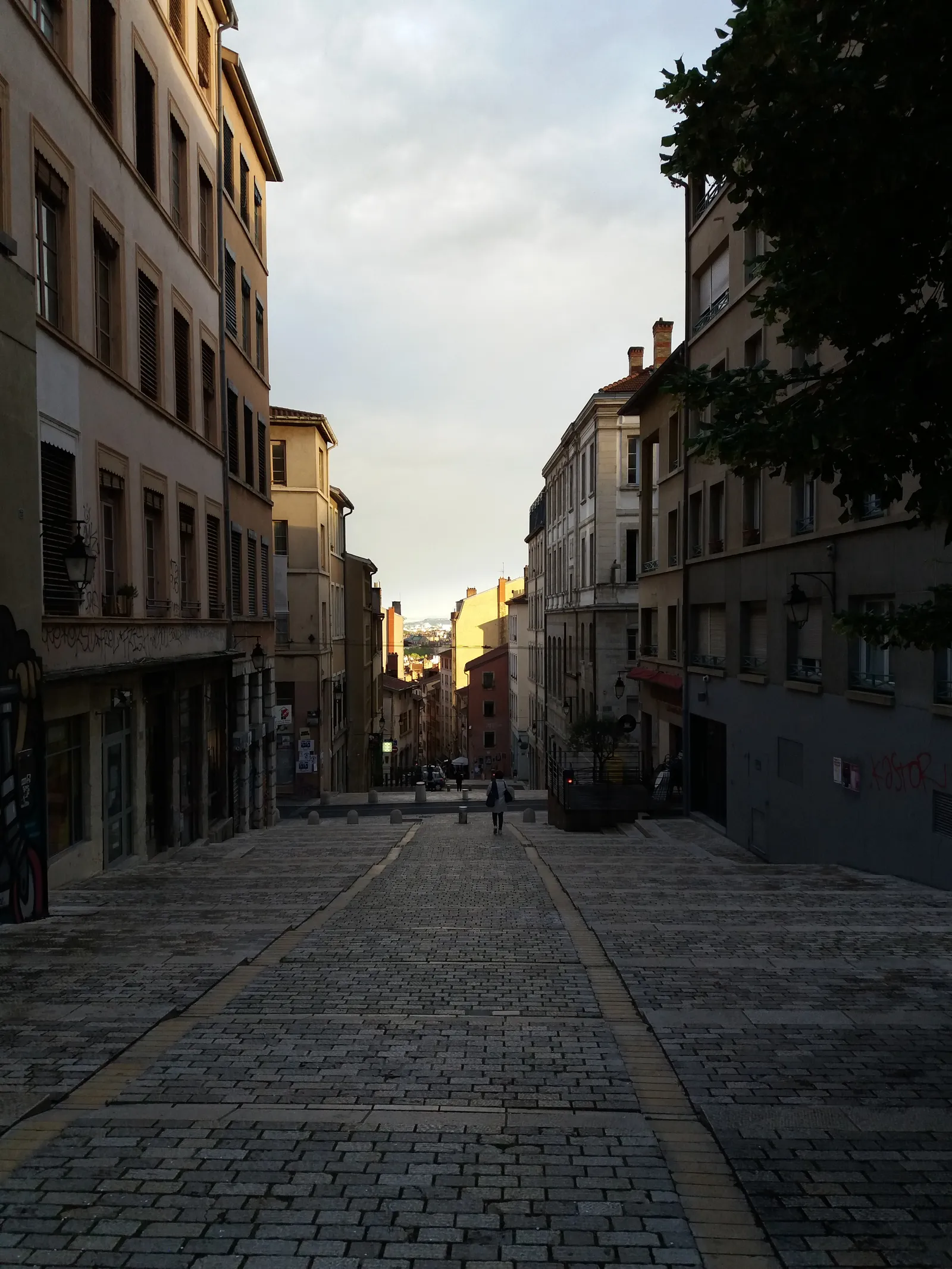
Going down it takes about fifteen minutes and going up it takes considerably longer. That is the practical argument for arriving by the rack railway and leaving on foot, and it is also why a wheeled bag turns this descent into a carried one: the steps run the full width in places and there is no ramped alternative alongside.
The rack railway that runs down off the hill
The metro line serving this hill climbs the steep section on a rack, with a toothed rail between the running rails and a cog under the train, because the gradient is too much for adhesion alone. It is the quickest way up here without walking, and the quickest way back down.
Rhônexpress leaves from Part-Dieu, on the flat east of the Rhône, so from up here the airport is two legs: down off the hill and across the river, then 30 minutes out to Lyon-Saint Exupéry Airport at 16 euros online or 17.10 from the platform machine. It runs every 15 minutes through the day and every 30 minutes before 6am and after 9pm, between 4.25am and midnight.
Budget two hours from the boulevard to your gate. The first leg is short, but the descent is the part people underestimate, and a missed connection at the bottom of the hill is harder to make up than one downtown.
The hill is a good use of a few free hours precisely because it is not built for visitors: a market at six in the morning, a stair somebody still climbs to get home, a Roman arena with a football pitch’s worth of grass round it. Leaving the bag down by the station rather than hauling it up here is what makes any of that a walk rather than a chore.
Frequently asked questions
How much of Croix-Rousse can you see without paying for anything?
Nearly all of it. The Cour des Voraces and the other passages covered by the city's agreement with residents are unlocked daily from 7am to 7pm, 8pm in summer, at no charge. The amphitheatre sits inside a public garden that costs nothing, the boulder at the top of the hill stands on an open boulevard, and the market is free to walk through whether or not you buy. The only ticket on this route is the silk workshop on rue d'Ivry, at 10 euros for the guided visit.
What days is the Croix-Rousse market on?
Every day except Monday, and it is a morning affair. Around 105 traders set up along Boulevard de la Croix-Rousse on Tuesday, Friday, Saturday and Sunday from 6am to 1.30pm, dropping to about 29 on Wednesday and Thursday, when it finishes at 1pm. Arrive after two in the afternoon and you will find an empty boulevard and the crates being loaded away.
Is the hill hard work on foot?
The climb is, the top is not. The plateau at the top is flat and the boulevard runs level along it, but everything between there and the city centre is a slope, and the connecting streets are stepped rather than ramped. A rack railway climbs the hill from the riverside if you would rather not walk up, and the Montée de la Grande Côte is the walkable way down, wide, cobbled and consistently downhill.
Is this a better use of a few hours than the old town?
It depends what you want. Croix-Rousse is quieter, higher and much less visited, and its interest is industrial and Roman rather than Renaissance. If you have never been to Lyon at all, the Renaissance quarter and the basilica hill are the more obvious first trip. Come up here when you have already done that, or when you would rather spend the time somewhere people actually live.