Montreal Layover Guide: Old Montreal From YUL
Montreal’s oldest quarter runs about a kilometre along the St Lawrence and holds a basilica whose ceiling is deep blue and covered in gold stars, a street cobbled since 1672, an observation wheel over the water and a forty-five-metre clock tower you can climb for nothing.
The Old Port observation wheel runs 365 days a year
La Grande Roue opened on the Old Port quays on 1 September 2017, sixty metres to the top, with forty-two enclosed cabins holding eight people each. The cabins are glazed and climate-controlled, which is the detail that decides whether this is worth doing in February as well as July.
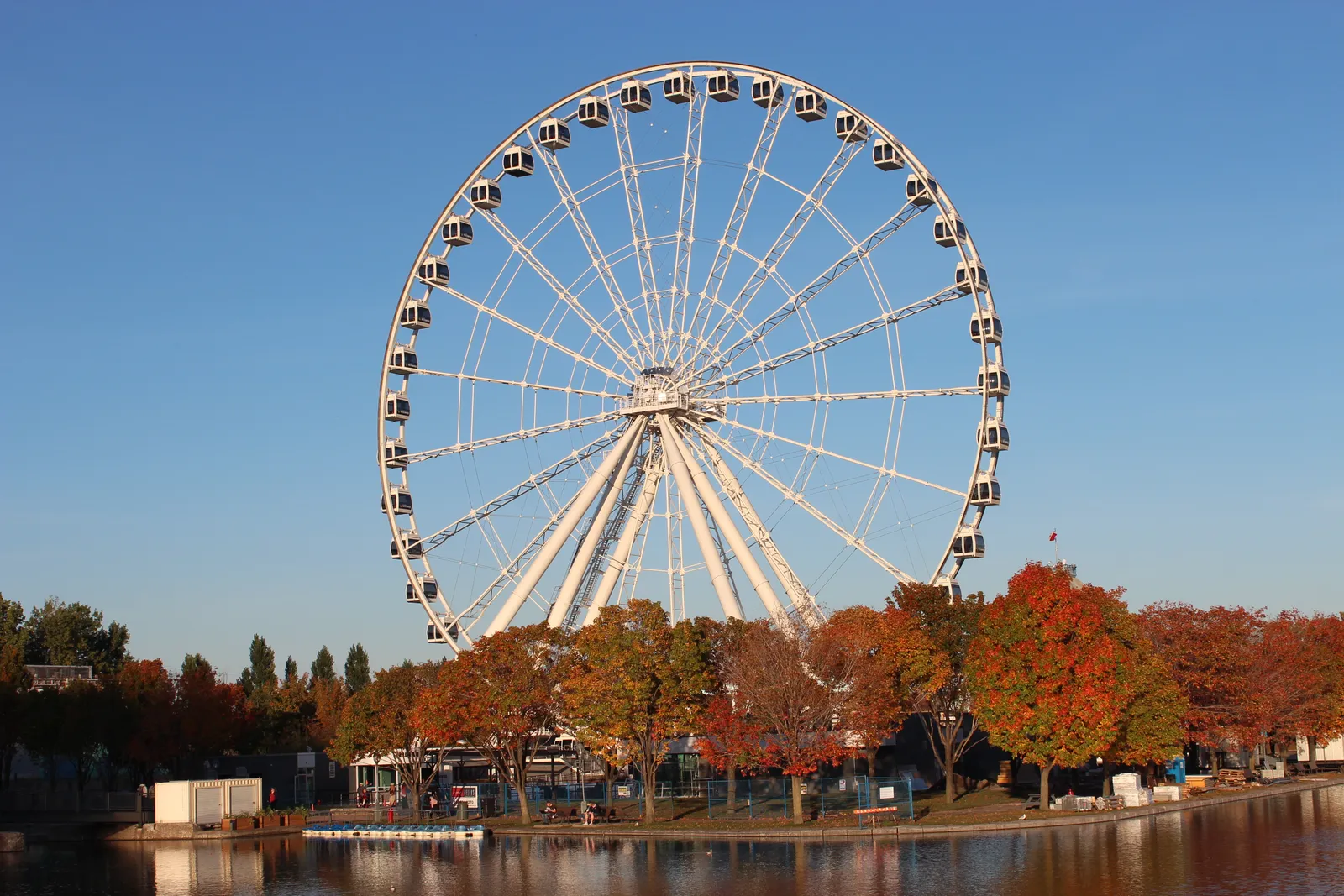
A ride lasts about twenty minutes, roughly three turns, and on a clear day the operator puts the visible distance at 28 kilometres, far enough to pick out the bridges downriver and the hump of Mount Royal behind the downtown Montreal towers. Adult admission is CA$29.50, CA$24 for teenagers and students and CA$16.50 for children from 5 to 12. Doors run from 10am to 11pm every day of the year, so this is one of the few paid stops in the city that is still open when a late flight is the reason you are here at all; a ticket bought ahead through a tours and activities platform skips the kiosk queue on the quay.
Notre-Dame Basilica’s vaults are blue and set with gold stars
James O’Donnell, a New York architect, drew the building and it went up between 1824 and 1829 facing Place d’Armes, with the towers added afterwards, the first finished in 1841 and the second in 1843. The vaults above the nave are painted deep blue and scattered with gold stars, and the rest of the interior works through azure, red, purple, silver and gold across hundreds of carved wooden panels.
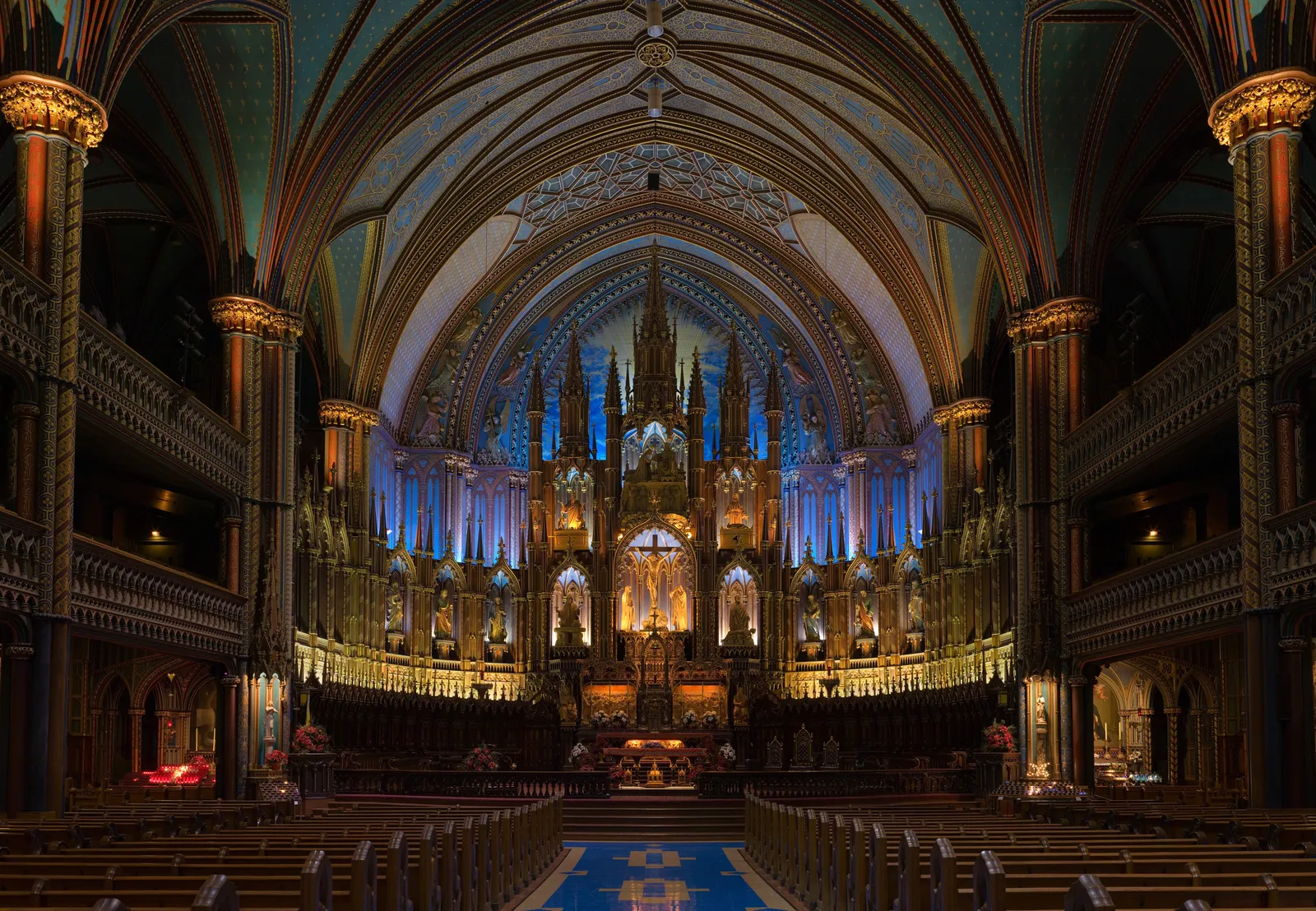
The sanctuary windows are the surprise. Instead of biblical scenes they show episodes from Montreal’s own religious history, which is a subject almost no other church of this size gives its glass over to. Above the main doors sits a Casavant Frères organ of 1891 with four keyboards, 99 stops and about 7,000 pipes. Behind the sanctuary, the Sacré-Coeur chapel was burned out by an arsonist on 7 December 1978; the lower two levels were rebuilt from historical drawings and a modern bronze altarpiece by Charles Daudelin now closes the end of it.
Sightseeing admission is CA$16 for an adult and the doors shut at 4.30pm on weekdays, earlier at the weekend, so this is the stop to do first rather than last. In the evening the interior becomes the screen for AURA, a thirty-minute projection and sound piece; after 5pm the desk stops selling and tickets go online or by phone only. The nearest metro station is a couple of minutes from the square, and only thirty of the network’s sixty-eight stations have a lift down to the platforms, so arriving with a suitcase usually means carrying it down a flight of stairs.
Nelson’s Column on Place Jacques-Cartier has stood since 1809
The square is a broad, divided slope running down from Montreal City Hall towards the water, and it exists because the Château Vaudreuil burned down on the site in 1803 and the city turned the empty ground into a market instead. It took the explorer’s name in 1847. Nelson’s Column went up at the top of it in 1809 and is the oldest public monument in the city; the original figure came down in 1997 to keep the weather off it, and what stands up there now is a copy. Through the summer the street is closed to cars and given over to terraces and buskers.
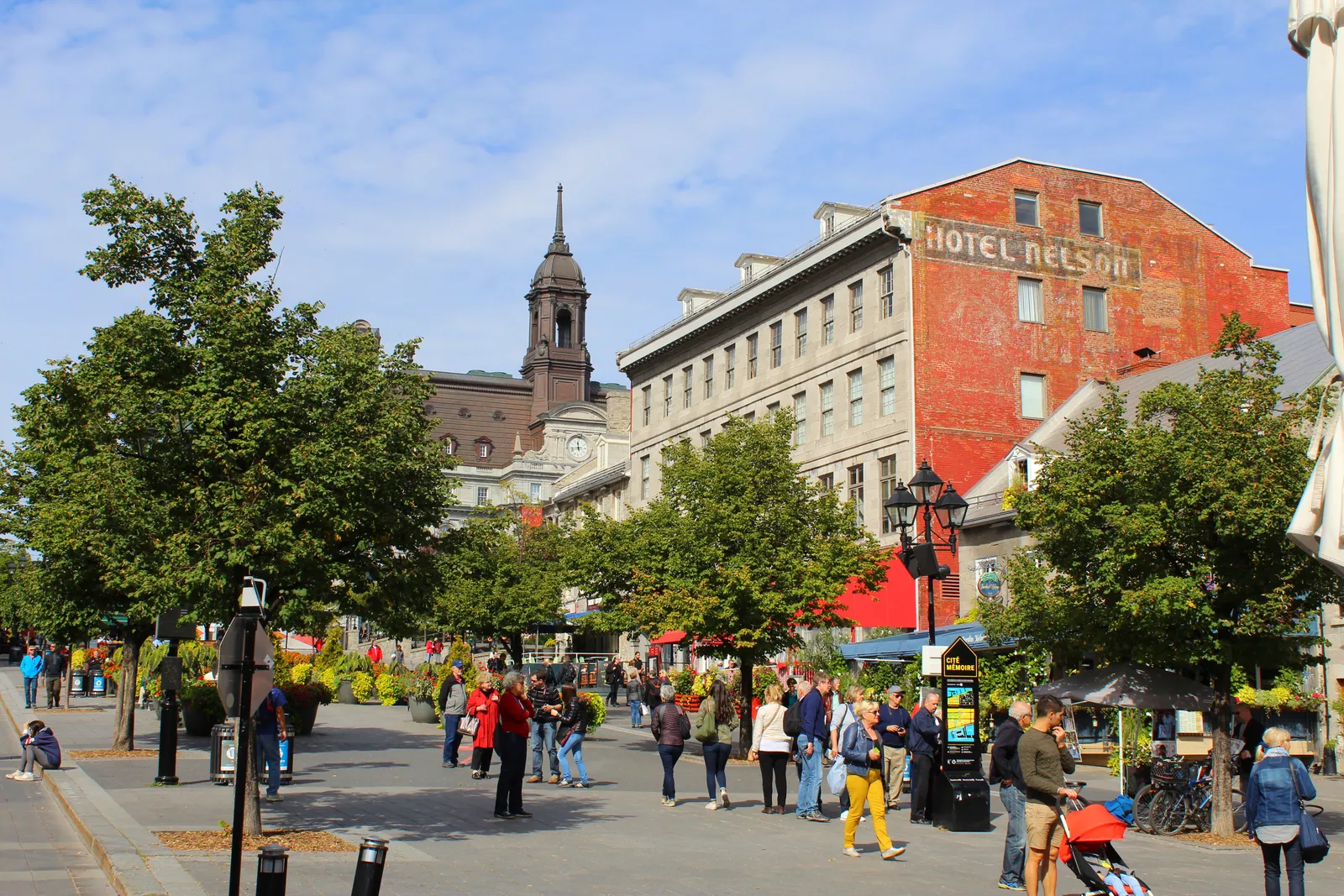
Rue Saint-Paul crosses the bottom of the square. François Dollier de Casson laid it out in 1672 when he drew the settlement’s first street grid, which makes it the oldest street in Montreal, and it was cobbled from the start; much of that kilometre still is. At number 350 the silver dome of Bonsecours Market marks a building begun in 1844 and finished in 1847, which held the city hall from 1852 to 1878 and, for one session in 1849, the Legislative Assembly of the Province of Canada. The farmers left in 1963 and the ground floor is now shops and cafés, free to wander through. Next door, the Notre-Dame-de-Bon-Secours chapel of 1771 is the oldest stone church in Montreal, and sailors who made it home hung model ships from its ceiling; walking into the nave costs nothing, while the tower climb and the museum beneath it charge.
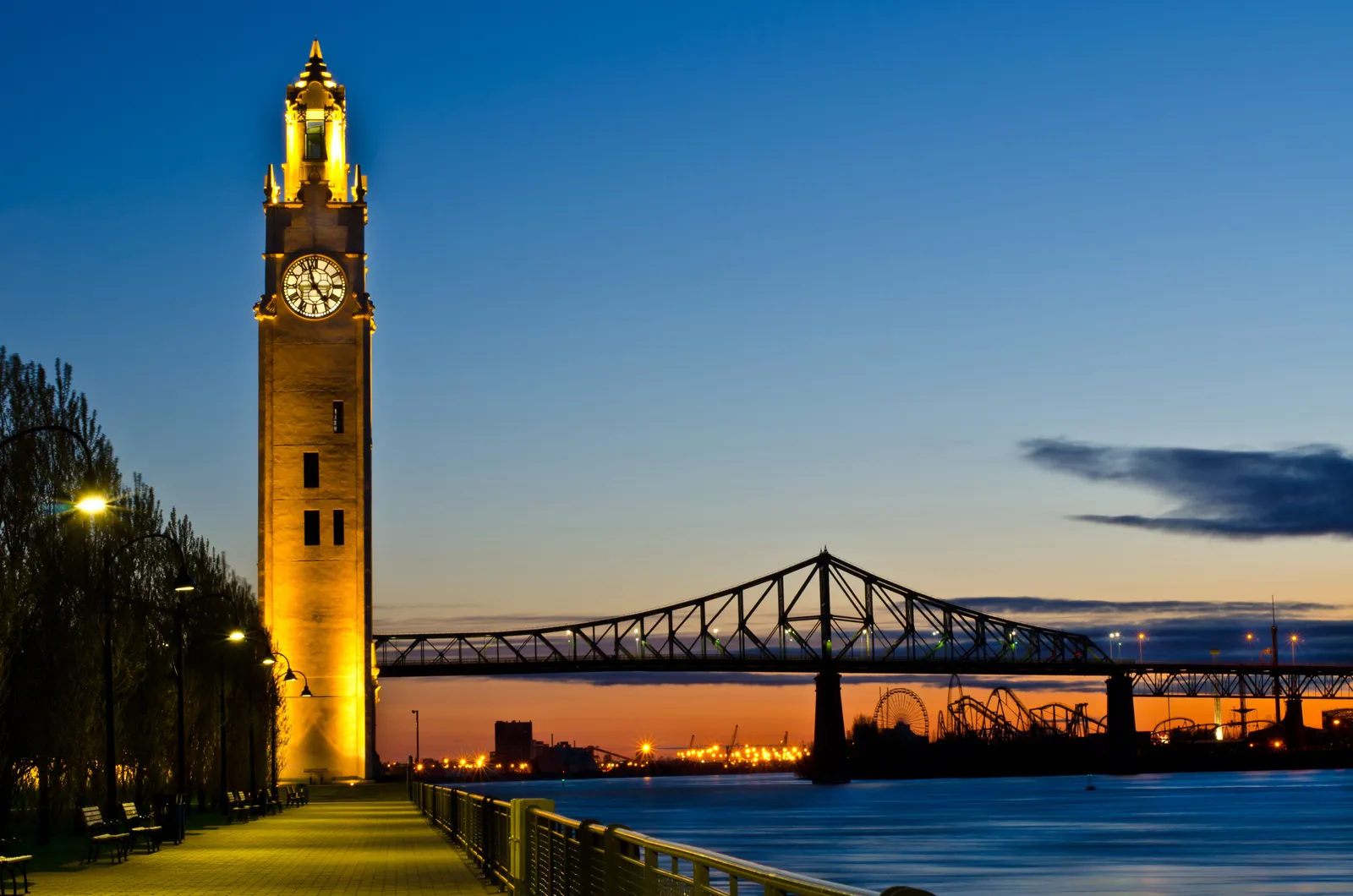
Down at the eastern end of the quays stands the clock tower, forty-five metres of it, built between 1919 and 1922 to remember the merchant seamen killed in the First World War. There are 192 steps inside with three landings to stop at, and the platform at the top looks straight across the river to the steel of the Jacques Cartier Bridge. It opens for the summer season, roughly June to September, late morning to early evening, and the climb is free within those hours; outside those months it is often shut for weather or maintenance, so check before making the walk out.
The Kondiaronk Belvedere, a semicircular terrace above downtown
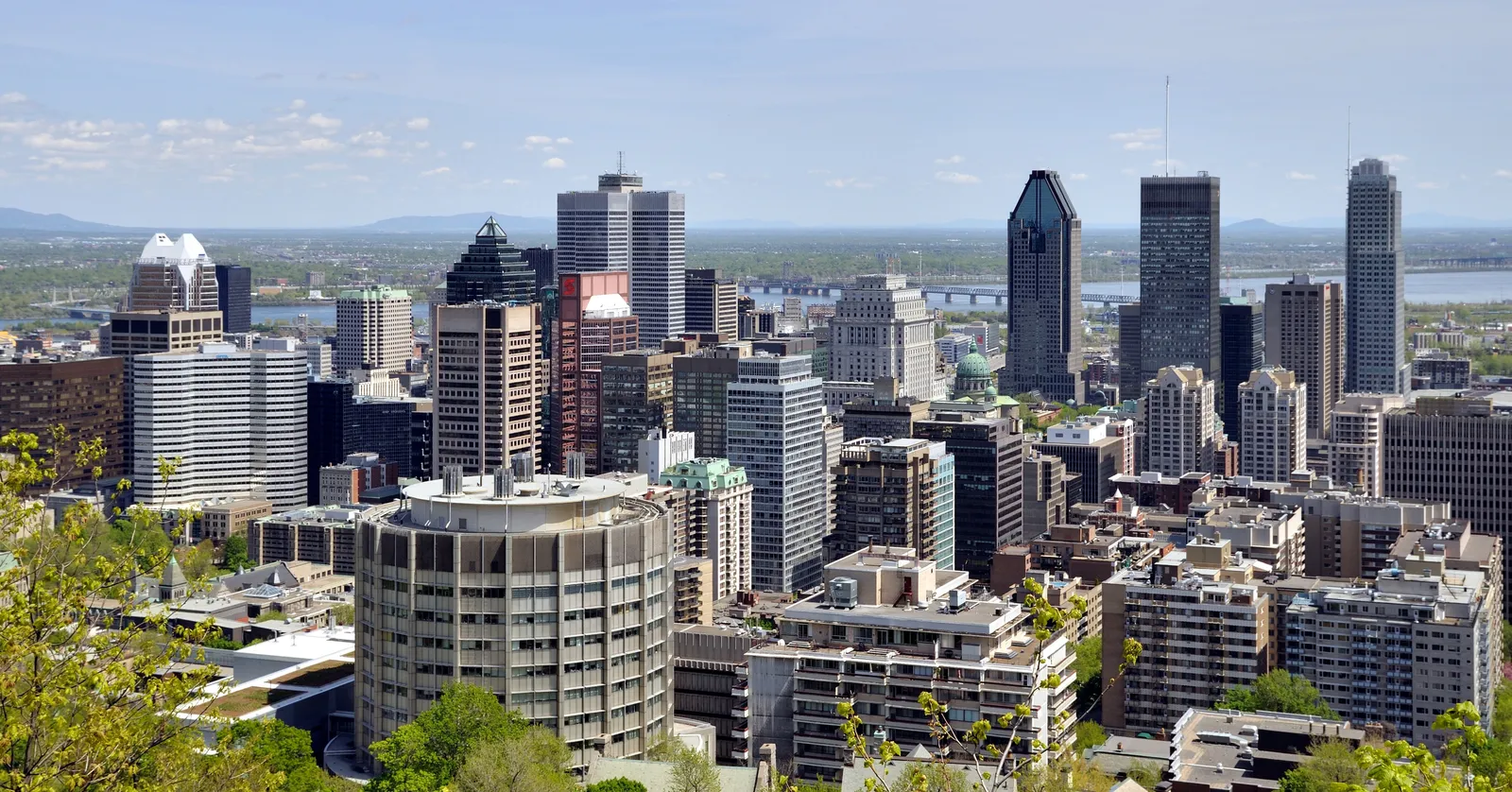
Mount Royal Park opened in 1876 to a design by Frederick Law Olmsted, who had already co-designed Central Park, though the money ran out before his plan was fully built. The terrace dates from 1906 and sits in front of the Mount Royal Chalet, which has toilets and a café inside it, and it takes its name from Kondiaronk, the Petun chief whose part in the negotiations brought about the Great Peace of Montreal in 1701. With more than four hours before a flight, this is the addition worth making.
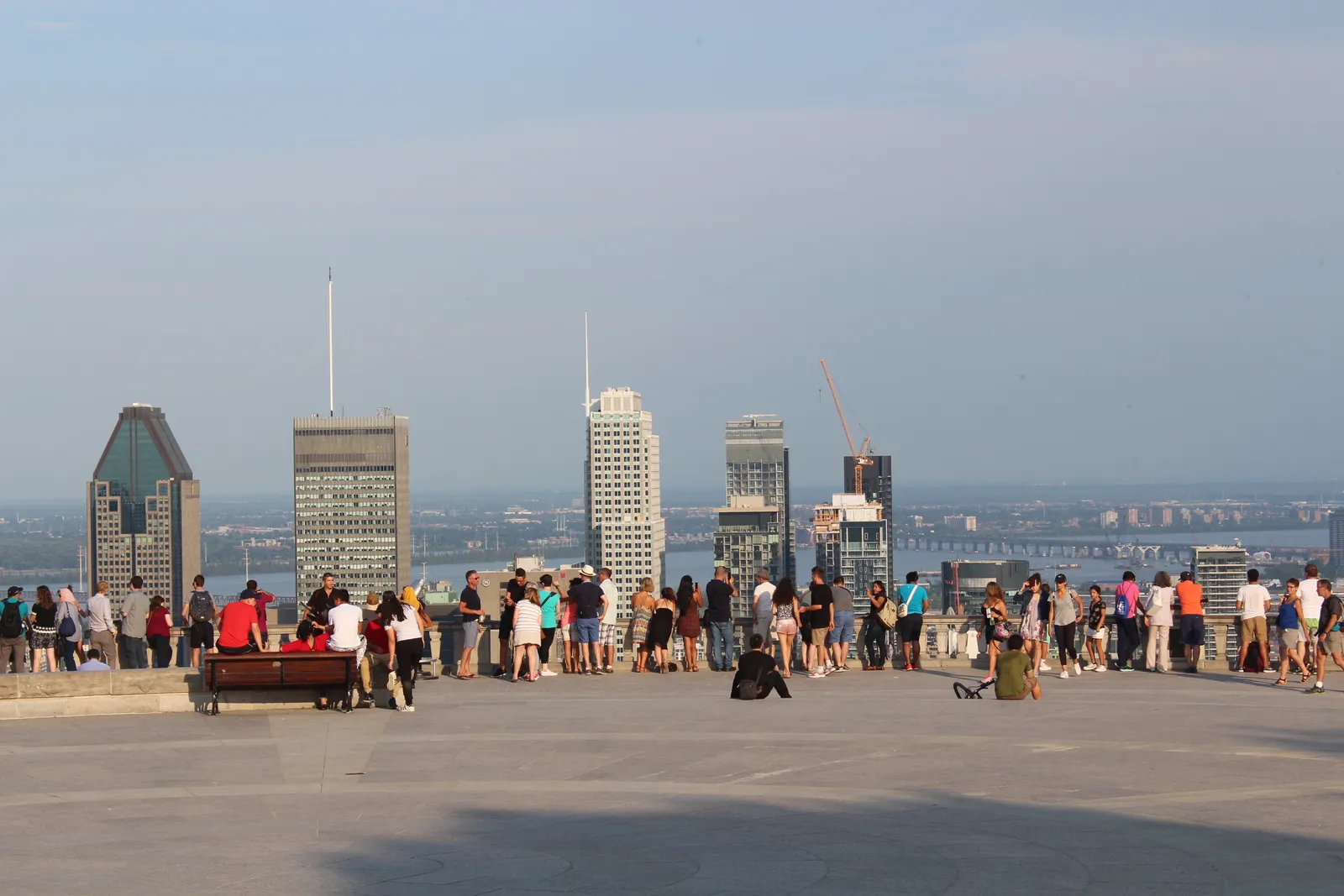
The summit behind it reaches 233 metres, and the cross on top has been lit since 1924; the present one is 31.4 metres tall, went fibre-optic in 1992, switched to LEDs in 2009, and shows white almost always, though it has turned purple on the death of a pope. None of it charges anything. A bus runs along Remembrance Road through the park and drops you about ten minutes’ walk from the terrace, which is the sensible option with a flight later; the walk up from Peel Street is a staircase for its whole length.
Dorchester Square, between Peel and Metcalfe at the bottom of that climb, is worth two minutes on the way past. The Sun Life Building on its east side was finished in stages between 1913 and 1931, and from the summer of 1940 a purpose-built vault three storeys beneath it held Britain’s negotiable securities, shipped over in the convoys of Operation Fish and guarded around the clock by the Mounted Police while they were sold off on the New York exchange to pay for the war. The five thousand people working in the offices above were never told. A rumour went round Montreal at the time that the crown jewels were down there, which conveniently explained the extra traffic through the lobby; the jewels never left Britain. Two blocks east, the tunnels under Place Ville-Marie opened in 1962 and have since grown into a network of some 33 kilometres linking ten metro stations, which is how downtown gets through February.
The airport bus fare doubles as a day pass on the whole network
Line 747 links Montréal-Trudeau International Airport (YUL) with the coach station at Berri-UQAM, runs 24 hours a day, and leaves every ten to twenty minutes in both directions. CA$11.25 covers it, and the same ticket is then valid for 24 hours on the rest of the bus and metro network, so if you buy it on arrival it also pays for the trips you make in between. Paying on board means exact change in coins; the farebox takes no notes.
That is the fare. The time is less tidy: the full run makes eleven stops and takes 45 to 70 minutes depending on traffic, while the shorter service between Lionel-Groulx metro and the airport covers the ground in about 30 to 35 minutes. Both figures are the ride only, so add the walk to the stop and the wait for the next departure on top. For an international departure, leave your last stop about three hours ahead. A taxi is a fixed CA$49.45 between downtown and the airport from 5am to 11pm, CA$56.70 between 11pm and 5am, tip not included. The light-rail branch out to the airport is still under construction and is not expected to carry passengers before the end of 2027, so the bus remains the only rail-or-road public option worth planning around. Toronto has an airport train from its central station rather than a bus, which changes the arithmetic at that end of a connection.
Leaving the suitcase at a storage point near Berri-UQAM or Place-d’Armes is what makes the day work as written: the basilica, the market hall and the wheel are all within a walk of each other, and none of them wants a wheeled bag coming through the door.
Frequently asked questions
What should I do during a layover in Montreal?
Stay inside the old quarter and the whole thing is walkable. Notre-Dame Basilica is the one stop that really needs a ticket, at CA$16 for an adult, and the blue and gold vaults inside are the reason to buy it. Place Jacques-Cartier, rue Saint-Paul and the ground floor of Bonsecours Market cost nothing, and the observation wheel on the Old Port quays is the paid extra worth booking ahead if the sky is clear. With more than four hours, the lookout terrace on Mount Royal is the addition; on a tighter stop it is the first thing to cut.
How much does it cost to go into Notre-Dame Basilica in Montreal?
Sightseeing admission is CA$16 for adults, CA$15 at 65 and over, CA$14 for students aged 17 to 22 and CA$10 for children from 6 to 16, with under-sixes free. Coming for mass, confession or quiet prayer costs nothing. Visiting hours run 9am to 4.30pm Monday to Friday, 9am to 4pm on Saturday and 12.30pm to 4pm on Sunday, which is the shortest day of the week and the one most likely to catch people out. AURA, the thirty-minute sound and light projection across the interior, runs in the evenings; from 5pm the on-site desk stops selling and tickets are online or by phone only.
What can you see in Montreal without paying for it?
Most of the old quarter. Place Jacques-Cartier, rue Saint-Paul, the ground floor of Bonsecours Market and the nave of the Notre-Dame-de-Bon-Secours chapel, with its model ships hung from the ceiling, are all free to walk into, and so is the climb up the Old Port clock tower during its summer season. Mount Royal park and the lookout terrace on it never charge. The Montreal Museum of Fine Arts is free for everyone aged 25 and under, and free for a parent with children on Saturday mornings from 10am to 1pm.
Is the bus or a taxi better for getting back to Trudeau?
The bus, unless there are three of you. Line 747 runs between downtown and Montréal-Trudeau International Airport (YUL) around the clock, every ten to twenty minutes, and the CA$11.25 fare is also a 24-hour pass on the rest of the bus and metro network, so it pays for the trips you make before it. A taxi between downtown and the airport is a fixed CA$49.45 from 5am to 11pm and CA$56.70 overnight, tip on top, which only makes sense split several ways or with a lot of luggage. The light-rail branch to the airport station is still being built and is not expected to carry passengers until the end of 2027.