Ho Chi Minh City in One Day: Old Saigon
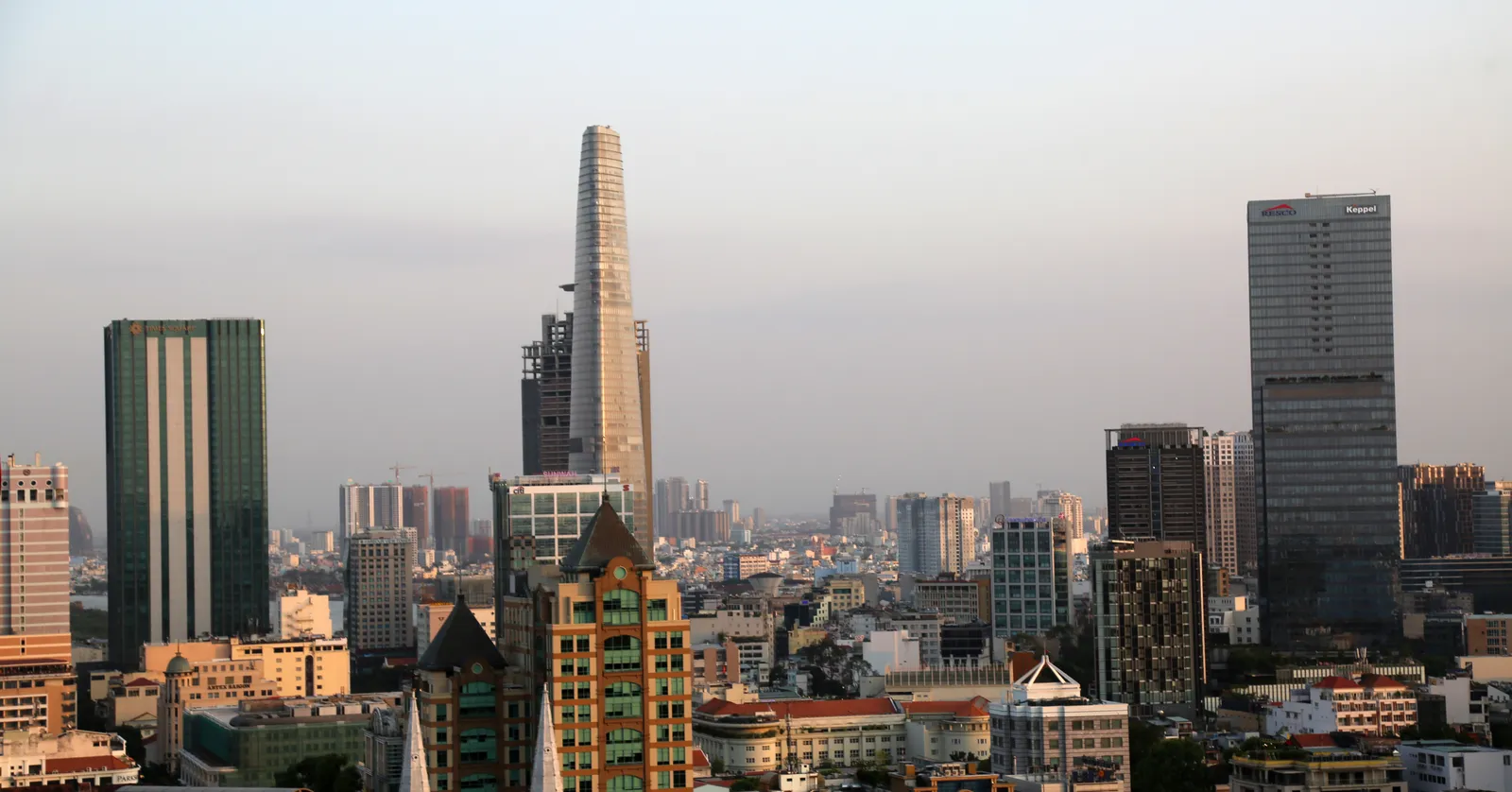
Central Ho Chi Minh City packs Independence Palace, the War Remnants Museum, the 1891 central post office and Ben Thanh Market’s clock tower into about a kilometre and a half of flat streets, close enough to walk end to end.
Independence Palace still has its basement war rooms
Independence Palace stands behind its own lawn at 135 Nam Ky Khoi Nghia, at the head of the boulevard Le Duan, a fifteen-minute walk northeast of Ben Thanh Market. Ngo Viet Thu finished it in October 1966 for South Vietnam’s president, and the building has been kept rather than restyled: the banquet hall, the cabinet room and the president’s office are all furnished as they were. Stairs at the back lead down to the basement war rooms, where the radio sets, telex machines and wall maps are still in place behind steel doors.
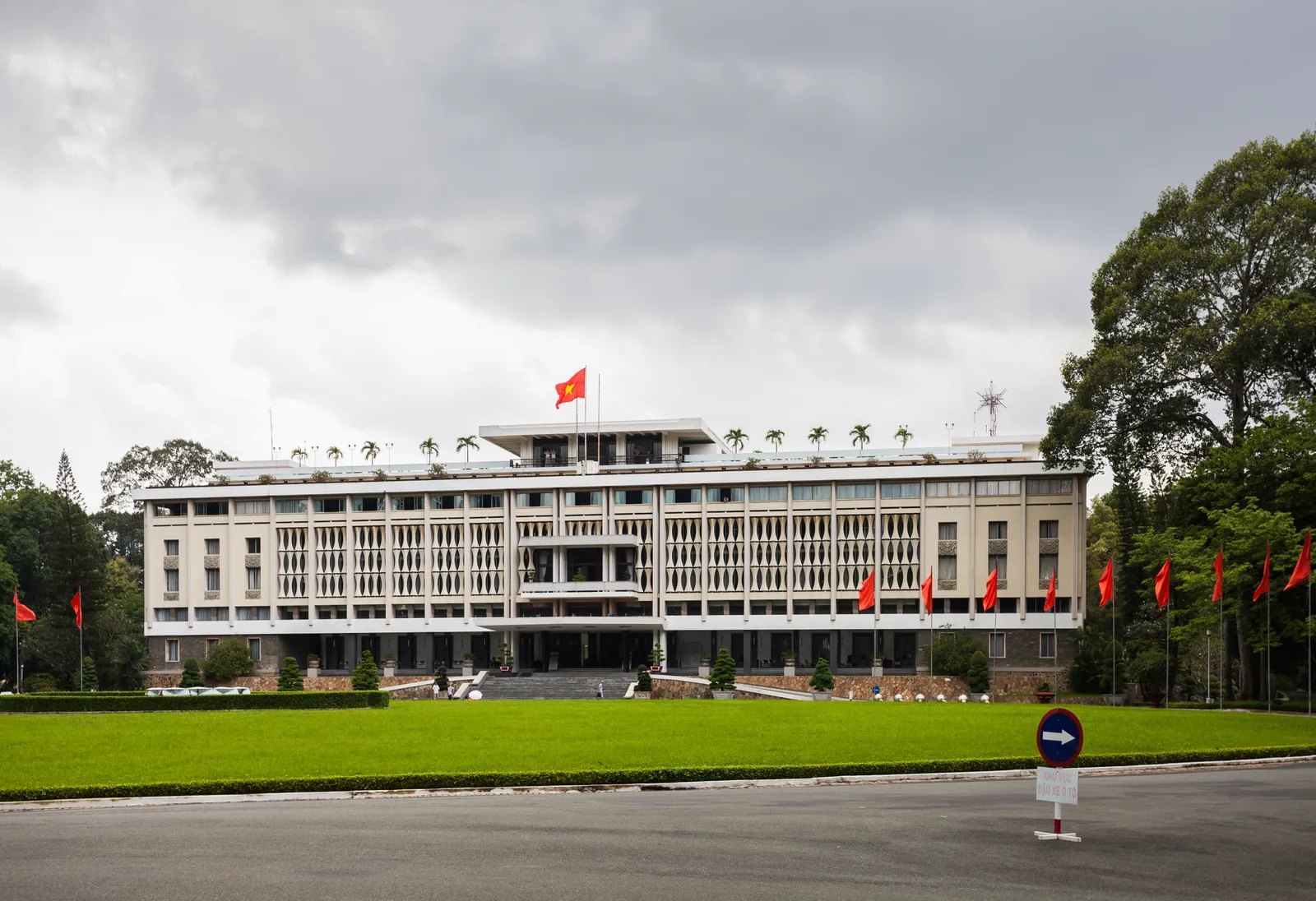
A T-54 tank sits on the grass inside the gate, for the morning of 30 April 1975 when one came through the railings at 10:45 and the war ended there. The palace opens 7am to 6pm daily; 40,000 dong covers the building itself and 80,000 adds the exhibition hall in the grounds, or you can buy entry tickets in advance through a tours and activities platform and walk past the queue at the gate.
Captured aircraft sit in the War Remnants Museum’s forecourt
The War Remnants Museum is at 28 Vo Van Tan, on the corner of Le Quy Don, and the hardware is in the open before you reach the ticket desk: a UH-1 Huey, an A-1 Skyraider, an F-5A fighter, an M48 Patton tank and a Daisy Cutter bomb, parked on the forecourt where anyone walking past can see them.
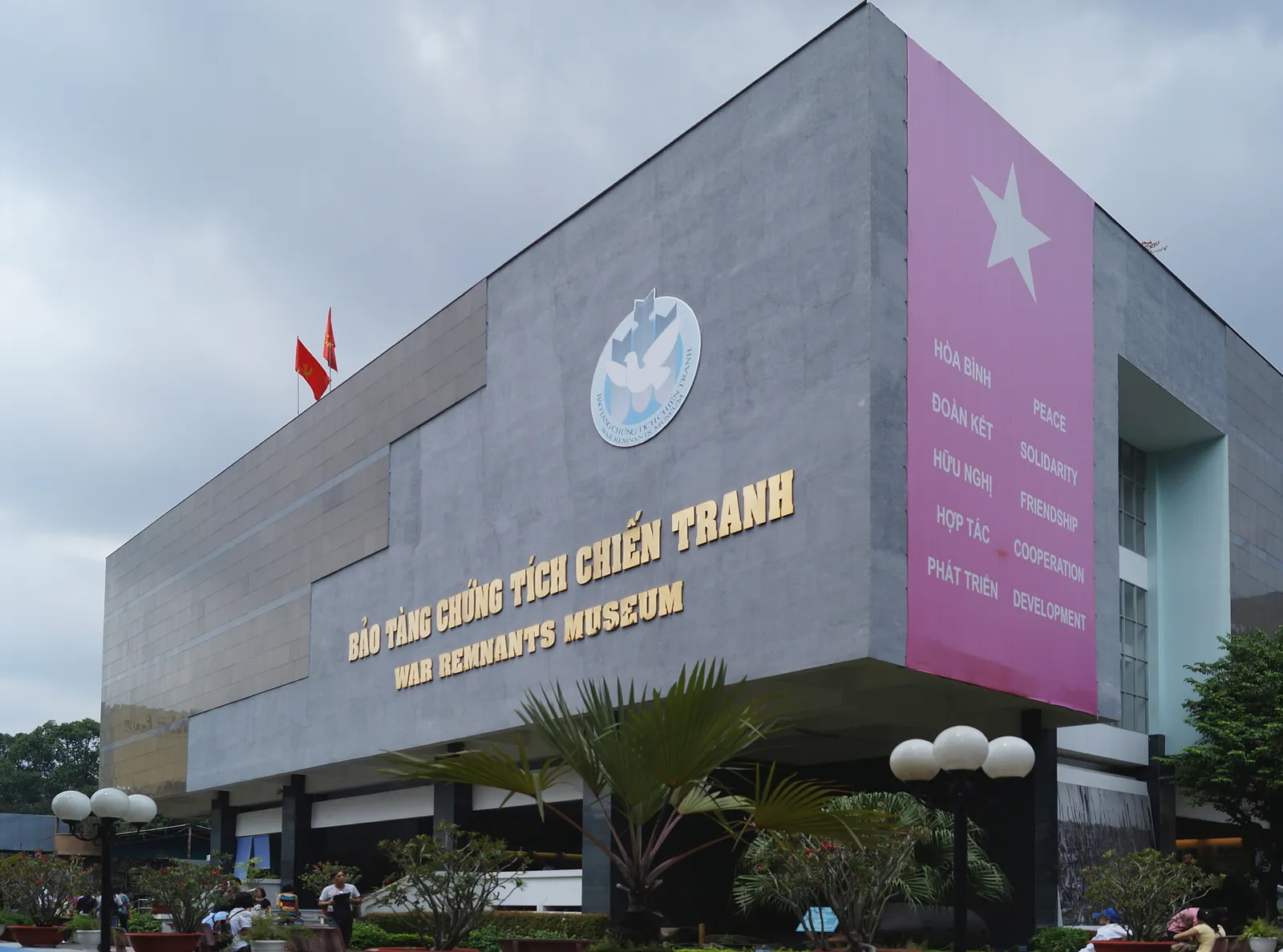
Inside, three floors work through the war from the Vietnamese side, including a room of press photography by correspondents killed covering it and a hall on the effects of Agent Orange that most people find the hardest part of the visit. A separate structure in one corner reproduces the tiger cages used to hold political prisoners on Con Dao. It opens daily from 7:30am, with the last admission at 5pm. Admission had been 40,000 dong for adults for several years, but the museum replaced its fee schedule on 1 October 2026, so take the rate from the window rather than from an older guide; tickets are also sold online through a tours and activities platform. Two hours is the usual visit and ninety minutes is enough.
Gustave Eiffel did not design Saigon’s central post office
The post office on Cong Xa Paris went up between 1886 and 1891 to a design by Alfred Foulhoux, then the colony’s chief architect, working alongside Auguste Henri Vildieu; an architectural journal of 1891 credits Foulhoux by name. Eiffel’s name attached itself later, helped along by the iron ribs of the roof, and it still turns up in tour scripts and guidebooks.
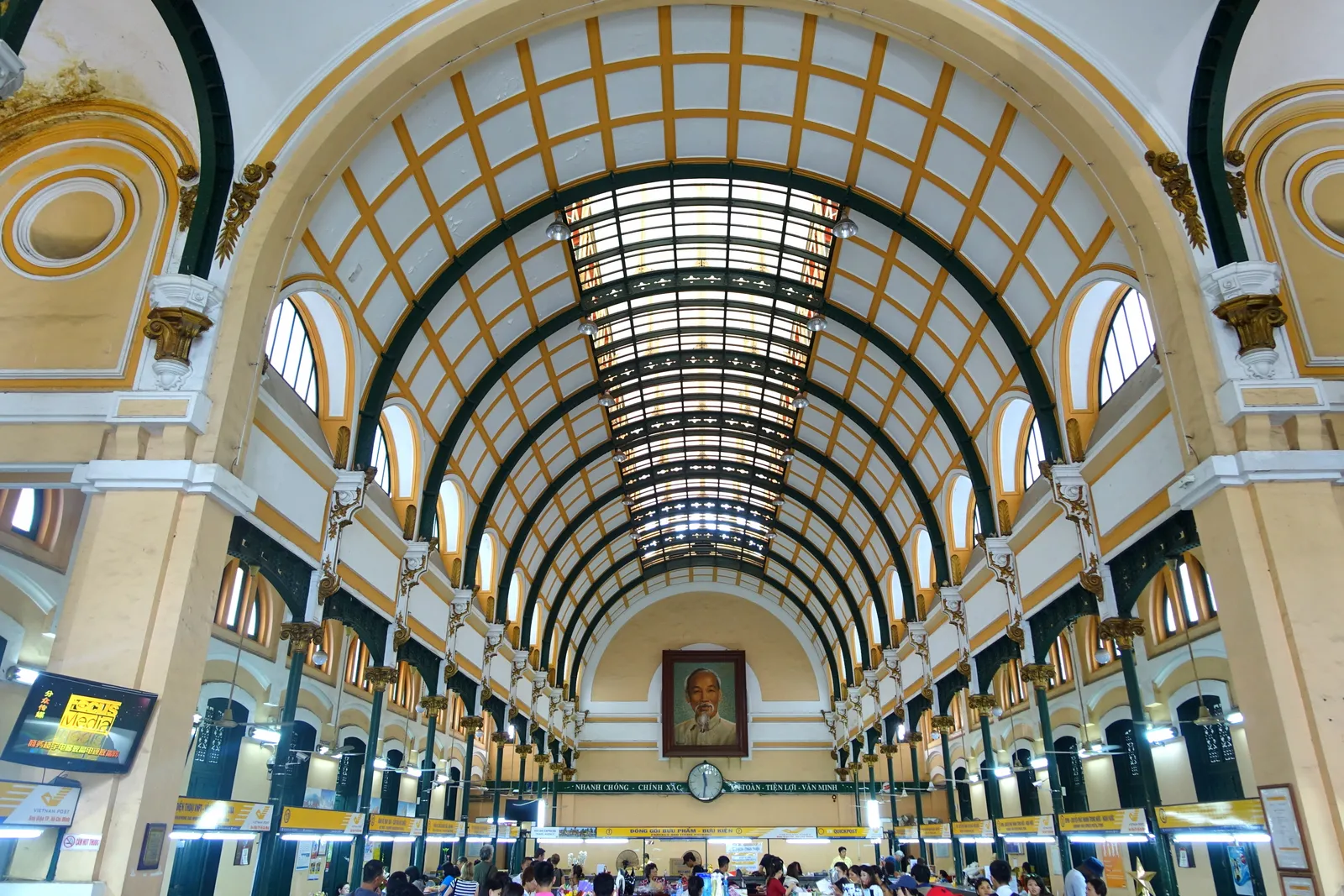
The room settles the argument better than the attribution does: one long hall under a glazed barrel vault carried on green painted arches, counters down both sides, wooden phone booths against the wall and a portrait of Ho Chi Minh at the far end. Two painted maps from 1892 survive on the side walls, one of Saigon and its surroundings, the other of the telegraph lines then running through southern Vietnam and Cambodia. It is free, it is still a working post office selling stamps to people posting actual letters, and it opens at seven in the morning and runs to early evening. Across the square, Saigon Notre-Dame has been under restoration since 2017 with its interior shut to sightseers; that work is currently scheduled to finish in 2027, and until it does the forecourt and the twin brick towers are what there is to see.
Ben Thanh Market’s clock tower has stood since 1914
The hall inside Ben Thanh is split into lanes by trade: bolts of fabric in one, dried fish and coffee in another, lacquerware and souvenirs nearest the tourist gate, and a food aisle of counter stools where the bun bo and banh xeo go out fast at lunch. The market was inaugurated on 28 March 1914, and the clock over its south gate has been on the city’s postcards ever since. Haggling is expected in the souvenir lanes and not in the food aisle.
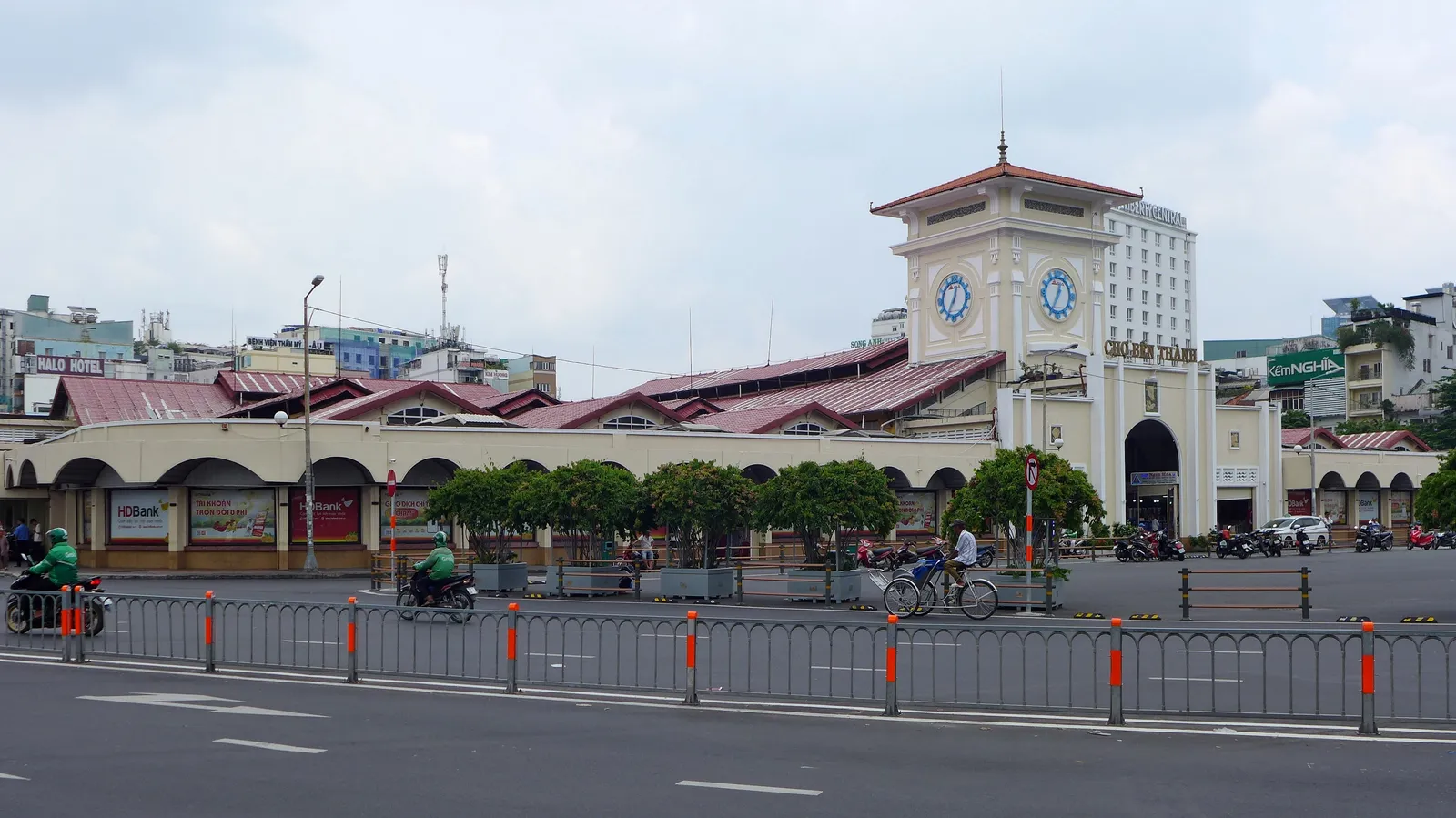
The day market runs from about half past seven to six in the evening; once it shuts, stalls set up outside along Phan Boi Chau and Phan Chu Trinh and trade on into the night. Pavements around the market and along Le Loi are parked solid with motorbikes, so a wheeled suitcase spends most of that walk out in the road with the traffic.
Nguyen Hue’s central strip has been a promenade since 2015
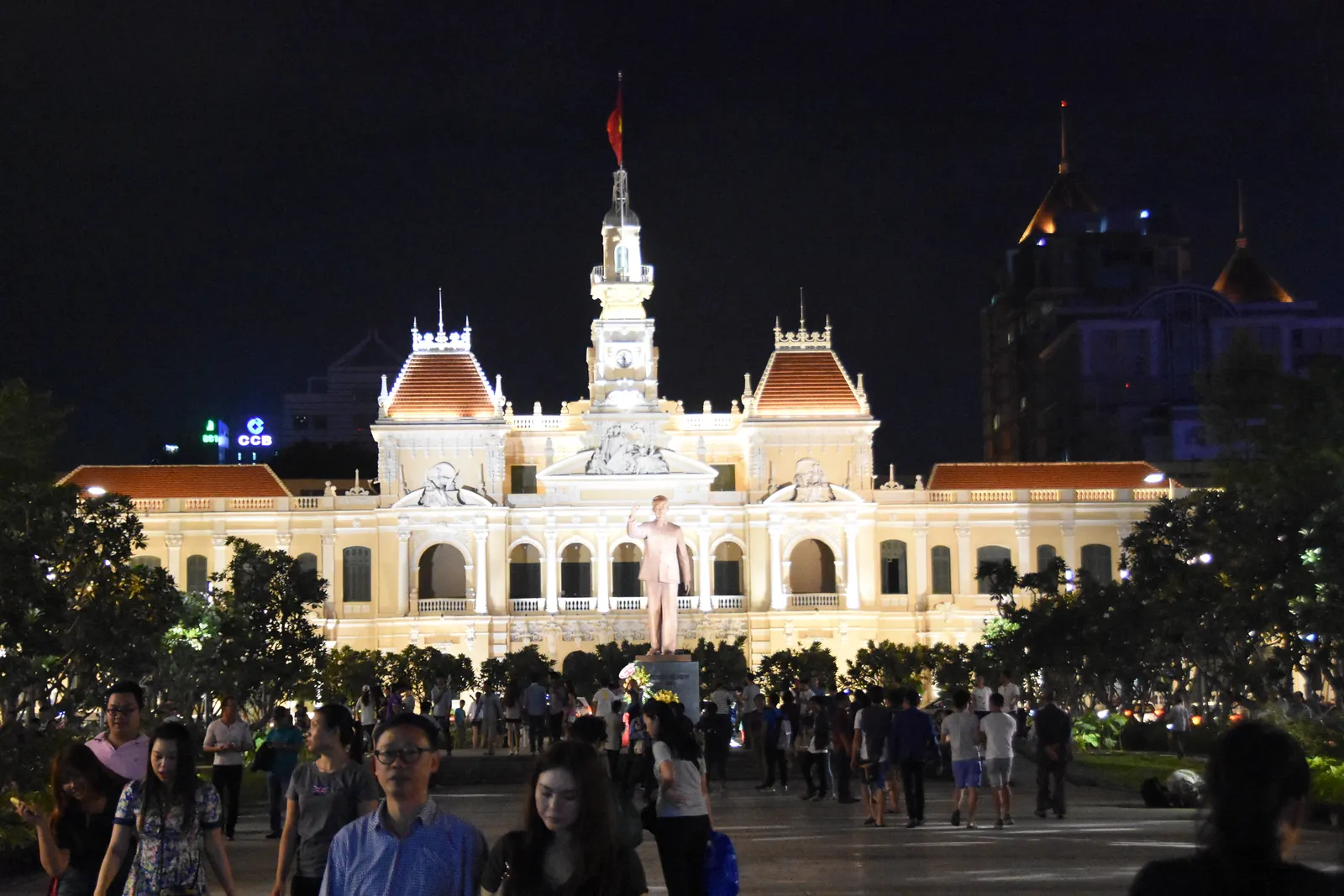
Nguyen Hue was a canal, then a boulevard; its middle 670 metres are now paved flat with the traffic lanes pushed out to either side, running from the steps of the People’s Committee building down to the Saigon River. That building, finished in 1909, is the one everyone photographs: a cream French colonial frontage with a central clock tower, floodlit after dark, and still a working government office, so the view is from the promenade rather than the lobby.
Halfway down at number 42 is a nine-storey apartment block from the 1960s whose flats have been taken over almost entirely by cafes, bars and small shops, one or two per floor, each with its own sign hung off the balcony. There is a small charge for the lift and a free staircase up the outside, and the upper floors look straight back down the promenade.
Thien Hau Temple has burned incense in Cho Lon since 1760
With closer to seven hours than five, Cho Lon is worth the fifteen minutes west of the centre by road. Thien Hau Temple at 710 Nguyen Trai was put up by Cantonese migrants and dedicated to the sea goddess who protected the crossing that brought them; it has been a national monument since 1993. The roof ridge is crowded with small glazed ceramic figures of opera scenes and processions, close enough to pick out from the courtyard.
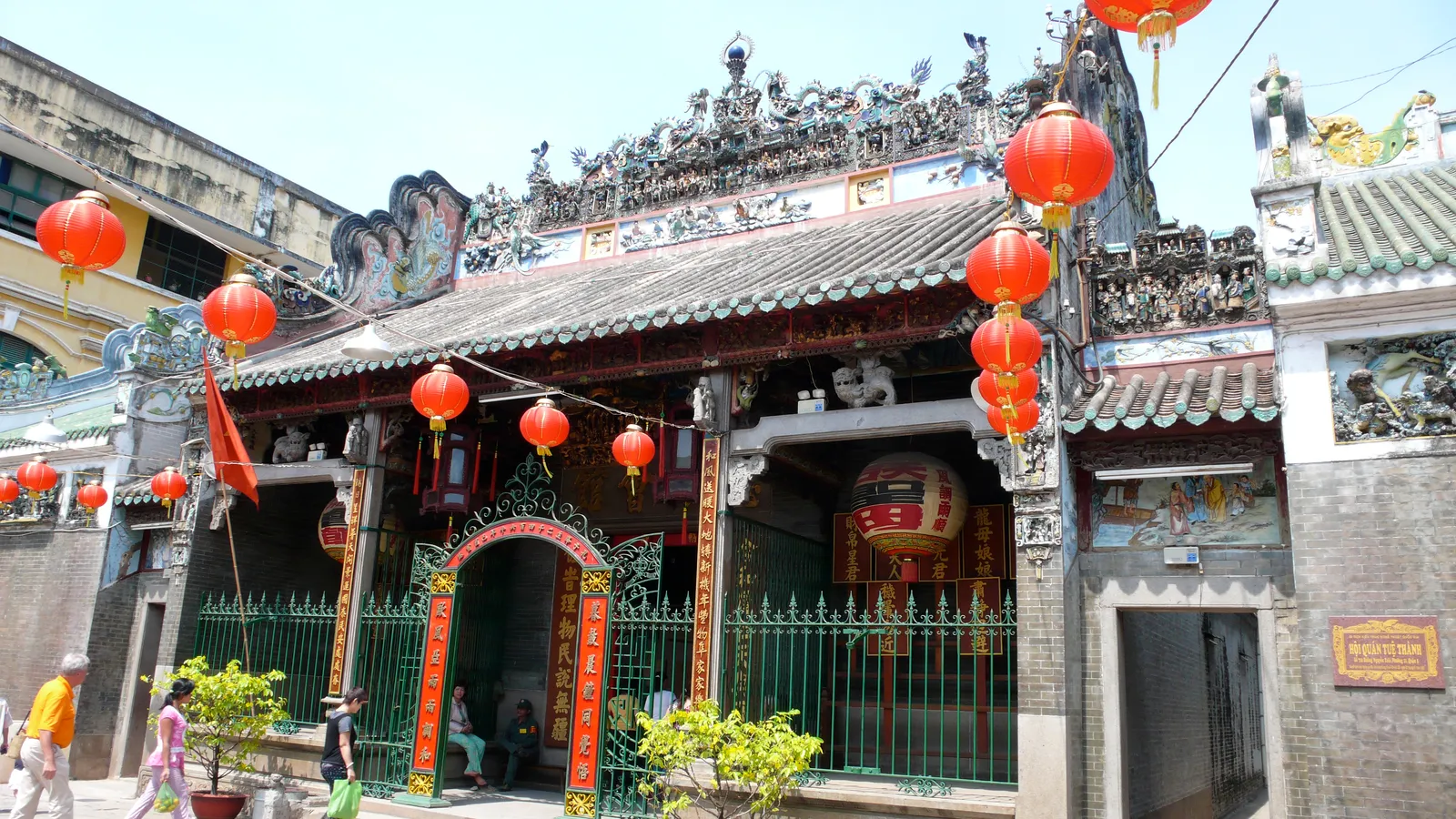
Inside, spiral coils of incense hang from frames above the open central court and burn for hours, which is why the light in there is always slightly grey. Binh Tay Market, the wholesale hall the district is built around, is another kilometre southwest if there is time for both.
No rail line reaches Tan Son Nhat, just city buses
The airport sits about eight kilometres northwest of the centre, and the metro’s one operating line, Ben Thanh to Suoi Tien, runs the other way entirely, out to the east. Bus 152 is the useful one because it stops directly outside Terminal 2, the international building: 5,000 dong a ride and another 5,000 for a large bag, roughly every 12 to 20 minutes from about 5am to 10pm, picking up near Ben Thanh Market. Bus 109 runs to Terminal 3, the domestic building that opened in 2025, and a free shuttle loops between all three terminals about every 20 minutes if you end up at the wrong one. A taxi or ride-hailing car does the trip in 25 to 45 minutes; the spread is entirely traffic, and between four and seven on a weekday evening it is the high end of that.
One thing worth checking on the ticket before you budget any of this: from 1 December 2026, long-haul international departures from the city move to Long Thanh, a new airport about 40 kilometres east in Dong Nai province, which is a much longer journey than the eight kilometres to Tan Son Nhat.
Leave central Saigon about three hours before an international departure and none of the above is tight. Collect the bag on the way out rather than doubling back for it: the storage points sit around Ben Thanh and Pham Ngu Lao, which is where the airport buses leave from anyway.
Frequently asked questions
What should I do during a layover in Ho Chi Minh City?
Four things sit inside a kilometre and a half of each other in central Saigon: Independence Palace, kept as it was in 1966 down to the basement war rooms; the War Remnants Museum, with captured aircraft and tanks parked in its forecourt; the 1891 central post office under its glazed barrel vault; and Ben Thanh Market behind its 1914 clock tower. Five hours covers the two ticketed interiors and a walk between them; seven leaves room for the Nguyen Hue promenade and Cho Lon out west. Book the palace and the museum ahead if you are arriving near the middle of the day, when the tour groups land. The post office, the market hall and the promenade cost nothing, so a short visit can skip both ticket desks without losing the shape of the day.
Is Saigon Notre-Dame Cathedral open to visitors?
Not inside. The cathedral on Cong Xa Paris has been under restoration since 2017, the interior is closed to general sightseeing, and the work is currently scheduled to finish in 2027. Mass is still said for parishioners through a side entrance at set times. The forecourt and the two brick towers are free to stand in front of at any hour, and the central post office directly across the square is open and unaffected, so the square is still worth the ten minutes even while the scaffolding is up.
Is the bus or a taxi better from Tan Son Nhat airport?
The bus, if your flight leaves from the international terminal and you are not tight on time. Route 152 stops directly outside Terminal 2 and costs 5,000 dong, plus another 5,000 for a large bag, running roughly every 12 to 20 minutes between about 5am and 10pm. Route 109 serves Terminal 3, the domestic building, and a free shuttle loops between all three terminals about every 20 minutes. A taxi or ride-hailing car covers the same eight kilometres in 25 to 45 minutes depending on traffic, which is the better call after 4pm on a weekday. Vietnam has no airport rail link at either end of the country: Hanoi runs on express buses from Noi Bai for the same reason.
Is a Ho Chi Minh City layover worth it in the rainy season?
Yes, as long as you plan around the afternoon. The rains run from May to November, and they usually arrive as one heavy downpour in the afternoon or early evening rather than all-day drizzle, with September the wettest month. Independence Palace, the War Remnants Museum, the post office hall and the market hall are all under a roof, so the ticketed stops are unaffected. What suffers is the Nguyen Hue promenade and the walk between sights, both of which are fully exposed. Saving the two museums for the afternoon and doing the open-air stretches in the morning covers most of it.