Binh Tay Market Layover: Cho Lon, Saigon
Part of the full Ho Chi Minh City in One Day: Old Saigon
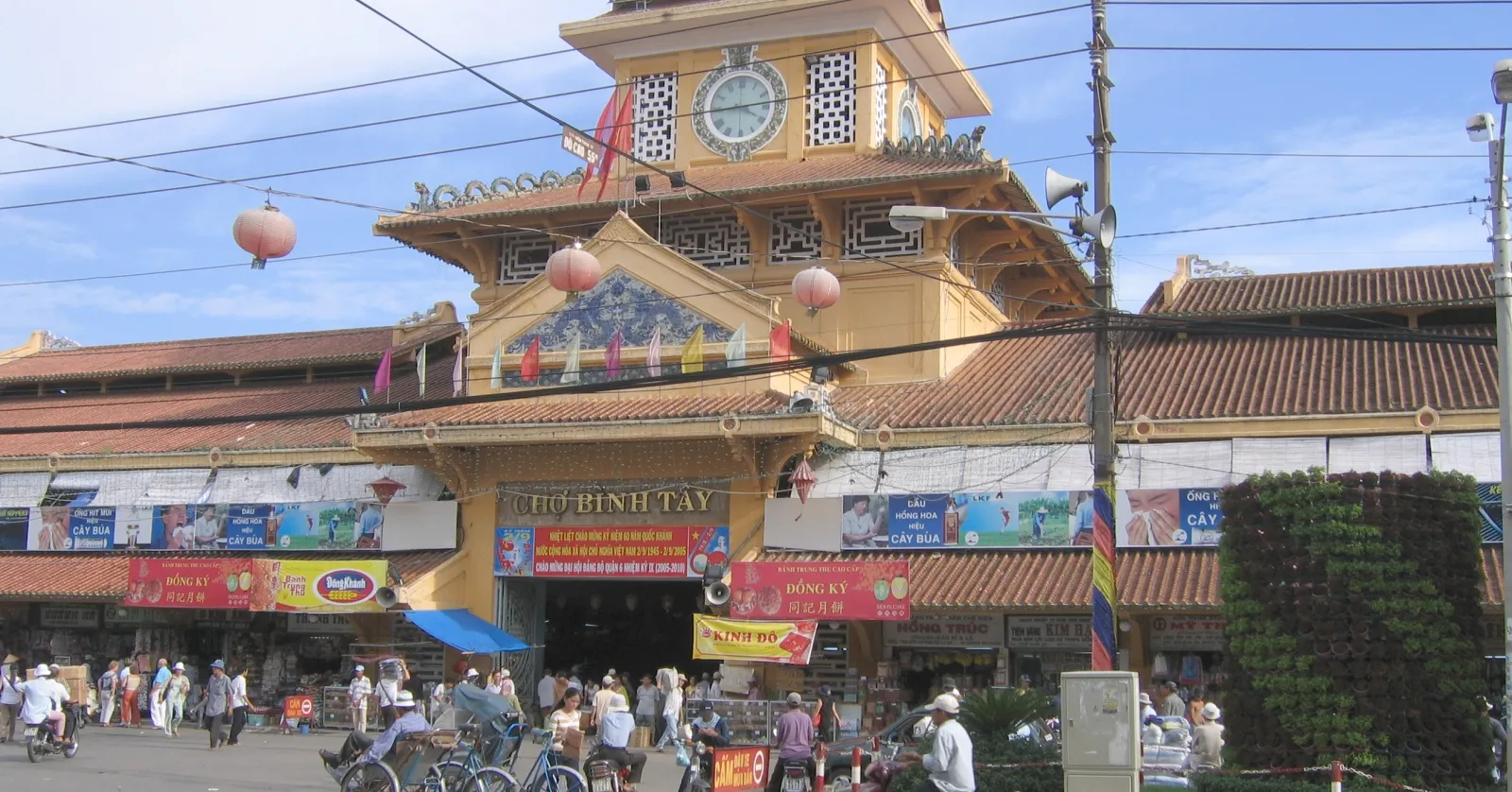
Binh Tay Market trades wholesale around a covered courtyard at the heart of Cho Lon, five kilometres west of central Ho Chi Minh City, within a kilometre and a half of two 19th-century Chinese assembly halls and the church where Ngo Dinh Diem was arrested.
Binh Tay Market trades by the box, not by the item
The market fills a block 89 metres by 109 at 57A Thap Muoi, built from 1928 and opened in 1930 with money from a Chaozhou merchant known here as Quach Dam. His life-size bronze statue stood in the middle of the courtyard, ringed by four bronze lions and four dragons spouting water, until it was taken out and replaced with a glass altar some time in the late 1970s; the statue is now in the city’s Fine Arts Museum.
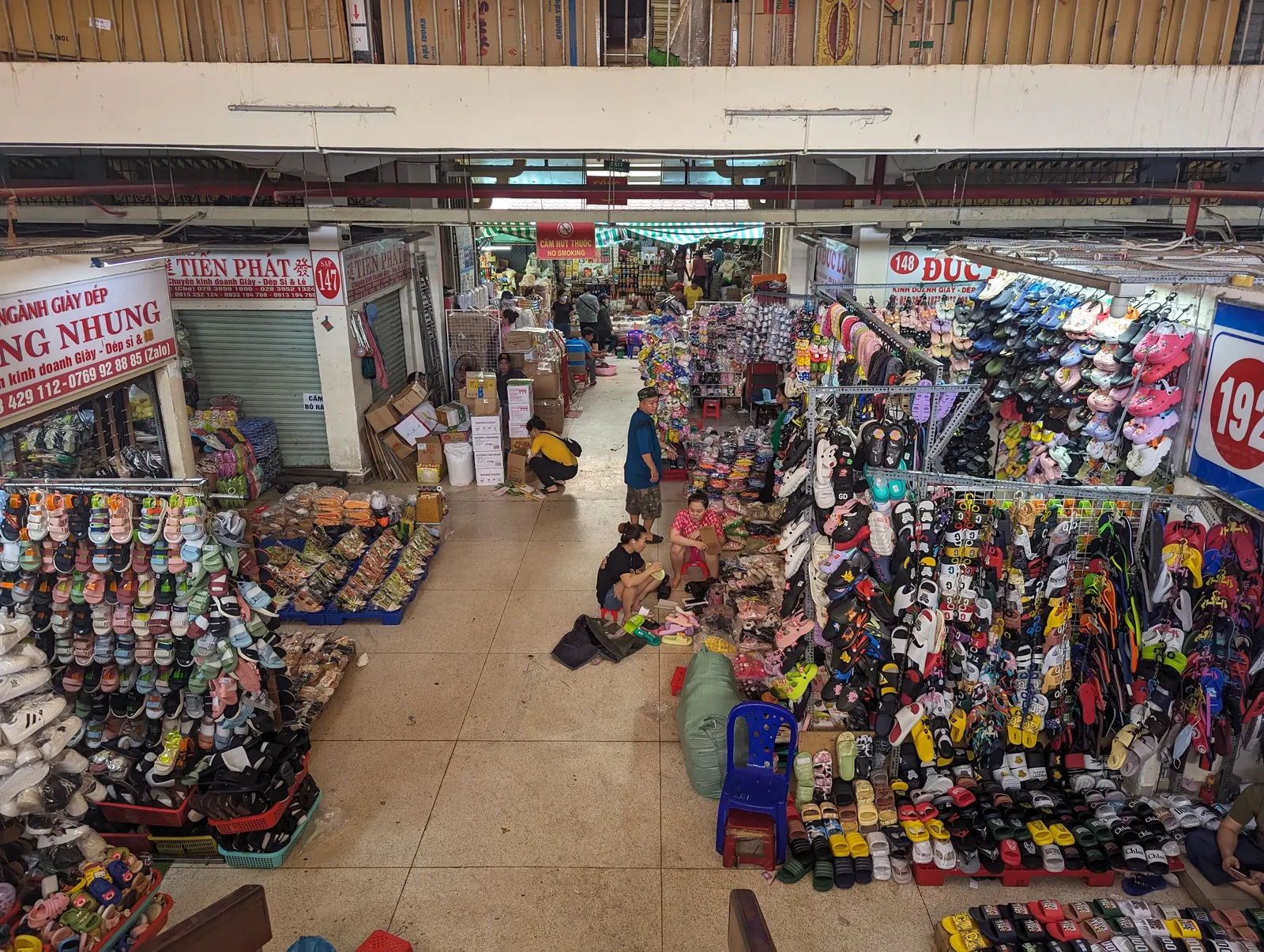
What trades here is bulk: shoes, fabric, dried goods, packaging, kitchenware, confectionery, stacked floor to ceiling and priced for shopkeepers rather than visitors. Doors open early and the trading thins out by about six. The district around it is also covered by a half-day guided walk bookable through a tours and activities platform, which saves working out the street grid from scratch. The aisles themselves are sized for the handcarts that move stock through them, about a metre across in the tighter runs, so a wheeled suitcase has nowhere to go when a cart comes the other way.
A plaque in Cha Tam Church marks where Diem was arrested
Saint Francis Xavier’s parish church at 25 Hoc Lac was begun on 3 December 1900 and dedicated in January 1902, and it is the reason this corner of Cho Lon turns up in every account of the end of South Vietnam’s first republic. Ngo Dinh Diem and his brother Ngo Dinh Nhu fled the presidential palace on 1 November 1963, spent the night here, and surrendered the following morning; an armoured carrier was sent for them and they were shot inside it before it reached the centre. A small plaque inside marks the pew.
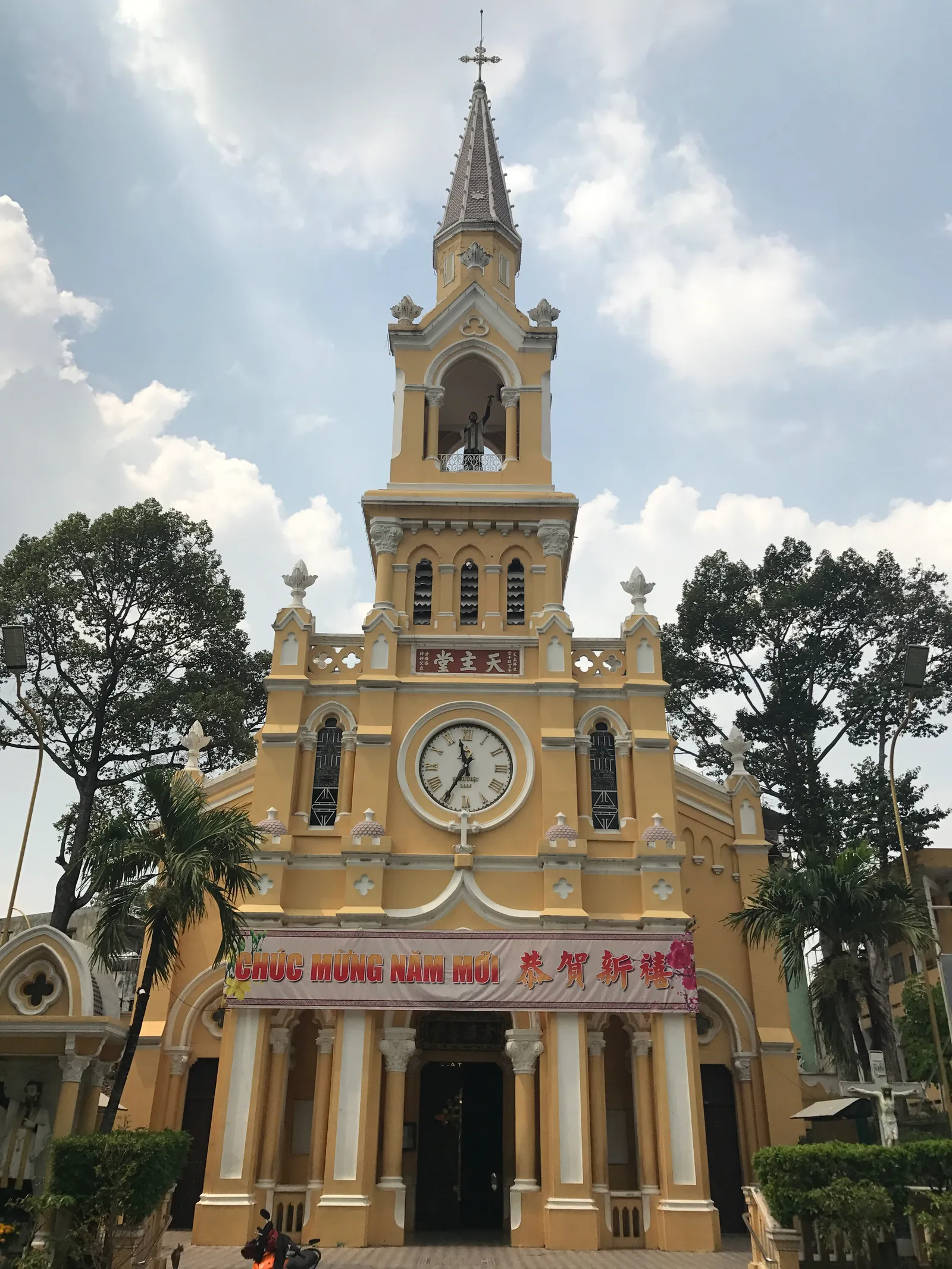
The building itself is worth the ten minutes regardless: a yellow Gothic parish church with a clock in its gable, Chinese characters on a red panel over the door, and a Chinese-roofed pavilion standing in the forecourt. It is an active parish, so the doors close during mass, and nothing is charged at any time.
Nghia An Assembly Hall keeps a life-size red horse for Guan Yu
The Teochew guildhall on Nguyen Trai goes back to 1819 and has been rebuilt or repaired five times since, most recently in 2014, which is why the woodwork looks sharper than its age suggests. It is dedicated to Guan Yu, worshipped here as a god of trade as much as of war, and the carved horse standing life-size inside the entrance is his: a red mount with an attendant at its head, which people touch on the way past.
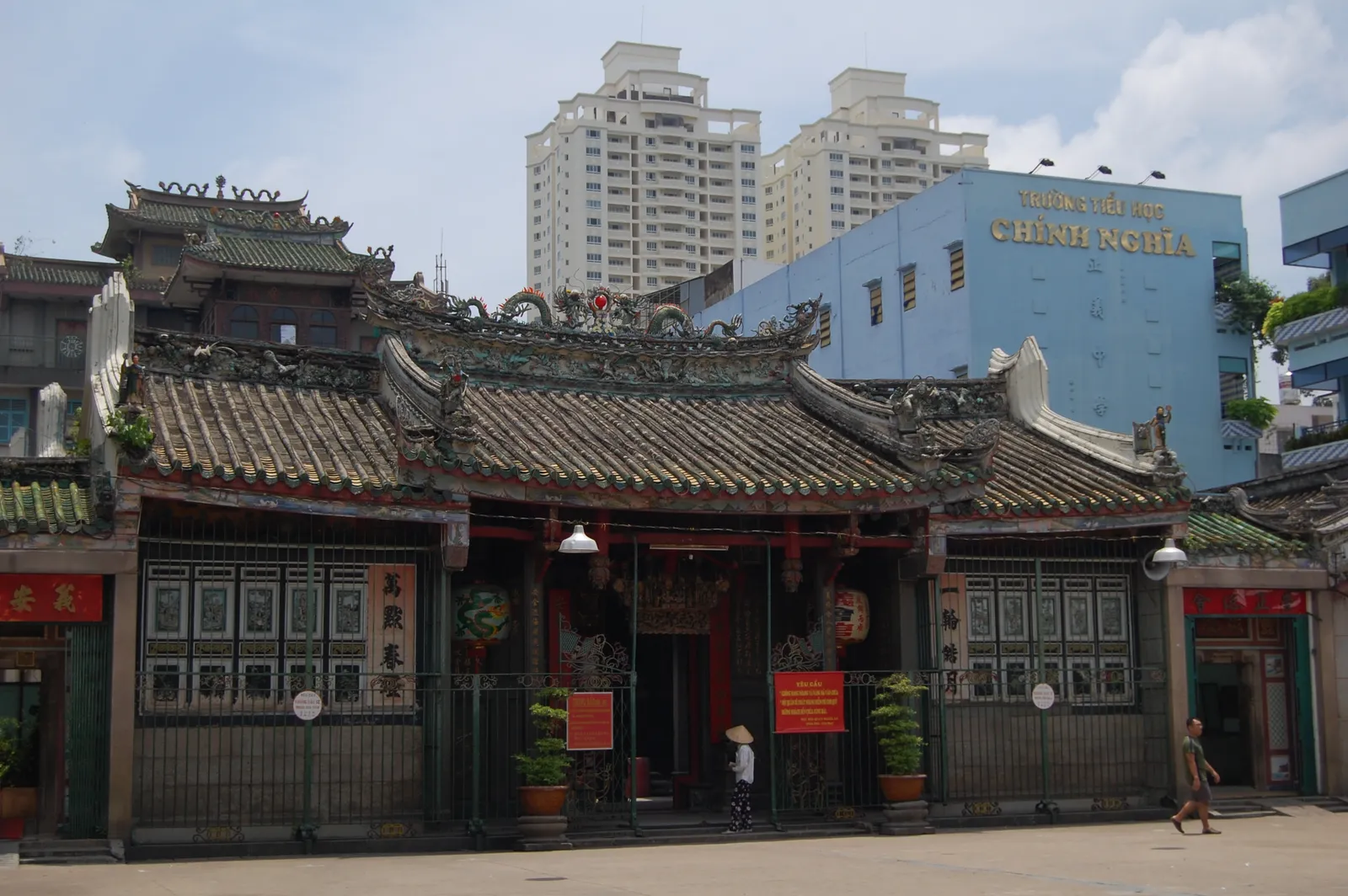
Outside, the roof is green-tiled, which marks it as Guan Yu’s, and the ridge carries two ceramic dragons contending over a pearl. Thien Hau, the temple most visitors to Cho Lon get sent to, stands a few hundred metres along the same street, and the main Ho Chi Minh City guide covers that one.
On Lang’s roof ridge is crowded with porcelain figures
On Lang is the Fujianese assembly hall on Lao Tu, a few streets north of Nguyen Trai, and the work is all overhead: rows of small glazed figures, opera characters and processions and animals, packed along the ridge and out onto the eaves. They read better from the far pavement than from the gate, because at the gate you are standing underneath them.
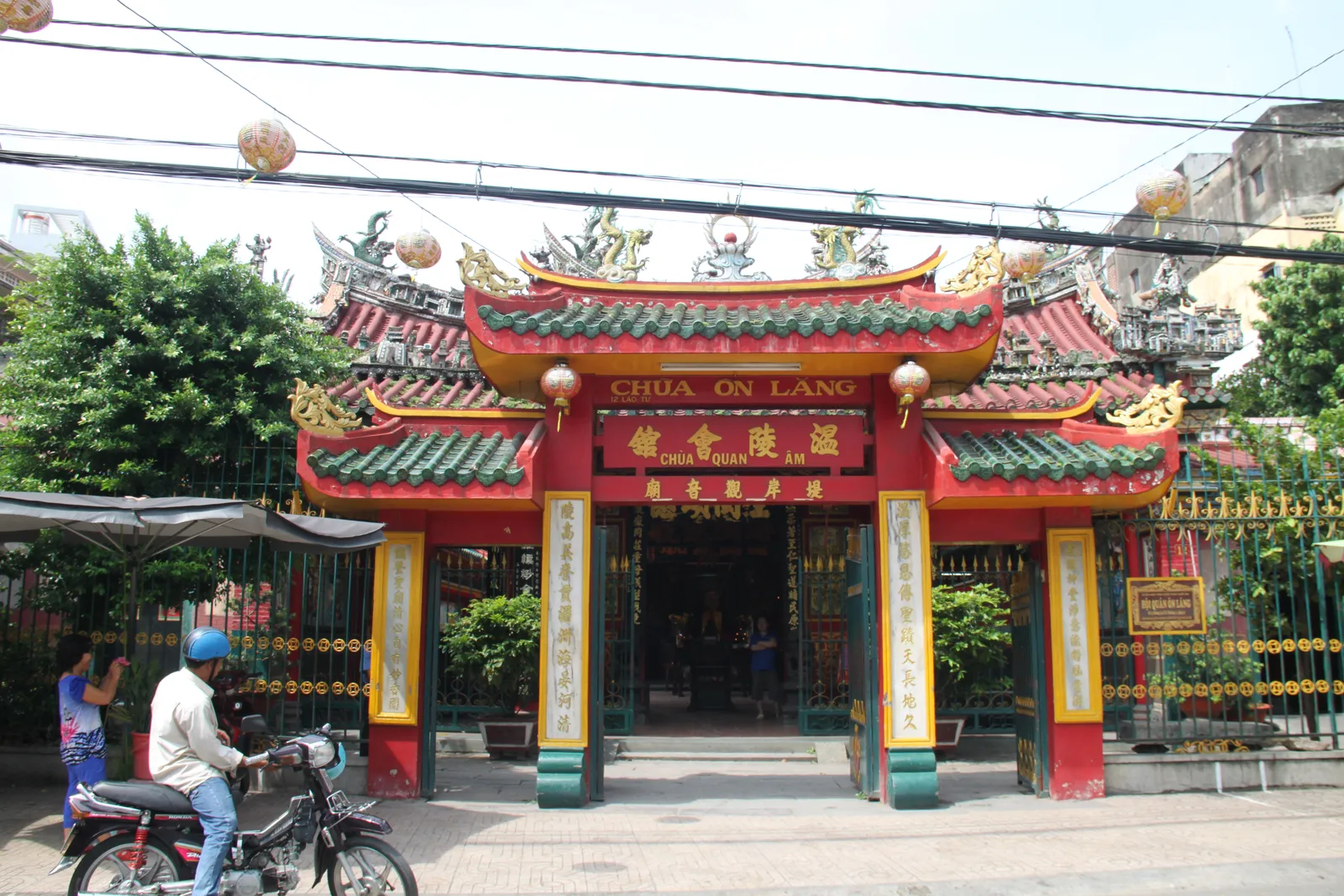
Inside, coils of incense hang over the courtyard and the side altars carry rows of small statues left as offerings. Entry costs nothing here either. If linking the halls on foot in the heat looks like more than you want, a guided cycling route named after Quach Dam threads the same streets, and is sold on the same platform.
The road back east is the slow part of a Cho Lon trip
Cho Lon was settled by Chinese families displaced from Bien Hoa in the 1770s, and it grew as a separate town before the French joined it to Saigon, which is why it sits five kilometres out with nothing quick connecting the two. The metro runs east from the market at the other end and never comes this way, so the return is a taxi or a ride-hailing car, 20 to 40 minutes to the centre depending on the hour.
For the airport, Tan Son Nhat is about nine kilometres north of here and there is no direct bus worth waiting for: take a car, or ride back to Ben Thanh Market and pick up bus 152 there, 5,000 dong, which stops outside the international terminal. Either way, budget three hours between leaving Cho Lon and an international departure, and collect anything you left in storage on the way rather than after.
Frequently asked questions
What should I do during a layover near Binh Tay Market in Ho Chi Minh City?
Start in the market itself, which trades wholesale around a covered courtyard at 57A Thap Muoi and opens from early morning until about six. Ten minutes north, Cha Tam Church is where Ngo Dinh Diem was seized on 2 November 1963 after fleeing the presidential palace, and a plaque inside marks the pew. Nguyen Trai carries two 19th-century Chinese assembly halls within a few hundred metres of each other, one Teochew and one Fujianese, both free to walk into. Four hours is enough for all of it at a walking pace; five is better, because the road back east is slower than the distance suggests.
What is sold at Binh Tay Market?
Mostly wholesale, which is the thing to understand before going. The stalls stack shoes, fabric, dried goods, kitchenware, packaging and confectionery in bulk, priced for shopkeepers buying by the box rather than tourists buying one of something. Plenty of traders will sell singly, but the prices are not set up for it and the aisles are built for handcarts. The food court on the ground floor is the exception and is the reason a lot of people come: it sells by the bowl and it is cheaper than the equivalent downtown.
Is Cho Lon walkable, or do you need transport between stops?
Walkable once you are there, and not before. The market, Cha Tam Church and the Nguyen Trai assembly halls sit inside about a kilometre and a half of each other, all on flat ground, so the whole circuit is a comfortable hour of walking plus however long you stop. Getting to Cho Lon from central Saigon is the part that needs a vehicle: five kilometres, no metro, and a taxi or ride-hailing car is the only sensible option.
Is Binh Tay Market worth visiting with a large group?
Split up inside it. The aisles are roughly a metre wide in places and work as a single file for the traders wheeling stock through, so a group of six moving together becomes a blockage very quickly, and the upper gallery is narrower still. The courtyard in the middle is the obvious place to regroup, and the ground-floor food court has enough counter seating to take a group in one go, which most of the surrounding street stalls do not.