Long Bien Bridge Layover: Hanoi's Island
Part of the full Hanoi Layover: The Old Quarter From HAN
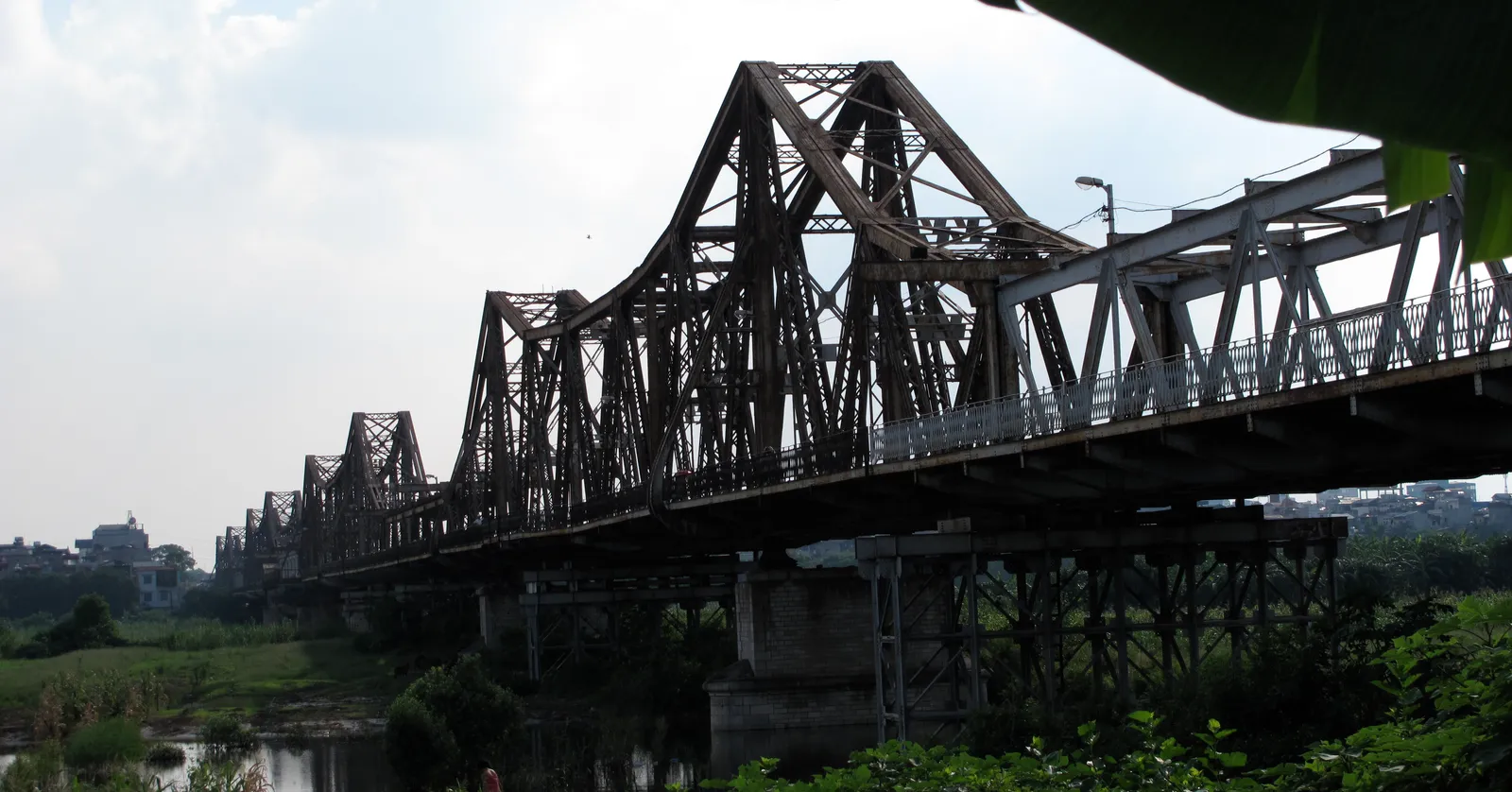
Long Bien Bridge in Hanoi has a steel staircase halfway across it that drops onto Bai Giua, a sandbank in the Red River planted with bananas and corn, and the crossing and the island both cost nothing.
Bananas and corn grow on a sandbank under the bridge
Bai Giua is the long island the Red River leaves in the middle of its channel, and the way down to it is a set of steel steps from the centre of the bridge deck. What is at the bottom is farmland: banana groves, corn, rough grass, goats, low huts, dirt tracks between the plots and people working them, about ten minutes from the edge of the Old Quarter and a completely different kind of ground.
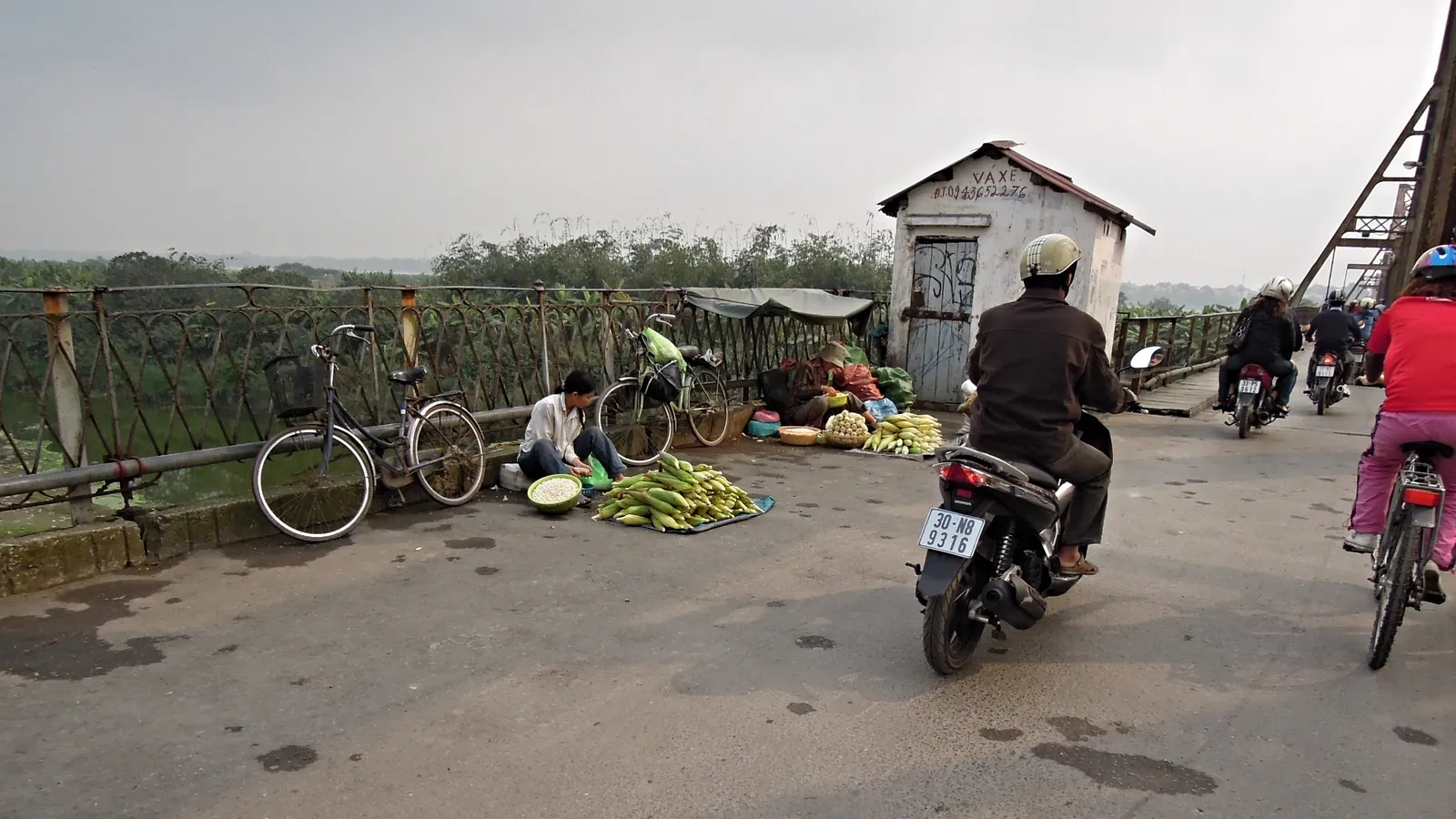
Some of what grows down there comes straight back up the stairs and is sold off the bridge deck, laid out on the ground next to the railing while motorbikes go past a metre away. Above it, the bridge is worth reading as you walk: Daydé & Pillé of Paris built it between 1899 and 1902, it opened in 1903 as the Paul-Doumer Bridge after the Governor-General of French Indochina, and the spans alternate between the original diamond trusses and squarer replacements where bombs took sections out.
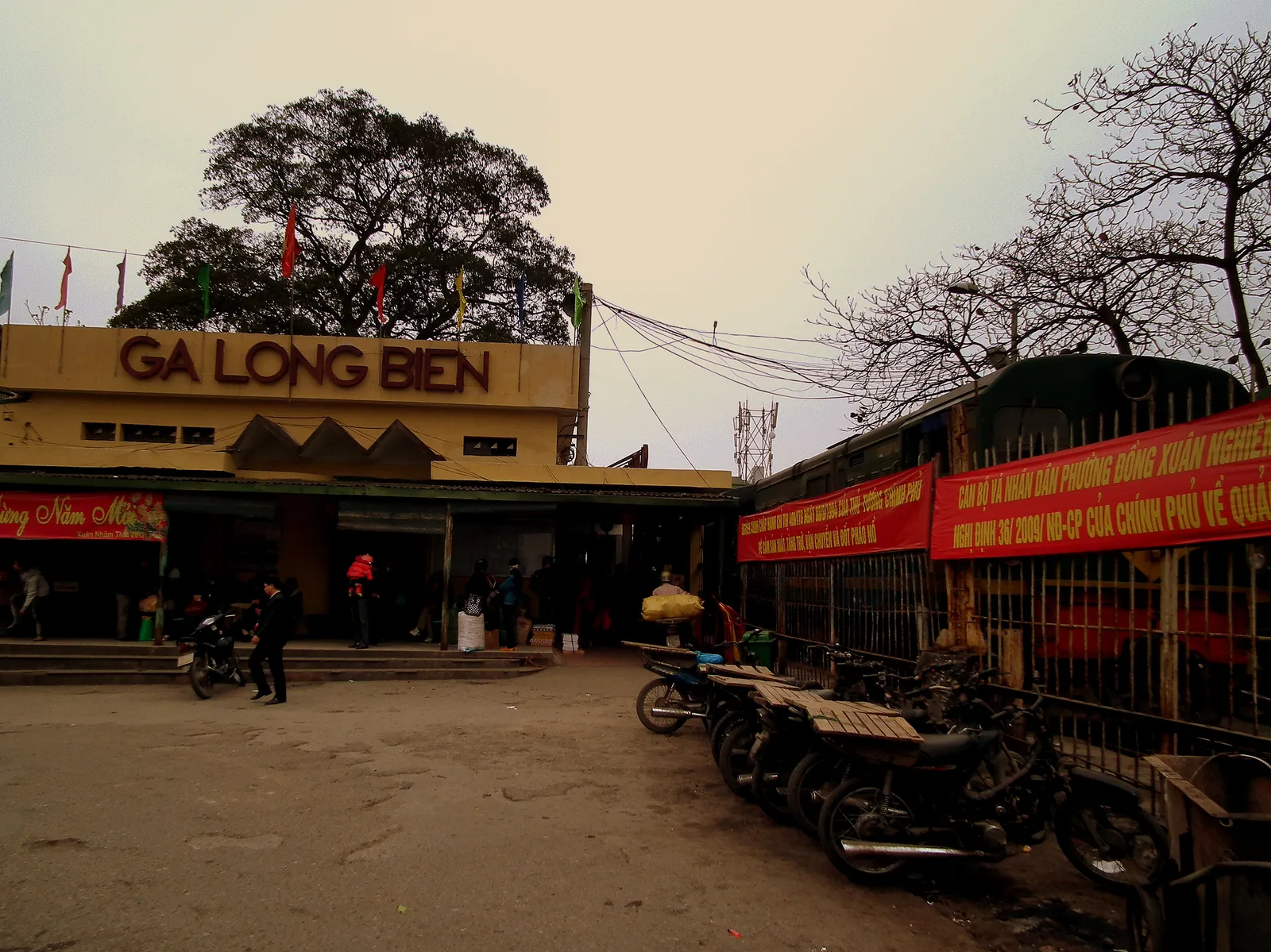
Long Bien station is a yellow shed at the city end
A low building with GA LONG BIEN painted in red over the door sits where the railway comes off the bridge and drops into the city, and it works the local services rather than the long-distance ones that use the main terminus across town. There is one platform, a colonnade of concrete posts, a strip of track, and motorbikes parked wherever there is room.
From here the line runs back into the Old Quarter on a brick viaduct of 131 French-built arches, a little over 1.7 kilometres of it, along Gam Cau and Phung Hung streets. Most of the arches were bricked up decades ago; a run of them on Phung Hung was opened out and painted with street scenes in a Vietnamese and South Korean project in 2017 and 2018, and the paintwork has been fading since. Underneath the bridge itself, on the river side, Long Bien Market has traded across more than 27,000 square metres since 1992, opening around ten at night and running to dawn. A guided food walk through these streets is one way to eat around here without guessing which counter to sit at. The tighter central loop of lakes, temples and trade streets is in the main Hanoi guide instead.
The staircase down is steel, and it is 2,290 metres back
The bridge is 2,290 metres long, which is 4.6 kilometres if you walk out and back, on a raised footway about wide enough for two people with motorbikes running in the lane alongside. The way down to the island is an open steel staircase, and the tracks at the bottom are dirt. It is the one stretch in Hanoi where nobody is going to help you carry anything.
The airport bus stops at the foot of the bridge
Long Bien transfer station on Tran Nhat Duat, at the city end of the bridge, is a stop on bus 86, the express service between Hanoi Railway Station and both terminals at Noi Bai International Airport. The fare is 45,000 dong flat, the ride is 50 to 55 minutes, and departures come roughly 45 minutes apart, with the last one leaving the city at 21:00.
That puts this corner among the simpler places in Hanoi to leave from, since the stop is at the end of the walk rather than a transfer away from it. Allow two hours from the bridge to the terminal door to absorb the wait, then whatever your airline asks for check-in. If the bus has stopped for the night, a taxi or a ride-hailing car covers the 30 kilometres in 35 to 60 minutes for around 250,000 to 400,000 dong.
Frequently asked questions
What should I do during a layover near Long Bien Bridge in Hanoi?
Walk out onto the bridge and, if the time allows, down the steel staircase in the middle of it to Bai Giua, the farmed island in the Red River: banana groves, corn plots and dirt tracks, ten minutes from the Old Quarter and nothing like it. Three hours covers the crossing, the island and Long Bien station at the city end; four leaves room to eat around the arches on Gam Cau. None of it is ticketed. The bridge is 2,290 metres each way on foot, which is the number that decides how much of the island you actually get.
Can you walk down to the island under Long Bien Bridge?
Yes, by a steel staircase that runs down from the middle of the bridge deck to Bai Giua, the long sandbank in the Red River. What is down there is farmland rather than a park: banana groves, corn, patches of wild grass, goats, small huts and people working plots, with dirt tracks between them. It is free and there is no gate. Wear something you do not mind getting dusty, and treat the staircase as the reason to leave a suitcase behind rather than bring it.
When does the market under Long Bien Bridge trade?
Overnight. Long Bien Market has been operating on more than 27,000 square metres under the bridge since 1992, and it is a wholesale market, so it opens around ten at night and runs until dawn, with the busiest hours between two and four in the morning. Most of Hanoi's smaller markets are supplied from here. It is the wrong stop for a mid-afternoon layover and close to the only stop worth making for a three-in-the-morning one.
Does a Long Bien Bridge walk work in the rain?
Badly. There is no cover anywhere on the 2,290 metres of deck, the footway on each side is a narrow raised strip, and the motorbike lane beside it throws up water. The island below turns to mud, and the staircase down to it is steel. In heavy rain the sensible version of this trip is Long Bien station and the arched brick viaduct running back into the Old Quarter, which at least has walls and roofs along most of its length.
Is Long Bien Bridge safe to walk across?
People do it all day, but it is a working bridge rather than a promenade. The footway on each side is a raised strip about wide enough for two people, with a lane of motorbikes and bicycles immediately beside it and a rail track down the middle, and there are no barriers between the walkway and the traffic for most of the length. Cars were taken off long ago, which removes the worst of it. The realistic difficulty is distance rather than danger: 2,290 metres each way, no shade and no shelter.