Carouge Layover: Geneva's Sardinian Town
Part of the full Geneva Layover: Jet d'Eau and Old Town, GVA
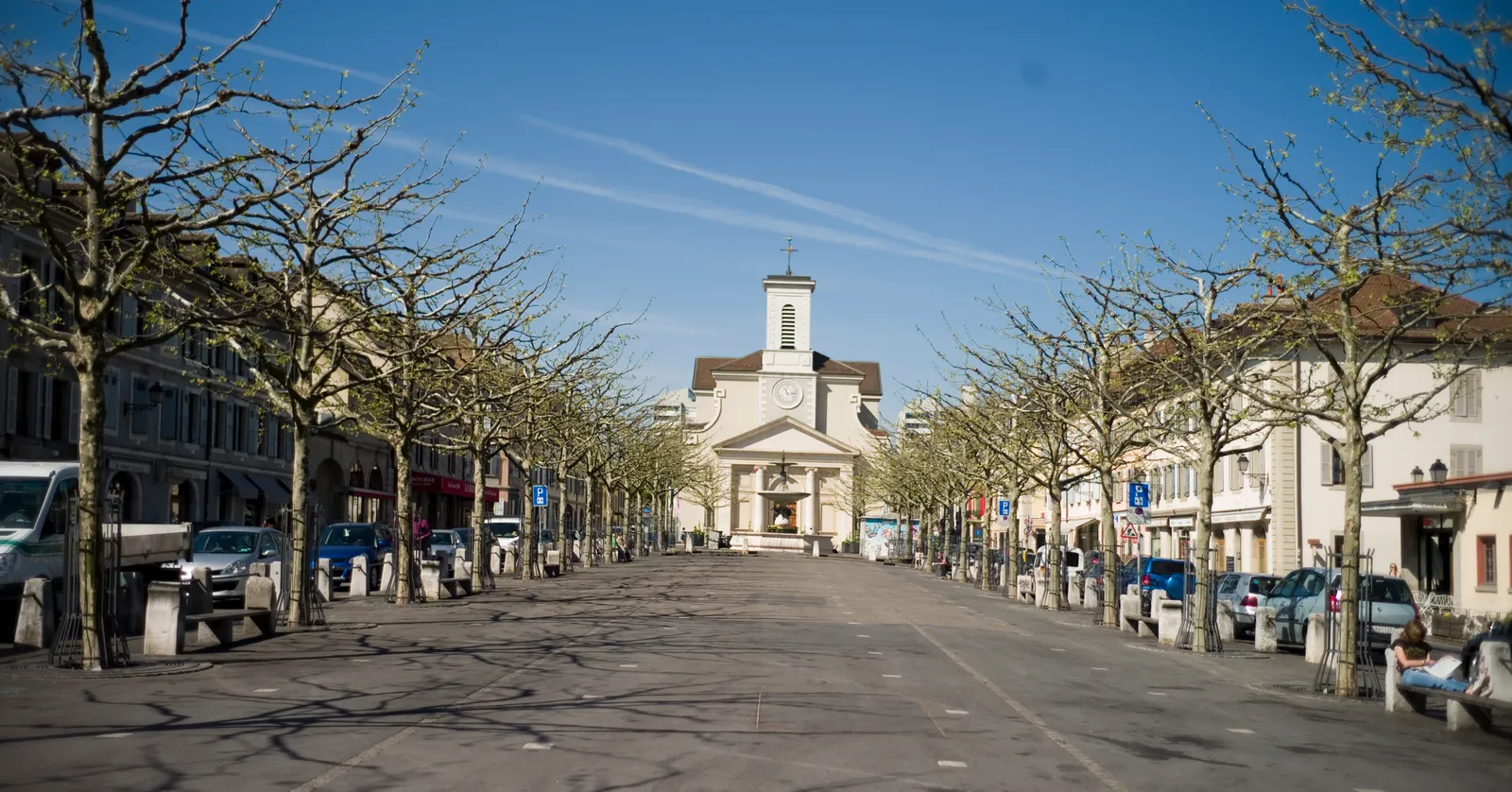
Carouge sits a fifteen-minute tram ride south of central Geneva across the Arve, laid out in the 18th century on a Sardinian grid of two-storey shuttered houses, with a market filling its Place du Marché on Wednesday and Saturday mornings and workshops and galleries along Rue Saint-Joseph.
Market mornings on Place du Marché, twice a week
The square is a long rectangle with rows of pollarded plane trees down both sides and the white front of the Catholic parish church closing the end of it, which makes the whole thing read as one composition rather than an accident of streets meeting. Stalls go up on Wednesday and Saturday mornings and are packing away by early afternoon, and from spring into late autumn there is an additional evening market on Thursdays. Produce, cheese and flowers dominate, with craft stalls mixed in.
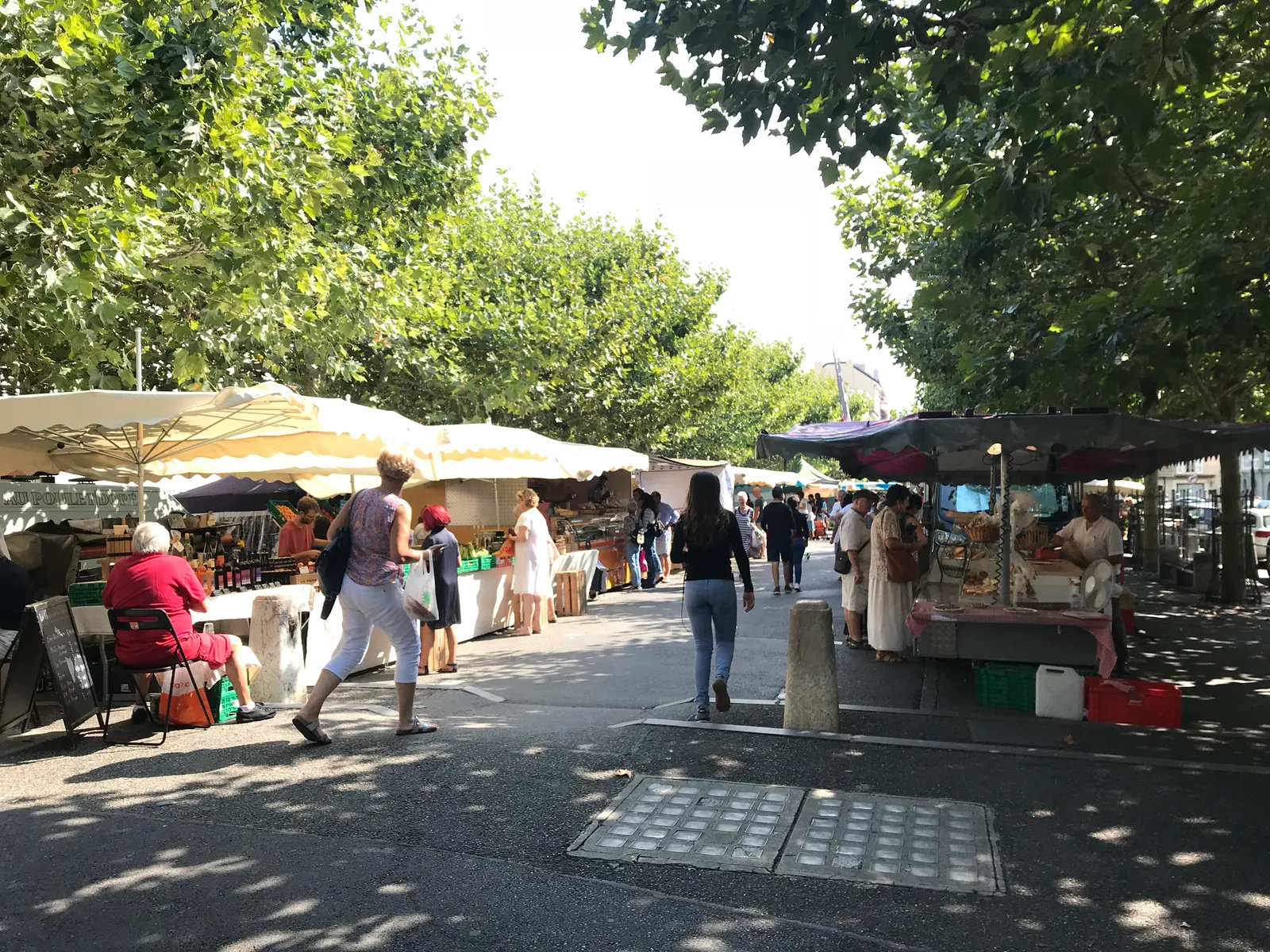
The trees matter more than they sound like they should. They are pollarded hard every winter and come back dense enough to roof the whole square in summer, which is why the market sits comfortably here in August in a way that an open plaza would not. Outside market hours the square empties out and the cafés along both flanks take over the shade.
The grid Sardinia laid out to compete with Geneva
Carouge exists because of a deliberate act of commercial sabotage. In the late 18th century the Kingdom of Sardinia decided to build a rival town on the doorstep of Protestant Geneva and pull its tradespeople across the river, so architects working for Turin took a hamlet of roughly seventeen houses and rebuilt it as a planned grid, modelled on Turin and Nice: regular blocks, low buildings of two storeys with shutters and balconies, a courtyard behind nearly every one, a Catholic church, a market square, and freedom of religion as the inducement. It was given city status in 1786.
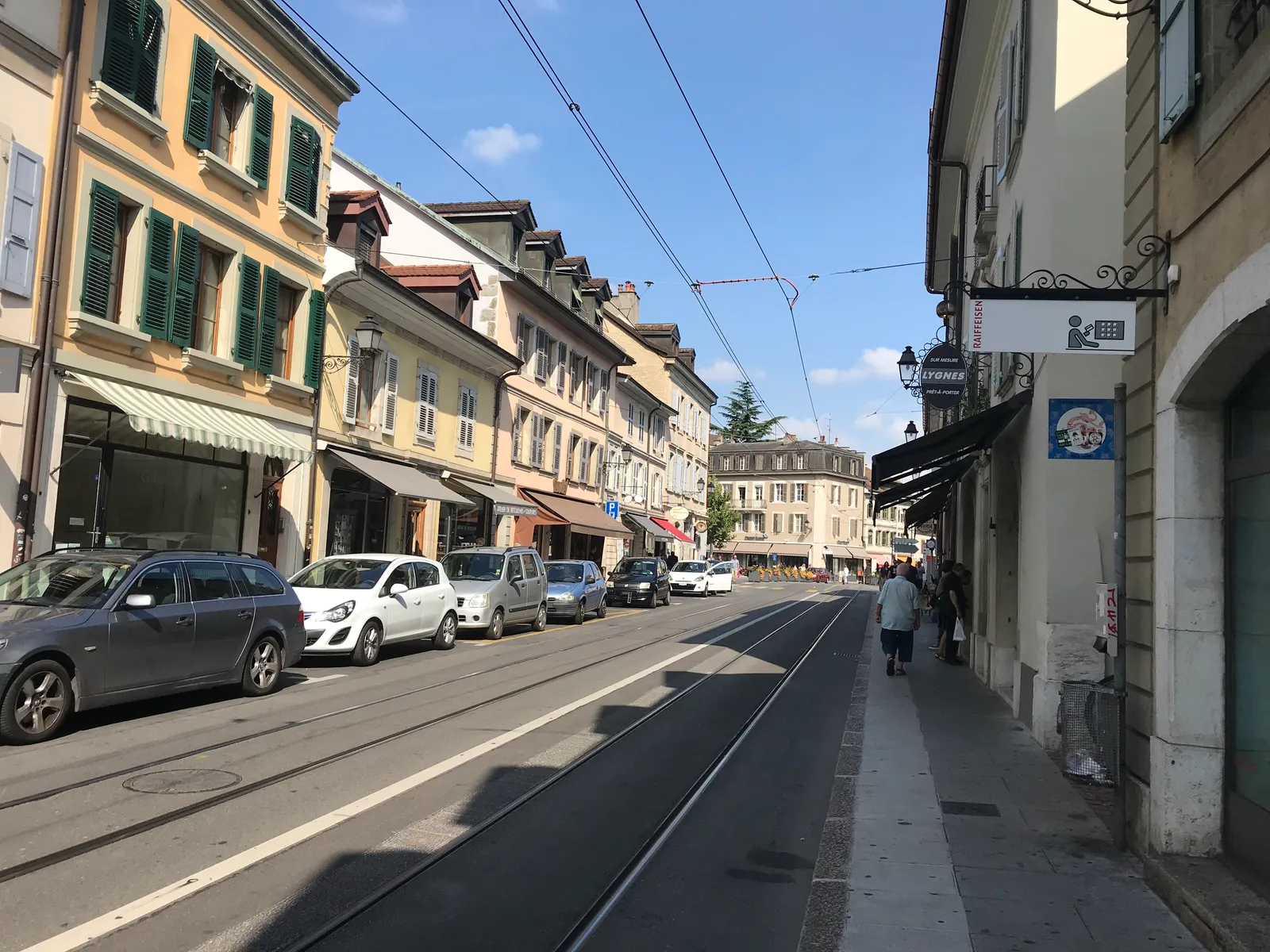
The plan survived the politics. Carouge only became Swiss in 1816, when the Treaty of Turin handed it to the canton of Geneva along with two dozen other municipalities, and the grid, the facades and the courtyards are now listed as Swiss national heritage, which is why the town still reads as northern Italian rather than Genevan. The courtyards are the part most visitors miss: passages off Rue Saint-Joseph and Rue Ancienne open into green interiors that give no sign of themselves from the street. Getting here and back is two tram legs, and a suitcase is something you handle four times over that trip rather than once.
Trams from Carouge run back through the centre to the station
Services from the stops along the main street run north over the Arve and through the middle of Geneva to Genève-Cornavin in about fifteen to twenty minutes, and a unireso zone 10 single at CHF 3 covers the whole thing. From Cornavin the train out to Genève-Aéroport takes seven minutes, up to seven an hour at peak, so allow an hour and a half from Carouge to a departure gate and you have margin left over.
This is the flattest itinerary of any around Geneva and the one furthest from the postcard version of the city, which is the trade the main Geneva guide makes in the other direction: a cathedral on a hill, a lake, and a climb to get to both. Carouge has none of that and does not want it. What it has is a town built to a single plan in a single decade, still legible two and a half centuries later, and a market that is the reason to time the trip rather than just take it.
Frequently asked questions
What should I do during a layover near Carouge in Geneva?
Walk the grid. Carouge was laid out from scratch in the 18th century on a Sardinian plan, so the streets run straight, the houses are two storeys with shutters, and most of them hide a courtyard you can only see from a passage. Place du Marché is the centre of it, with the market filling the square on Wednesday and Saturday mornings and Rue Saint-Joseph running off it past jewellers and small workshops. Three hours is plenty, and none of it is ticketed; a midweek afternoon is the quietest version and also the least interesting one.
Why does Carouge look Italian rather than Swiss?
Because it was built by the Kingdom of Sardinia, not by Geneva. In the late 18th century Sardinia set out to create a commercial rival on Protestant Geneva's doorstep, and had Italian architects rebuild what had been a hamlet of about seventeen houses as a planned grid modelled on Turin and Nice, with a Catholic parish church, a market square and religious freedom as a draw for tradespeople. It was granted city status in 1786 and only became Swiss in 1816, when the Treaty of Turin transferred it to the canton of Geneva.
Can you actually walk into the Carouge courtyards?
Some of them, and the passages are easy to miss. The town was laid out so that nearly every block encloses an interior courtyard, and narrow openings off Rue Saint-Joseph and Rue Ancienne lead through into them. Several hold workshops, galleries or café tables and are used as semi-public space during the day; others are plainly residential, with the gate or the planting making that clear. The rule of thumb is to treat an open passage as an invitation and a closed one as somebody's garden, and to keep the noise down either way.
How long does it take to reach Carouge from central Geneva?
Around fifteen minutes by tram from the middle of the city, over the Arve and south. It is a separate municipality rather than a Geneva district, which is why the character changes so sharply at the bridge, but the fare is the same as anywhere in the canton at CHF 3 for a zone 10 single. The streets here are flat, and the grid means you cannot really get lost in it.