Wieliczka Salt Mine Layover From Kraków
Part of the full Kraków Layover: Old Town and Wawel From KRK
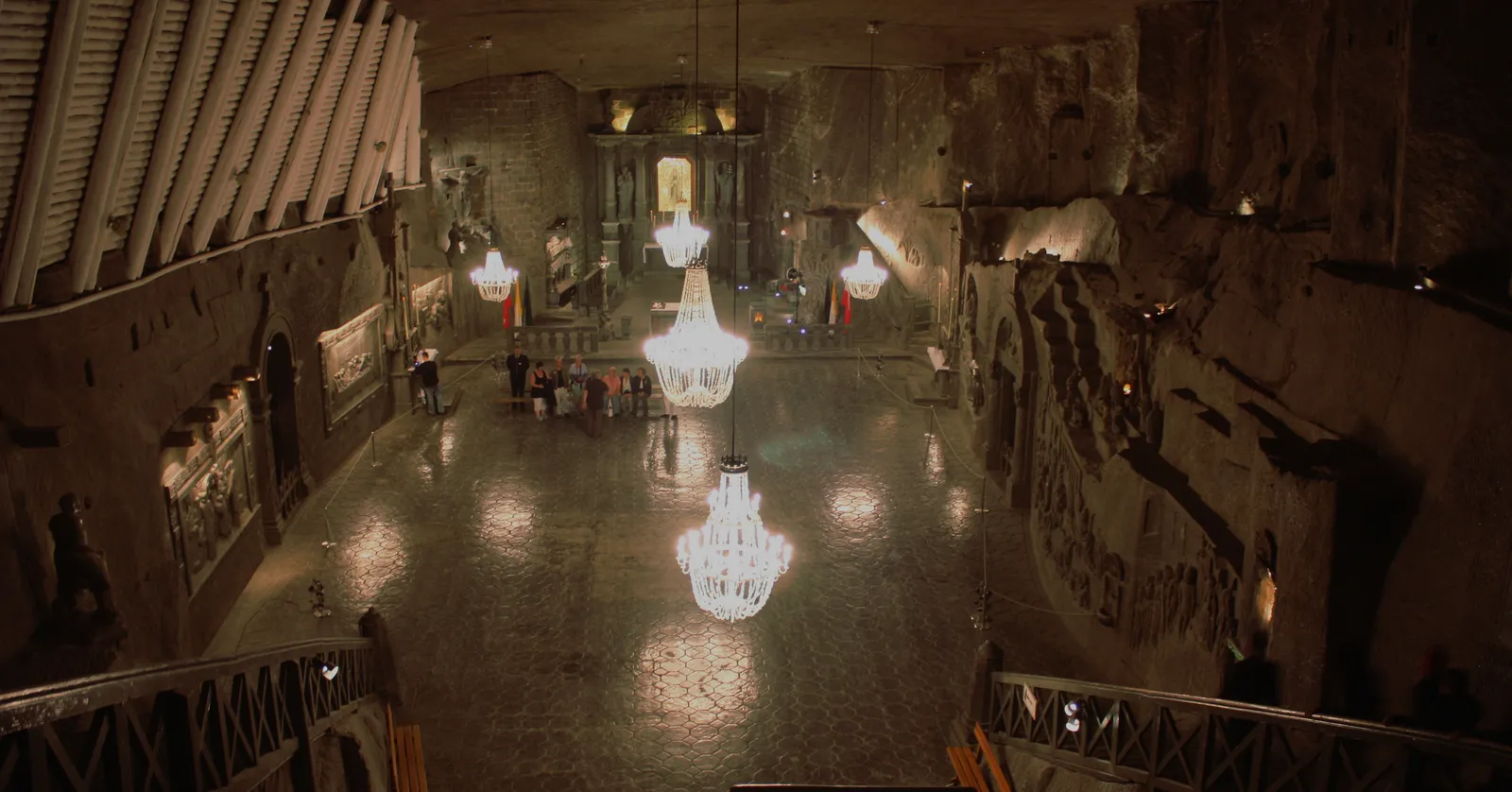
The Wieliczka salt mine is 25 minutes by train from Kraków Główny, and what the fare gets you is 3.5 kilometres of carved chambers reaching 135 metres down, on a guided slot booked in advance rather than a walk improvised on the day.
St Kinga’s Chapel, carved out of rock salt 101 metres down
Miners started cutting the chapel in 1896, beginning with Józef Markowski and carried on by others for decades afterwards, and what they left is a church hollowed out of the rock salt: altarpieces, wall reliefs and a floor worked to look like laid tiling, all of it the same grey-green mineral as the walls. The chandeliers are salt crystal, dissolved and recast to get the clarity. Mass is still said down there.
It is the reason the mine has been on the World Heritage list since 1978, and the reason the tourist route sells out. Entry runs on guided departures in set languages at set times, tickets start at around 130 złoty and the route itself is open 7.30am to 6.30pm, so a guided half-day booked ahead is the version that fits a fixed departure, since walking up in July and asking for the next slot generally does not work.
Over 800 steps down, and a lift back up
The descent starts at the Daniłowicz shaft in the middle of Wieliczka: 380 wooden steps in a tight square spiral down to the first level at 64 metres, done in one go, with the group behind you setting the pace. The route keeps descending after that and totals more than 800 steps before it bottoms out at 135 metres.
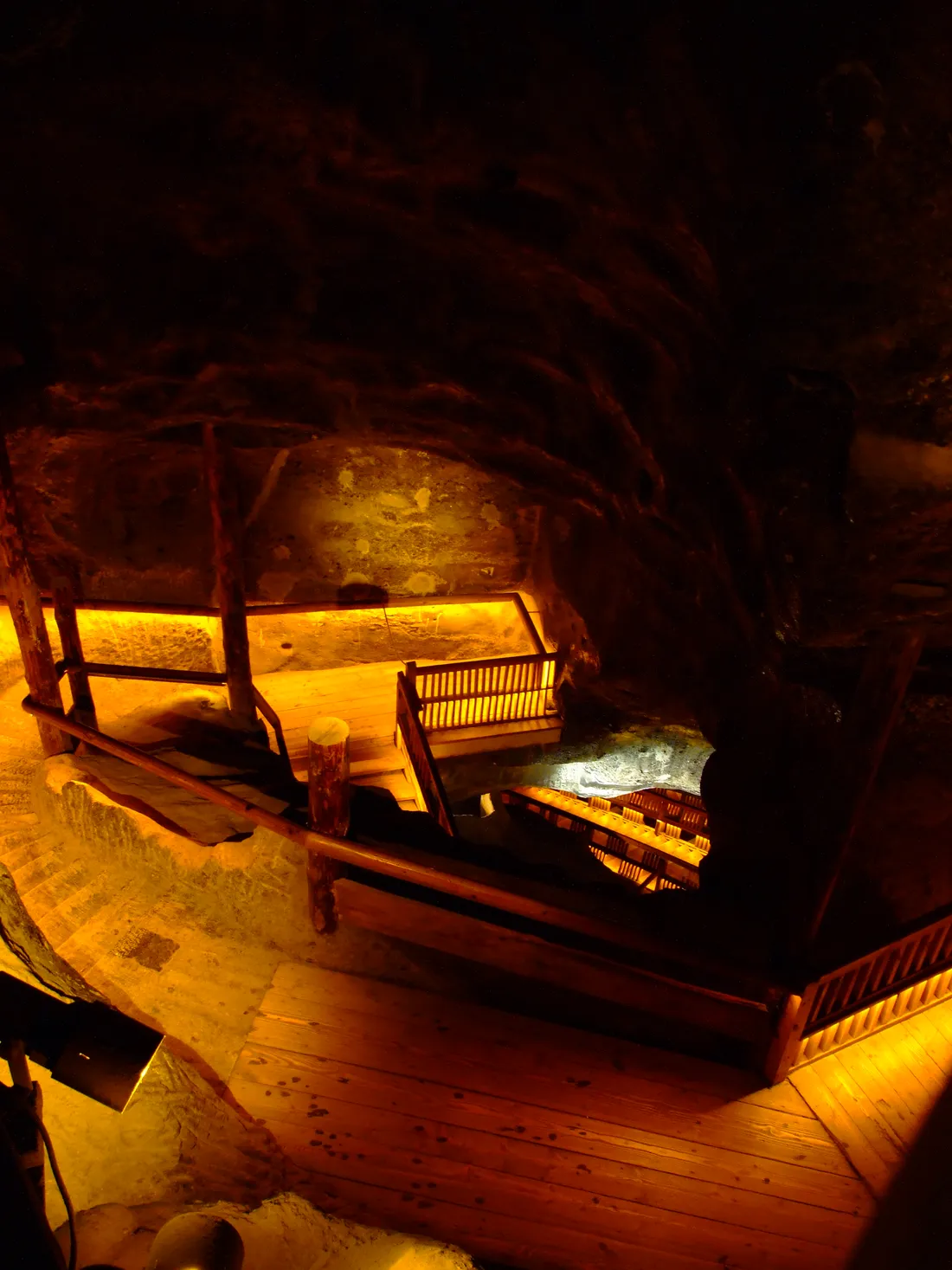
None of them are climbed back. The exit from the bottom is a miners’ lift, taken in small groups, which is also why the route only runs one way and why you cannot drop out of it partway.
Anything larger than 20 by 20 by 35 centimetres has to come off you before the descent, and the automated lockers at the shaft are free but limited in number and size, with no guarantee one will take your bag.
Timber-walled galleries and a saline lake underground
The mine runs 287 kilometres of passages over nine levels to a depth of 327 metres, and the tourist route covers 3.5 of those kilometres, under two per cent of it. What fills the rest of the walk between the carved chambers is the working mine: galleries lined floor to roof with stacked pine logs holding the rock apart, the timber winding gear the miners turned by hand, and the saline lakes standing in worked-out chambers.
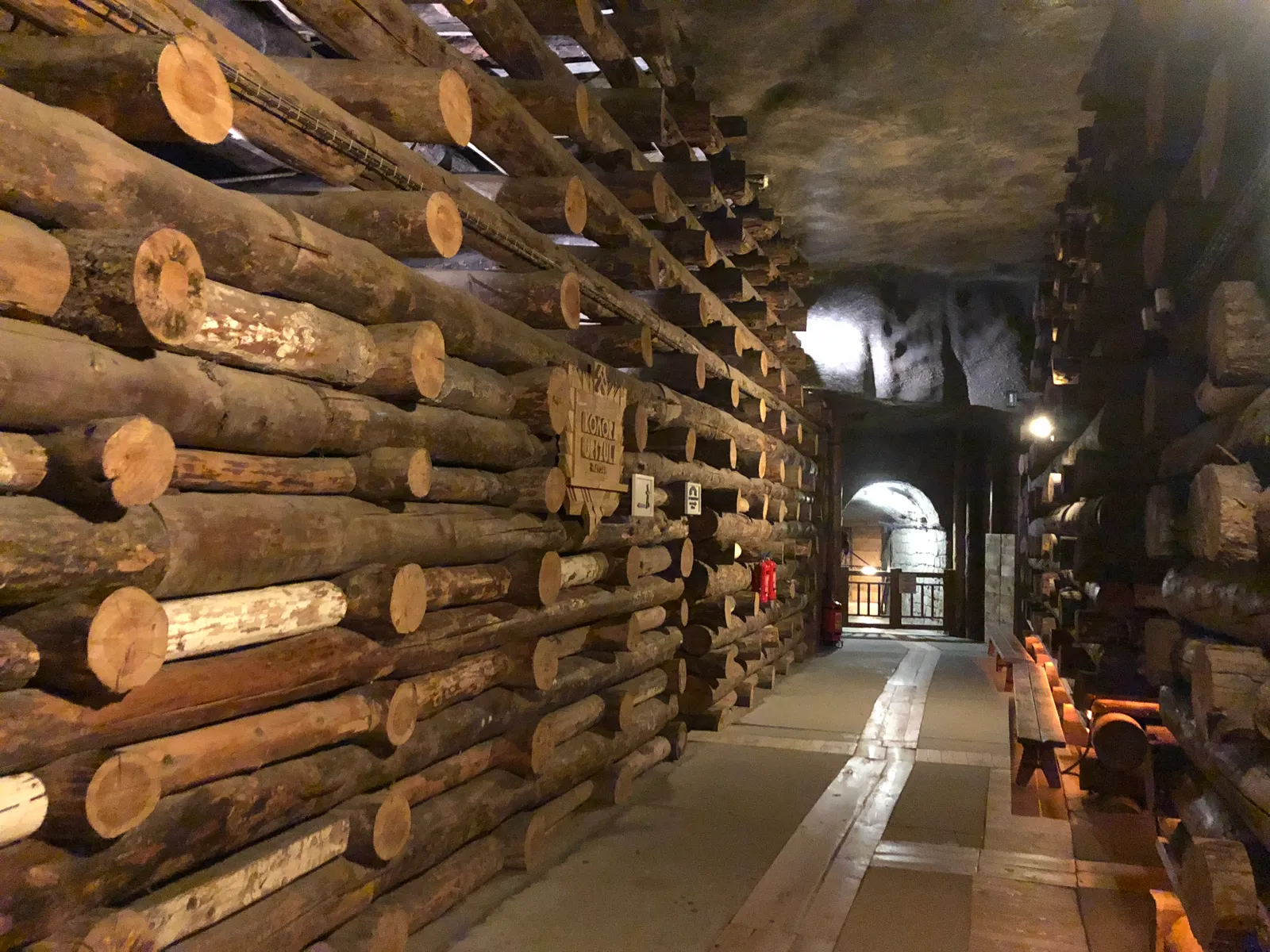
Salt was mined here from the 13th century until 1996, when cheap imports and flooding ended table-salt production, and the timbering you walk past is the accumulated result of seven centuries of keeping the roof up. It holds 17 to 18 degrees down there whatever the weather above.
The graduation tower and the castle above the shaft
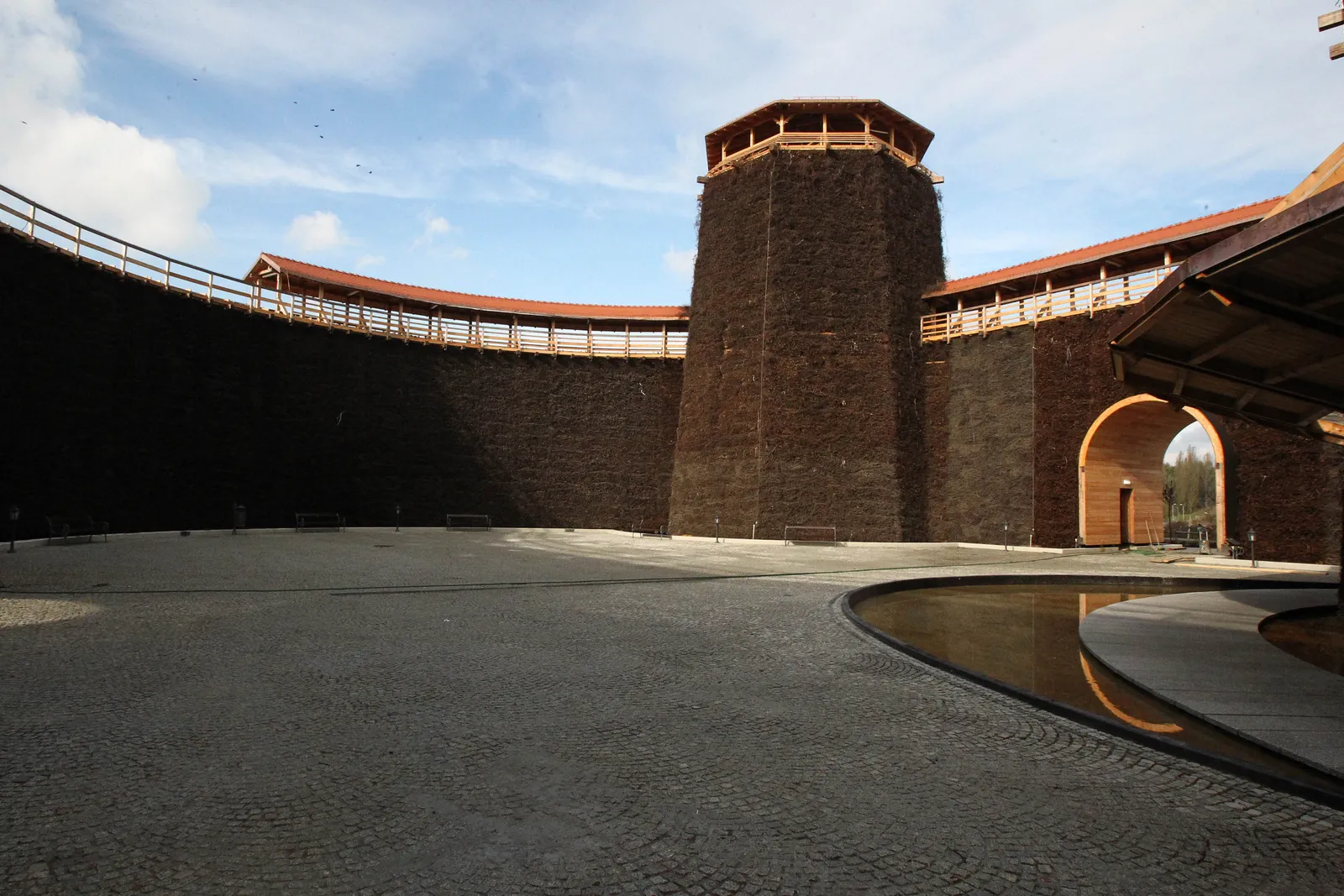
Most people come up the lift and get straight back on the train, which leaves two things in Wieliczka unvisited. The first is in Park św. Kingi beside the Daniłowicz shaft: a curved wall of blackthorn brushwood covering 7,500 square metres, built in 2014, with brine trickling down through it so the air around it carries salt. An octagonal timber tower over 22 metres high stands in the middle of it, 250 steps to a terrace over the town.
The second is the Saltworks Castle a few streets away, the medieval headquarters of the royal salt works, which ran the mine as crown property for centuries. It holds the Cracow Saltworks Museum now, with an archaeological display and a collection of salt cellars, and it was added to the mine’s World Heritage listing in 2013 as part of the same site.
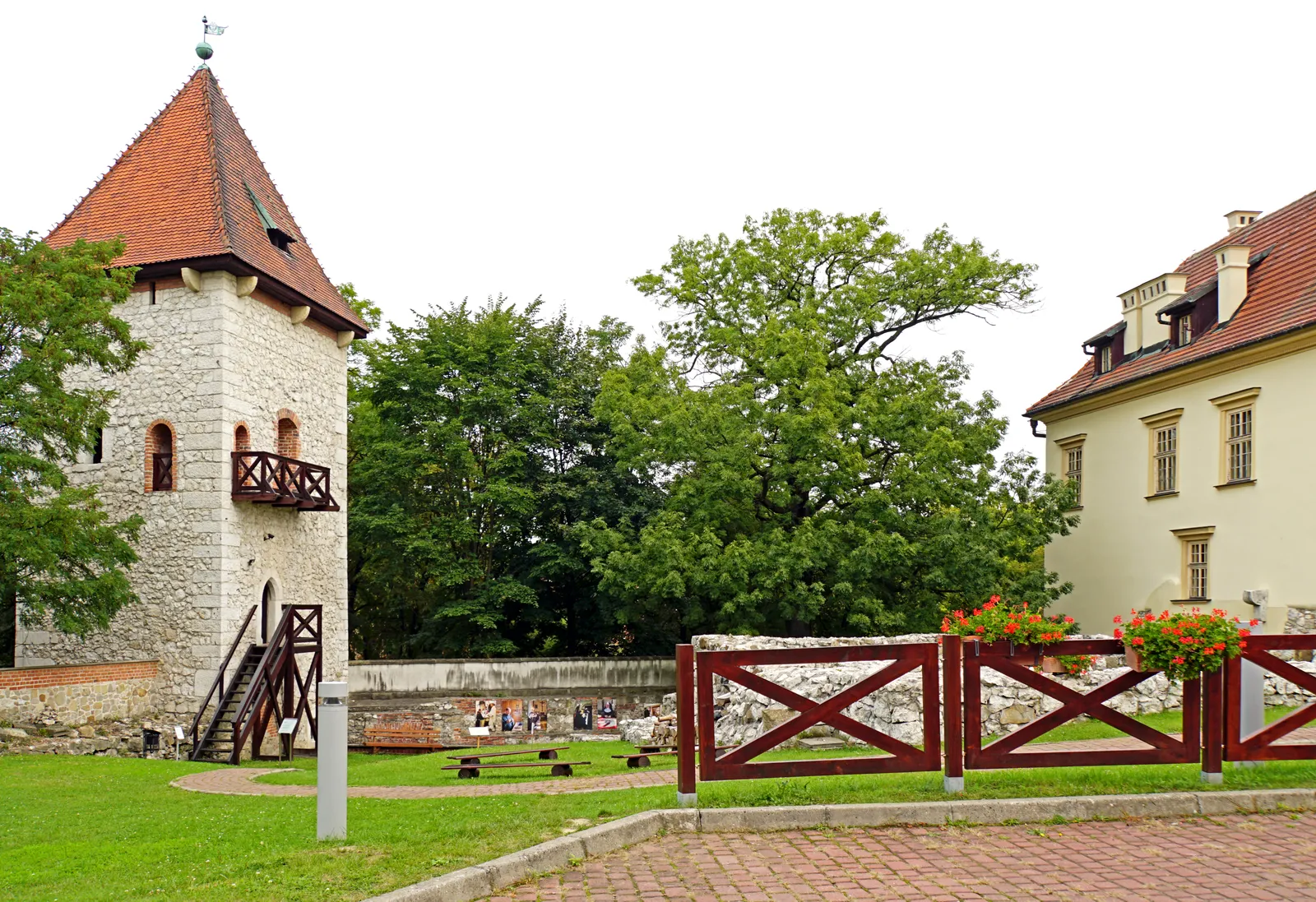
Admission is about 8 złoty, 5 reduced, it is free on Saturdays, and an hour covers it. Against 130 złoty and a booked slot for the mine, that is the stop to make if the underground tour has already gone for the day.
Wieliczka shares one railway line with Kraków’s airport
The SKA1, a regional service run by Koleje Małopolskie, runs Wieliczka Rynek-Kopalnia at one end, Kraków Główny in the middle and Kraków John Paul II International Airport at the other. Wieliczka to Kraków Główny is about 25 minutes; Wieliczka all the way to the airport is about 45, with no change, which makes this the one out-of-town stop near Kraków you can reach and leave without touching the city. The airport platform is joined to the terminal by a covered footbridge of 200 to 250 metres, and the fare from Kraków Główny to the airport is a flat 20 złoty.
Trains run roughly twice an hour through the day and hourly early and late, with nothing at all between about 1am and 4am, when bus 902 covers the airport leg instead for 6 złoty and about 45 minutes. If your connection is short enough that this whole trip is out of reach, what the airport itself offers is the shorter version of the same line.
The thing to plan around is that this is the only route near Kraków with no exit halfway. Everything else in the city can be abandoned at any point and walked away from; once the lift takes the group down, you are on the mine’s schedule until it brings you back up.
Frequently asked questions
Can you go into the Wieliczka mine without a guide?
No. The tourist route runs as guided departures in set languages at set times, and you are underground with the group for the whole of it. Slots are sold for a specific hour and go three to five days ahead in the summer, so this is the one stop near Kraków that genuinely has to be settled before you travel rather than decided at the gate.
How many stairs are there, and is there a lift?
The descent is 380 steps down the Daniłowicz shaft to the first level, 64 metres down, and there are more than 800 in total across the route as it works down to 135 metres. The way out is a lift, taken in small groups, so the stairs are all in the downward direction. There is no step-free version of the tourist route.
How long does the round trip from central Kraków take?
Five hours is the realistic minimum. The train is about 25 minutes each way, the shaft is a five-minute walk from Wieliczka's station, the route itself runs two to three hours, and you are asked to be there before your slot. If that does not fit, the main Kraków route stays inside the city and can be cut short at any point, which this cannot.
How cold is it underground, and what should you wear?
Between 17 and 18 degrees all year, which in a Polish August is a 15-degree drop from the street and in January is a rise. Take a layer whatever the season: three hours at that temperature with no sun on you is colder than the number suggests, and there is nowhere on the route to go back up for a jacket.