Kraków Wawel Hill Layover: The Dragon's Den
Part of the full Kraków Layover: Old Town and Wawel From KRK
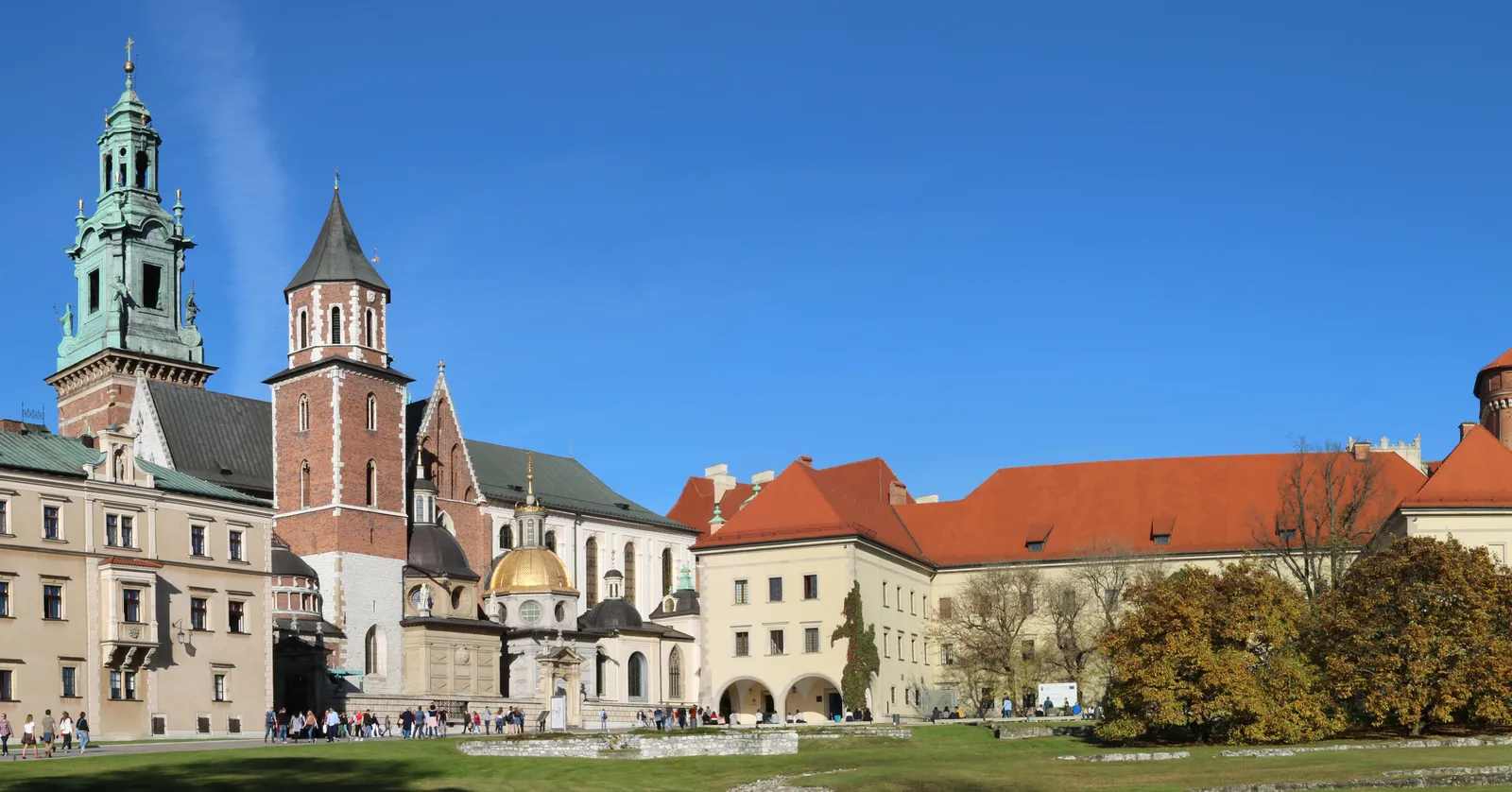
Wawel Hill in Kraków costs nothing to walk onto, and from the cathedral at the top a one-way staircase drops through the rock to the Vistula boulevards, which run east past Skałka to a footbridge over the river.
Wawel Cathedral and the bones chained over its door
Polish kings were crowned in the cathedral on Wawel Hill for four centuries and most of them are buried under it, along with Tadeusz Kościuszko, Józef Piłsudski and the poet Adam Mickiewicz. The building is a pile of additions rather than one design: a Gothic core with side chapels grafted on over centuries, the best known of them the gold-domed Sigismund Chapel of the 1530s on the south side.
Three large bones hang on chains over the main door, and the story is that they came off the dragon that lived under the hill. What they actually are has never been settled, though whale, mammoth and woolly rhinoceros are the usual guesses. The other legend attached to them is that Kraków lasts as long as they stay up there, which is presumably why nobody has taken them down to check.
Up in the tower is the Sigismund Bell, cast in 1520 by Hans Beham of Nuremberg, 9,650 kilograms of bronze with a clapper of another 365. Twelve ringers, six a side, are needed to swing it, and it is rung only for church and state occasions. One ticket at 26 złoty, 18 reduced, covers the cathedral, the crypt, the bell tower and the museum, and it is sold at the office facing the door rather than online. If you would rather have the castle and the cathedral explained instead of guessed at, a guided walk of both books ahead and takes about two hours.
The Vistula boulevards under the castle wall
Both banks of the river below Wawel are laid out as a continuous strip of grass and paving with no road on it, free at any hour and lit after dark. It is where Kraków sits down in warm weather: on the slope facing the water, with the castle wall directly above and cyclists running the flat path underneath.
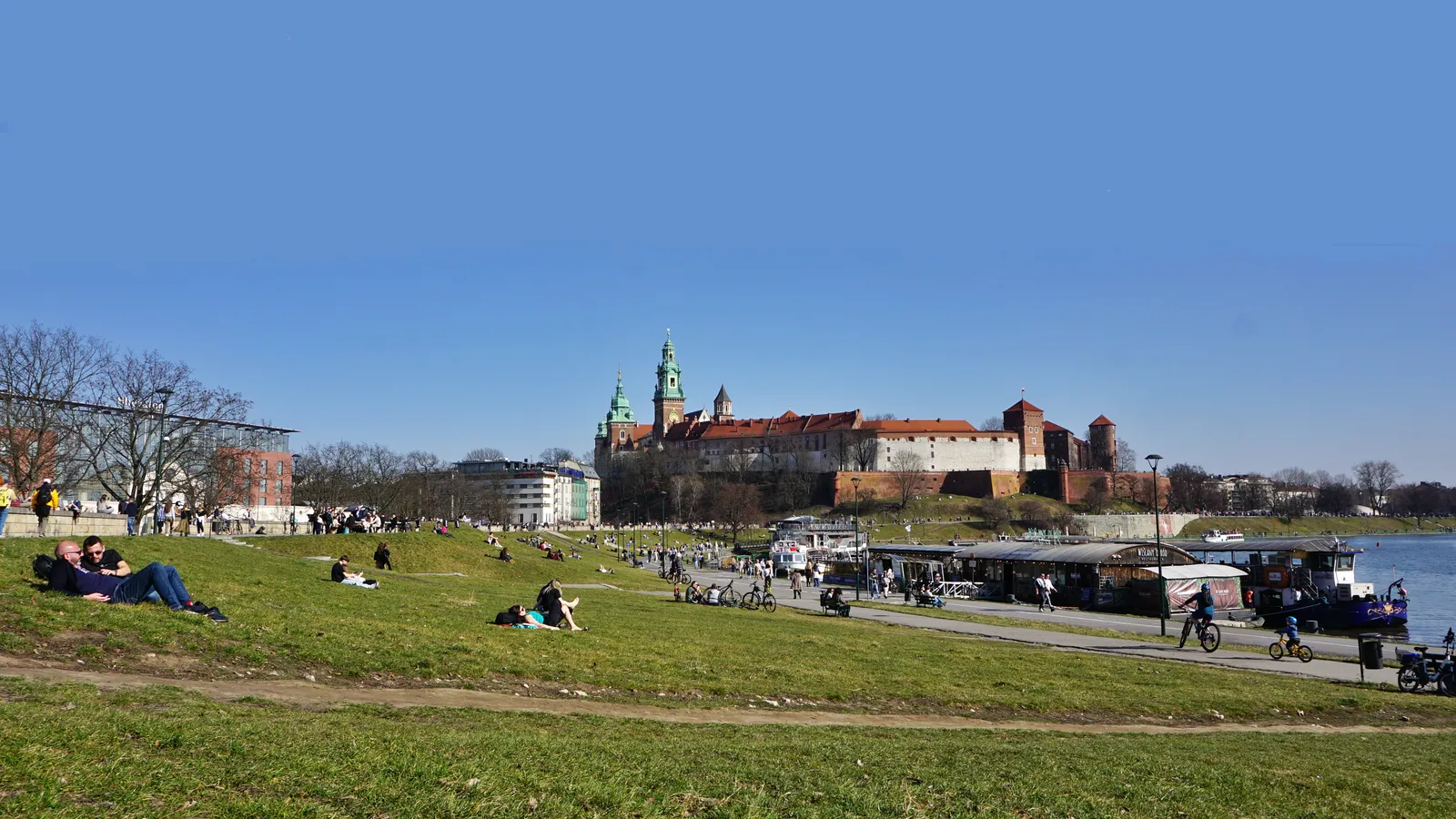
Barges are moored along Bulwar Czerwieński under the hill, several of them converted into bars that open in season, and the cruise boats leave from the same stretch. A 50-minute run downriver from here passes Dębniki, Podgórze, Kazimierz and Stradom and puts you back where you started, which is the one way to see the hill from below rather than stand on it.
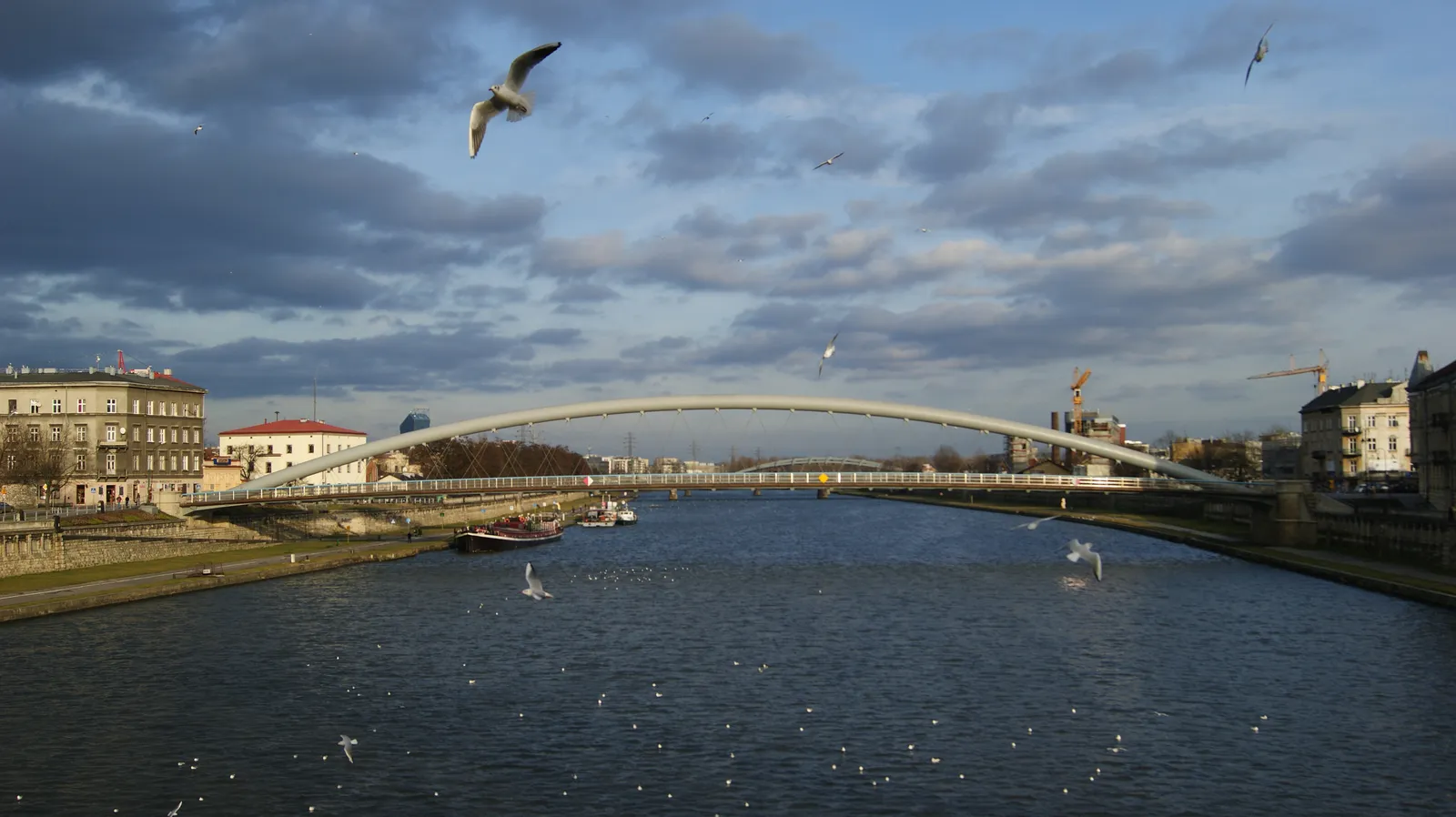
Twenty minutes east along the same bank is the Father Bernatek footbridge, opened in September 2010: a single curved steel beam 145 metres long, designed by the Kraków architect Andrzej Getter, with separate decks for walkers and cyclists slung on either side of it. Acrobat figures hang in the air above the deck, and the mesh railings have long since disappeared under padlocks. It lands in Podgórze on the far bank, which is where the main Kraków route ends up too, by a different way round and with the Old Town in front of it.
The Dragon’s Den, 135 steps down and no way back up
The cave under the hill runs 270 metres in total; 81 of them are open, and getting into them means a tight spiral staircase dropping about 21 metres through the limestone. There is no lift and no return route: the exit is a low door at the bottom that puts you out on the riverbank.
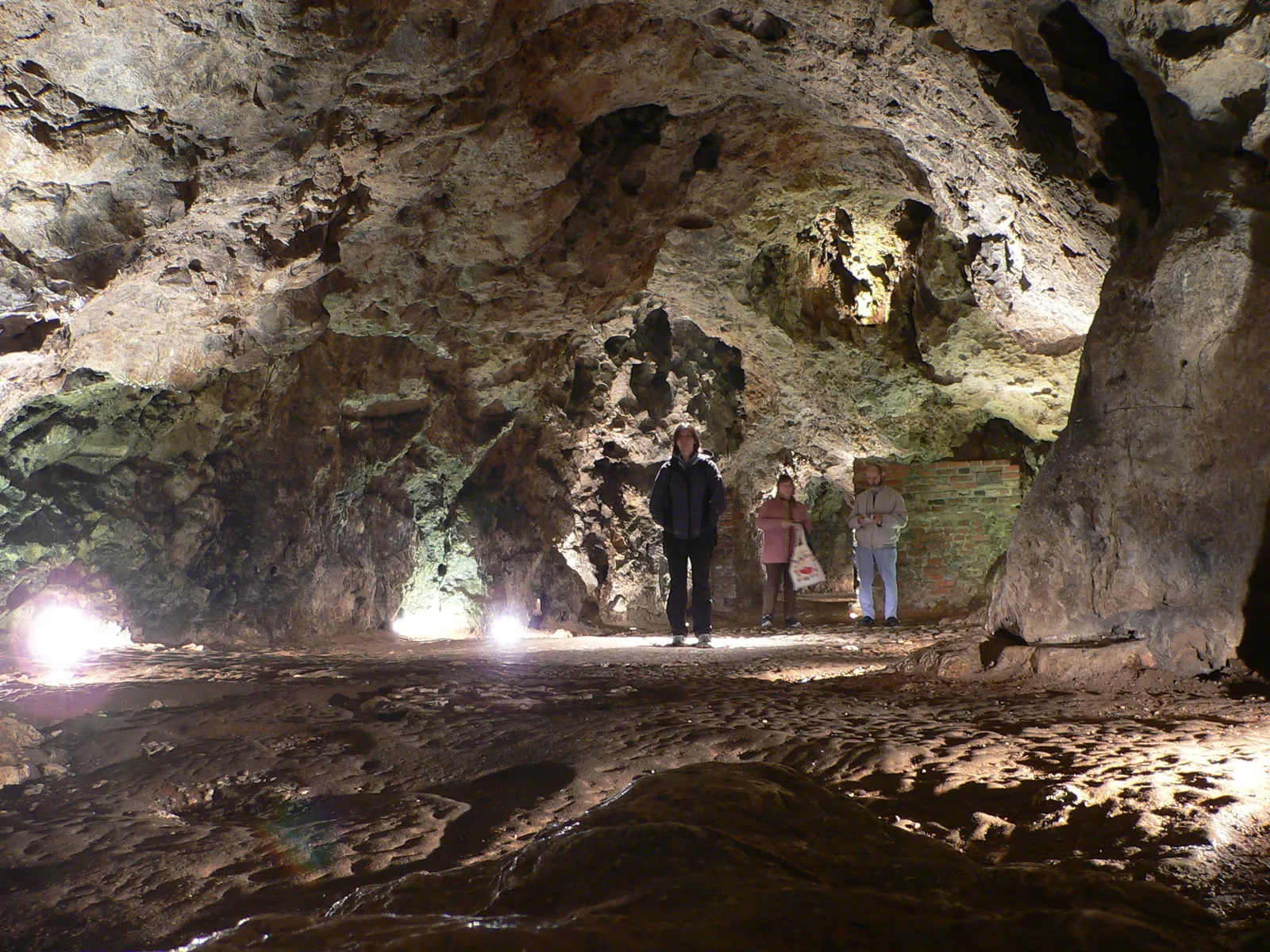
Entry is 15 złoty, 10 reduced, free under seven, and it opens daily from late April to the end of October before shutting for the winter. Waiting outside that low door is Bronisław Chromy’s bronze dragon, installed in 1972, seven heads on one body, with a gas nozzle in its mouth that fires a jet of flame every few minutes to a small crowd of children.
Both approaches up the hill are cobbled and neither is short, and the cave route only runs downhill, so a suitcase brought this far has to be carried back up the way it came.
Skałka, the crypt where Poland buries its writers and painters
Jan Długosz was laid under the church on ulica Skałeczna in 1480, and since 1880 the crypt there has been kept for Poles judged to have earned a place in it. Stanisław Wyspiański is down there, and Jacek Malczewski, Karol Szymanowski, Józef Ignacy Kraszewski and, added in 2004, Czesław Miłosz. All of them lie below the floor of a plain white Baroque church finished in the 1750s.
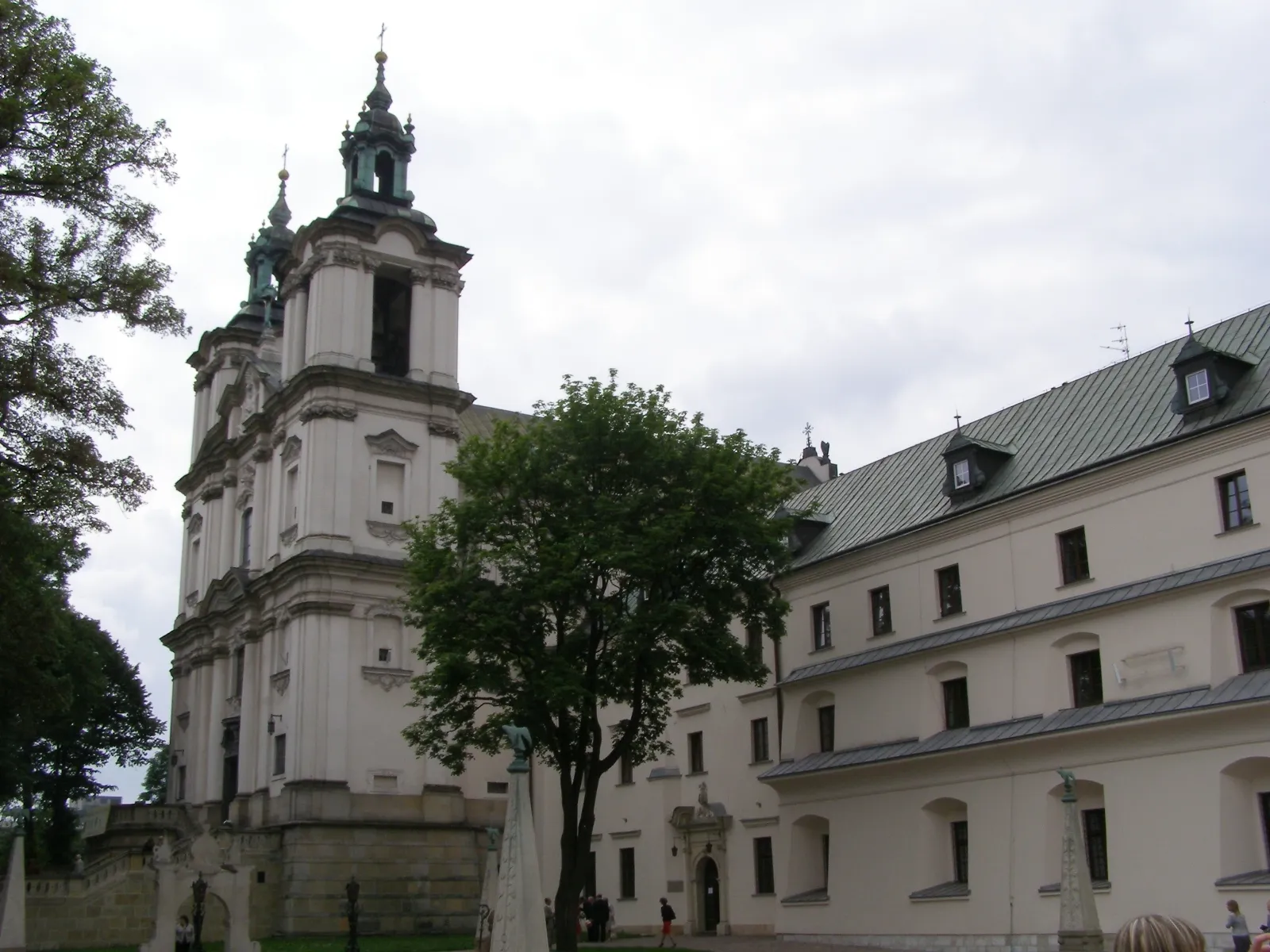
The rock the church sits on is where Bishop Stanislaus was killed in 1079, on the orders of the king he had excommunicated, which made him Poland’s patron saint and made this a pilgrimage site four centuries before anything Baroque went up on it. The pool in the courtyard is part of that story. Church and courtyard are free; the crypt runs on daytime hours for a few złoty and is by request in winter.
Wawel has no rail link of its own to the airport
Kraków Główny is the only station that does, and it is about twenty-five minutes on foot north of the hill, or a short tram ride from the stops on the Planty side. From there the SKA1, a regional service run by Koleje Małopolskie, reaches Kraków John Paul II International Airport in around 20 minutes for a flat 20 złoty, roughly twice an hour through the day and hourly early and late. The airport platform is joined to the terminal by a covered footbridge of 200 to 250 metres, so the honest door-to-door figure from Wawel is closer to an hour than to the 20 minutes on the timetable.
Nothing runs on that line between about 1am and 4am. Bus 902 covers the same route from around 11.25pm, hourly until just after 4am, for 6 złoty and about 45 minutes, and a taxi from the hill is roughly 50 złoty.
The awkward part of this particular route is that it finishes at the bottom of a hill you started at the top of, or on the far side of a river, depending on how far east you walked. Everything here is flat once you are down at the water, and none of it goes back past the station until you do.
Frequently asked questions
Can you get off Wawel Hill without using the Dragon's Den steps?
Yes. The hill has two walking approaches, one from the Old Town end and one from the riverside, and both work in either direction. The cave is the only one-way route on the hill: 135 steps down a tight spiral with no lift, no way back up and no room for a pushchair, so anyone who cannot manage stairs should treat it as a separate decision rather than the way down.
Is the Dragon's Den worth doing with children?
It is the one thing on the hill built for them. Tickets are 15 złoty, 10 reduced and free under seven, the walk underground is 81 metres of lit cavern rather than a squeeze, and it comes out at the bronze dragon on the riverbank that shoots a jet of flame every few minutes. The staircase is the catch: 135 steep steps down, carried children and no strollers, and it only runs from late April to the end of October.
Can you walk from Wawel to Kazimierz along the river?
Easily, and it is the better route. The embankment path is flat, paved, closed to cars and lit at night: about ten minutes east to Skałka, twenty to the Father Bernatek footbridge. That lands you in Kazimierz, which is a slower few hours in its own right. The main Kraków route makes the same trip through the streets instead, which is quicker but has traffic lights in it.
What does the Wawel Cathedral ticket cover?
Four things on one 26 złoty ticket, 18 reduced: the cathedral, the Royal Tombs in the crypt, the climb to the Sigismund Bell, and the Cathedral Museum in a separate building across the courtyard. It is sold only at the office opposite the cathedral door, not online and not on the hill's main ticket desk. Hours are 9am to 5pm Monday to Saturday and 12.30pm to 5pm on Sunday from April to October, closing an hour earlier the rest of the year.