Kraków Główny Layover: The Barbican and Floriańska
Part of the full Kraków Layover: Old Town and Wawel From KRK
Kraków Główny, the city’s main railway station, sits within ten minutes’ walk of the Barbican, St Florian’s Gate and the whole length of Floriańska Street, so a couple of free hours can go on the northern edge of the Old Town without ever reaching Wawel or crossing the river.
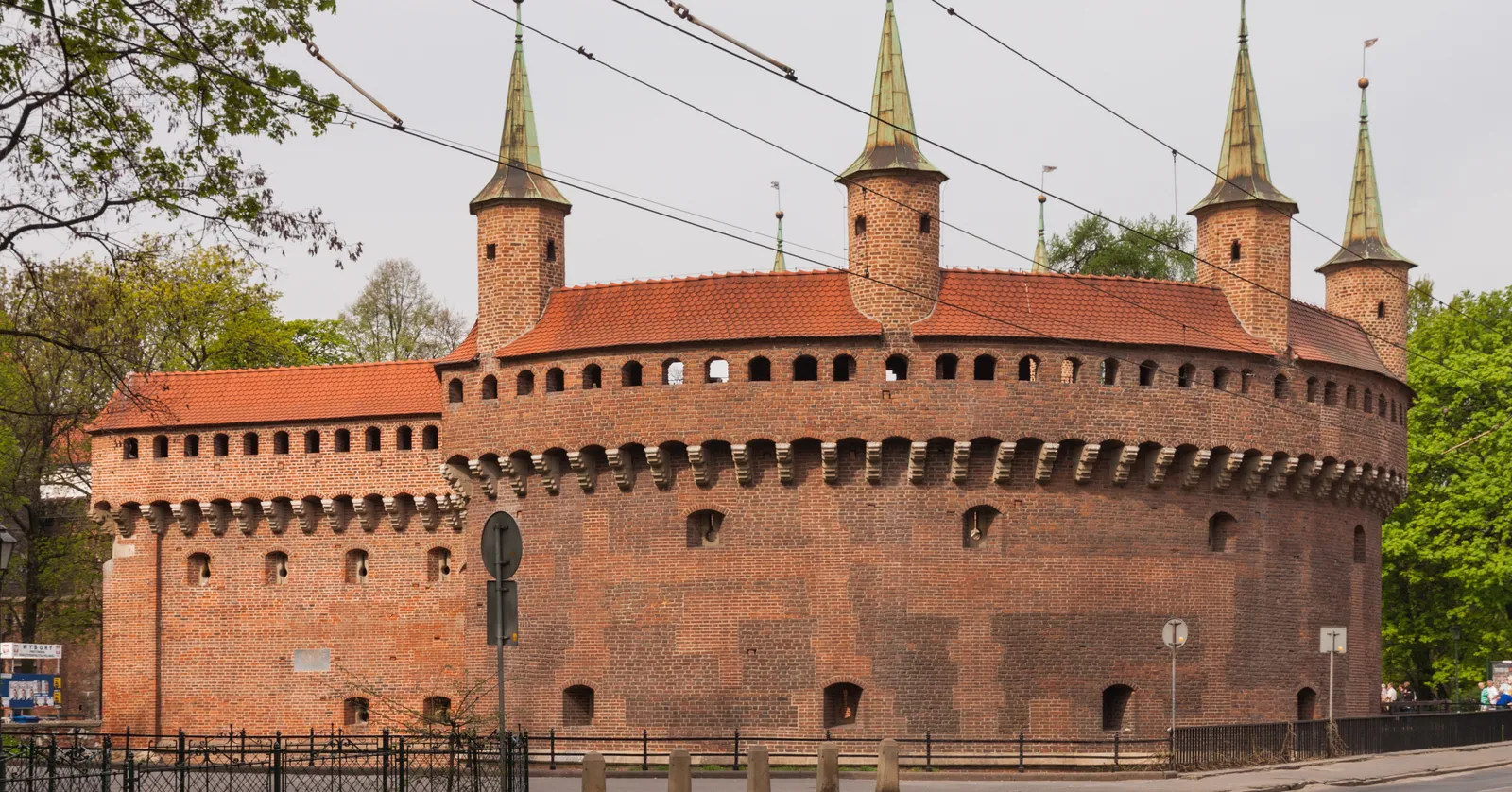
The Barbican, seven turrets on a circular brick outwork
Around 1498 Kraków built a detached fort out beyond its northern gate, on the far side of a moat 26 metres wide and six deep, and then kept it when the rest of the fortifications were pulled down in the 1820s. The courtyard inside measures 24.4 metres across. The brick walls are three metres thick at the base and taper to half a metre at the top, and they carry 130 arrowslits under a roofline of seven pointed turrets. It stands on the Planty, the ring of park laid out where the walls used to run, and from the station concourse it is under ten minutes on foot.
A plaque on the eastern face names Marcin Oracewicz, a haberdasher who defended this spot against Russian troops in 1768 during the Bar Confederation. The story attached to him is that he ran out of shot and fired a button off his own coat, killing the officer leading the attack. Going inside costs 22 złoty, 16 reduced, Tuesday to Sunday from 10am to 4pm, on a ticket that also covers the surviving stretch of city wall. Standing in the park looking at it costs nothing at any hour, which for most short stops is the version worth having.
Leonardo’s Lady with an Ermine on ulica Pijarska
Cecilia Gallerani was about sixteen when Leonardo painted her holding a white ermine, around 1489 in Milan, and the panel now hangs at ul. Pijarska 15, roughly ten minutes from the station platforms. It is the reason most people come to the Czartoryski Museum, which reopened in December 2019 after nine years closed for rebuilding, but the collection around it holds two Rembrandts, a Mantegna and a Holbein as well.
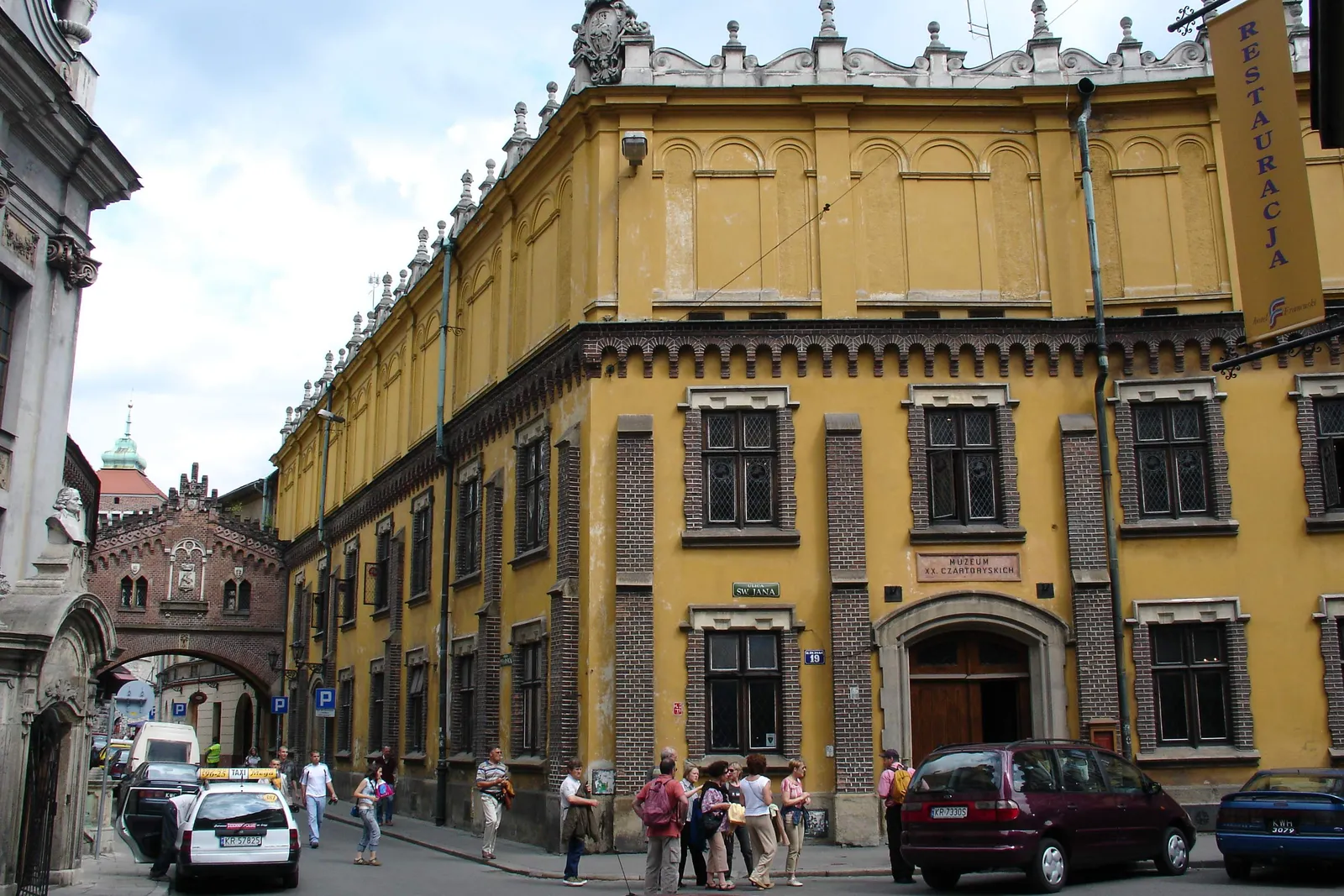
One frame on the wall is empty. It held Raphael’s Portrait of a Young Man until 1945, when the painting left Kraków with the German occupation and was never seen again; it is one of roughly 800 items still missing from this museum alone, and the frame has been left hanging for it. The museum opens Tuesday to Sunday, 10am to 6pm, with last admission an hour before closing, at 65 złoty or 50 reduced. Tuesdays are free but the tickets are timed and the day’s allocation is small, so a pass that covers entry here is the surer way in on a fixed schedule. Three connected buildings make up the museum, linked by an arcaded bridge thrown across ulica Pijarska, which is worth standing under whether or not you go in.
St Florian’s Gate, the one survivor of eight medieval gates
The tower first turns up in the records in 1307 and stands 33.5 metres to the tip of the Baroque metal helmet added in 1660 and reworked in 1694. Kraków’s walls had eight gates; this is the only one the nineteenth-century clearances left standing. On its city face is an eighteenth-century relief of St Florian, and on the outer face a stone eagle carved in 1882 by Zygmunt Langman to a design by Jan Matejko.
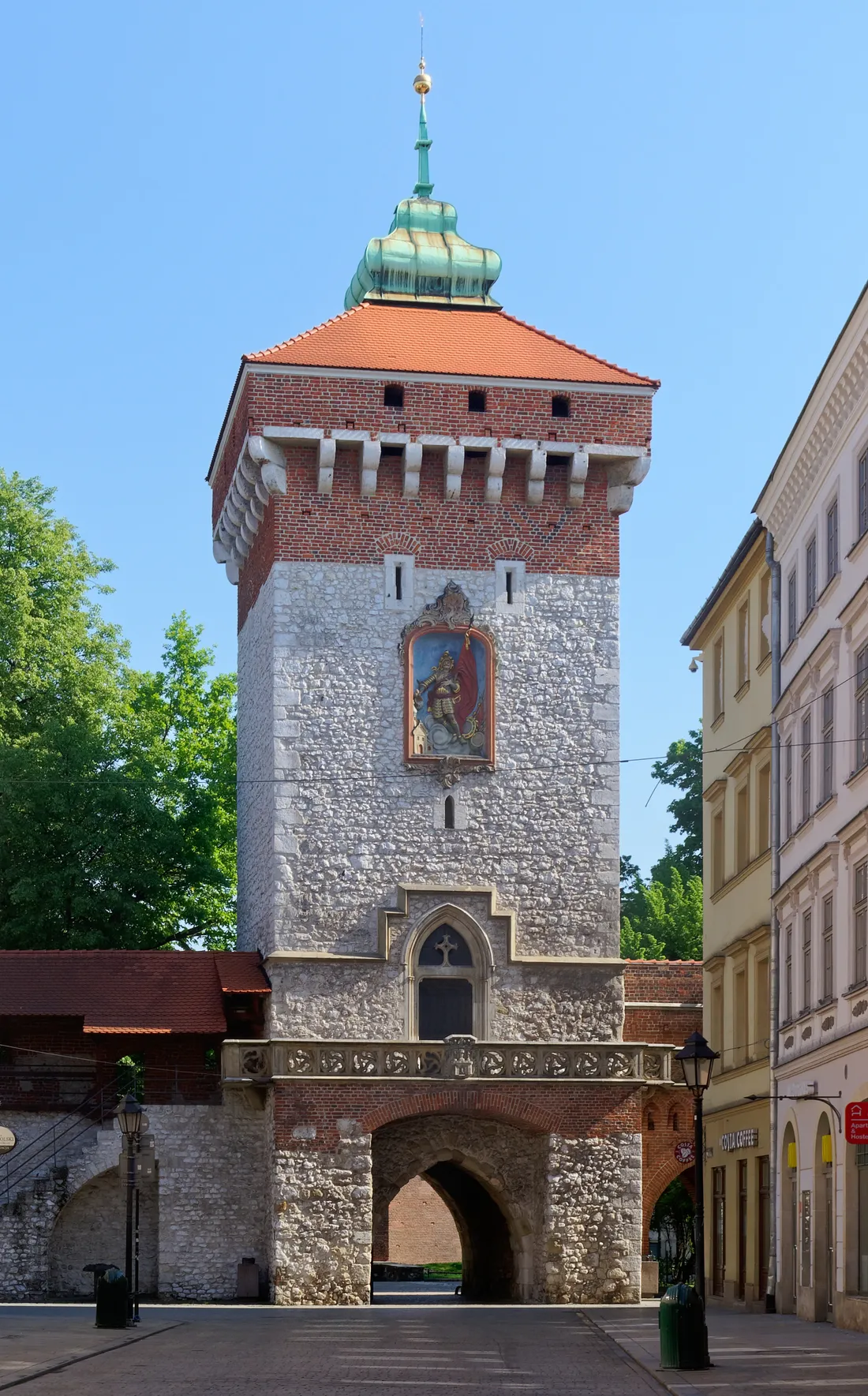
Three Gothic towers still stand on the wall running west from the gate, built and manned by the carpenters’, joiners’ and haberdashers’ guilds. Local painters hang framed canvases directly on that stretch of wall along ulica Pijarska and sell them off it, every day of the year including through the winter, which is the closest thing the Old Town has to a permanent open-air gallery. Walking through the archway itself is free and there is no closing time on it.
Floriańska Street, the royal way down to the Main Market Square
Kings came into Kraków along this street for their coronations, north to south, and it has carried the same name for close to seven hundred years. It runs a few hundred metres, five minutes end to end at a normal pace, cobbled and closed to traffic, with the two unequal towers of St Mary’s Basilica sitting square in the view the whole way down.
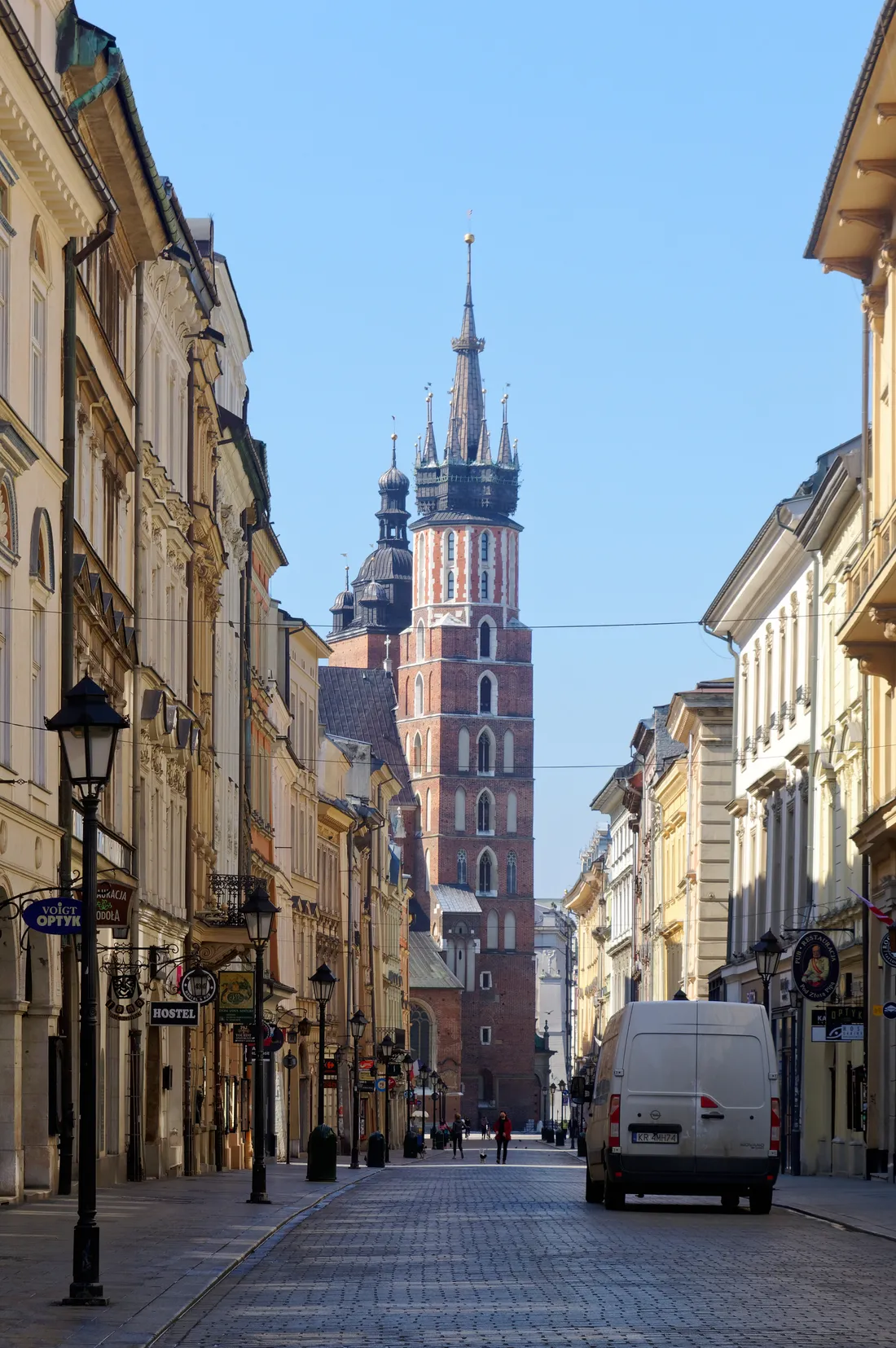
Number 41 is where Jan Matejko lived and painted, now a museum of his studio and his things. Number 45 is Jama Michalika, opened in 1895 by a confectioner from Lviv who let students from the art academy up the road eat on credit and took their drawings in payment; the walls are still covered in what he collected. From 1905 the back room housed the Green Balloon, the cabaret that the Young Poland writers and painters ran there for the best part of a decade, and the interiors were rebuilt in Art Nouveau by the stage designer Karol Frycz in 1910. Coffee at a table under them costs what coffee costs.
Floriańska ends at the Main Market Square, and that is where the longer version of this afternoon begins: with four hours or more, the full Kraków route carries on south down Grodzka to Wawel Hill and over the river to Podgórze.
Every way out of Kraków Główny runs through the concourse under the platforms, and most of the exits from there come up inside the shopping centre attached to the station rather than on the street, which is a slow stretch to cover twice with a suitcase.
The Grunwald Monument on Matejko Square
Ignacy Jan Paderewski, the pianist, put up roughly 500,000 crowns for the monument and had it unveiled on 15 July 1910, five hundred years to the day after the battle it commemorates, in front of a crowd reported at 150,000. Władysław Jagiełło sits on the horse at the top; the Grand Master of the Teutonic Order lies dead across the base.
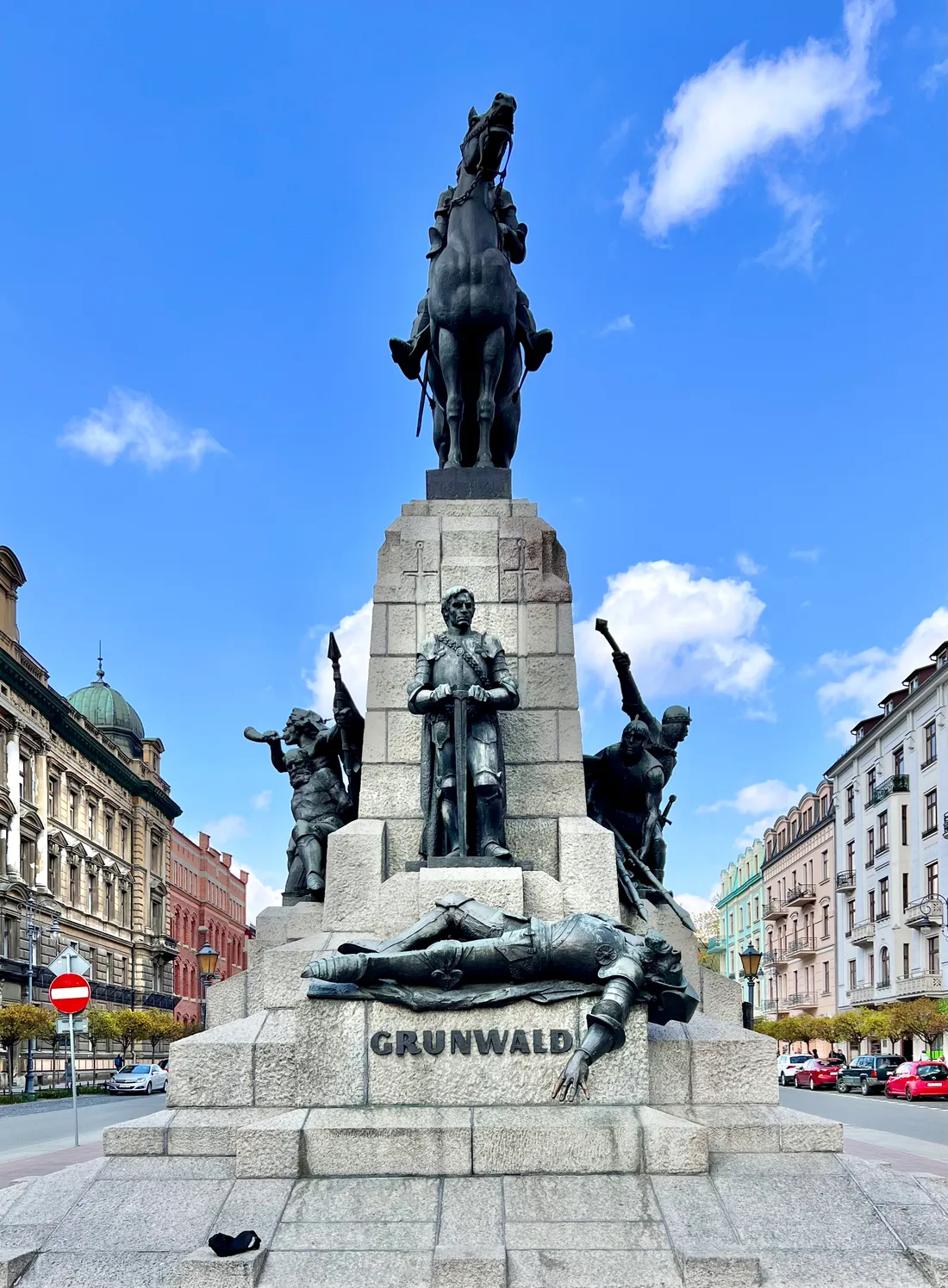
The German occupation dismantled it between November 1939 and April 1940, dynamiting the plinth and shipping the bronze away. What stands now went up in 1976, rebuilt from photographs and the sculptor’s original models. The square around it is open ground with no ticket and no hours, five minutes from the Barbican across the park ring, and it also holds St Florian’s Church and the Academy of Fine Arts building that fed Jama Michalika its artists.
The airport line out of Kraków Główny also runs to the salt mine
One regional service, the SKA1, covers the whole of it: Wieliczka at one end, Kraków Główny in the middle, Kraków John Paul II International Airport at the other. The airport leg takes about 20 minutes for a flat 20 złoty, roughly twice an hour through the day and hourly early and late, with first departures around 4am and last around 1am. Tickets come from the machines on the concourse or from the conductor, and cards work. At the airport end the platform connects to the terminal by a covered footbridge of 200 to 250 metres, so allow 35 to 40 minutes door to door rather than the 20 on the timetable.
Between roughly 1am and 4am nothing runs on that line. Bus 902 covers the same route from about 11.25pm, hourly until just after 4am, for 6 złoty and about 45 minutes; a taxi is nearer 50 złoty and no faster than the train outside rush hour.
Working backwards from a flight, an hour and a half from Matejko Square is comfortable: ten minutes back to the station, a few for the bag, the wait, the ride and the footbridge. Everything on this route is inside that ten-minute radius, which is the whole argument for staying on this side of the Old Town when the time is short.
Frequently asked questions
How long is the walk from Kraków Główny to the Main Market Square?
About fifteen minutes for a little over a kilometre, all of it flat and all of it on pedestrian ground once you clear the station. The natural line runs through the park ring to the Barbican, under St Florian's Gate and straight down Floriańska, which is why those three end up on a short stop whether you planned them or not. If you have four hours or more and want Wawel Hill and the far bank of the river as well, the main Kraków route is the longer version of the same afternoon.
Is Kraków Główny step-free from the platform to the street?
Yes. The five island platforms each have a lift and an escalator down to the concourse that runs underneath the tracks, and from there the route through the shopping centre to Pawia Street is level. There is also a covered walkway that skirts the shopping centre entirely and comes out on the Old Town side, signed for ul. Lubicz, which is the shorter way if you are heading for the park ring.
Is anything near Kraków Główny worth seeing in the evening?
The outdoor half of this route, yes. The Barbican shuts at 4pm and the Czartoryski Museum at 6pm, but St Florian's Gate, the surviving wall stretch, Floriańska and Matejko Square are all open street at any hour and lit after dark. The café at Floriańska 45 serves until 10pm on weeknights and 11pm on Friday and Saturday, which makes it the practical last stop before walking back.
Is a guided Old Town walk worth doing on a short stop?
It depends whether you want the streets explained or just walked. Everything described here is free to look at and reads well enough on its own, so for two hours or less the honest answer is no. With three or four hours and no appetite for navigating, a two-hour guided walk of the Old Town covers this ground plus the Main Market Square. It starts in the centre rather than at the station, so budget ten minutes at each end to reach it.