Grünerløkka Layover in Oslo: Mathallen
Part of the full Oslo Layover Guide: The Opera Roof From OSL
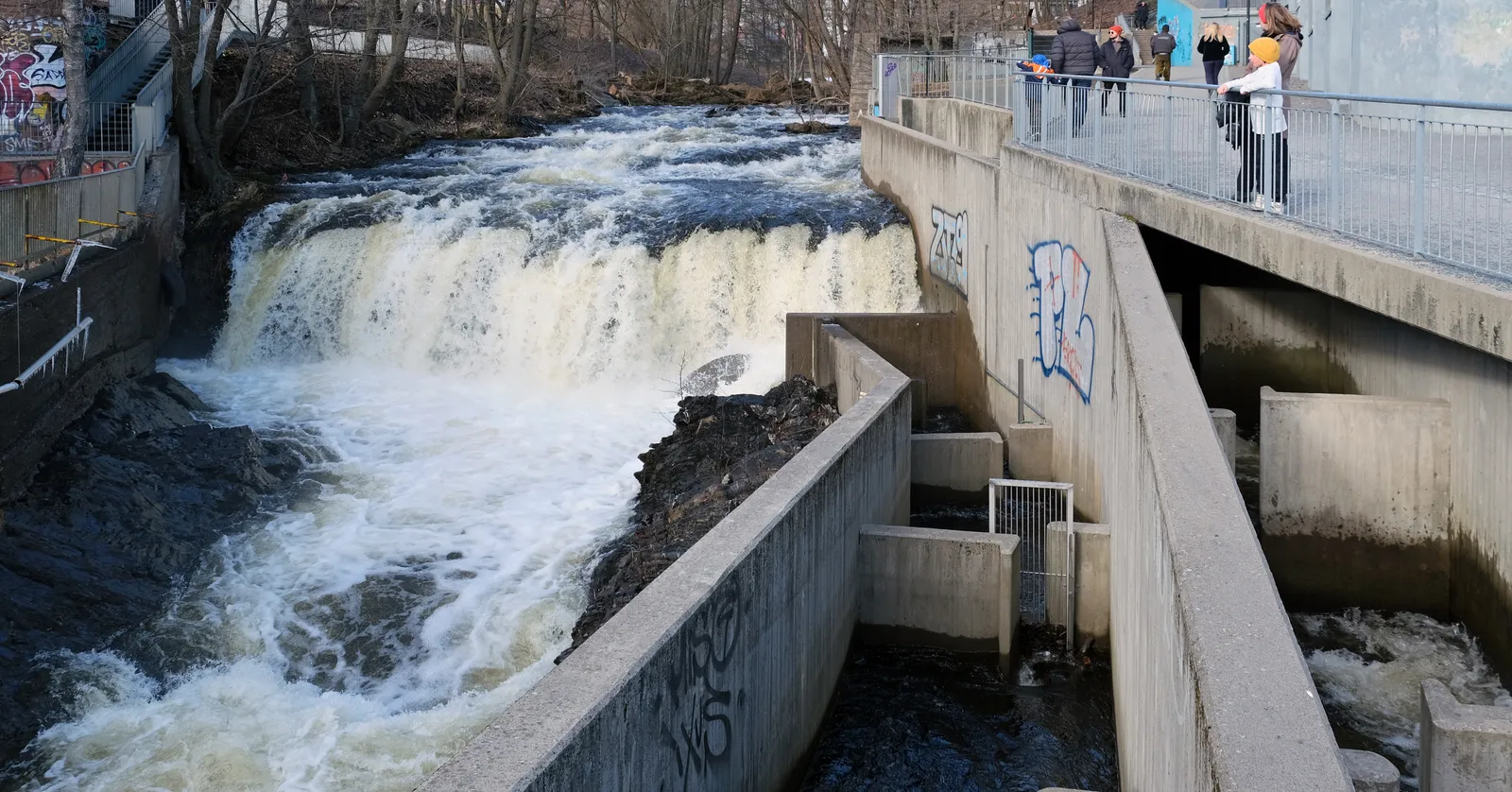
Grünerløkka is the old mill district inland from Oslo’s harbour, built along the Akerselva, with a riverside path past working waterfalls, a food hall in a converted iron foundry at Vulkan, and a grid of 19th-century tenement streets around Olaf Ryes plass.
The Akerselva and the mills that used to run on it
The river is the reason the district exists. It drops from Maridalsvannet in the north to the fjord over roughly eight kilometres, and the fall in it, some twenty waterfalls with a 16-metre drop as the largest, was Oslo’s power supply before electricity. Six large sawmills stood on it by 1624; by 1743 there were 21; by 1820 the count had reached 24 sawmills plus a clothing factory, two paper mills, four grain mills, a playing-card works and a run of oil and soap factories. The workers lived on the banks, which is how Grünerløkka came to be built at all.
A continuous path follows the whole length now, and the stretch through Grünerløkka is the most worked-over of it: brick mill buildings converted or half-converted, weirs, footbridges, and retaining walls that have been painted end to end for years. It is free, flat enough, and open at any hour. If you would rather have the industrial history and the eating done together, there is a walking tour of the district’s food and breweries that works the same riverbank.
Mathallen, a food hall in a former iron foundry
Vulkan 5 was an iron foundry, and the hall inside it opened as a food market in 2012: over 30 stalls, specialist shops and small kitchens under the original steel roof trusses, arranged around a central floor of tables.
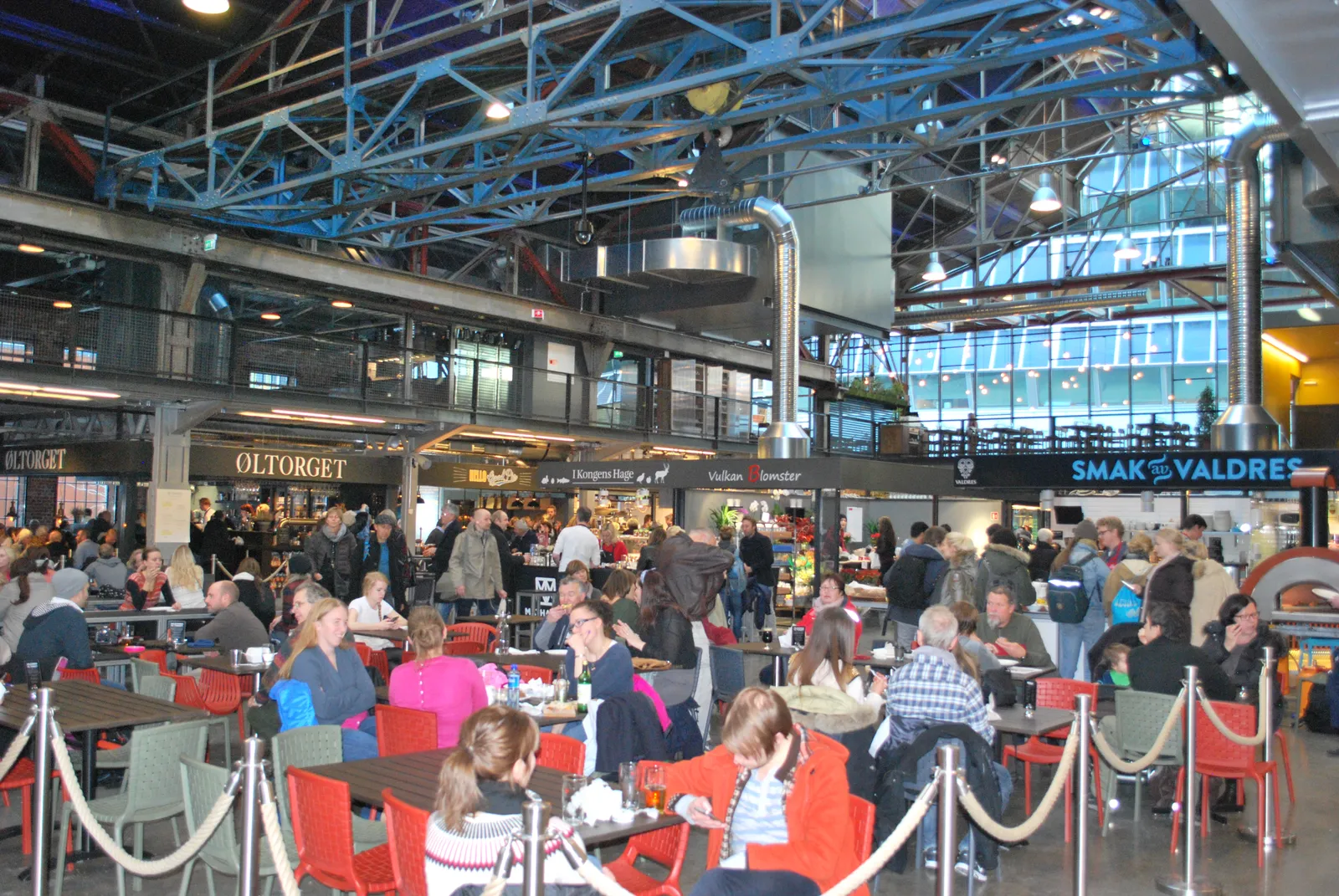
It runs Tuesday to Saturday, 10am to 8pm, and Sunday 11am to 6pm, and shuts entirely on Mondays, which is the single fact most worth knowing before you plan a day around it. Individual stalls keep their own hours inside that window and some kitchens stop early on quiet weekdays.
On the roof, between the hall and the dance house next door, sit two hexagonal timber beehives that Snøhetta designed in 2014 for a local urban beekeeping outfit. Around 160,000 bees live in them, a keeper works them daily, and some of what they produce is sold at the counters underneath, which is about as short as a supply chain gets in a capital city.
The aisles between the counters are narrow and the tables spill into them once lunch starts, so a suitcase is genuinely awkward in here rather than merely unwelcome, and there is nowhere along the river path outside to set one down either.
Olaf Ryes plass, the square Grünerløkka sits out on
Thorvald Meyer bought the land in 1861 and cut the street that still carries his name, and the tenement blocks went up around it fast: the parish covering this district grew from 13,600 people in 1866 to 22,000 by 1900. The square in the middle of that grid was open field until the 1880s, when the city bought it from the Grüner family in 1883 and laid it out as a park.
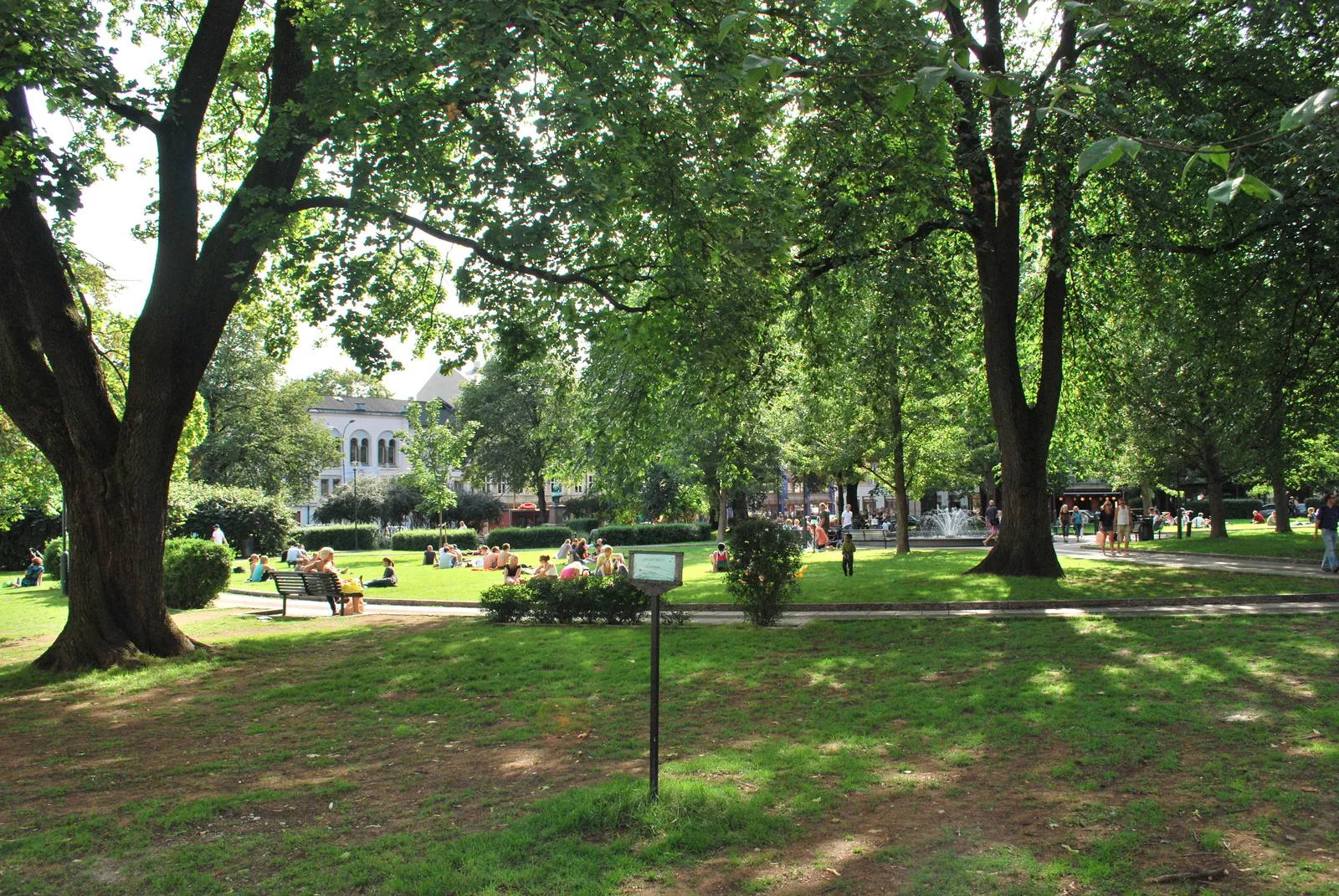
It is still what the district uses as a front garden, which is the point of walking up here rather than staying on the river: the blocks around it were built as workers’ housing and are lived in the same way now, so the square is busy with people who are not visiting anything. A few minutes downstream, in Ingensgate on the riverbank, a handicraft and second-hand market runs every Sunday of the year.
Grünerløkka has trams but no airport train
Nothing that goes to the airport stops in this district, so the trip out is two legs. A tram down Thorvald Meyers gate puts you at Oslo S in about ten minutes; Flytoget, the airport express, leaves from there for Oslo Airport, Gardermoen every ten minutes, 19 minutes and 268 kroner. Vy’s regional trains run the same line for roughly half the fare and a few minutes more.
Two hours from the food hall to the gate covers the tram, the wait, the ride and check-in without rushing. If the free time is shorter than that, or the day is a Monday, the main Oslo route stays down by the water where nothing has a closing day.
Frequently asked questions
What is there to do in Grünerløkka on a short layover?
Walk the Akerselva and eat at the end of it. The riverside path runs the whole length of the district past weirs and waterfalls that powered Oslo's mills, and Mathallen, the food hall in the old foundry at Vulkan, sits directly on it. Olaf Ryes plass and the tenement streets around it fill in the rest. Two hours covers the lot at a walk, and none of it needs booking. Mathallen is the one thing with a locked door: it closes on Mondays.
Can you do Grünerløkka cheaply?
More cheaply than the harbour, yes, but Mathallen is not a budget option by default. The hall mixes counters where a plate is the price of a sandwich with sit-down restaurants that are not, and the difference between the two is a decision you make at the door rather than at the till. Everything outside it is free: the river path, the waterfalls, the squares, and the street art along the retaining walls. The Sunday market by the river costs nothing to walk through either.
When is the Sunday market in Grünerløkka?
Every Sunday, year round, in Ingensgate beside the Blå and Ingensteds venues on the riverbank. It is a handicraft and second-hand market rather than a food one: knitwear, ceramics, jewellery, glass, vintage clothes, toys and work by local artists. Browsing is free, and it is a few minutes downstream from the food hall, so the two combine into one Sunday afternoon without a change of transport.
Where does the Akerselva walk start and end?
It runs about eight kilometres in total, from Maridalsvannet at the top of the city down to the fjord, and the path follows the water almost the whole way. The Grünerløkka stretch is the middle of it and the most built-up: converted mill buildings, weirs, footbridges and painted retaining walls. You do not need to walk the lot. Picking it up at the food hall and following it either way for twenty minutes gives you the industrial half of the river without committing to the full length.