Layover Near Oslo Central Station
Part of the full Oslo Layover Guide: The Opera Roof From OSL
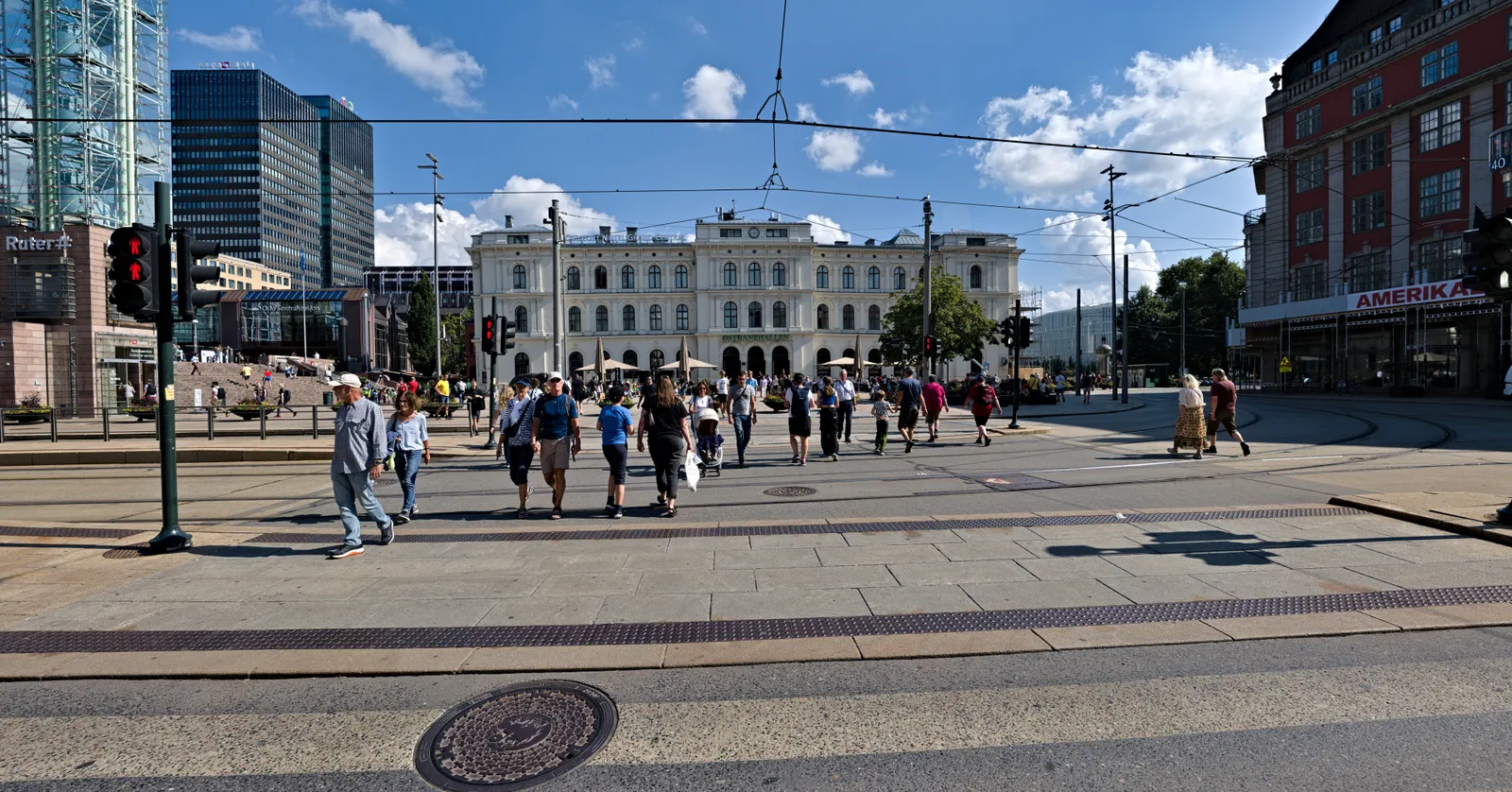
Oslo Central Station sits within fifteen minutes’ walk of a cathedral consecrated in 1697, a red brick market arcade from the 1840s, the twelve towers of the Barcode row and a free seawater pool out on the Sørenga spit.
Østbanehallen, the 1882 train hall at Oslo Central Station
Georg Andreas Bull expanded Oslo’s East station in 1882, replacing most of an 1854 original by Heinrich Schirmer and Wilhelm von Hanno with a bigger, airier train hall and two rendered brick wings facing the harbour and Jernbanetorget. Bull had already built the West station across town, which is now the Nobel Peace Center: the two ends of 19th-century Oslo rail, by the same hand, both still standing and neither one still a station.
Trains stopped using it when the current Oslo S opened in 1980. It spent the years after that as a shopping centre, and since 2012 it has been a hotel with 170 rooms, with the ground floor kept as a hall of food counters, bars and shops. Walking through it is free and takes two minutes, and it is the only part of the station complex where the ceiling is worth looking at. There is a tourist information desk in there too.
Oslo Cathedral’s painted ceiling on Stortorvet
Stortorvet, the market square about seven minutes north of the station, has held Oslo’s cathedral since 1697, when the present building was consecrated on foundations laid three years earlier. Entry has never been charged.
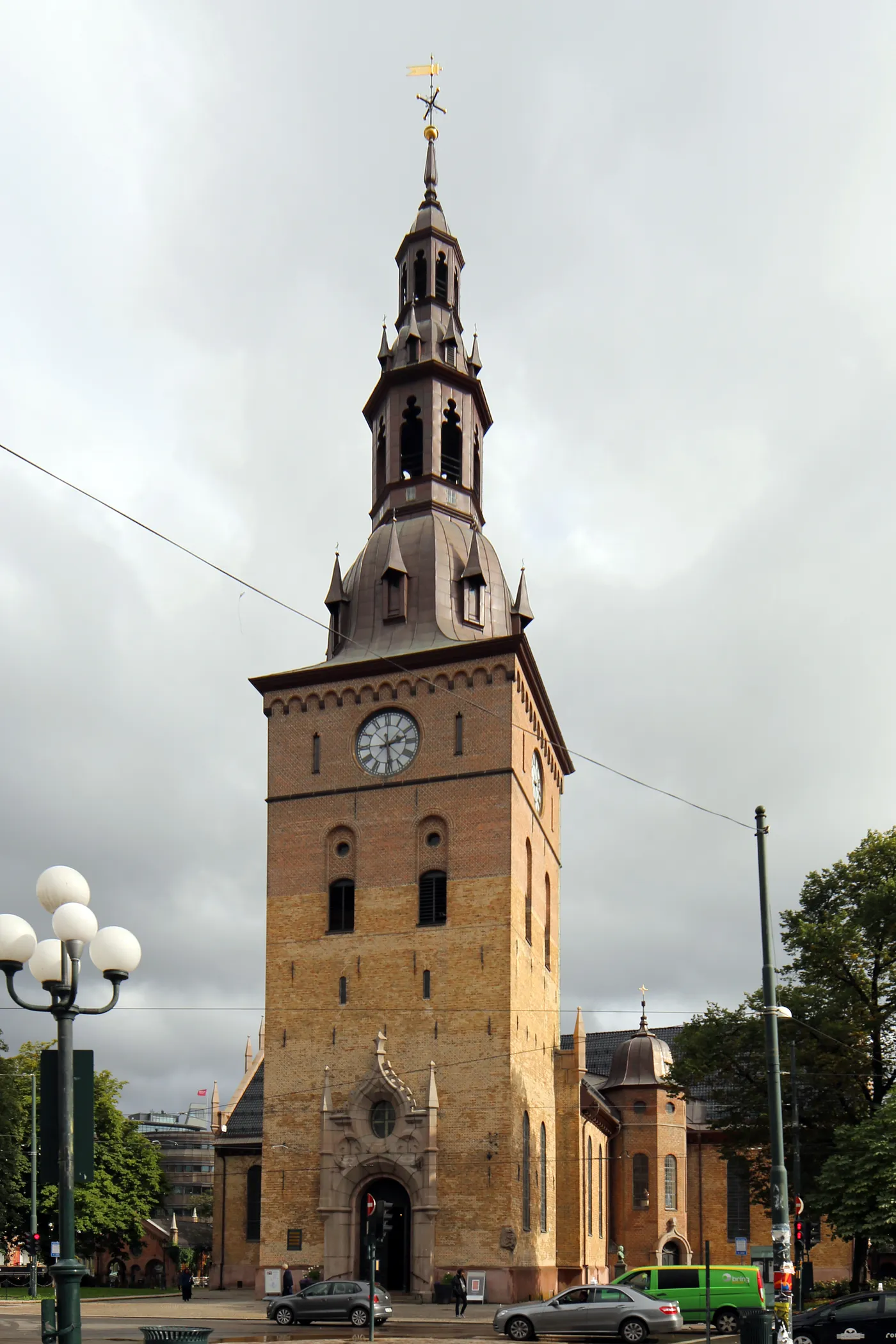
The ceiling is the reason to go in. Hugo Lous Mohr painted the whole of it, working across the second half of the 1930s and through the 1940s, so what is overhead is one continuous 20th-century scheme in a 17th-century room rather than the patchwork of periods most old cathedrals carry. Emanuel Vigeland, younger brother of the sculptor whose figures fill the park out west, made the stained glass in the choir between 1910 and 1916. The hours are the thing to check: Saturday through Thursday it is open 10am to 4pm, but Friday inverts that completely, shut all day until 4pm and then open until midnight.
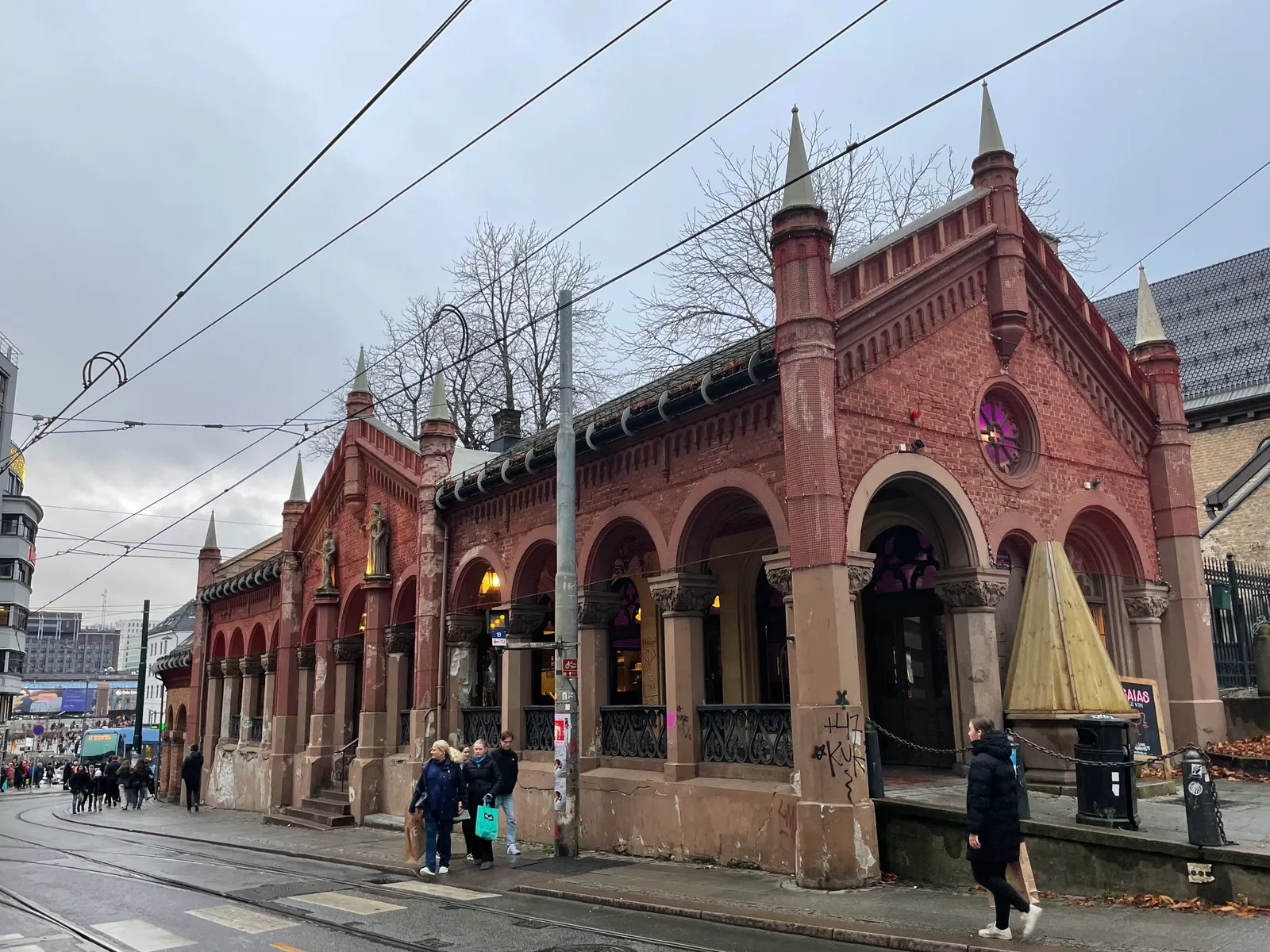
Wrapped around the back of the churchyard is Basarhallene, a curved red brick arcade of open round arches built between 1840 and 1859 to plans by Christian H. Grosch, the city architect who also drew the university buildings on Karl Johans gate. It was a food market, and one section of it served as Oslo’s main fire station until 1939. The arches now hold cafés and small shops, and the courtyard behind them is a quiet place to sit that most people crossing Stortorvet never turn into.
The twelve towers of Barcode on Dronning Eufemias gate
Dronning Eufemias gate runs east from the south side of the station’s tracks, and the row of buildings along its northern edge is what Oslo calls Barcode: twelve narrow high-rises, each by a different hand within one masterplan by DARK and a-lab with the Dutch firm MVRDV, finished in 2016.
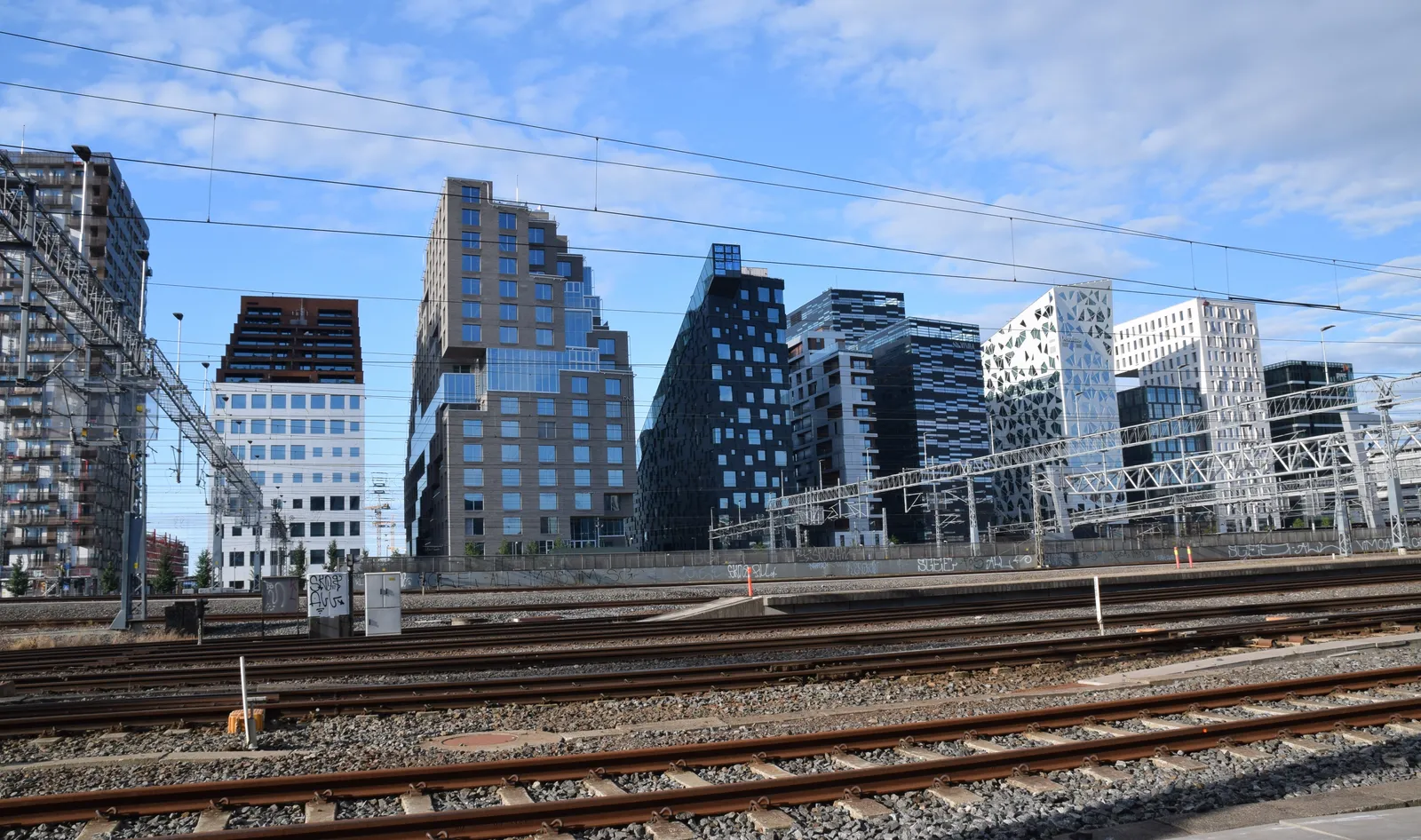
The point of the thing is the gaps. Each block is thin and separated from its neighbours, so the row reads as a set of vertical bars from a distance and lets daylight and sight lines through to the fjord from behind, which is what a solid wall of offices would have blocked. About 10,000 people work in them and 400 flats sit among the offices. You do not go inside; you walk the length of it in ten minutes, or look at it for free from the north side of the tracks, which is where the row actually reads as a row.
The seawater pool at the end of Sørenga
Sørenga is a spit of reclaimed dock south-east of the station, and the bathing complex at the end of it is free, municipal, and open until 10pm. There is a 50-metre lane pool, a shallower children’s pool, a diving board, a ramp for wheelchair access into the water, and floating jetties running out into the fjord with Hovedøya island in the view.
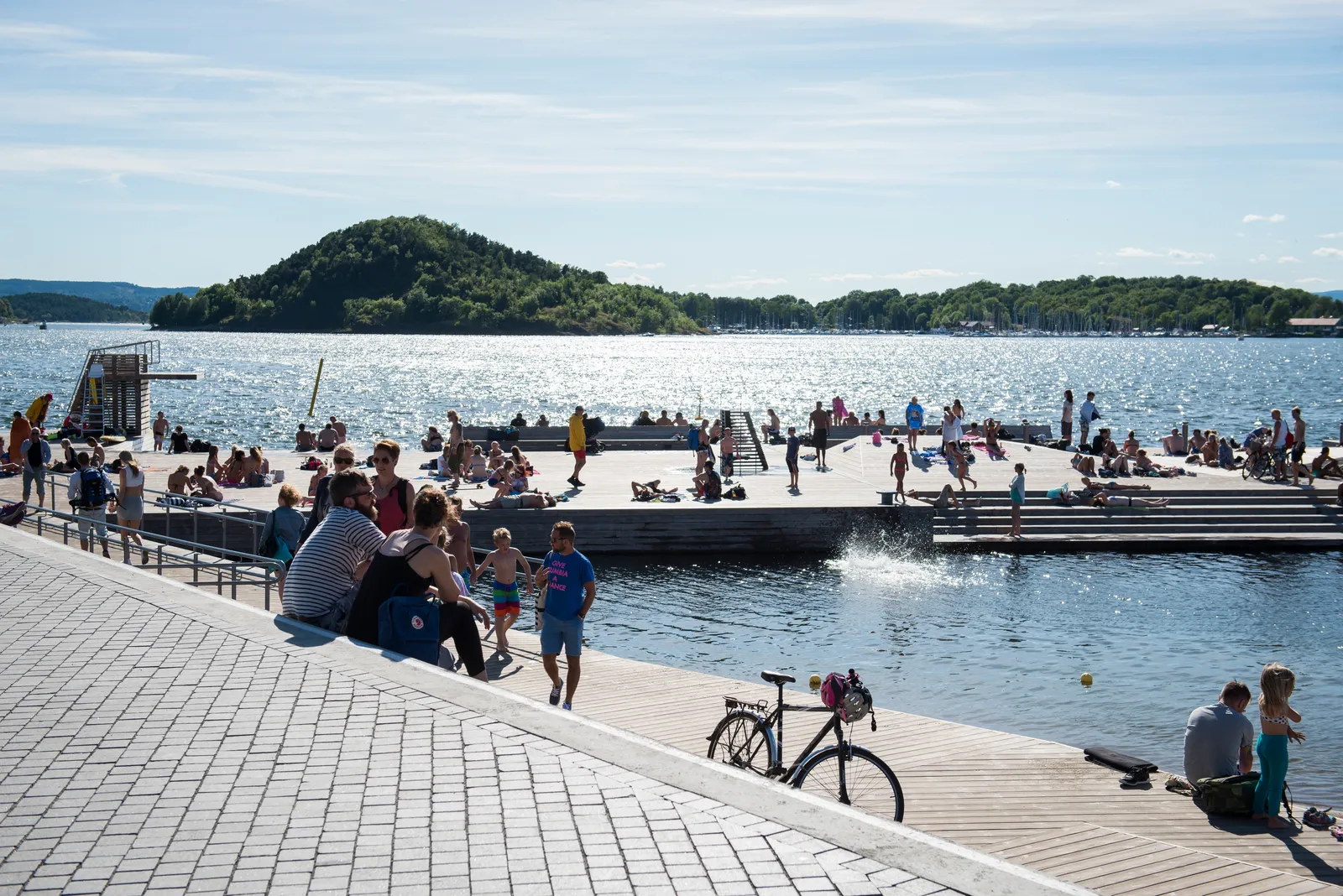
It stays open in winter for cold-water swimmers, and there is a sauna on the spit for afterwards. Getting there takes about fifteen minutes on foot from the station, out past the Opera House and over a floating footbridge, all of it flat and none of it charged.
The walk back rejoins the station through the concourse under the platforms, which empties onto Jernbanetorget, where the trams, buses and metro entrances all share one square; it is not ground you want to cross twice with a suitcase to retrieve at the end.
The airport express and the local train share one line out of Oslo S
Flytoget, the airport express, leaves Oslo S for Oslo Airport, Gardermoen every ten minutes and takes 19 minutes, at 268 kroner for an adult, 134 for students, 16-to-20-year-olds and over-67s, and nothing at all for children under 16 travelling with an adult. Vy’s regional trains run the same Gardermoen line for roughly half that and take about 23 minutes. Both arrive at a station in the terminal basement, one level below the check-in hall.
Working back from a departure, two hours from Jernbanetorget covers it: retrieving the bag, the platform, the ride and check-in. If the free time runs longer than this route needs, the wider Oslo walk picks up the Opera House roof, Akershus Fortress and the Nobel Peace Center in Bull’s other station, all of which sit further out than the fifteen minutes this page stays inside.
Frequently asked questions
What is actually within walking distance of Oslo Central Station?
More than the station's own concourse suggests. Oslo Cathedral is about seven minutes north up to Stortorvet, free to walk into, with the 1840s bazaar arcade wrapped around its churchyard. The Barcode row of twelve towers starts immediately south of the tracks. Sørenga's free seawater pool is fifteen minutes out along the water past the Opera House. None of those four charges anything, and none of them needs to be booked, which is why this works as a two-hour window rather than a planned afternoon.
Is Oslo Cathedral open on a Friday afternoon?
Not in the afternoon, no, and that catches people out. The cathedral keeps 10am to 4pm from Saturday through Thursday, but on Fridays it does the opposite: the doors stay shut until 4pm and then stay open until midnight, as a night-open church. So a Friday arrival at 2pm finds it locked, and a Friday evening between 4pm and midnight finds it open when almost everything else in the centre has closed.
Can you swim near Oslo Central Station?
Yes, and it costs nothing. Sørenga sjøbad is a seawater bathing complex at the end of the Sørenga spit, about fifteen minutes on foot from the station along the water, with a 50-metre lane pool, a separate children's pool, a diving board and floating jetties out into the fjord. It is open daily until 10pm, and it stays open through the winter for cold-water swimmers, with a sauna on site. Bring a towel: there is nowhere on the spit that rents one.
Does anything near Oslo Central Station work with kids?
Two things in particular. Sørenga has a shallow children's pool set apart from the deep water and a diving board older kids queue for, and it is free, so a bad half hour costs nothing. If the weather rules that out, the Paradox Museum on Rosenkrantz' gate, about ten minutes from the station just off Karl Johans gate, is seventy-odd rooms built on optical illusions, open 11am to 7pm on weekdays and from 10am at weekends, 279 kroner for an adult with last entry an hour before closing; booking a slot ahead saves the queue at the door on a wet afternoon.