Venice Layover From Treviso Airport (TSF)
Part of the full Venice Layover: The Grand Canal From VCE
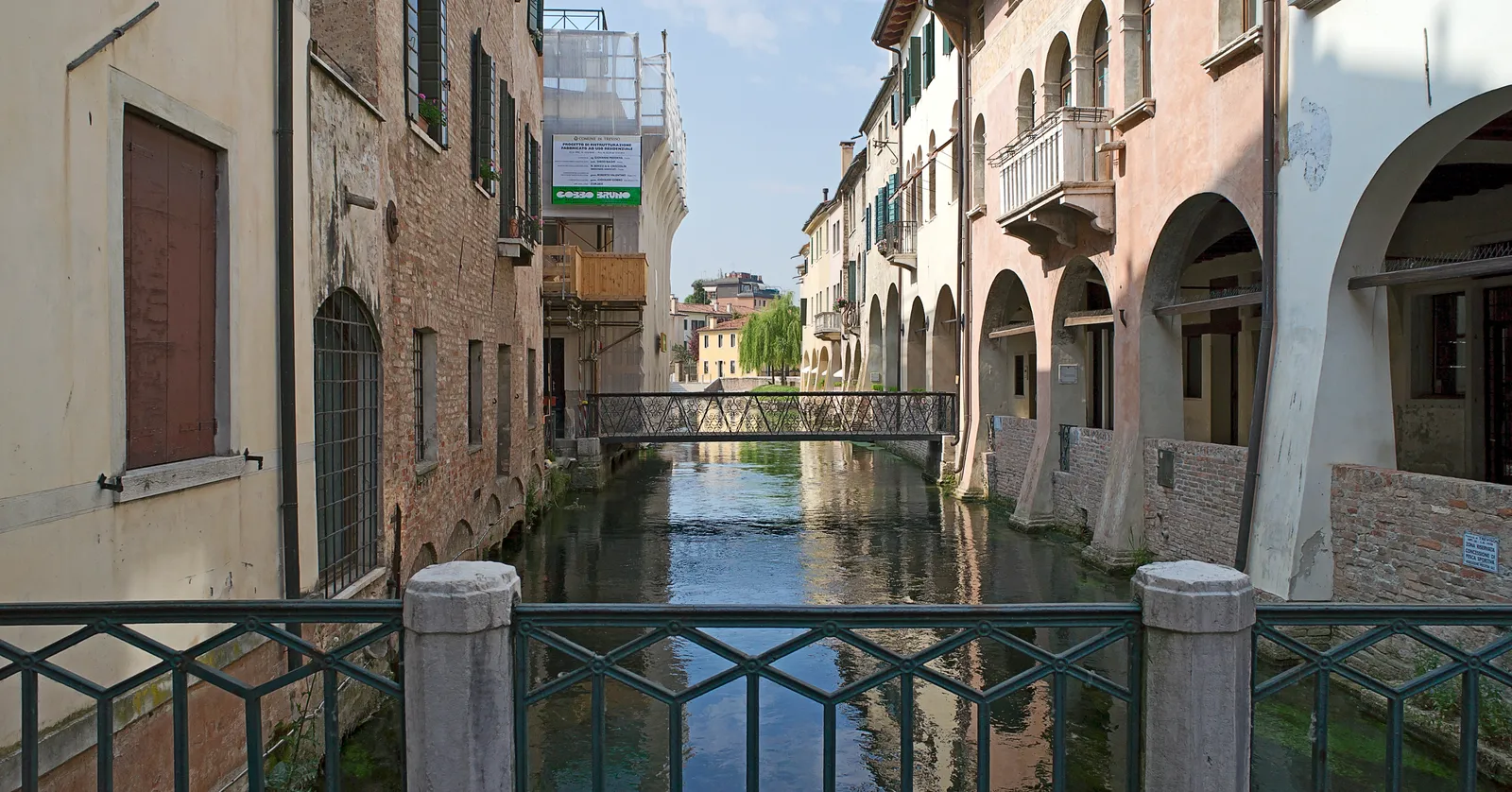
Venice Treviso Airport is 40km inland from the lagoon, and the town it takes its name from is under twenty minutes away on an ordinary city bus. Treviso has canals of its own running through the middle of it, a fish market on an island in one of them, and the earliest known painting of a pair of spectacles, on a chapter-house wall at San Nicolò.
One bus from Treviso Airport goes to Venice, the other into Treviso
The airport is officially named for Antonio Canova, the sculptor born up the road at Possagno, and it is a single small terminal with no railway station attached. Everything out of here is a bus, and there are two entirely different journeys on offer.
The airport coach to Venice costs in the region of 14 euros one way, about 24 as a return, and takes a little over an hour to Piazzale Roma, where the roads stop and the city begins. There is a second operator running the same route by motorway in around 40 minutes, but it terminates at Tronchetto, from where you still need the People Mover up to Piazzale Roma for 1.50 euros. Either way, count on two and a half hours of travel for the return trip before you have looked at anything, which is why this only makes sense with six hours or more. If you are going anyway and St Mark’s Basilica is the reason, note that it now sells timed entry online only, with no desk at the door, so book the slot before you get on the coach through a tours and activities platform rather than after you arrive. The full Grand Canal and St Mark’s route is what you would be doing with the day.
The city bus into Treviso is line 6, from a stop a minute’s walk from the terminal on Via Noalese. It goes about every half hour, reaches Treviso Centrale station and the town centre in under twenty minutes, and costs a couple of euros if you buy before boarding rather than from the driver. That is the version of this stop that actually fits a short gap, and the rest of this page is about what is at the other end of it.
Nearly everyone flying out of here is on a low-cost ticket with a cabin bag they have already paid extra to carry on, which is the one piece of luggage nobody is willing to check just to spend three hours walking round a town.
The Canale dei Buranelli and the water running through Treviso
The thing nobody mentions about Treviso is that it is wet. The Botteniga comes down off the hills, splits into three inside the town walls and runs through the middle of the centre in open channels before joining the Sile on the south side, so the streets keep opening onto water where you are not expecting it.
The best of it is the Canale dei Buranelli, a short stretch where the houses come right down to the channel on both sides, arcades at street level, balconies leaning out over the green water, with a small iron footbridge partway along. The name comes from a family of merchants from Burano in the lagoon who owned the building on the corner. It is a two-minute walk from Piazza dei Signori and it costs nothing, and if you want the whole thing there is a signed walk of about half an hour that follows the water round most of the centre.
Treviso was known for centuries as urbs picta, the painted town, because the house fronts were frescoed rather than faced in stone. Weather and rebuilding have taken most of it, but there are still patches of colour and figure work on facades around the centre once you start looking up.
The Palazzo dei Trecento, rebuilt with its bomb damage showing
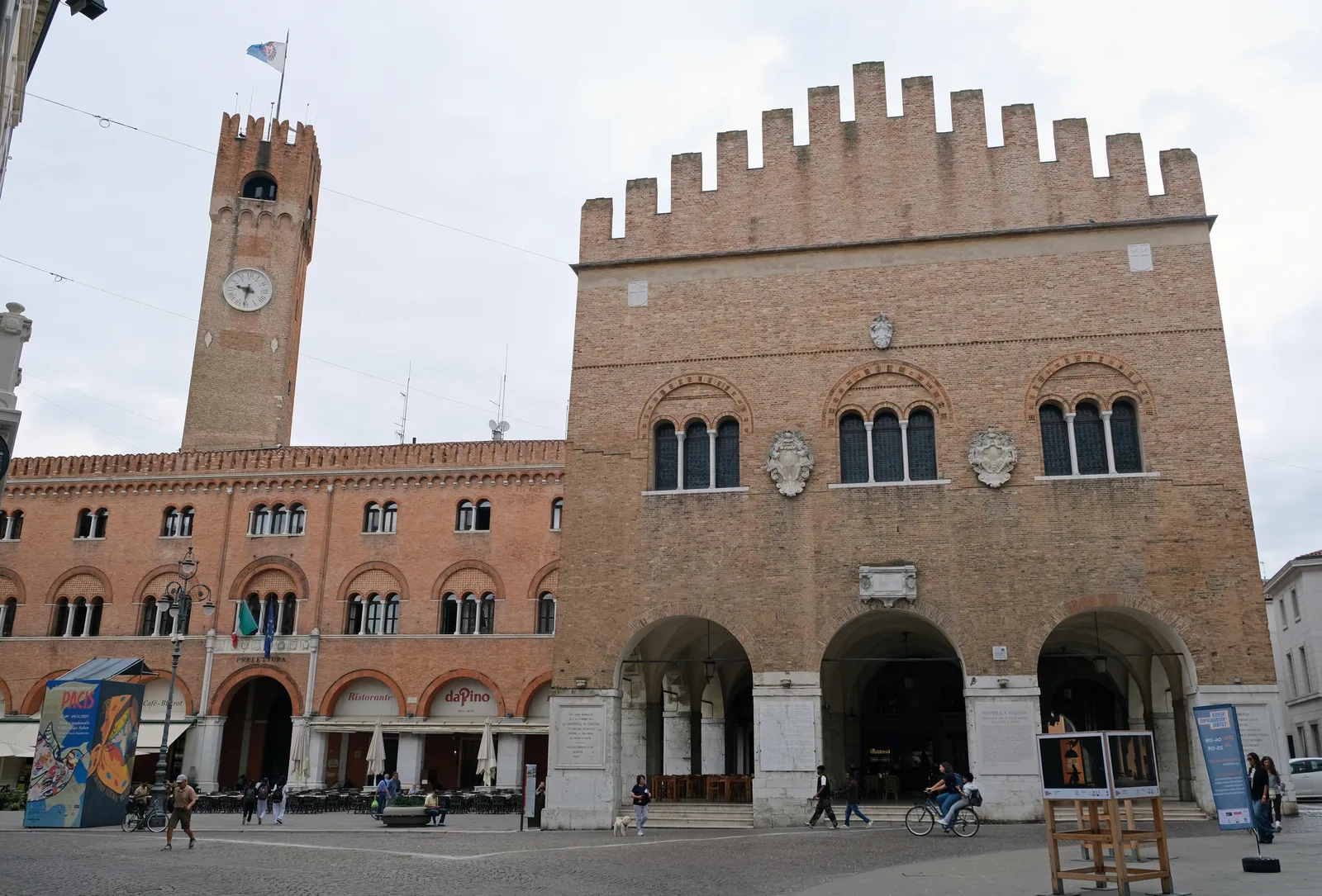
The centre of Treviso is one large brick square with a deep arcade running along the bottom of the buildings and the tables of four or five bars set out under it. Locals drink a spritz here in the early evening in numbers that make the square feel like a room.
The Palazzo dei Trecento is the big battlemented brick block on one side, put up in the thirteenth century as the seat of the council of three hundred that governed the city. What happened to it afterwards is the part worth knowing. On Good Friday, 7 April 1944, 159 American bombers hit Treviso in a raid lasting five minutes, killing well over a thousand civilians and flattening a large part of the medieval centre; a bomb went through the palazzo. The city rebuilt it rather than replacing it, and when the work was done the line between the surviving medieval brick and the new was left plainly visible across the wall instead of being blended away. You can stand in the arcade and see exactly where the building stops being old.
The first painting of a pair of spectacles, in Treviso’s San Nicolò
Ten minutes south-west, near the walls, is a very large brick Dominican church with tall lancet windows and almost no decoration on the outside.
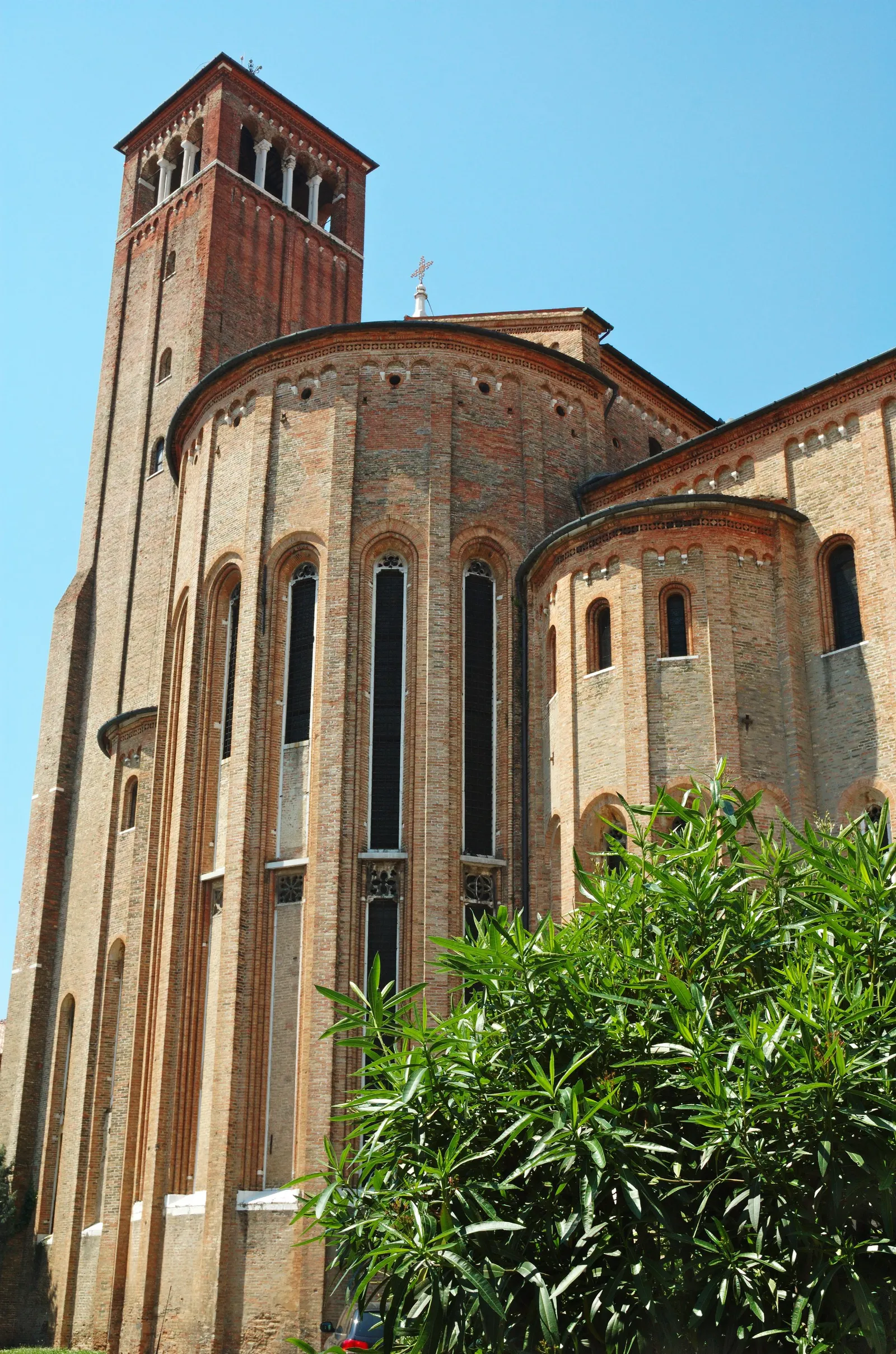
San Nicolò holds Tomaso da Modena frescoes on its columns, but the thing to ask for is the chapter house of the old monastery next door, now part of the seminary. In 1352 the Dominicans commissioned Tomaso, then in his twenties, to paint forty distinguished members of the order round the walls of it. He painted them not praying but working: reading, copying, sharpening a quill, caught mid-task at their desks.
One of them, Cardinal Hugh of Saint-Cher, is wearing a pair of rivet spectacles on his nose. It is the earliest known depiction of eyeglasses in a painting anywhere, dated to the year, and two of his neighbours are using a hand lens and a reading glass on a stand, which makes the wall a small accidental catalogue of what a short-sighted scholar in the fourteenth century had to work with. Access is through the seminary door beside the church and the hours are limited, so it is worth checking before you make the walk.
A fish market on its own island in Treviso
Back toward the centre, one of the canals widens and there is a small island sitting in the middle of it with a roof over it and footbridges onto both banks.
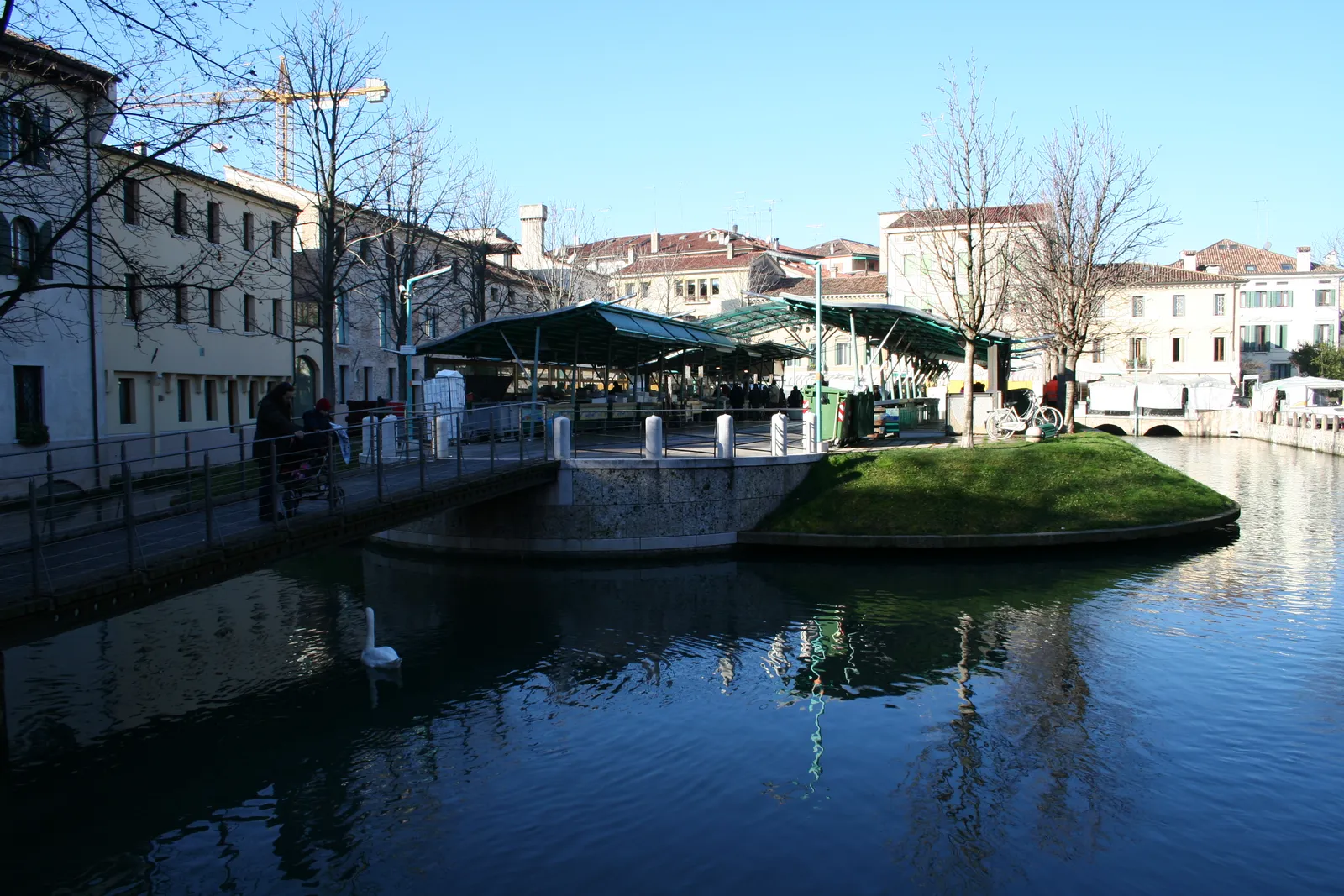
This is the Isola della Pescheria, and the fish market has been held on it since the middle of the nineteenth century for the obvious practical reason: the water carries the waste away and keeps the stalls cool. It trades in the mornings from Tuesday to Saturday, under an ironwork canopy from around 1856 with fish and shellfish worked into the grating. Outside market hours it is simply a small green island in the middle of a town, with benches, which is a strange enough thing to be worth the five minutes.
The bars round it are the ones to use if you want cicheti and a glass of local wine standing up, and the prices in Treviso bear no resemblance to what the same thing costs across the water in Venice.
Going back out is easy in a way the Venice trip is not: line 6 returns from the same stops it dropped you at, gets you to the terminal in under twenty minutes, and Treviso Airport is small enough that ninety minutes from the town centre to the gate is comfortable rather than tight. Add a bit of margin anyway if your flight leaves in the early evening, when several low-cost departures cluster and one security lane is doing all the work.
Frequently asked questions
Is Treviso Airport actually in Venice?
No. It sits on the edge of Treviso, roughly 40km inland from the lagoon, and the airline booking screen calling it Venice Treviso is doing a lot of work. There is no railway station at the airport. Reaching central Venice means a coach of a little over an hour to Piazzale Roma, so a return trip into the city plus check-in eats most of a six-hour gap. Treviso's own centre, by contrast, is under twenty minutes away on an ordinary city bus.
What is the cheapest way from Treviso Airport into Venice?
Not the airport coach. Take MOM city bus line 6 to Treviso Centrale station for a couple of euros, then a regional train to Venezia Santa Lucia, which takes around 35 minutes and costs four or five euros. That is roughly an hour door to door for about seven euros, against a little over an hour and around 14 euros on the direct coach. The coach still wins if you are tired, travelling late, or want one vehicle rather than two connections.
Did tiramisu really come from Treviso?
Treviso has the strongest claim to the modern version of it. Le Beccherie, a restaurant on Piazza Ancilotto in the centre, put tiramesù on its menu in 1972 after Alba Campeol and the pastry chef Roberto Linguanotto worked out the recipe there, and the family never tried to trademark it, which is part of why it spread so fast. Other towns dispute the origin and the arguments are unresolved. The dessert is on menus all over the centre either way.
Is Treviso worth a few hours on its own?
If the alternative is two hours on a coach, yes. Almost all of it is free: the sixteenth-century walls and the gates, the canals cutting through the middle of town, Piazza dei Signori, the fish market island, the arcaded streets and the surviving frescoed house fronts. The only things you pay for are the museums and a coffee. It is a compact town, and everything above sits inside a walk of about half an hour end to end.