Venice Layover Near the Accademia Bridge
Part of the full Venice Layover: The Grand Canal From VCE
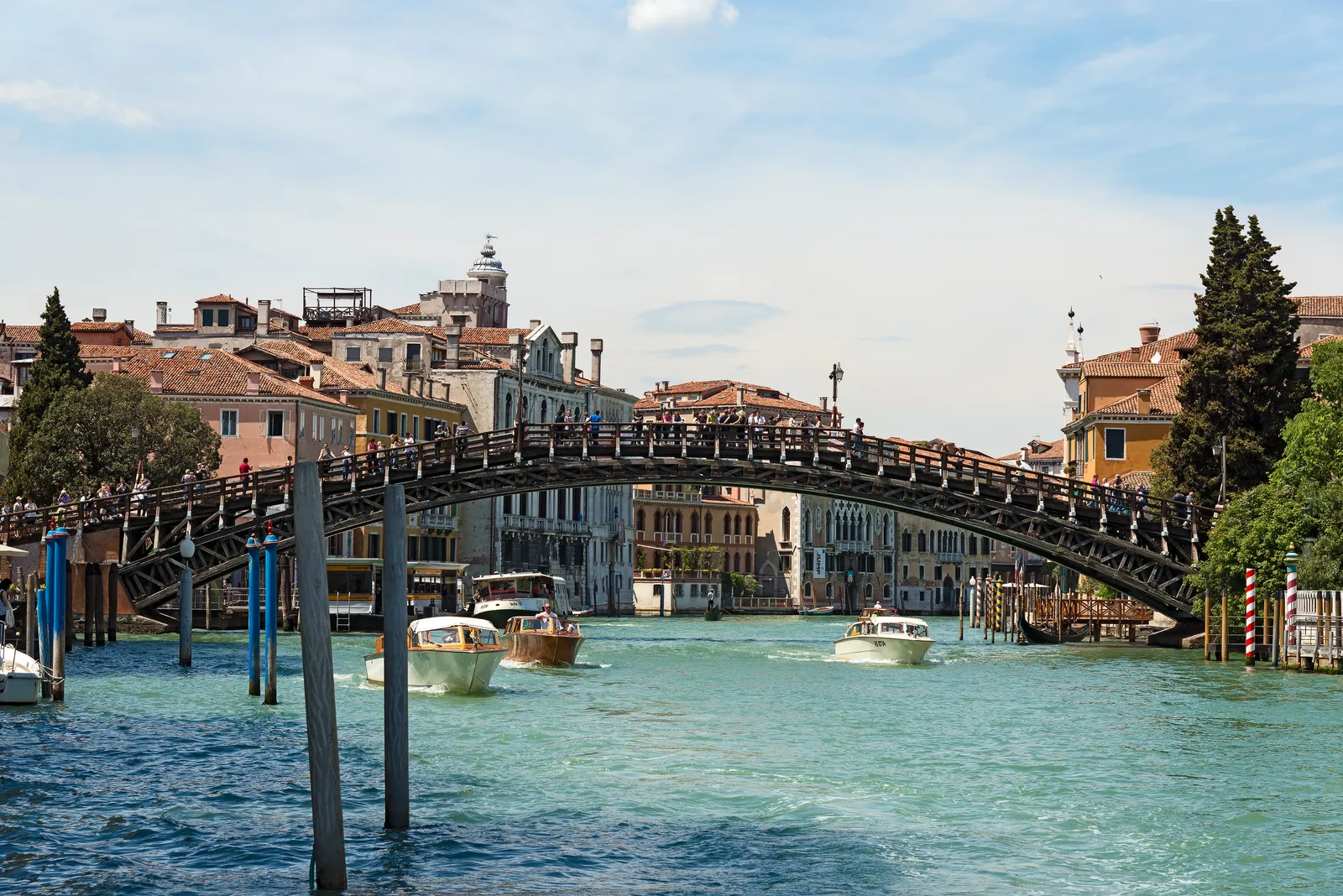
The Dorsoduro end of Venice’s Accademia bridge has two galleries within five minutes of each other: the Gallerie dell’Accademia’s Bellinis and Veroneses for 20 euros, and Peggy Guggenheim’s Pollocks and Picassos, in an unfinished palace on the Grand Canal, for 17. Below both, a boatyard still builds gondolas by hand and the Zattere runs flat along the water.
The Accademia bridge has been temporary since 1933
The first crossing here was Alfred Neville’s iron bridge, opened in November 1854 and disliked for the rest of its life. When it was pulled down, Eugenio Miozzi threw up a timber arch in its place as a stopgap, something to walk on while the city settled the argument about the stone bridge everyone actually wanted. It opened in 1933. The argument was never settled.
By the 1980s the wood was failing, so Venice ran a design competition, looked at the entries, and built a faithful replica of the stopgap instead, this time with a steel arch inside and the timber worked as cladding over it. That is what you cross today: a bridge on its second life and still officially provisional, ninety years after the temporary one went up.
It is also a full flight of steps up and the same again down, with no ramp and no lift, which is worth knowing before you commit a wheeled bag to it. The Accademia pontoon sits at the foot of the span on the Dorsoduro side, on water bus lines 1 and 2, so the Grand Canal ride the main Venice guide is built around passes directly under the bridge you are standing on.
Bellini, Carpaccio and Titian in the Gallerie dell’Accademia
Straight off the bridge on the south bank is a low neoclassical front with ACCADEMIA DI BELLE ARTI cut into the stone, and behind it a church, a monastery and a confraternity hall that Napoleon’s administration suppressed in 1807 and handed to the art school.
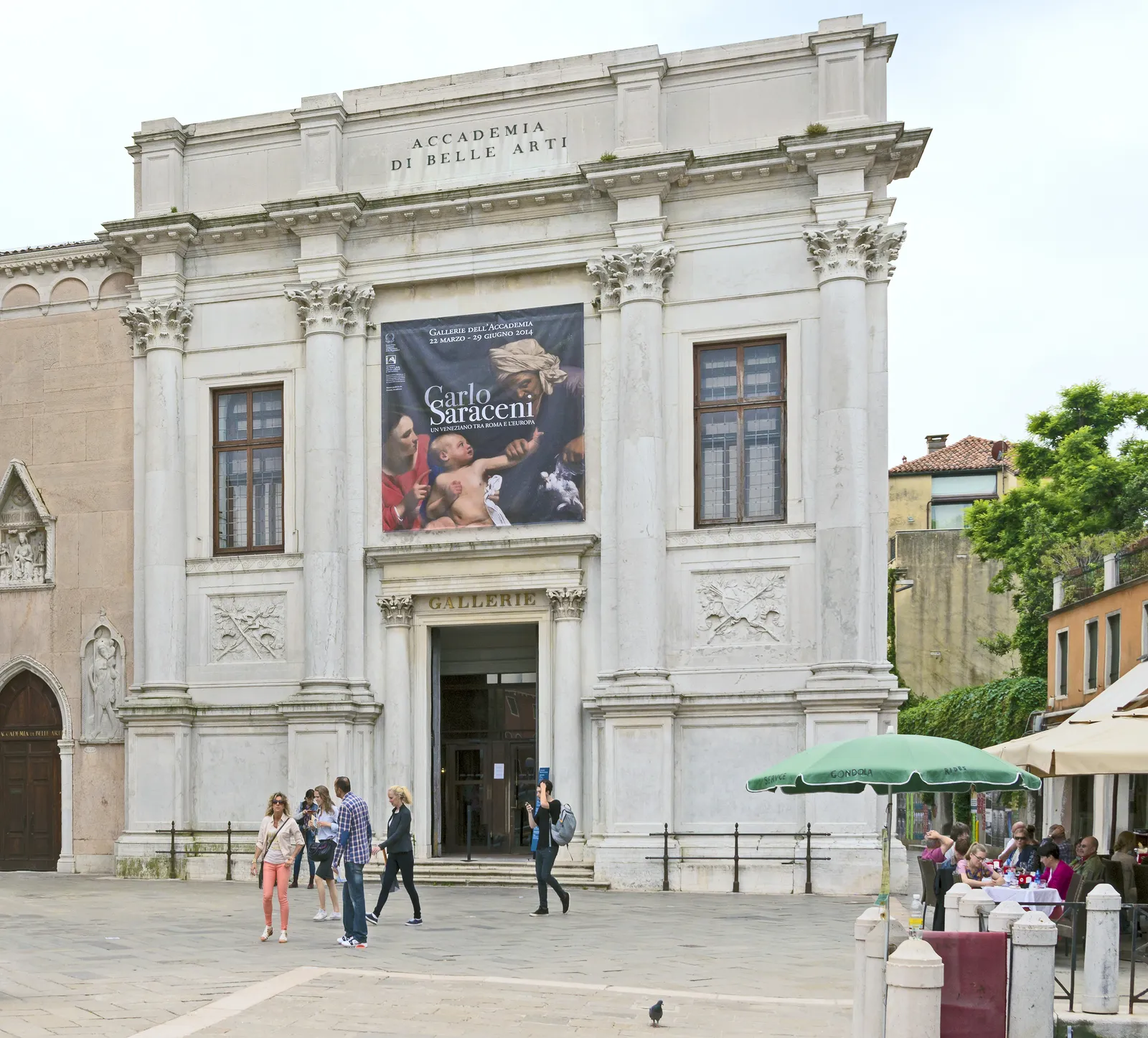
What ended up inside is the Venetian painting the republic left behind: Bellini altarpieces, Carpaccio’s nine-canvas St Ursula cycle, Giorgione’s Tempest, Tintoretto, Titian, Veronese. The picture with the best story in the building is Veronese’s twelve-metre Feast in the House of Levi, painted in 1573 as a Last Supper and hauled in front of the Inquisition for the dogs, dwarfs and drinkers Veronese had put around the table. He declined to repaint any of it. He changed the title instead, and the tribunal let it stand.
Entry is 20 euros, Tuesday to Sunday from nine until seven, with the ticket desk shutting an hour before the doors. It is closed on Mondays, and free to everyone on the first Sunday of the month, which is the one day the queue is worth checking before you walk over.
Peggy Guggenheim’s unfinished palace on the Grand Canal
Five minutes east along the canal bank, between two four-storey palaces, is a building that stops at the ground floor. Lorenzo Boschetti began the Palazzo Venier dei Leoni in 1749 and the money ran out almost immediately, leaving a white stone base with nothing on top of it and a roof terrace where the piano nobile should be.
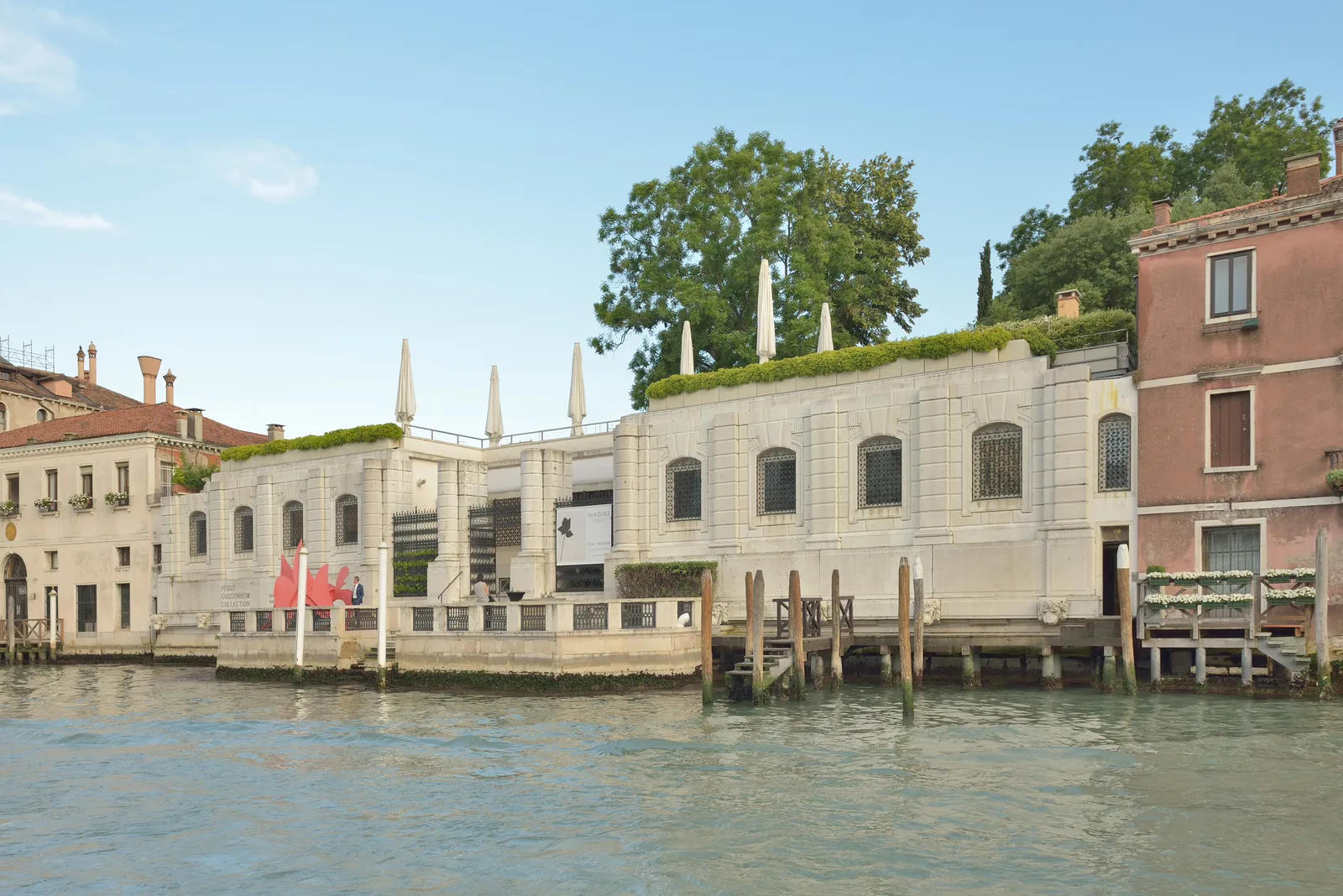
Peggy Guggenheim bought the shell in 1948, moved in the year after with her collection, and lived here until she died in 1979. It is her house rather than a museum built to be one, which is why the Pollocks, Picassos, Ernsts, Magrittes and Brancusis hang in domestic rooms at domestic scale and the whole thing takes an hour rather than a morning. She is buried in the garden beside her Lhasa Apsos, under a plaque that lists every dog by name. Entry is 17 euros with last admission at five, it shuts on Tuesdays, and timed entry can be booked ahead through a tours and activities platform if you would rather not lose ten minutes at the desk.
Neither gallery lets luggage past its entrance: the Accademia’s free lockers take a 1-euro deposit and stop at 45 by 35 by 65 centimetres, and the Guggenheim turns back backpacks and suitcases at the ticket office.
Gondolas being repaired at the Squero di San Trovaso
Ten minutes south-west of the Accademia bridge, on a canal corner in a quiet stretch of Dorsoduro, are three timber sheds with their fronts open to the water and gondolas hauled up on the slipway in front of them.
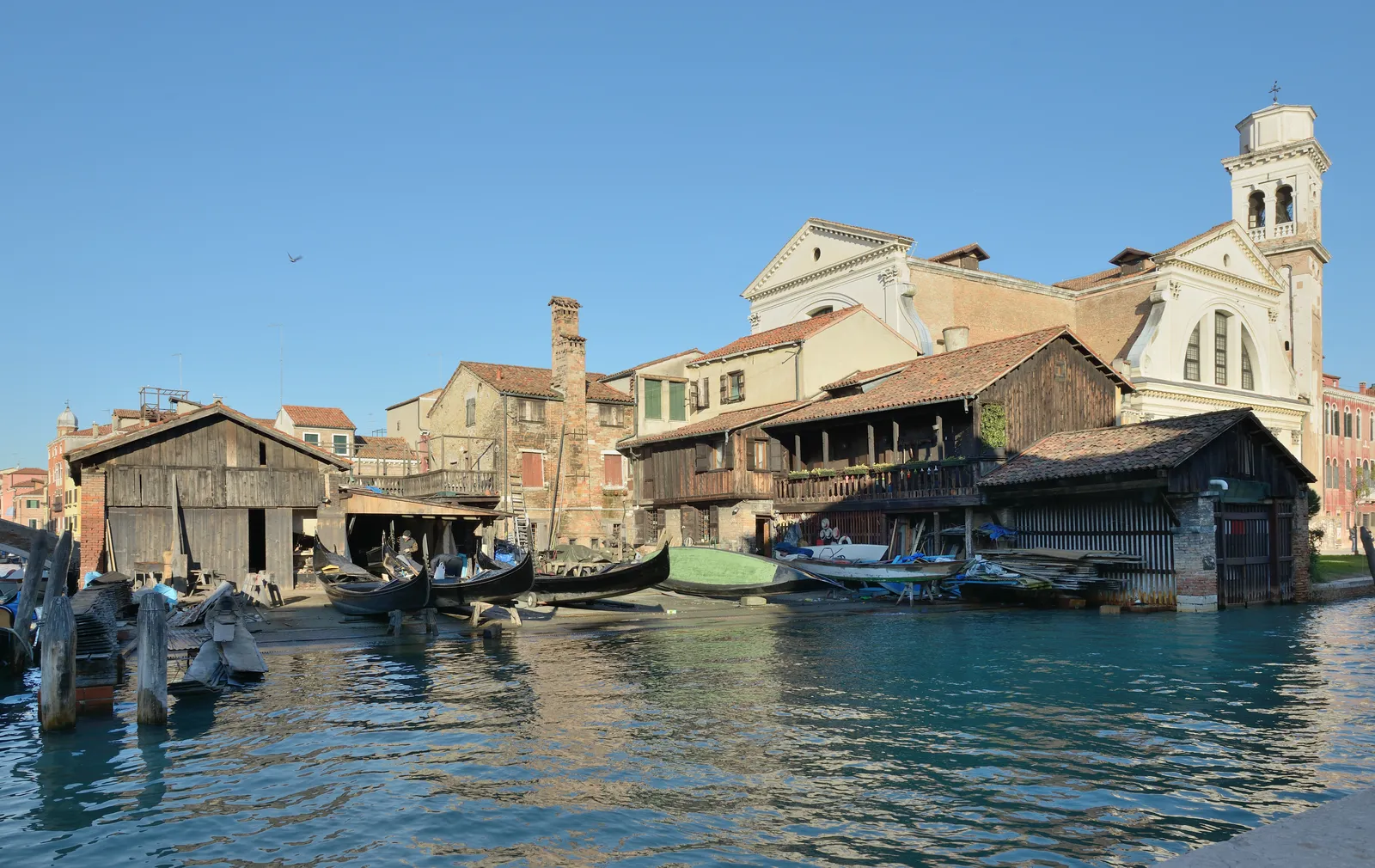
A squero is a boatyard, and this one has been working since the seventeenth century. The reason it looks like it was airlifted from the Alps is that it more or less was: the boatbuilders came down from the Cadore, the timber country north of Venice in the Dolomites, and put up the wooden mountain houses they knew how to build. Venice later banned timber construction as a fire risk, which is why these are among the last wooden buildings left in a city of stone.
A gondola takes eight species of wood, mahogany, cherry, fir, walnut, oak, elm, larch and lime, and the yard turns out roughly one new one a year alongside the repairs, which are what you are usually watching. There is nothing to book and nothing to pay: you stand on the quay across the narrow canal and look in. The crews are used to it and will ignore you as long as you stay on your own side of the water.
The Zattere faces south across the Giudecca canal
The Zattere begins two minutes past the Squero, where the lanes end at open water. It is named for the zattere, the timber rafts floated down from those same mountains and broken up here, and it now runs well over a kilometre of unshaded stone quay facing the island of Giudecca across a wide shipping channel.
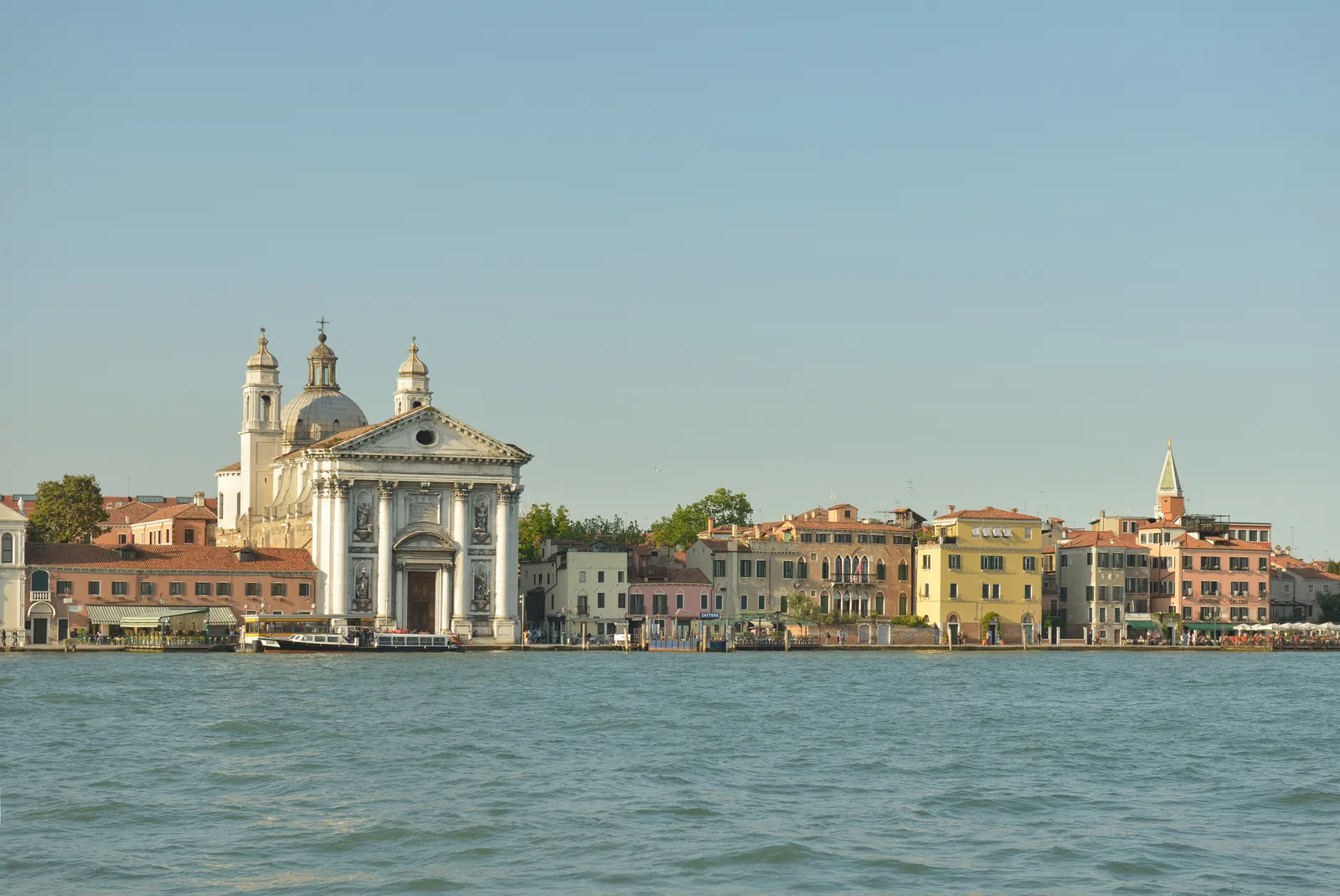
It is the one long walk in the historic centre with sky on one side of it, which after a morning in lanes two metres wide is the actual point. There are benches, a few gently arched bridges over the side canals, and the Magazzini del Sale, the republic’s old salt warehouses, now exhibition space. Gelateria Nico has been on this quay since 1935 and sells a gianduiotto, a slab of chocolate-hazelnut gelato dropped into a cup and buried under whipped cream, which people eat standing at the railing.
With five hours or more, this is also the easiest way to end the day rather than doubling back, walking east along the water instead of retracing the bridge before heading for the boat.
The Zattere’s own water bus runs straight to Piazzale Roma
Line 2 calls at the Zattere pontoon and heads west without doubling back through the Accademia, reaching Piazzale Roma in about twenty minutes; both airport services leave from bays there. Allow around two hours from the quay to the gate.
Frequently asked questions
Is Leonardo's Vitruvian Man on show at the Gallerie dell'Accademia?
Almost certainly not on the day you turn up. The gallery owns the drawing, but it is ink on paper and fades under light, so it lives in a climate-controlled store and comes out only for short runs years apart, behind glass and on a timer that drops a curtain over it every twenty minutes. Treat any sighting as luck rather than an itinerary item: the paintings are the reason to go in.
Do the Accademia and the Peggy Guggenheim ever shut on the same day?
No, and that is worth knowing if your stop lands early in the week. The Gallerie dell'Accademia closes on Mondays and otherwise runs Tuesday to Sunday from 09:00 to 19:00, with ticket sales stopping at 18:00 and full entry at 20 euros. The Peggy Guggenheim Collection closes on Tuesdays and otherwise runs daily from 10:00 to 18:00, last admission 17:00, at 17 euros. So one of the two is always open, and a Monday or Tuesday arrival simply decides which.
Is there anything to do around the Accademia bridge in the rain?
More than most of Venice offers. Two substantial indoor collections sit five minutes apart on the same bank, and the Accademia alone will absorb a couple of hours without hurrying, which is unusual in a city where the sightseeing is mostly outdoors and mostly wet when the weather turns. What does not work in rain is the rest of this route: the boatyard is watched from an open quay and the Zattere has no shelter along it at all.
How do you get from the Accademia bridge to the airport bus?
Both airport services leave from Piazzale Roma, and nothing bound for Marco Polo comes any closer. The Accademia pontoon at the foot of the bridge is served by water bus lines 1 and 2, which run up the Grand Canal through San Tomà, Rialto and Ferrovia to Piazzale Roma on a 9.50-euro ticket. Walking it instead takes about 25 minutes and crosses several stepped bridges on the way.