Venice Layover Near Piazzale Roma
Part of the full Venice Layover: The Grand Canal From VCE
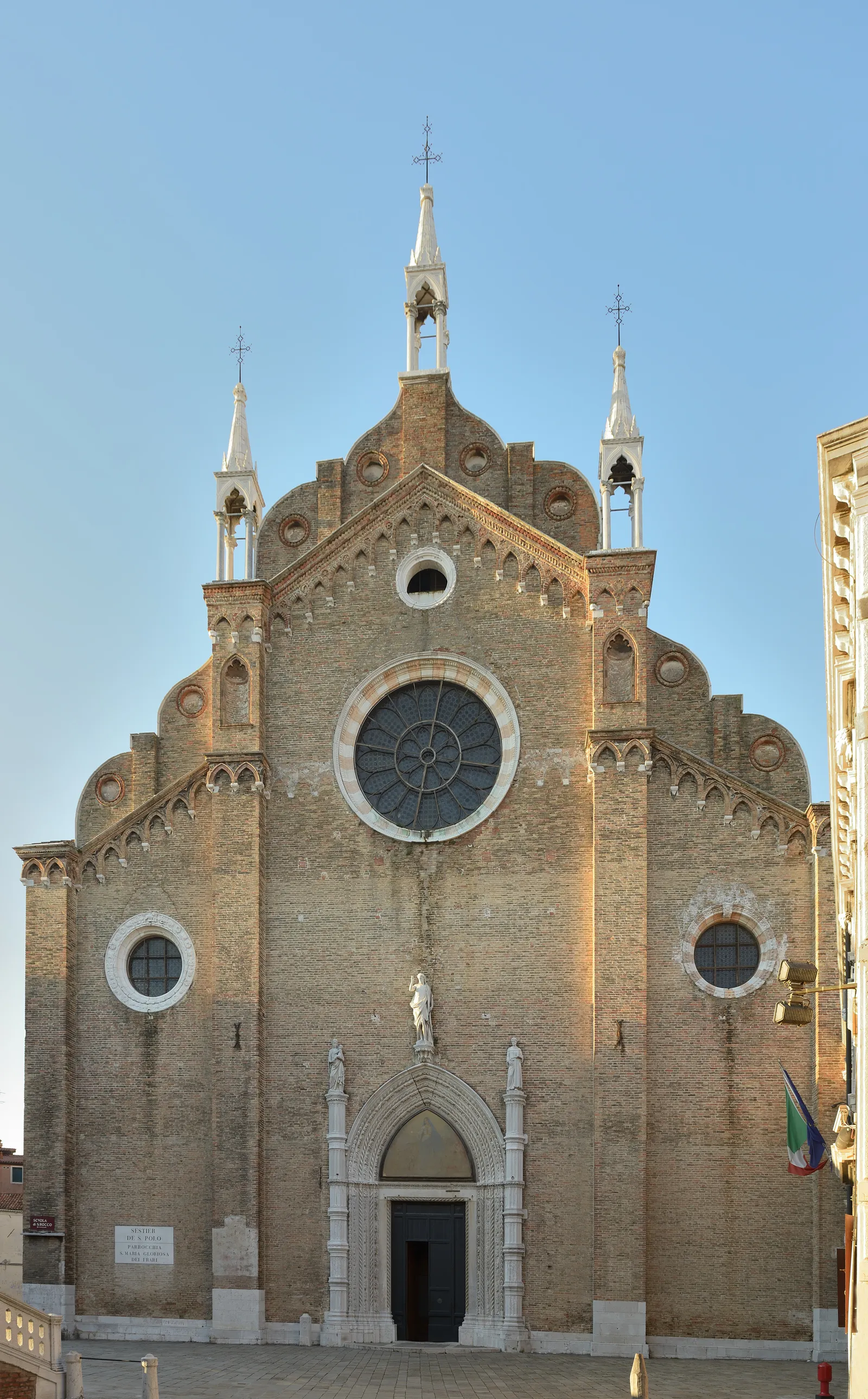
Ten minutes south of Piazzale Roma, the Venice square where every bus, coach and tram in the city terminates, the Frari basilica holds Titian’s Assumption for 5 euros and the Scuola Grande di San Rocco holds more than fifty Tintoretto canvases for 12, with Campo San Polo’s open paving five minutes further east.
Titian’s Assumption over the Frari’s high altar
The Frari is a barn: a plain brick Gothic basilica the Franciscans spent a century building and finished in 1443, with almost nothing on the outside except a rose window and three stone pinnacles.
Inside, framed in the stone choir screen so that you see it down the whole length of the nave as you come in, is Titian’s Assumption of the Virgin: nearly seven metres of red and gold, unveiled in 1518 and still in the spot it was painted for, which is rare enough for a picture of this age. Titian himself is buried a few metres away in the right aisle. Two more things worth finding: Giovanni Bellini’s triptych in the sacristy, and Canova’s tomb in the left aisle, a marble pyramid with a door standing open at its base and figures walking into it.
Entry is 5 euros, and the hours are 09:00 to 18:00 Monday to Saturday but only 13:00 to 18:00 on Sundays. The nearest water bus stop is San Tomà on lines 1 and 2, which is also a gondola station if you would rather spend the money that way; the gondoliers here work the smaller canals behind the church rather than the Grand Canal, and a shared ride can be booked in advance through a tours and activities platform for a fraction of what a private one costs.
Tintoretto’s twenty-three years inside the Scuola Grande di San Rocco
The Scuola Grande di San Rocco stands just behind the Frari, its marble front of tall windows and coupled columns at an angle to a smaller domed church on the same little square.
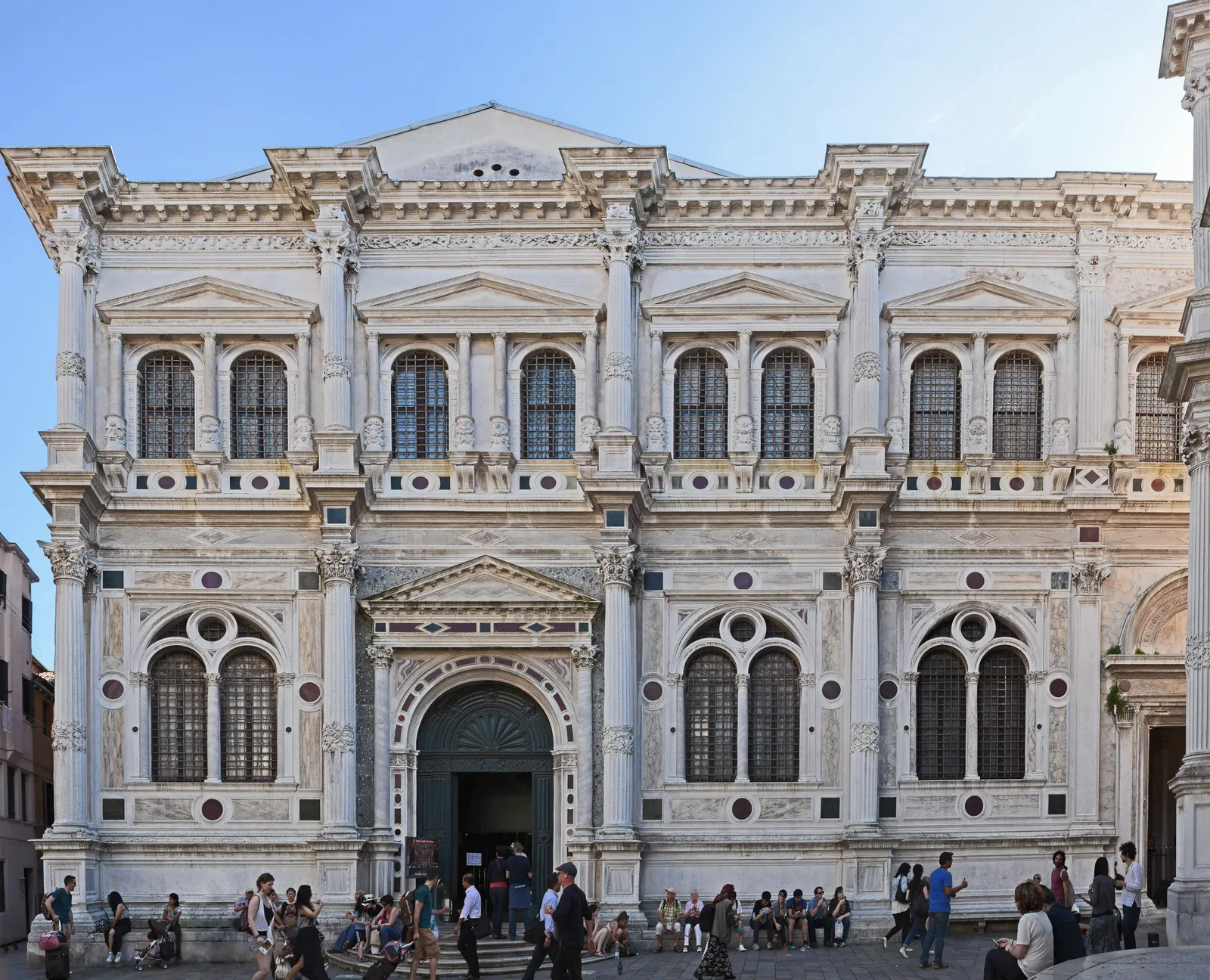
The Scuola Grande di San Rocco was a lay confraternity, a wealthy one, and in 1564 it held a competition for the ceiling of a side room. Tintoretto did not submit a sketch like the other entrants. He had the finished painting installed in the ceiling overnight and pointed out that it was already a gift to the saint, which under the confraternity’s own rules could not be refused. He got the commission and then kept going for twenty-three years, until the walls and ceilings of the whole building carried more than fifty of his canvases: the Crucifixion in the upper hall runs the entire length of one wall.
They are all still where he put them, which is the point of coming. Entry is 12 euros, or 14 with the church next door, open daily 09:30 to 17:30 with the ticket desk shutting at five. Mirrors are handed out at the door because half the paintings are on the ceiling.
Campo San Polo, where Venice used to run bull hunts
With three hours or more, Campo San Polo is five minutes further east: the largest campo in the city, a plain rectangle of paving with a pink palace on one side and no church front facing it at all, because San Polo’s church turns its back on the square.
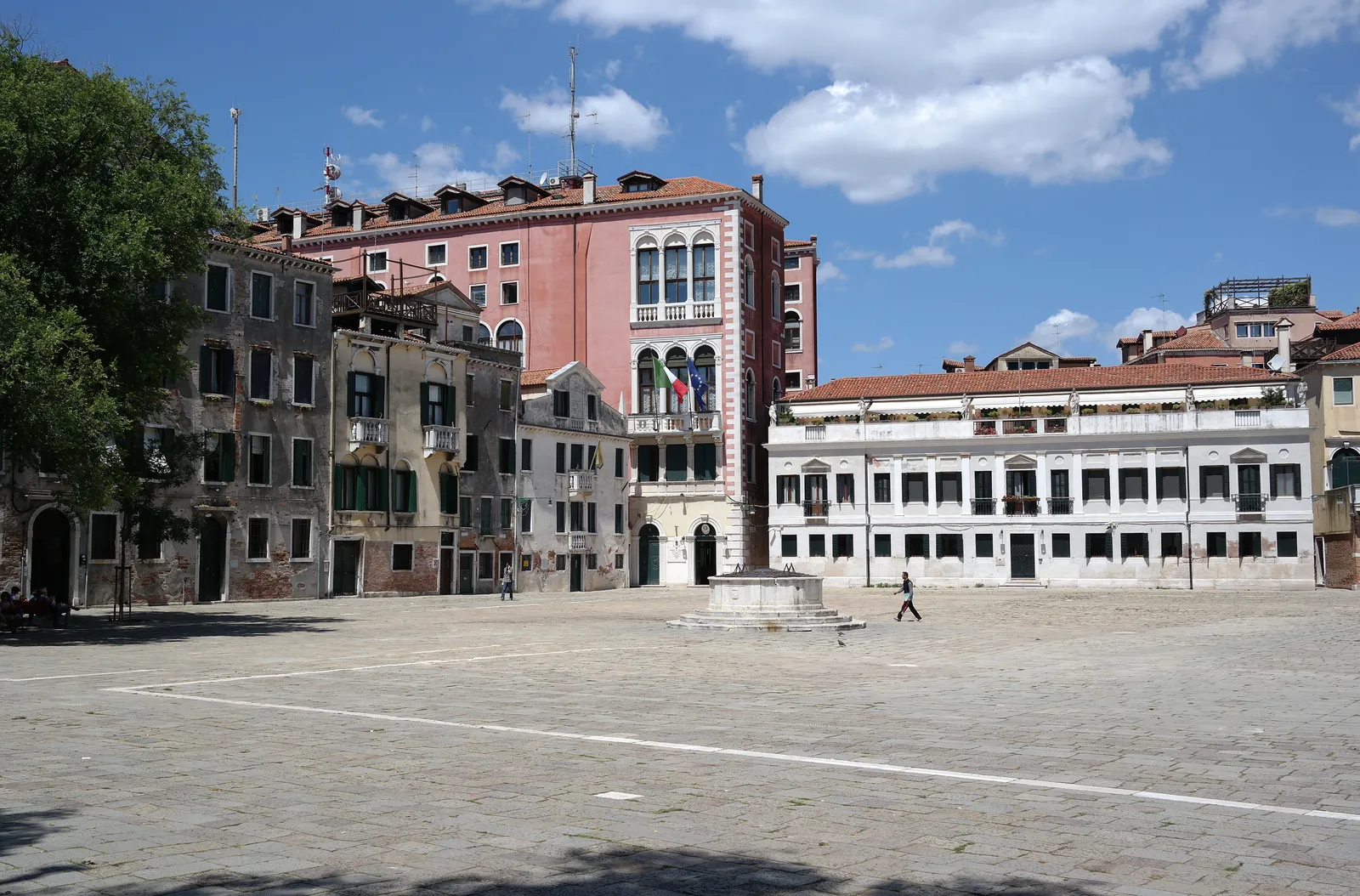
For a few centuries this was where the city came for its blood sport. Bulls were let loose here with dogs set on them and handlers working ropes, in front of crowds packed onto temporary stands, and the paintings of it hang in museums around the city. The practice was banned everywhere in Venice after a stand collapsed at one of these events in Campo Santo Stefano in 1802. Nothing much happens here now, which is exactly its use on a short stop: it is a large, flat, free, mostly empty space with cafe tables round the edges, ten minutes from the bus.
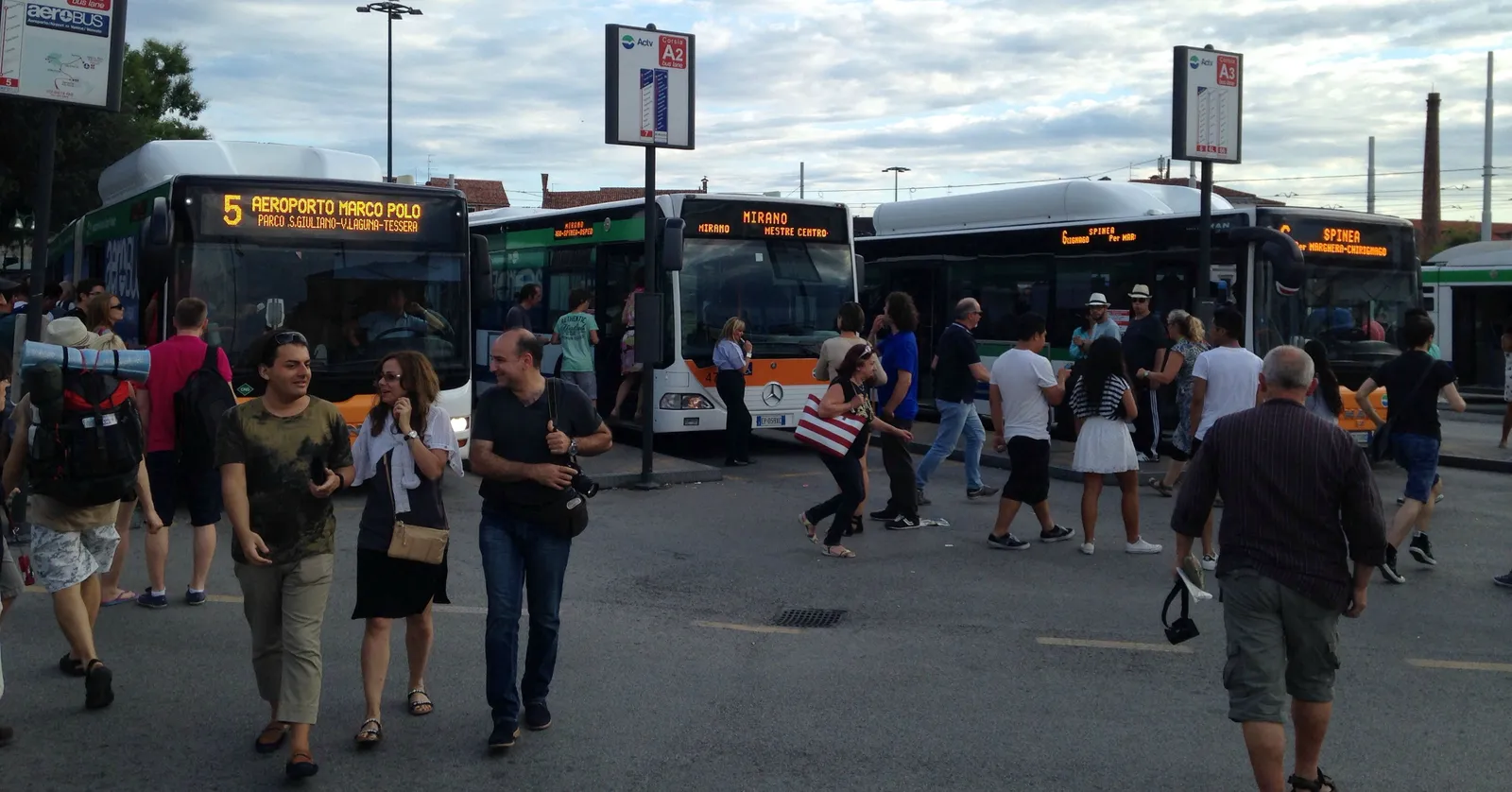
The bus bays, the tram and the car park all sit on one square
Piazzale Roma is the only square in the historic centre with roads running into it, so everything with wheels ends here: both airport bus services, the long-distance coaches, the tram in from Mestre, the People Mover up from the Tronchetto car park, the taxis, and a 1930s multi-storey garage that is still in use. Water bus lines 1 and 2 leave from the Grand Canal pontoons at the north edge, and Venezia Santa Lucia station is five minutes away over the Ponte della Costituzione, the white steel arch whose glass treads were finally swapped for stone after years of people falling on them.
All of which is why the square gets tight in the twenty minutes after a coach wave lands and why the suitcase is better left near it than dragged across it.
The airport bus leaves from bays on this same square
Getting back out is the easy part of the day: the express coach takes about 20 minutes for 12 euros, and the ordinary city bus about 25 for 10. From Campo San Polo, allow around ninety minutes to the gate.
Frequently asked questions
Is two hours enough to see anything from Piazzale Roma?
Yes, if you pick one thing. The Frari is ten minutes' walk and the Scuola Grande di San Rocco is two minutes past it, so either one fits comfortably inside two hours with the walk both ways. What does not fit is crossing to St Mark's, which is 35 to 40 minutes each way on foot from here. If your stop is longer than four hours, the walk down the Grand Canal to St Mark's is the better use of it.
What actually arrives at Piazzale Roma?
Everything on wheels, and nothing else. It is the only square in the historic centre a road reaches, so both airport bus services, the long-distance coaches, the tram in from Mestre, the People Mover from the Tronchetto car park and the taxis all terminate on the same paving. Water bus lines 1 and 2 leave from pontoons on the Grand Canal at its northern edge, and Venezia Santa Lucia station is five minutes away on foot over the Ponte della Costituzione.
Do the Frari and San Rocco open on Sundays?
The Scuola Grande di San Rocco does, all day: 09:30 to 17:30 daily, with the ticket desk shutting at 17:00. The Frari opens Monday to Saturday from 09:00 to 18:00 but only from 13:00 on Sundays, because the morning is given over to Mass. If you land on a Sunday morning with a short stop, San Rocco is the one that will be open when you get there.
Where can you sit down near the bus terminus?
In the Giardini Papadopoli, the walled public garden beside the square, two minutes from the bus bays and free. It is a real park in the historic centre, laid out in 1834 by Francesco Bagnara on the site of a convent that Napoleon's administration had suppressed and demolished, and it lost about a third of its ground in 1933 when the Rio Nuovo canal was cut through during the works that created Piazzale Roma itself. Benches, gravel paths, shade, and a fraction of the noise of the terminus.