Bologna Layover: Porticoes and Markets, BLQ
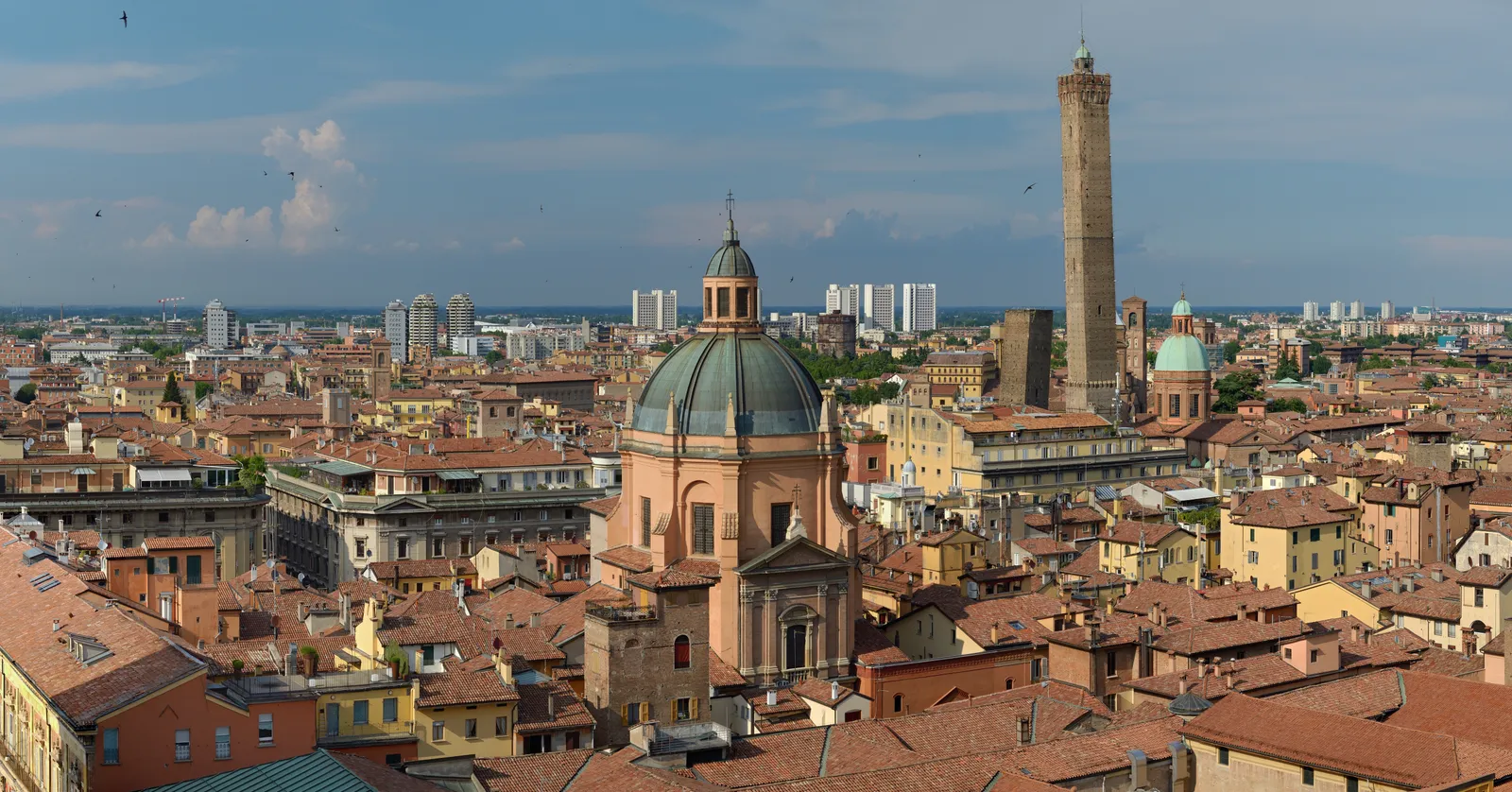
Central Bologna fits into a few streets around Piazza Maggiore: the city hall’s clock tower, the food stalls of the Quadrilatero, a 17th-century anatomy theatre, and two free churches, San Petronio and Santo Stefano, all within about ten minutes’ walk of each other and mostly under the city’s covered porticoes.
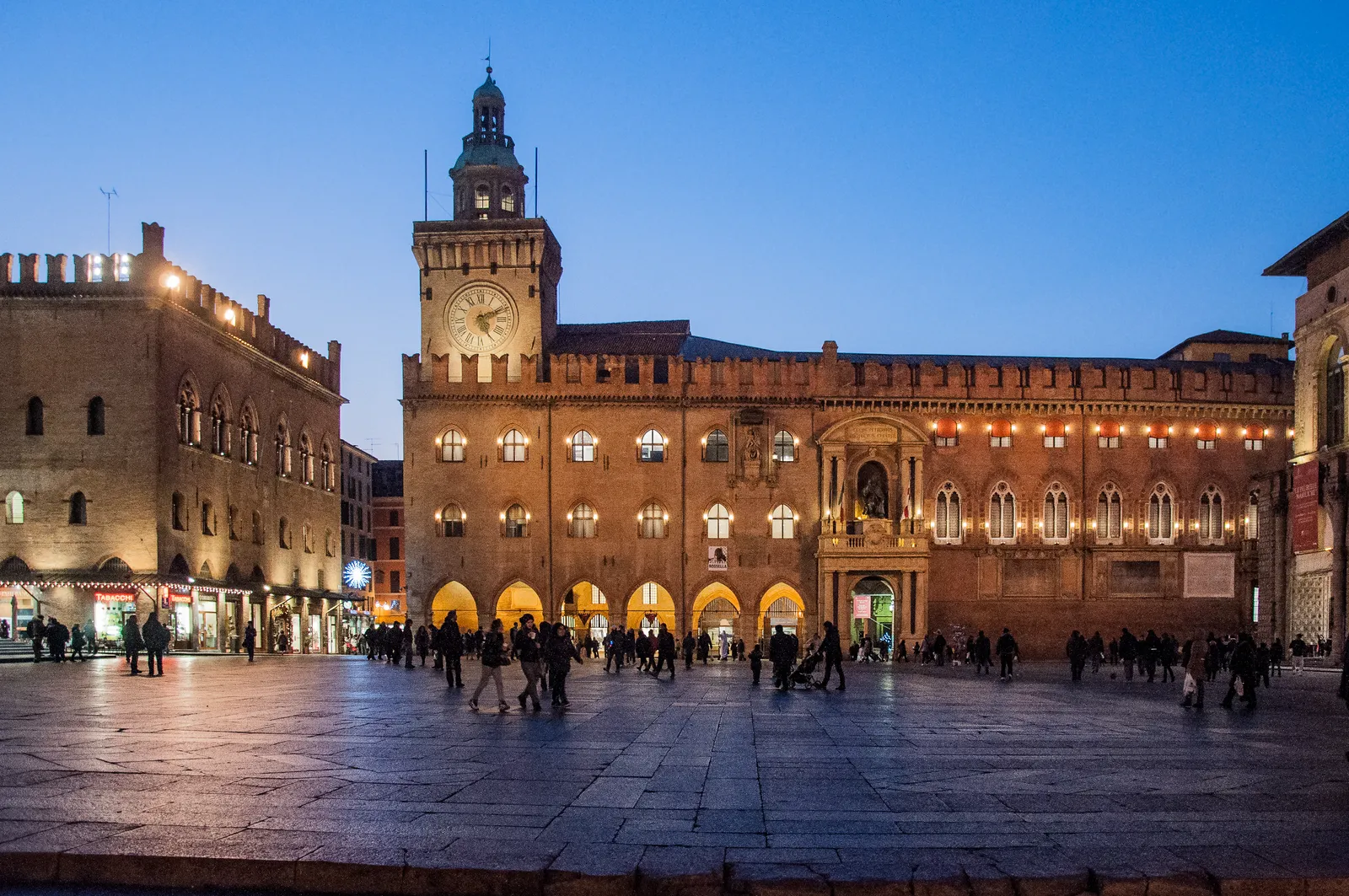
The clock tower of Palazzo d’Accursio on Piazza Maggiore
Palazzo d’Accursio, Bologna’s city hall and the seat of its government since 1336, fills the west side of Piazza Maggiore, the city’s main square, and the brick clock tower on its front was added in the 15th century. The climb inside it stops at two terraces: one at the level of the battlements, looking straight down on the square, and one at the top, where the view runs over the red roofs to the hills around the city. A ticket costs €10 and also covers the Collezioni Comunali d’Arte, the city’s own art collections, on the palace’s upper floors, and a guided visit of the tower and the collections, with a tasting afterwards can be booked ahead.
Giambologna’s bronze Neptune, fixed in place around 1566, stands on the smaller Piazza del Nettuno next to the main square; the trident in his hand is the one Maserati took for its badge in 1920. On the north side of Piazza Maggiore, the vaulted passage under Palazzo del Podestà has a trick locals call the “telefono senza fili,” the wireless telephone: whisper into one of its four corners, facing the wall, and someone standing in the diagonally opposite corner hears you clearly.
The Quadrilatero, Bologna’s medieval market lanes
The Quadrilatero is the grid of lanes just east of Piazza Maggiore, bounded by Via Clavature, Via Pescherie Vecchie, Via Drapperie and Via degli Orefici, and each street is named after the trade that worked it in the Middle Ages: fishmongers on Pescherie Vecchie, drapers on Drapperie, goldsmiths on Orefici. Greengrocers still set their crates out on the paving, and delis hang mortadella and wheels of Parmigiano in the windows; the deli Tamburini has carried that name since the Tamburini brothers took it over in 1932. A small-group food tour covers tortellini, tagliatelle and aged Parmigiano in a few hours, and most of it happens in and around these lanes.
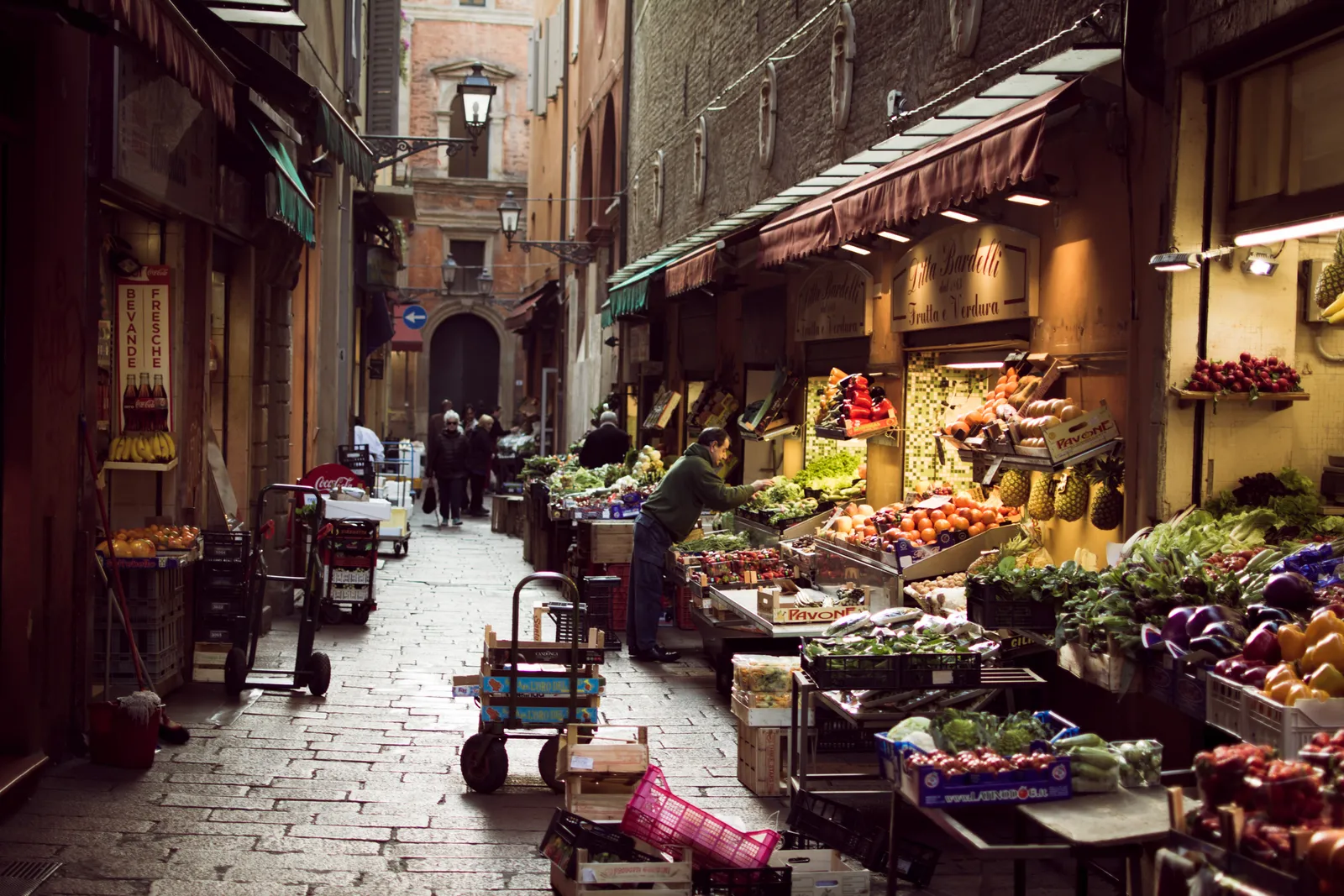
At lunchtime the produce crates and bar tables on both sides of Via Pescherie Vecchie leave only the middle of the lane to walk in, which is where a suitcase starts to hold everyone up.
The Archiginnasio’s wooden anatomy theatre
The Archiginnasio, on Piazza Galvani along the south side of San Petronio, was built in 1562 and 1563 to bring the University of Bologna’s scattered schools under one roof, and it served as the university’s headquarters until 1803. Its arcaded courtyard and stairways are covered in about 6,000 painted coats of arms, each one belonging to a student elected to lead his fellow students from the same region or country. Upstairs, the Anatomical Theatre of 1636 is a steep room panelled entirely in fir, where dissections were watched from tiered wooden benches; the lecturer’s chair sits under a canopy held up by two carved figures of skinned men, the “spellati,” by Ercole Lelli.
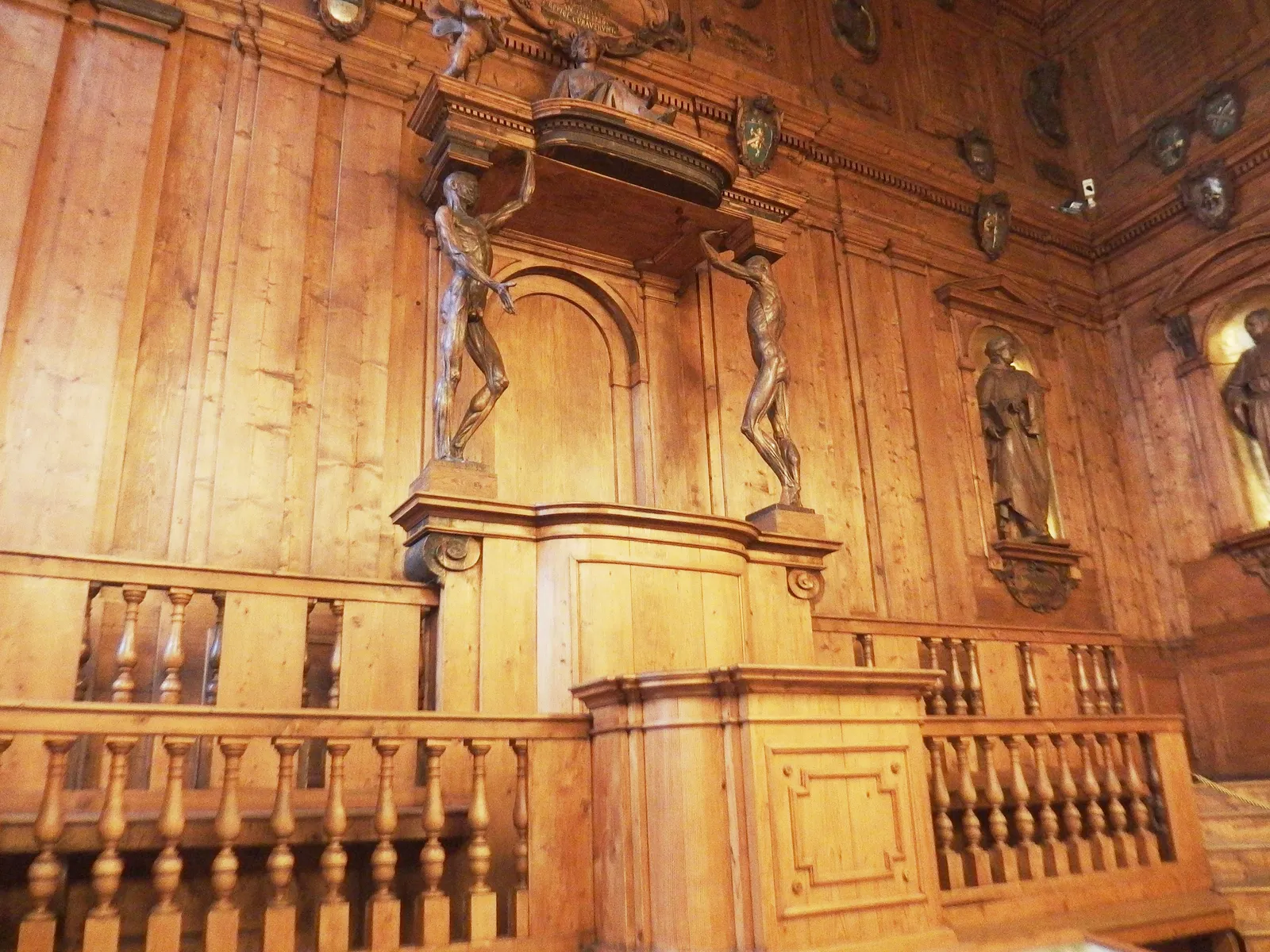
Allied bombing wrecked the theatre on 29 January 1944, and what stands now was carefully rebuilt to the original design after the war. The building also houses the Archiginnasio library, the largest in Emilia-Romagna. A guided walking tour of the centre stops at both the Archiginnasio and San Petronio.
San Petronio’s half-clad facade and Cassini’s meridian line
The Basilica of San Petronio closes the south end of Piazza Maggiore, and its front has been left unfinished for centuries: work began in 1390, marble cladding reached about halfway up, and the upper part is still bare brick. The church is 132 metres long and 66 wide, and entry is free.
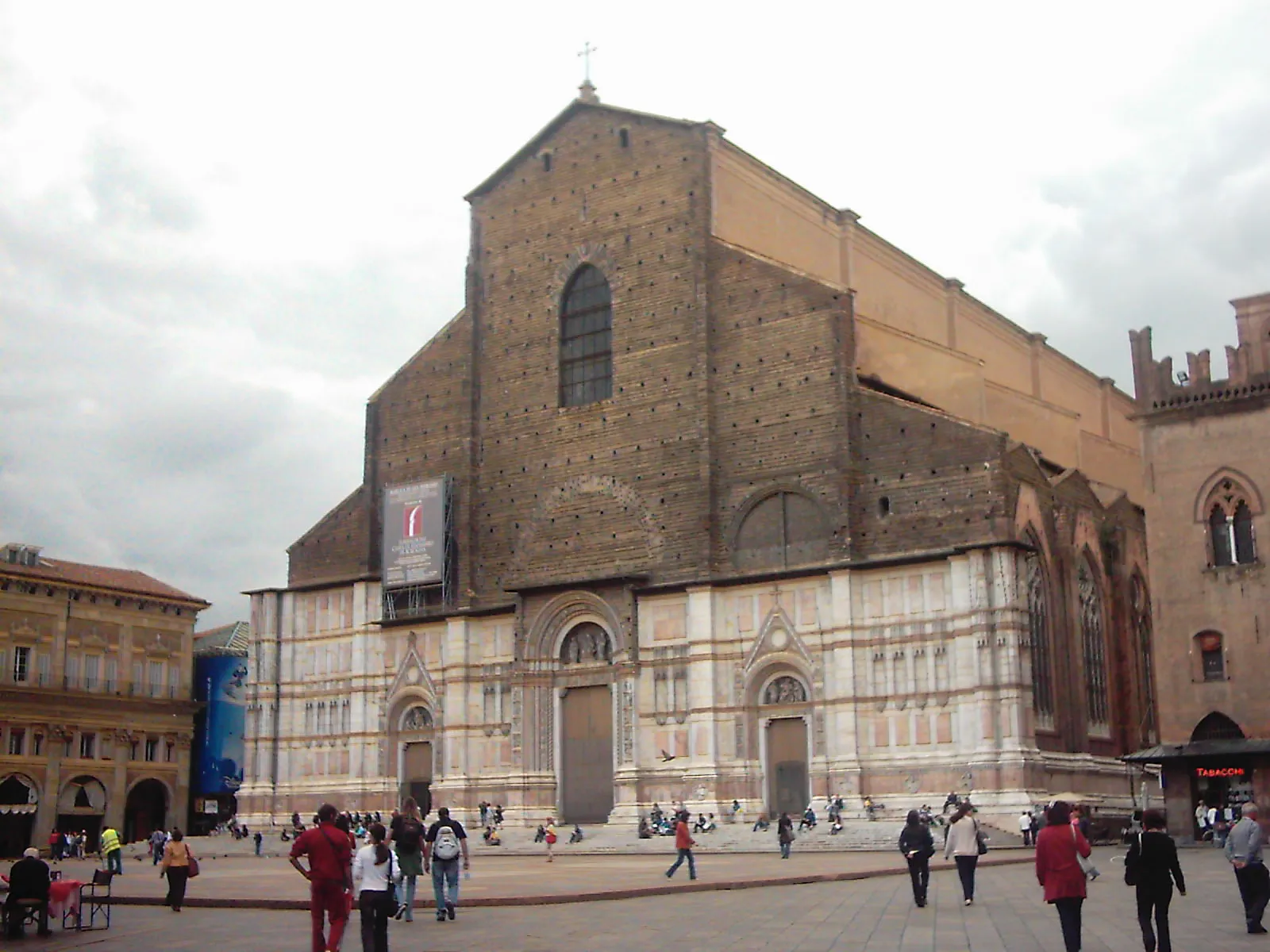
The thing to look for inside is on the floor. A meridian line 66.8 metres long runs across the floor, laid out in 1655 by the astronomer Giovanni Domenico Cassini; at solar noon a spot of sunlight from a small hole high in the vault lands on the line, and Cassini used its position through the year to measure the sun’s movements.
The Seven Churches of Santo Stefano
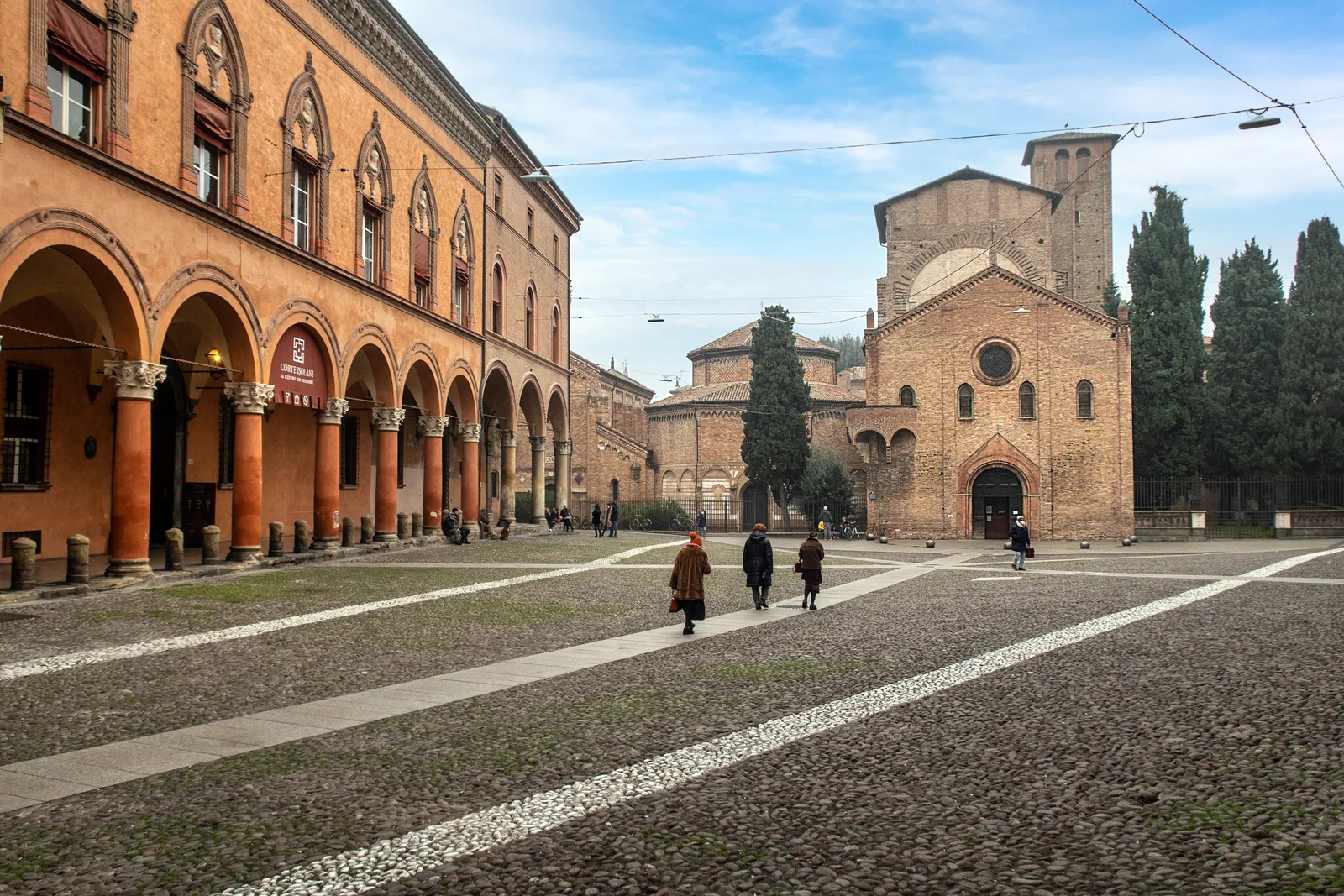
Piazza Santo Stefano is a long, cobbled triangle of a square opening off Via Santo Stefano, lined with arcaded palaces, and at its far end stands the Santo Stefano complex, known in Bologna as the Sette Chiese, the Seven Churches. Behind the brick fronts is a warren of linked churches and courtyards: the oldest, Saints Vitale and Agricola, goes back to the 4th century, and the round Church of the Holy Sepulchre was built to echo the one in Jerusalem. Entry is free, and the complex closes for a long break in the middle of the day, so it suits the start or the end of an afternoon more than lunchtime.
With more than four hours to spend, Santo Stefano is the natural last stop, since Via Santo Stefano starts beside the Two Towers, the leaning pair of 12th-century family towers that mark the middle of the city. The Asinelli is 97 metres tall and the Garisenda, much shorter, leans more than three metres off vertical. Neither can be climbed at present: the city sealed off the Garisenda in October 2023 over fears it was tilting too far, the Asinelli’s staircase has been closed alongside it, and as of September 2026 no reopening date has been set.
Seven minutes to the airport on the Marconi Express monorail
The Marconi Express, an elevated monorail, links Bologna Centrale, the main railway station, with Bologna Guglielmo Marconi Airport (BLQ) in about seven and a half minutes, with one stop at Lazzaretto on the way. It runs daily from 5:40 to midnight, every 15 minutes for most of the day and every seven and a half at peak times, and a single ticket costs €12.80, paid by contactless card at the gates. The monorail’s station is on the north side of Bologna Centrale, off Via dei Carracci, so allow a few minutes to cross through the station to it.
From Piazza Maggiore, Via dell’Indipendenza runs straight north to the station in about 20 minutes on foot, which makes the whole trip from the square to the terminal closer to 40 minutes once the walk, the crossing and a wait for the next car are added. Leave the centre about two hours before your flight. With the bag left at a storage point near the station or the square, it’s collected on the way back north to the monorail. For a second city on the same trip, the fastest high-speed trains from Bologna Centrale reach Florence in under 40 minutes.
Frequently asked questions
What should I do during a layover in Bologna?
Base the day on Piazza Maggiore: climb the clock tower of Palazzo d'Accursio, the city hall, then eat your way through the Quadrilatero's market lanes just east of the square. The Archiginnasio's wooden anatomy theatre and the Basilica of San Petronio sit on the square's south side, and the Seven Churches of Santo Stefano are a short walk further east. San Petronio and Santo Stefano are free; the clock tower and a food tour are the two things worth booking ahead if either is on the list.
Can I climb the Two Towers in Bologna?
Not at the moment. The city sealed off the leaning Garisenda tower in October 2023 over fears it was tilting too far, and the climb up the taller Asinelli tower beside it has been shut while the stabilisation work goes on. As of September 2026 no reopening date has been announced, and the work on the Garisenda is expected to run for years. The towers are still worth seeing from the street at the top of Strada Maggiore, and for a view over the rooftops in the meantime, the clock tower of Palazzo d'Accursio on Piazza Maggiore is open to visitors.
Is Bologna a good city for a layover in the rain?
Yes, largely because of the porticoes. More than 38 kilometres of covered arcades line the streets of the historic centre, a network listed as a UNESCO World Heritage Site in 2021, so almost every walk between Piazza Maggiore, the Archiginnasio and Santo Stefano can be done under a roof. The open squares and the Quadrilatero's market lanes are the parts where you'll get wet.
What can I see in Bologna without paying?
Entry to the Basilica of San Petronio is free, including a look at Cassini's 66.8-metre meridian line set into its floor, and so is the Santo Stefano complex of churches. Piazza Maggiore and Giambologna's bronze Neptune on the square beside it cost nothing, and neither does the whispering trick in the vaulted passage under Palazzo del Podestà, where a voice spoken into one corner carries to the opposite one.
Why does every street in Bologna have a portico?
Because the city required them. Porticoes grew up in the Middle Ages as private extensions built out over public land, and in 1288 the municipality ruled that every new house had to be built with one. The early ones were wooden, and a 1568 decree ordered them rebuilt in brick or stone, though a few wooden porticoes survive, including on Via Marsala.