Berlin Layover Near Zoologischer Garten and City West
Part of the full Berlin Layover Guide: What to Do Before a Flight Out of BER
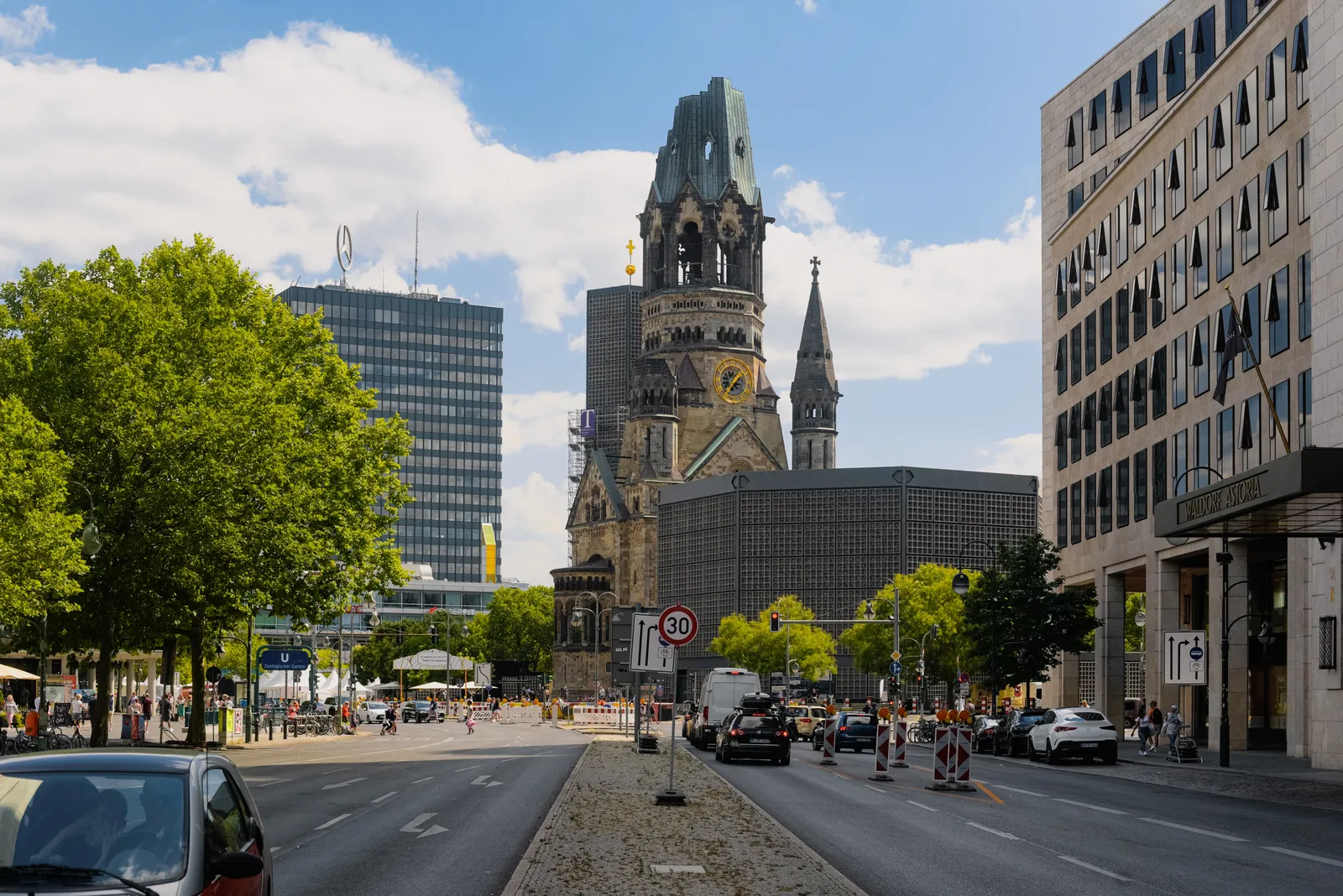
From Bahnhof Zoo, the ruined tower of the Kaiser Wilhelm Memorial Church is free and open daily, Bikini Berlin’s panorama window looks straight into the zoo’s monkey rock for nothing, and the Kurfürstendamm runs west from the door.
The tower nobody was allowed to tidy up
Five minutes from the station, on Breitscheidplatz, stands the broken west tower of the Kaiser Wilhelm Memorial Church. It was hit in a raid in November 1943 and burned out, and when the ruin was finally dealt with in the late 1950s the plan was to clear it and start again. Berliners objected loudly enough that the stump was kept, and Egon Eiermann built the new church around it instead: a low octagon and a free-standing bell tower, both in concrete honeycomb filled with blue glass made in Chartres.
The result is the most-photographed thing in western Berlin and it still functions as a working church. Locals call the ruin the Hohler Zahn, the hollow tooth, which is affectionate rather than rude. Inside the base of it, a memorial hall keeps the surviving ceiling mosaics from the original 1890s building, and next door the new church interior is a solid wall of blue on every side, which is much stranger in person than in photographs. Both are free and open daily from 10am to 6pm.
Watching the zoo without buying a ticket
Directly across Budapester Straße is Bikini Berlin, a long 1950s slab that was renovated into a concept mall in 2014 and is, for layover purposes, one of the more useful buildings in the city.
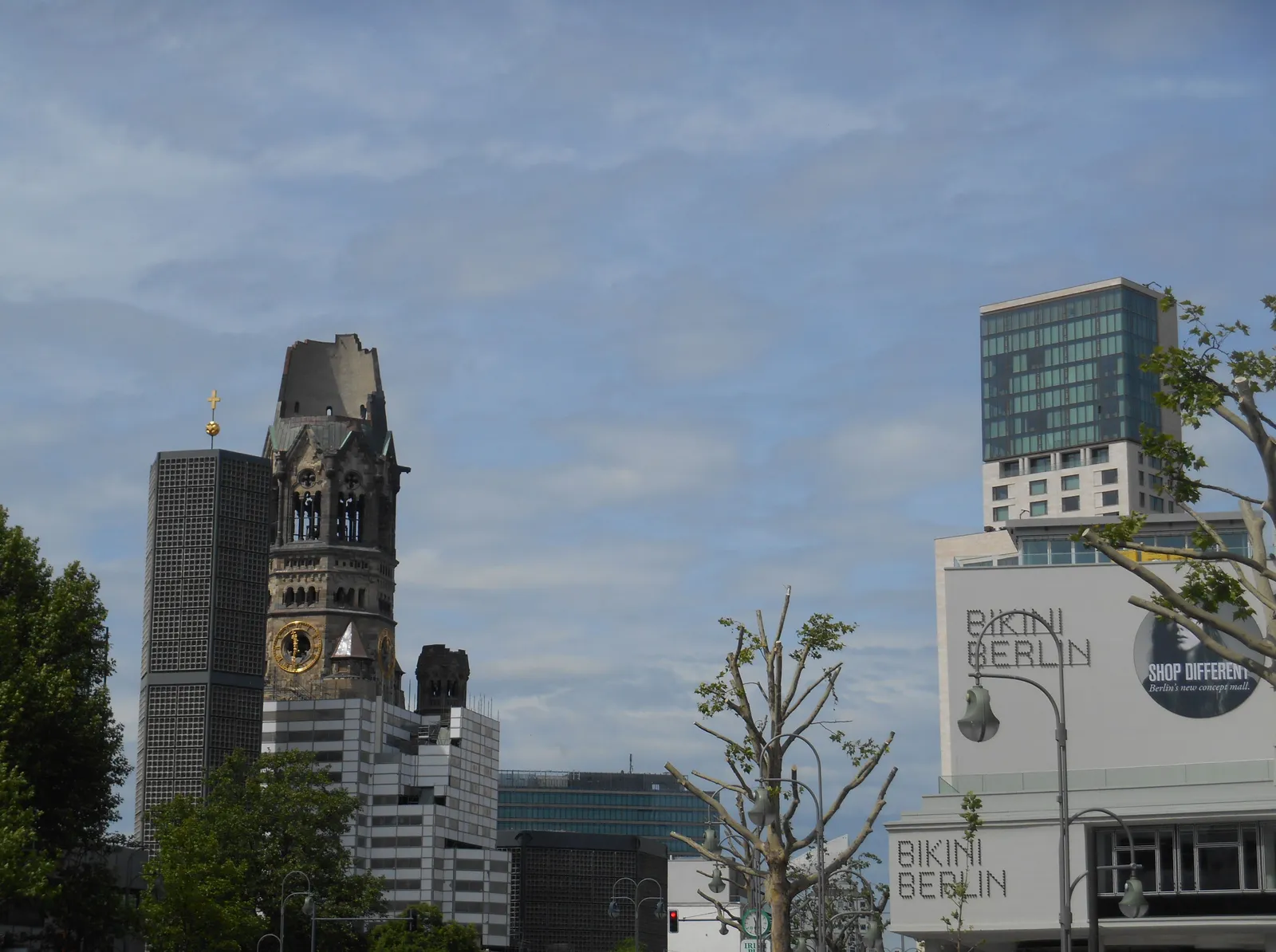
The building backs directly onto Berlin Zoo, and rather than wall that off, the architects put a long panorama window along the ground floor looking straight at the zoo’s monkey rock. You can stand in a shopping centre, for free, watching baboons at close range, and the enclosure is close enough that you get the whole social performance rather than distant shapes. Above it, the roof terrace runs to some 7,000 square metres and is also free and open to anyone, with the zoo on one side and the church tower on the other. There is a food hall on the first floor if the weather turns.
City West is where most of Berlin’s long-distance coaches and westbound regional trains put people down, so a good share of the people on this square arrived with a full-size case that has already been on a bus overnight, and there is nowhere on Breitscheidplatz to set it down.
Three and a half kilometres of boulevard, of which you want the first twenty minutes
The Kurfürstendamm starts at the church and runs southwest. Bismarck ordered it widened into a grand approach in the 1880s, deliberately modelled on the Champs-Élysées, and through the divided decades it was the shop window of West Berlin: the street that had to look richer and busier than anything on the other side of the Wall.
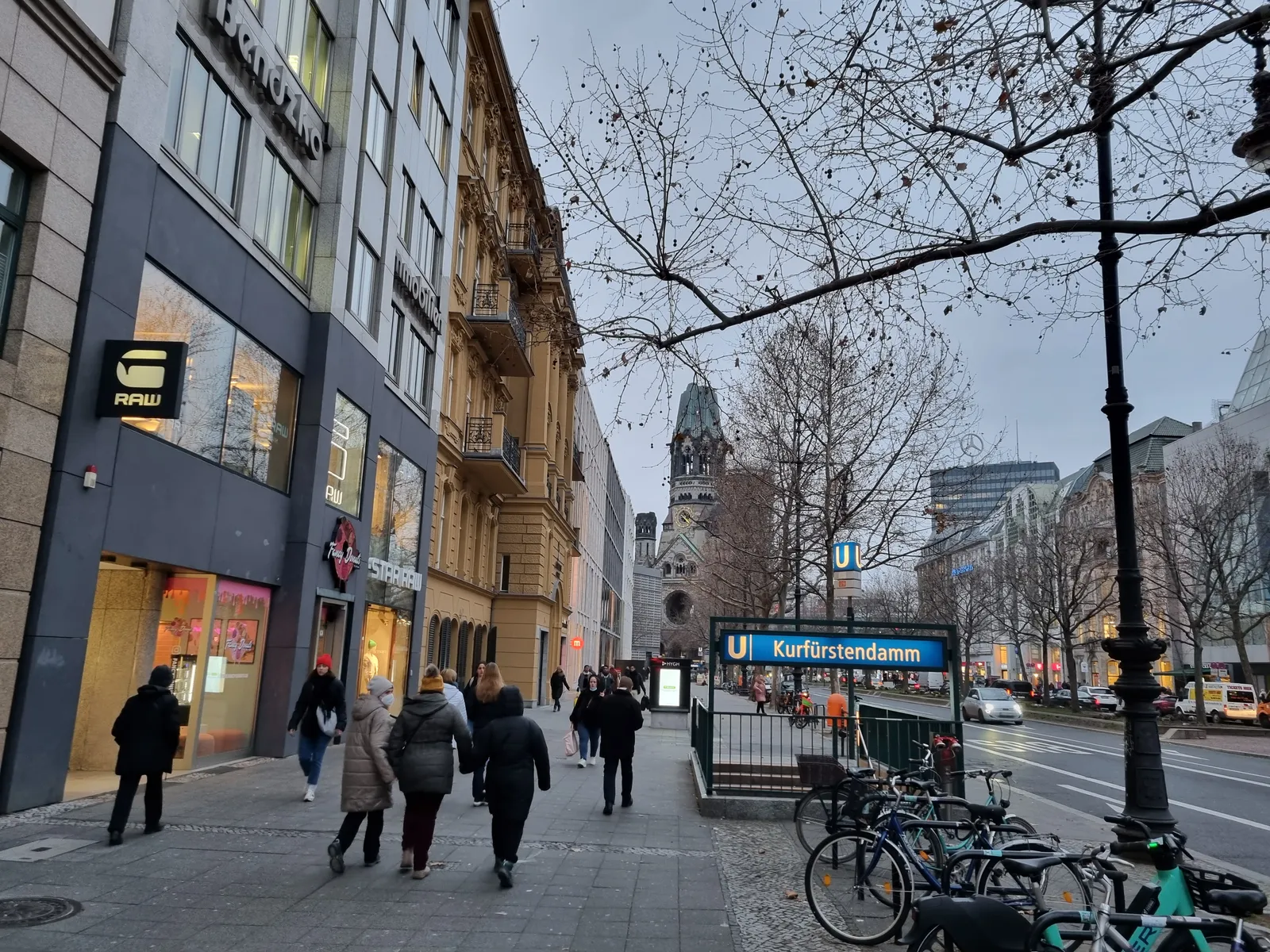
Today it is a shopping street like other shopping streets, and there is no reason to walk all 3.5 kilometres of it. The stretch worth doing is the first twenty minutes, where the side streets off it, Fasanenstraße in particular, still have the villas and the courtyards that survived. In the other direction, ten minutes east along Tauentzienstraße, is KaDeWe, continental Europe’s largest department store, whose top-floor food hall is a genuine attraction rather than a shop.
If the window runs to four hours or more, stop walking the boulevard and get on the M45 bus outside the station and ride about twenty minutes to Schloss Charlottenburg. It is the largest surviving Hohenzollern palace in Berlin, built from 1695 and rebuilt after the war, and while the state rooms are ticketed, the baroque garden behind it is a public park with no gate and no charge. On a warm afternoon that garden, with the Spree along one edge, is a considerably better use of an hour than another shopping street.
The half of the city that used to be the centre
For forty years everything on this page was the middle of a country’s worth of activity compressed into half a city, and since 1990 it has been quietly demoted to a district. That is exactly what makes it a good layover: the infrastructure is still that of a capital, the crowds are not, and almost everything worth stopping for here, the church, the window, the terrace, the palace garden, costs nothing at all. The one thing that makes it harder than it needs to be is arriving off a night coach and having to carry the bag through all of it.
Frequently asked questions
Is Bahnhof Zoo still a major station?
Not the way it was. Until 2006 it was the main long-distance station for the western half of the city, and it lost almost all of that traffic when Hauptbahnhof opened. What is left is the S-Bahn, the U2 and U9, regional trains and a large bus interchange, plus the central coach station a few minutes further west at Messedamm, which is why so many people still arrive in Berlin here with everything they own.
What is the quickest way from here to BER?
Two stops on the S-Bahn to Hauptbahnhof and then the FEX, which is about 23 minutes from there. The S9 does run all the way through from Zoologischer Garten to the airport without a change, but you are boarding at nearly the far end of the line, so it is a long sit. Either way you need an ABC ticket at 5.00 euros.
Does the Memorial Church cost anything?
No. Both halves are free and open daily from 10am to 6pm: the memorial hall inside the base of the ruined tower, with its surviving mosaics, and the modern octagonal church next to it. There is a donation box and a small shop, and that is the extent of it.
What is this area like during the holidays?
Breitscheidplatz, the square the church stands on, holds one of the biggest Christmas markets in the city through December, which makes the whole area slower to walk and much busier after dark. It is also the site of the attack on the market in December 2016; the memorial is a gold-filled crack running down the church steps, with the names of the twelve people killed cut into the front of them, and it is easy to walk over without noticing.