Berlin Layover Near Potsdamer Platz
Part of the full Berlin Layover Guide: What to Do Before a Flight Out of BER
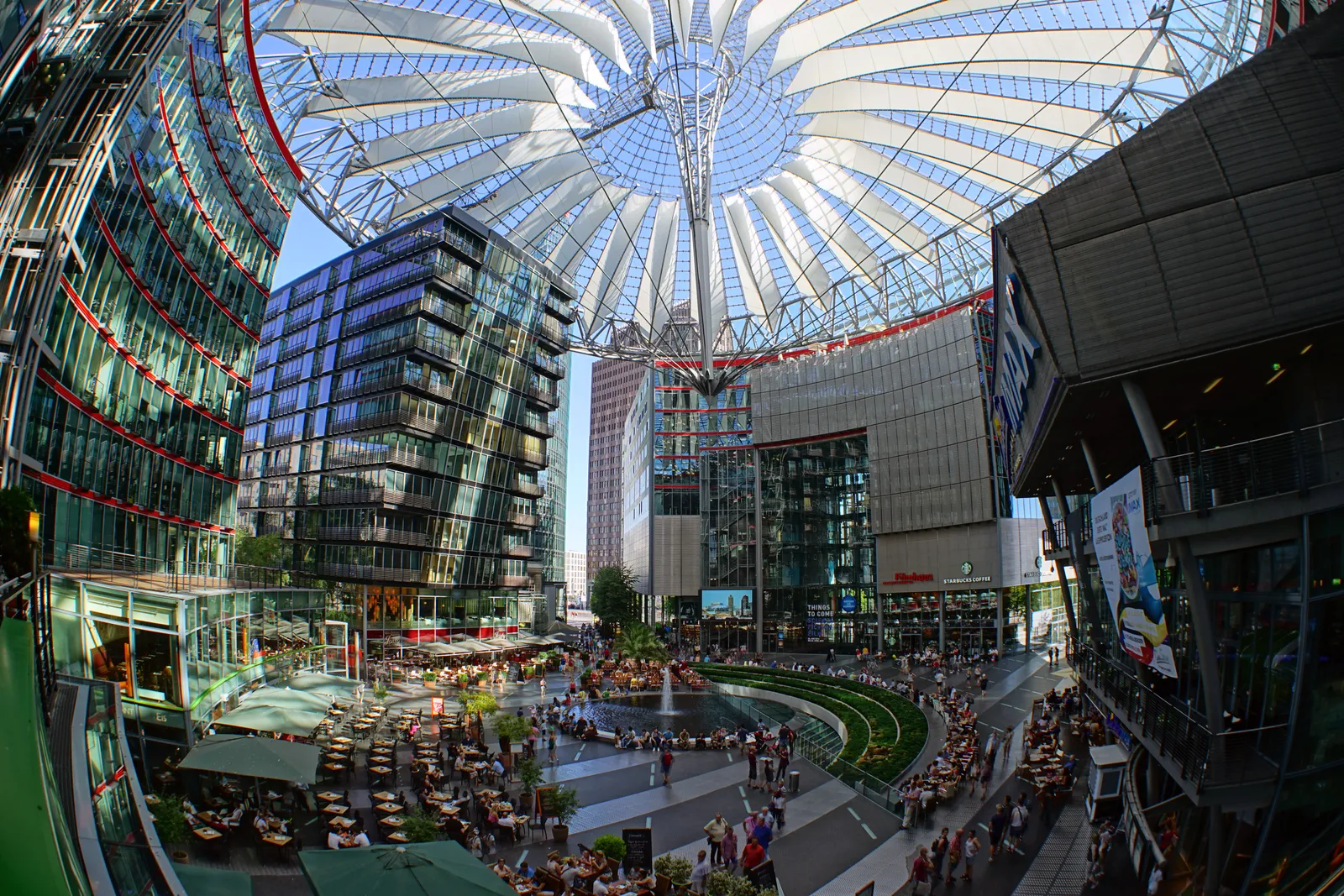
Potsdamer Platz is 19 minutes from BER on the FEX and almost entirely indoors: the glass-roofed Sony Center, a free lunchtime concert in the Philharmonie foyer, and the Kulturforum galleries five minutes west.
Busiest square in Europe, then a field, then this
Nowhere in Berlin has swung as far. In the 1920s Potsdamer Platz was the busiest intersection on the continent, busy enough that Europe’s first traffic light tower was installed here in 1924 to sort it out; a replica of that tower still stands on the square. The war flattened it, the Wall then ran directly across it, and for nearly thirty years the busiest square in Europe was an empty strip of sand with watchtowers on it.
What was built after 1990 is not to everyone’s taste, but for a traveller with a few hours and possibly bad weather it is unusually practical. The centrepiece is the glass-roofed court that everyone still calls the Sony Center: a ring of buildings around an open plaza covered by a fabric and steel canopy on a radial frame, finished in 2000. It is public space, it costs nothing, it is open at all hours, and it is dry.
One o’clock, in the foyer, for nothing
Five minutes west of the square is the Kulturforum, and the gold-clad building with the crumpled roofline is Hans Scharoun’s Philharmonie, finished in 1963 and built with the orchestra in the middle of the hall rather than at one end, which almost nobody had tried before.
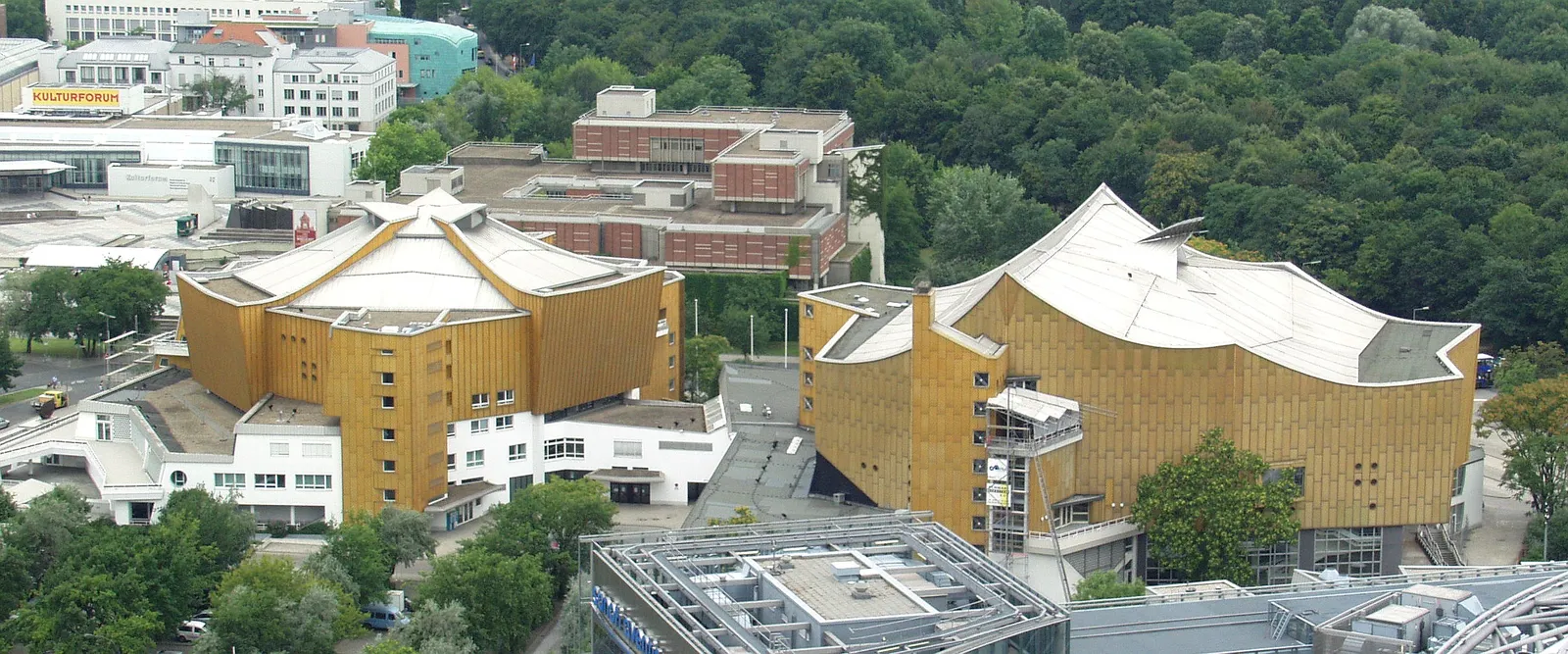
The reason to know about it on a layover has nothing to do with buying a ticket. Most weeks from around mid-September to mid-June, the foyer hosts a free chamber concert at 1pm: roughly 40 to 50 minutes, played by members of the Berliner Philharmoniker or scholars of its academy, with no booking, no ticket and no charge. People sit on the stairs and stand along the balconies. There are no concerts in July or August, and the weekday it lands on has shifted more than once, so check the orchestra’s calendar rather than a guidebook. If your window happens to line up, it is the best hour available anywhere in this city for nothing.
A glass box on a granite plinth
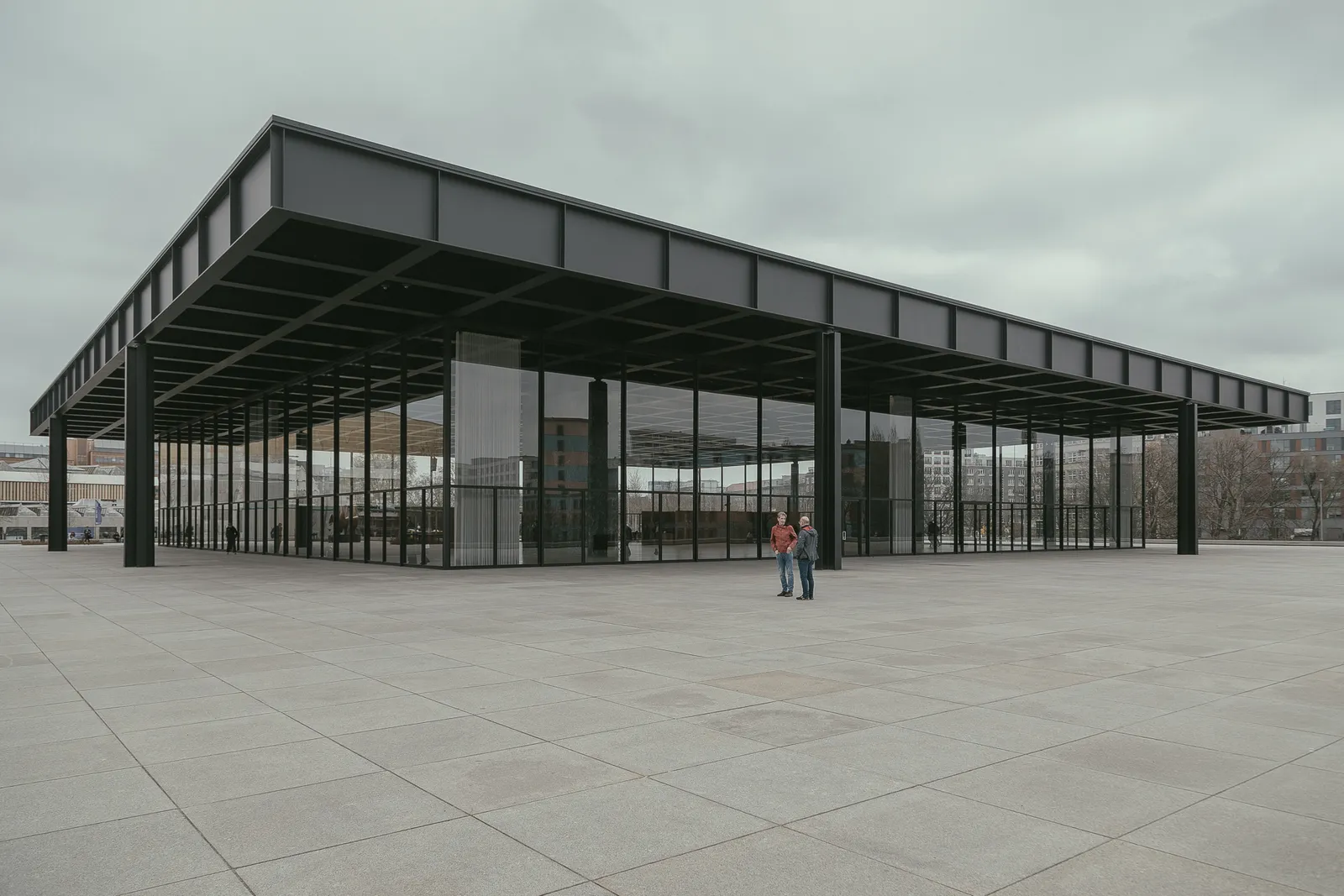
On the same square, Mies van der Rohe’s Neue Nationalgalerie is a single square room of glass under a flat black steel roof carried on eight columns, finished in 1968 as the last building he completed. It reopened in 2021 after a six-year strip-down and reassembly by David Chipperfield, and the upper hall is deliberately almost impossible to hang art in, which is part of the argument about it.
Next to it, the Gemäldegalerie is the serious one: European painting from the thirteenth to the eighteenth century, and one of the few collections anywhere that can put several Vermeers, a room of Rembrandts and a wall of Bruegel in front of you in the same afternoon. Both are state museums, both close on Mondays, and both sit around ten euros.
Getting back down to the trains is the part to allow for: Potsdamer Platz is stacked rather than spread out, with the regional and S-Bahn platforms well below street level and the links between floors running mostly on escalators, so a wheeled case here means hunting for the lifts instead of following the crowd.
The one building that was already standing
Walk south from the Sony Center along Alte Potsdamer Straße and there is a six-storey brick and stone building that does not match anything around it. Weinhaus Huth was built in 1912 as a wine merchant’s house with a steel frame, which was unusual enough at the time to be worth mentioning and turned out to be the reason it is still here: it is the only building on Potsdamer Platz that survived the war standing.
It then spent three decades alone. Everything around it was cleared, the Wall went up alongside, and photographs from the 1980s show a single ornate facade in the middle of an empty plain. When the square was rebuilt, the developers built around it rather than through it. Two minutes of looking at it will reorganise your sense of everything else on this page.
Three buildings and a platform
This is the most weather-proof layover in Berlin, and the most compressed: an indoor plaza, a free concert, two galleries and a survivor building, all inside about a fifteen-minute walk of one station that runs a direct train to the airport. On a wet January afternoon there is nowhere in this city that serves a spare few hours better. Just do not spend them steering luggage up and down escalators to reach any of it.
Frequently asked questions
How long is Potsdamer Platz from BER?
About 19 minutes on the FEX, which calls here between Hauptbahnhof and Südkreuz every 15 minutes. That puts it four minutes closer to the airport than Hauptbahnhof and five further out than Südkreuz. The U2 and the north-south S-Bahn lines also stop here, so you can reach it from almost anywhere in the centre without a long change.
Is the Philharmonie lunch concert genuinely free?
Yes, and there is no ticket to book. A free chamber concert runs in the foyer at 1pm most weeks from around mid-September to mid-June, lasting roughly 40 to 50 minutes, with no concerts in July and August. The performers are usually members of the orchestra or academy scholars. The weekday it falls on has moved over the years, so check the orchestra's own calendar for the week you are travelling rather than trusting a blog.
Does this work with a large group?
The galleries do; the concert does not, particularly. Nothing at the lunch concert can be reserved and spaces cannot be held for people arriving late, so six of you turning up at five to one will not be sitting together and may not be sitting at all. Either send one person early to stake out floor space, or treat it as a stand-at-the-back thing, which is how most of the audience experiences it anyway.
Which Kulturforum gallery should I pick with one slot?
The Gemäldegalerie if you want depth: it holds one of the strongest old master collections in the world, with Vermeer, Rembrandt, Bruegel and Cranach in quantity, and it is big enough to absorb two hours. The Neue Nationalgalerie if you want the building as much as the art, since the Mies van der Rohe pavilion is the point. Both are Berlin state museums, both are shut on Mondays, and neither is far above ten euros.